In this guide
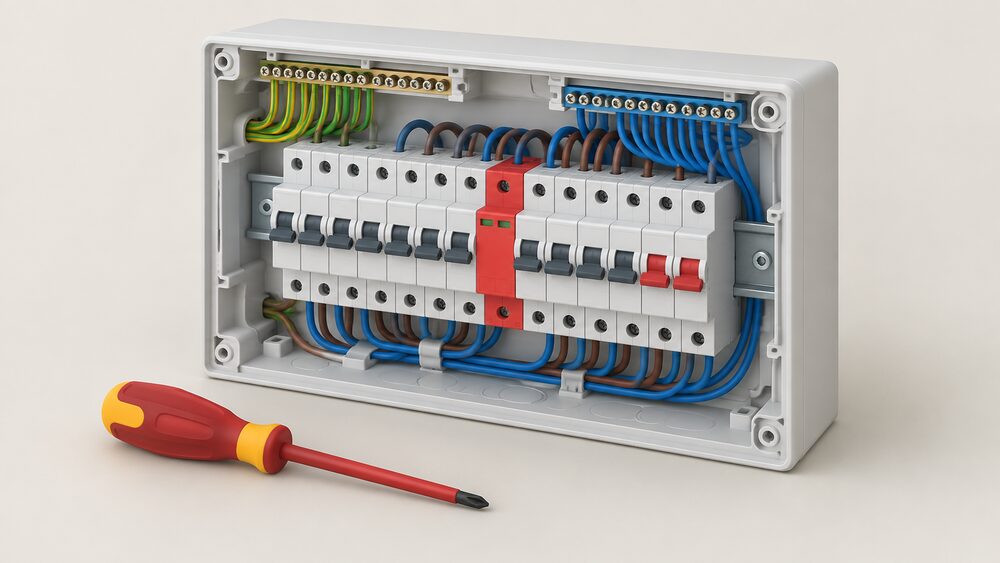
A surge protection device (SPD) is a component fitted into a home's electrical installation to limit transient overvoltages, the brief high-voltage spikes that arrive on the mains, on telephone lines or through a lightning strike nearby. The Institution of Engineering and Technology describes them as protecting the electrical installation, which consists of the consumer unit, wiring and accessories, and the sensitive equipment connected to it, such as computers, televisions, washing machines and safety circuits including fire detection systems and emergency lighting1.
For a household thinking about energy independence, an SPD is a small but load-bearing part of the picture. It does not generate anything and it does not reduce reliance on the grid. What it does is protect the equipment a household has invested in, including the inverters, batteries and backup supplies that keep a home running when the grid fails. A solar string inverter, for example, typically carries surge protection and anti-islanding as built-in features to guard against electrical faults and grid failures2.
The cost is modest against the value of what sits behind it. Published guidance puts SPD costs at as little as a few hundred pounds1. The decision on whether one is needed is not automatic: the wiring regulations call for a risk assessment, and the answer depends on the property, its location and what is connected to the installation.
What a surge protection device does and why homes need one
A transient overvoltage is a short, sharp rise in voltage on a circuit. It can come from a lightning strike some distance away, from switching operations on the network, or from equipment within the home. An SPD is designed to divert or clamp that excess so it does not reach the equipment downstream. The IET's consumer guidance is explicit that SPDs protect the electrical installation, which consists of the consumer unit, wiring and accessories, and the sensitive electronic equipment connected to it, such as computers, televisions, washing machines and safety circuits such as fire detection systems and emergency lighting1.
The case for fitting one rests on what a household now has plugged in. A modern home runs routers, smart heating controls, televisions, computers and increasingly a home battery or solar inverter. Northern Ireland Electricity Networks advises that a UPS or similar device can protect computers, tablets, televisions, alarm systems, central heating time clocks and TV cable boxes from over-voltage or under-voltage damage, and that devices should meet British Standards Institution national standards5. That is protection against both directions of disturbance, not just the spike.
Surges are not only a lightning problem. Short duration interruptions, the brief losses of supply that network operators record, are a separate phenomenon, and Northern Powergrid's guidance to customers suggests investing in devices such as uninterruptible power supplies and surge protectors to help maintain the flow of electricity and prevent possible damage to appliances and equipment6. The two measures do different jobs: a UPS carries equipment through a loss of supply, an SPD limits the voltage spike that can accompany a disturbance or a strike.
For a household, the practical point is that the equipment most exposed is often the equipment that matters most during a power cut. A router, a heating control or a home battery inverter is not cheap to replace, and an SPD fitted at the consumer unit is a single intervention that covers the installation rather than one socket.
Type 1, Type 2 and Type 3 SPDs: which does what
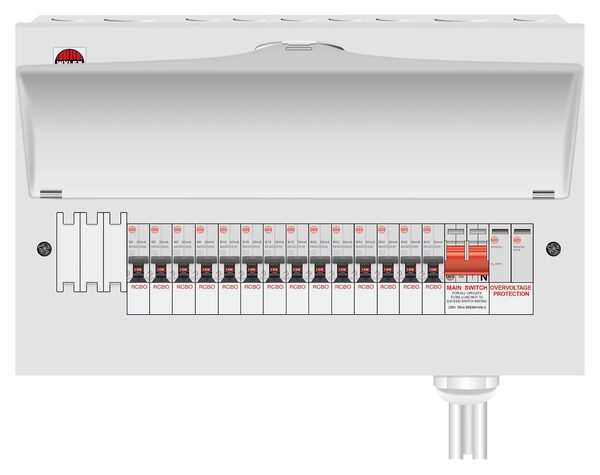
SPDs are classified by the surge environment they are built to withstand. The distinction matters because fitting the wrong type in the wrong place gives a false sense of protection.
Type 1 devices are intended for the point where a lightning strike is a realistic prospect, typically a building with an external lightning protection system or an overhead supply in an exposed location. They are built to handle a partial lightning current. Type 2 devices handle the switching and indirect surges that arrive on the network, and they are the usual choice for a household consumer unit. Type 3 devices are installed close to the equipment being protected, as a final stage.
The IET's guidance notes that combined Type 1 and 2 SPDs are available and are usually installed in consumer units1. That combination is common where a single device is wanted at the origin of the installation. Type 2 SPDs are also installed at sub-distribution boards, which is relevant in larger properties or where a supply runs to an outbuilding1.
Manufacturers build the same classification into their own equipment. Sungrow describes a solar string inverter with an AC Type II SPD and a DC Type I+II SPD among its protection features2. LuxPower's GEN3-LB-EU 3-8K hybrid inverter is listed with a built-in Type II SPD7. Solax's MIC G3 microinverter is described as having Type II DC/AC surge protection for lightning safety8. These are maker statements about their own products, and they protect the inverter rather than the whole installation.
| SPD type | Typical location | What it handles |
|---|---|---|
| Type 1 | Origin of installation, where a lightning protection system or overhead supply exists | Partial lightning current |
| Type 2 | Consumer unit, sub-distribution boards | Switching and indirect surges |
| Type 3 | Close to the equipment being protected | Residual surges as a final stage |
| Combined Type 1 and 2 | Consumer units | Both environments in one device1 |
The coordination point is that a device at the origin and a device at the equipment are not alternatives. Where both are fitted, they are selected so that the first stage takes the bulk of the energy and the second stage deals with what remains.
Type 2 SPDs: the standard choice for household consumer units
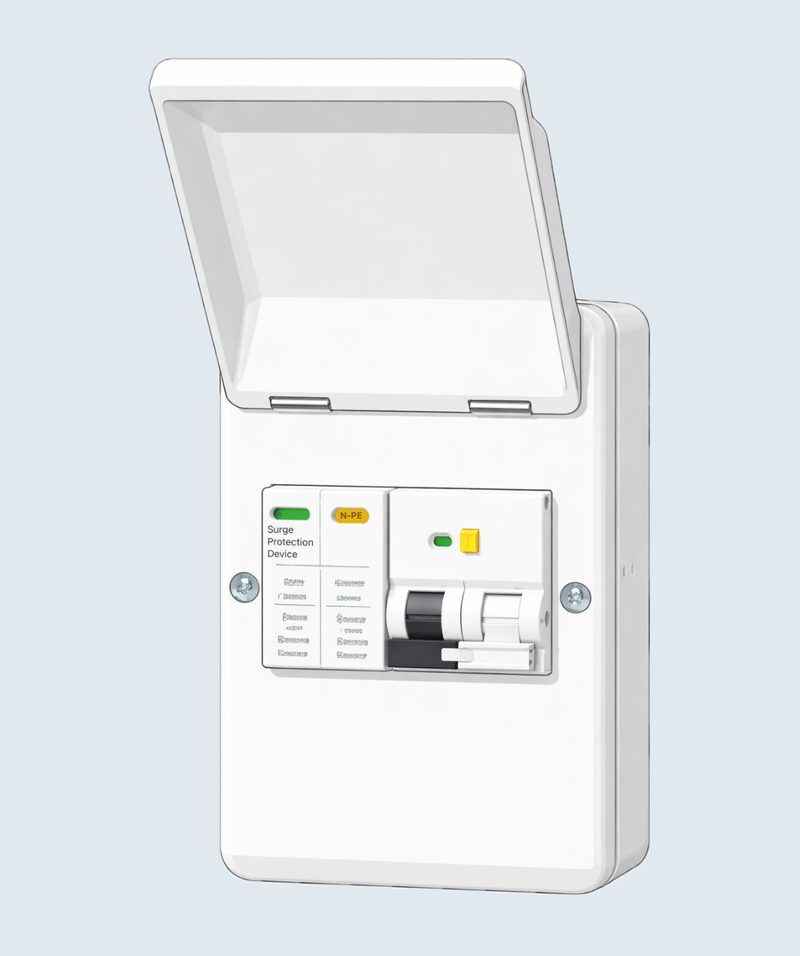
For most homes, the Type 2 device is the one that matters. It sits in the consumer unit, at the point where the incoming supply is divided into final circuits, and it protects everything downstream. The IET states that SPDs are usually installed within the consumer unit to protect the electrical installation, and that surge protection could be installed in an existing consumer unit if appropriate physical space was available1.
That last condition is the practical constraint. A consumer unit has a fixed number of module ways, and an SPD occupies space that might otherwise hold a circuit breaker. In a full board, fitting an SPD may mean a larger enclosure or a separate device. This is one reason the work is not a simple swap.
The consumer unit itself is a regulated part of the installation. Installing or replacing a consumer unit is considered notifiable work under Part P of the Building Regulations in England and Wales, and guidance states it is absolutely essential to hire a registered electrician to carry out any work relating to the installation, replacement or repair4. Because an SPD is fitted inside that enclosure, the same expectation applies.
There is a second reason to think about the consumer unit as a whole rather than the SPD alone. Where a plug-in solar device is installed, the interim product specification requires the product to be supplied with a durable label intended to be affixed at or near the consumer unit, indicating the presence of a plug-in generation device9. That is a reminder that the consumer unit is becoming a place where generation, storage and protection all meet, and that labelling and layout matter as much as the devices themselves.
The wiring rules that govern SPD installation
The governing document for UK electrical installations is the eighteenth edition of the Wiring Regulations, published by the Institution of Engineering and Technology and the British Standards Institution as BS 7671:201810. The current version is BS 7671:2018+A4:2026, published on 15 April 2026, which supersedes BS 7671:2018+A2:2022+A3:20243. Earlier amendments remain available as read-only documents, and BS 7671:2018+A1:2020 was intended to be implemented immediately11.
The regulations do not simply mandate an SPD in every home. They require a risk assessment, and the outcome determines whether protection is needed. That is why two apparently similar houses can reach different conclusions. The assessment weighs the exposure of the location, the nature of the supply and the consequences of a surge reaching the equipment.
Enforcement differs across the UK. Most fixed electrical installation work in homes must comply with the regulations by law in England and Wales, under Part P of the Building Regulations12. Scotland operates a separate Building Standards system, and electricians carrying out work in England and Wales have to comply with Part P whereas the Scottish system works differently13. Northern Ireland has its own arrangements: installations, appliances, fuse boards and wiring should comply with BS 7671, and the electrical safety standards in Northern Ireland legislation are defined by reference to the eighteenth edition of the Wiring Regulations5.
Where the installation includes generation, further documents apply. All electrical work on solar installations must comply with the IET Code of Practice for Grid Connected Solar Photovoltaic Systems and the IET Wiring Regulations14. That matters for SPD selection because the DC side of a solar installation has its own surge environment, separate from the AC side.
"you must ensure the correct protective devices are selected for the installations being worked upon"
The same guidance advises checking with the manufacturer to establish whether the devices being installed are bi-directional or unidirectional, a point that bears directly on protection devices in installations with generation and storage15.
Lightning protection systems and how they work with surge protection
A lightning protection system and a surge protection device are complementary, not interchangeable. The external system, the air terminals, down conductors and earth termination, gives a strike a controlled path to earth so that it does not pass through the fabric of the building. The SPD limits the transient overvoltage that reaches circuits and equipment, whether the strike is direct or nearby.
The IET's guidance describes SPDs as protecting circuits and equipment from high-voltage power surges, such as those caused by lightning1. NICEIC uses the same framing, describing surge protective devices as protecting circuits and equipment from high-voltage power surges, such as those caused by lightning4. Neither describes the SPD as a substitute for an external system.
Protection also extends beyond the mains. Different types of SPD are available to protect the installation from other incoming services, such as telephone lines and cable TV1. That is significant because a surge can arrive on a data or communications cable and reach equipment that the mains device does not cover. Surge protectors sold for domestic use can protect equipment such as landline phones and internet routers from voltage variations, and these can be purchased from electrical shops and DIY stores16.
For a household with generation or storage, the DC side deserves the same attention as the AC side. Sungrow's inverter guidance lists surge protection and anti-islanding among the features that protect against electrical faults and grid failures2. Solax describes Type II DC/AC surge protection for lightning safety on its MIC G3 microinverter8. These are built-in protections for the equipment itself, and they do not remove the case for a device at the origin of the installation.
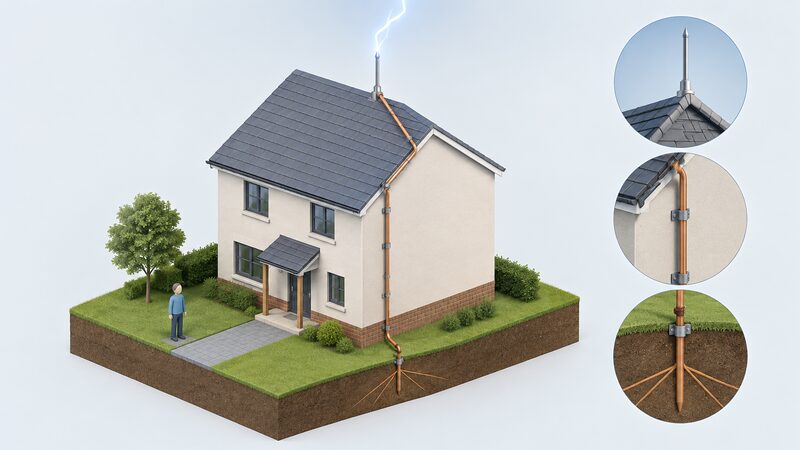
Choosing and siting an SPD in your installation
The starting point is the risk assessment required by the wiring regulations. Its outcome decides whether an SPD is needed at all, and if so, which type. A property with an external lightning protection system, an overhead supply or a long run to an outbuilding is a different case from a suburban house on an underground supply.
Siting follows from the type. A Type 2 device belongs at the consumer unit, at the origin of the installation, so that it protects every final circuit. Where sub-distribution boards exist, Type 2 devices are installed there as well1. A Type 3 device belongs close to the equipment it protects, as a final stage.
Compatibility is a real consideration. Items supplied by different manufacturers should be confirmed for compatibility1. Mixing an SPD from one maker with a consumer unit from another is not automatically a problem, but it is not automatically safe either, and the confirmation is part of the design.
There is also an insurance dimension. Some insurance policies may state that equipment must be covered with an SPD1. That is a policy condition rather than a legal requirement, and it varies between insurers, but it is worth checking before deciding against protection.
For a household with backup equipment, the siting question extends to the backup supply itself. A UPS or similar device can protect computers, tablets, televisions, alarm systems, central heating time clocks and TV cable boxes from over-voltage or under-voltage damage, and devices should meet British Standards Institution national standards5. That is protection at the point of use, layered on top of protection at the origin.
Cost, fitting and what installation involves
Published guidance describes SPD costs as little as a few hundred pounds1. That is an indicative figure, not a quotation, and it does not separate the device from the labour. Where no published price exists for a particular installation, the work is installer-quoted rather than sold at a shelf price.
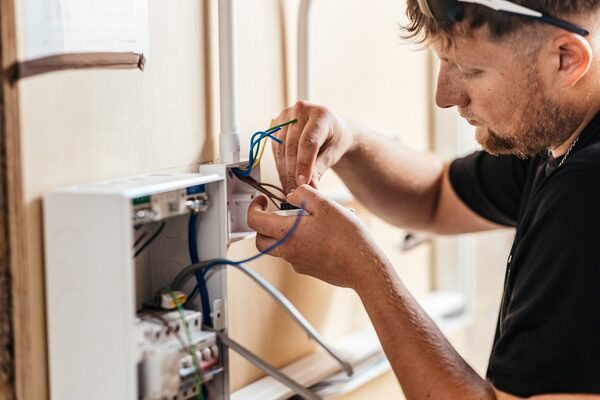
The scope of the work depends on the state of the consumer unit. If there is appropriate physical space, surge protection could be installed in an existing consumer unit1. If the board is full, the job grows. Installing or replacing a consumer unit is notifiable work under Part P of the Building Regulations in England and Wales, and guidance states it is essential to hire a registered electrician for installation, replacement or repair4.
The process in outline:
- A risk assessment under the wiring regulations establishes whether an SPD is needed and of which type.
- The consumer unit is inspected for physical space and for compatibility with the proposed device.
- The device is selected, with compatibility between items from different manufacturers confirmed1.
- The work is carried out by a registered electrician, and where the consumer unit is installed or replaced, the work is notified under Part P in England and Wales4.
- The installation is labelled and recorded, in line with the expectation that generation devices are marked at or near the consumer unit9.
For comparison, other electrical work in the home carries its own cost structures. Government guidance on energy-saving materials gives an example of a charge of £1,000 excluding VAT for an installation17. That is a different category of work and is not an SPD price, but it illustrates how installation charges are quoted excluding VAT in official guidance.
Standards and certification: what to check before buying
The standard that governs the installation is BS 7671:2018, in its current amended form BS 7671:2018+A4:2026, published on 15 April 2026 and superseding BS 7671:2018+A2:2022+A3:202410. A device is selected to work within that framework, and the risk assessment that decides whether it is needed is part of the same document.
Certification of the people doing the work matters as much as the device. Installers under UK Government schemes must be TrustMark registered and/or Microgeneration Certification Scheme certified18. The Microgeneration Certification Scheme includes clear standards to support the installation of wind turbines and air source heat pumps, and the installer of equipment should check that the installation complies with the scheme's planning standards, including requirements on noise19. MCS Standards define and maintain quality, performance, and consumer protection requirements for small-scale renewable energy technologies, covering products, installers, and certification processes in the UK19.
Where a product carries its own safety mark, the pattern is familiar from other domestic safety equipment. Carbon monoxide alarms should comply with British Standard EN 50291 and carry a British or European approval mark, such as a Kitemark, before purchase20. The same principle applies to protective devices: the mark and the standard are what a buyer checks.
For plug-in solar equipment, the regulatory picture is still settling. Only plug-in solar devices that are compliant with the interim product specification will be able to be sold in the UK and plugged in under the amendment to the Plugs and Sockets etc. (Safety) Regulations 199421. The specification covers both electrical design, British plug requirements, mounting systems and fire protection22. Plug-in solar products are covered by the General Product Safety Regulations 2005 in Great Britain22. The legal changes follow rigorous, independent safety testing covering all key electrical elements, which shows that compliant panels are safe and compatible with UK wiring23. The Electrical Contractors' Association has warned that the government must not put speed ahead of safety on plug-in solar panels24.
| Check | What to look for |
|---|---|
| Installation standard | BS 7671:2018+A4:2026, current, published 15 Apr 2026, superseding BS 7671:2018+A2:2022+A3:20243 |
| Device compatibility | Confirmation where items come from different manufacturers1 |
| Installer certification | TrustMark and/or MCS for government schemes18 |
| Product marking | British or European approval mark where applicable20 |
| Plug-in solar | The specific model must be on the list of devices that meet UK standards, checkable on the ENA Connect Direct LCT device register21 |
What owning surge protection means for energy independence
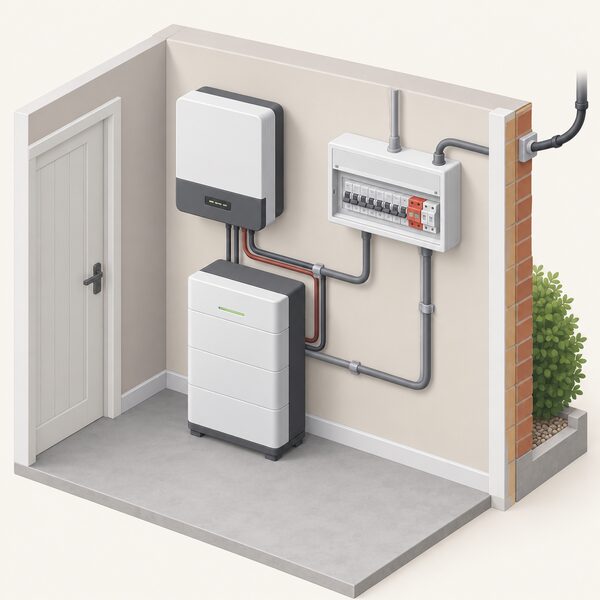
An SPD does not make a household more independent in the sense of generating its own power or storing it. It does something narrower and more practical: it protects the equipment that a household's independence depends on. A home battery, a solar inverter, a heat pump controller or a backup supply is expensive to replace, and a transient overvoltage is one of the few risks that can destroy several of them at once.
The dependence that remains is unchanged. The household is still connected to the grid, still supplied by an energy supplier, and still exposed to the network events that cause surges in the first place. An SPD limits the damage from those events; it does not prevent them. Network operators themselves direct customers towards surge protectors and uninterruptible power supplies as a way of maintaining the flow of electricity and preventing possible damage to appliances and equipment6.
Where a household has added generation, the protection question becomes more layered. Solar installations must comply with the IET Code of Practice for Grid Connected Solar Photovoltaic Systems and the IET Wiring Regulations14, and the equipment itself often carries built-in protection: Sungrow lists surge protection and anti-islanding among its inverter features2, LuxPower lists a built-in Type II SPD on its hybrid inverter7, and Solax lists Type II DC/AC surge protection on its microinverter8. Those are maker statements about their own products, and they protect the device rather than the installation.
The wider context is that domestic electrical installations are being asked to do more. BS 7671 Amendment 4 reflects advancements in modern electrical installations including renewable energy systems25. Domestic batteries are expected to be installed in compliance with standards including MCS, PAS 63100 and PAS 203526. PAS 1878 provides a technical specification that allows domestic appliances to operate in a demand side response system27. As the home becomes a site of generation, storage and flexible demand, the protective devices at its origin carry more weight, not less.
For a household, the honest summary is that surge protection is a small, one-off intervention that guards a growing investment. It does not reduce reliance on the grid, and it does not replace a UPS or a backup supply. It sits alongside them, at the point where the supply enters the home, doing a job that nothing else in the installation does.
Sources27 cited
- Surge Protective Devices, Institution of Engineering and Technology, 2026-09-17
- Everything you should know about solar string inverters, Sungrow, 2026-09-17
- Requirements for Electrical Installations, IET Wiring Regulations, BSI, 2026-04-15
- Consumer units and fuse boxes, NICEIC, 2025-09
- Unplanned power cuts, NIE Networks, 2026-09-20
- Short duration interruptions, Electricity North West, 2026-09-19
- Hybrid solar inverter GEN3-LB-EU 3-8K, LuxPowerTek, 2026-07-29
- MIC G3, Solax Power, 2026-09-17
- Plug-in solar interim product specification (withdrawn), GOV.UK, 2026-06
- The Electricity Safety, Quality and Continuity Regulations (Northern Ireland) 2024, legislation.gov.uk, 2024-11-27
- Electric vehicle charging installations FAQs, Institution of Engineering and Technology, 2026-09-17
- Part P of the Building Regulations, Electrical Safety First, 2026-09-17
- Building Regulations, Electrical Safety First, 2026-09-17
- Plug-in solar panels vs rooftop systems, Which?, 2026-04-27
- Have your views heard on BS 7671:2018 Amendment 3, Electrical Safety First, 2026-09-19
- Compensation: a power cut damaged something in my home, UK Power Networks, 2026-09-17
- Draft VAT guidance on changes to energy-saving materials, GOV.UK, 2026-09-17
- Energy efficiency of existing homes, House of Commons Library, 2026-05-13
- The Microgeneration Certification Scheme, Planning Portal, 2026-09-17
- Gas appliances: frequently asked questions for owner occupiers, Health and Safety Executive, 2026
- Plug-in solar consultation, GOV.UK, 2026-06-16
- Plug-in Solar Device Interim Product Specification, GOV.UK, 2026-06-16
- Households can save as plug-in solar panels come to market, GOV.UK, 2026-08-26
- Government must not put speed ahead of safety on plug-in solar panels, Electrical Contractors' Association, 2026-07-20
- Warm Homes: Social Housing Fund wave 3 scheme guidance addendum, GOV.UK, 2026-06
- Guide to the Electricity and Gas (Energy Company Obligation) Regulations 2021, GOV.UK, 2026-09-18
- Government response on the communications hub replacement programme, Public Accounts Committee, 2023-10-20
 Fire and Electrical SafetyHow likely is a solar panel fire, and what actually causes one?
 Prepare Energy for StormsWhat to do before and during a storm or flood warning to protect meters, the consumer unit, heating equipment and fuel tanks.
 The Full Home Batteries GuideA home battery stores cheap or solar power for later, but will it really cut your bills enough to be worth it?
 Warranties and DegradationHow long do solar panels actually last, and what do the warranties really cover?
 Grants and Energy IndependenceCan you get a grant for solar panels or a battery?
 Energy Security for HouseholdsCan a household really protect itself from gas and electricity price shocks, and what actually makes a difference?