
In this answer
Short answer
A new build home does not have to have surge protection by name. There is no legal requirement in the UK that singles out surge protective devices (SPDs) for new dwellings. What governs the question is the wiring rules: electrical work is covered by the Building Regulations in England and Wales, and throughout the UK it is also covered by the IET Wiring Regulations (BS 7671)1. An SPD is a wiring-rules decision made by the electrician designing the installation, not a planning condition attached to the house.
That matters for a household because a new build is exactly the moment when an SPD is cheapest to fit. The device is usually installed within the consumer unit to protect the electrical installation, and it can be installed in an existing consumer unit if appropriate physical space is available1. In a new build the consumer unit is being specified and wired from scratch, so the space and the circuit arrangement can be planned in rather than retrofitted around.
The honest limit is that surge protection is not energy independence. It protects the wiring and the equipment connected to it from transient overvoltages, and it does nothing about a power cut, a gas supply or a grid connection. What it does do is protect the inverter, battery or backup equipment a household adds later, which is why it belongs in the same conversation as backup power planning.
What surge protection does: SPD types explained
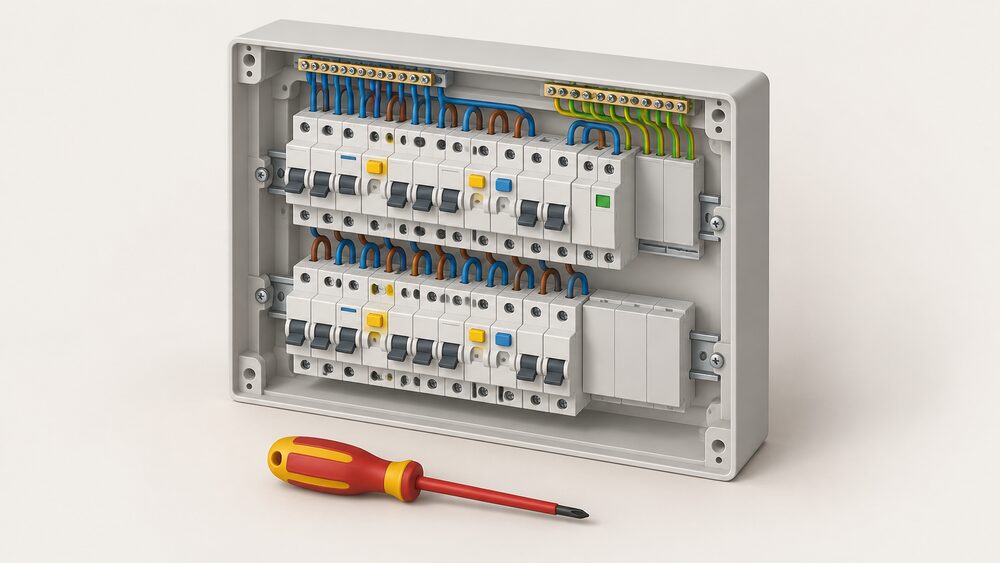
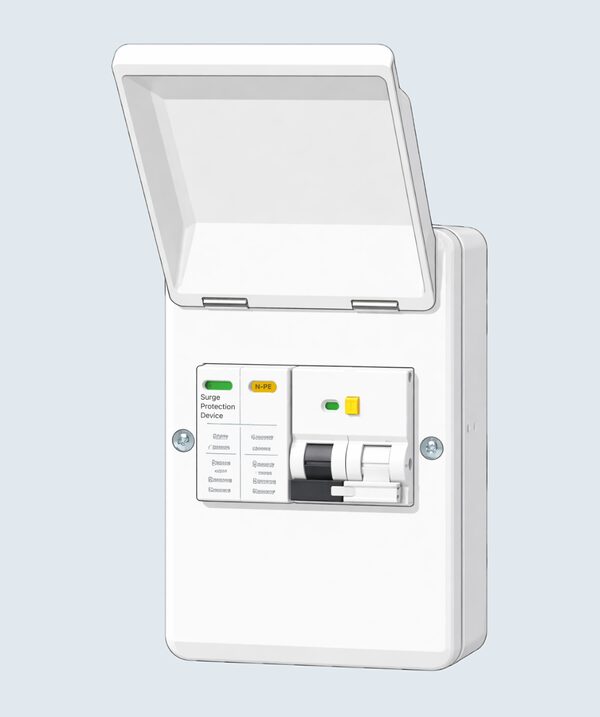
A surge protective device protects the electrical installation, which consists of the consumer unit, wiring and connected equipment, from transient overvoltages1. A transient overvoltage is a short, high-voltage spike on the supply, and the SPD gives it a low-resistance path to earth before it reaches the equipment. The device is a sacrificial component: it is designed to take the hit.
SPDs are not only for the mains. Different types of SPD are available to protect the installation from other incoming services, such as telephone lines and cable TV1. That matters in a new build because the incoming services all enter at roughly the same point, and a spike on a phone line or a coaxial cable can reach equipment that the mains SPD does not cover.
The type numbering matters most where a household adds generation. One maker lists an AC Type II SPD and a DC Type I+II SPD for its solar string inverter range4. The split is the point: the AC side of a solar installation and the DC side are treated as separate protection problems, and a DC SPD is a different device from the one in the consumer unit. A household planning solar, a battery or an EV charger is therefore looking at more than one SPD, not one.
"Surge Protective Devices (SPD) are used to protect the electrical installation, which consists of the consumer unit, wiring and connected equipment, from transient overvoltages"
Where UK wiring regulations stand on surge protection in new builds
The regulatory position is layered, and the layers do different jobs. Building regulations approval is required for certain electrical work, including changing electrics near a bath or shower5. Building regulations for electrics apply in England and Wales, and in England special locations are the spaces around baths and showers6. None of that names SPDs.
The energy side of the regulations is moving, but not towards surge protection. Regulation 25B requires that where a building is erected it must be a nearly zero-energy building, and that requirement applies in England7. The Future Homes Standard applies by law to new homes built in England, and from 24 March 2027 every new home built in England has to have a heat pump, solar panels, and much better insulation8. In Scotland the New Build Heat Standard is a requirement set out in law9. Those are fabric and heating standards. They push new builds towards more electrical equipment, which raises the case for an SPD, but they do not mandate one.
The practical consequence is that SPD provision in a new build is a design decision under BS 7671, taken by the electrician who signs off the installation, and it can legitimately be omitted. A buyer who wants it should raise it before the consumer unit is specified, because the cheapest moment to include it is while the board is being built.
How surge protection is fitted in a new build consumer unit
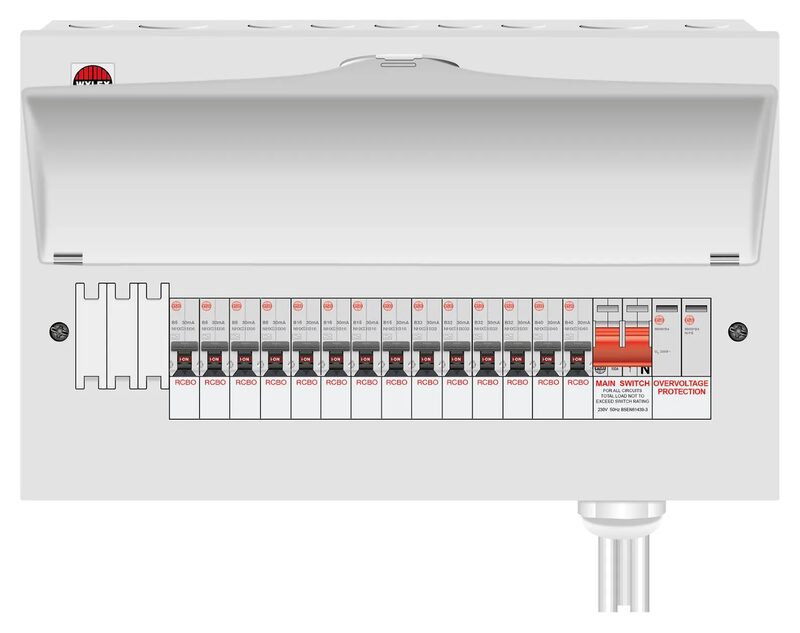
In a new build the SPD is normally a module on the consumer unit rail. SPDs are usually installed within the consumer unit to protect the electrical installation1. The board itself is chosen at first fix, and the choice of board determines whether an SPD fits comfortably.
Consumer unit formats differ in ways that bear on this. Duplex units are arranged in two rows for the required protective devices and offer a larger capacity for managing multiple electrical circuits10. High integrity units provide either circuit breakers or the combined RCD and circuit breaker protection of an RCBO for each connected circuit, without combining circuits under a single RCD10. A board with spare ways and a two-row layout leaves room for an SPD module without crowding the final circuits.
Where a household adds plug-in solar after moving in, the installation carries a labelling duty. The product must be supplied with a durable label intended to be affixed at or near the consumer unit, indicating the presence of a plug-in generation device11. The interim product specification for plug-in solar covers both electrical design, British plug requirements, mounting systems and fire protection12. That label is how a later electrician knows the board has generation on it, which is directly relevant to how the SPD and the protective devices are arranged.
Cost of fitting surge protection in a new home
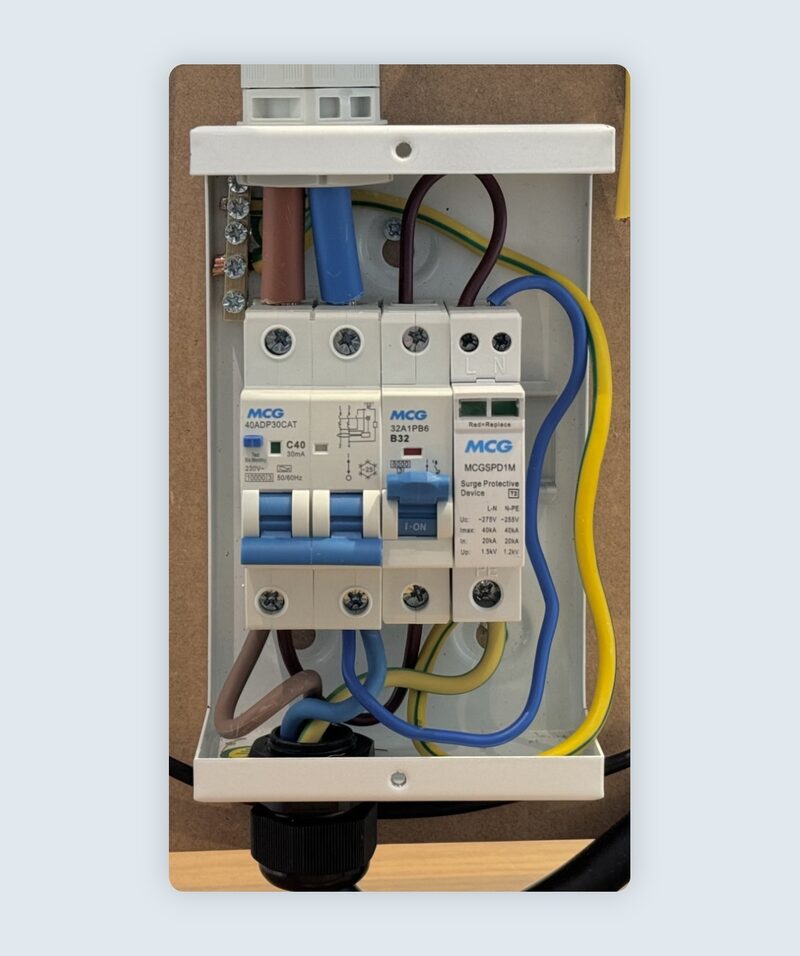
No published UK price for a Type 2 SPD, or for fitting one, appears in the available figures. Prices are installer-quoted, and the honest answer is that the cost depends on the board. If the consumer unit has appropriate physical space, the SPD can be installed in the existing unit; if enough space is not available, it can be installed in an external enclosure adjacent to the existing consumer unit1. The second route adds an enclosure, cable runs and labour, so it is the more expensive of the two.
The wider context is that electrical and energy work in a new home is quoted rather than listed. For comparison, the figures that are published for adjacent retrofit work show the spread: draughtproofing a whole house professionally is around £250, and hiring a professional installer to draughtproof a home could cost around £20013. Internal solid wall insulation for a whole house costs around £12,000, which usually includes redecoration14. Those are different jobs, but they show why an SPD quote should be read as a line item rather than a package.
The one scheme figure that touches new build costs is the CIGA New Build Guarantee, which includes surveillance of assessment requirements charged separately at £10 of the cost15. That is a guarantee administration charge, not an SPD price, and it should not be confused with one.
Signs your new build may lack surge protection
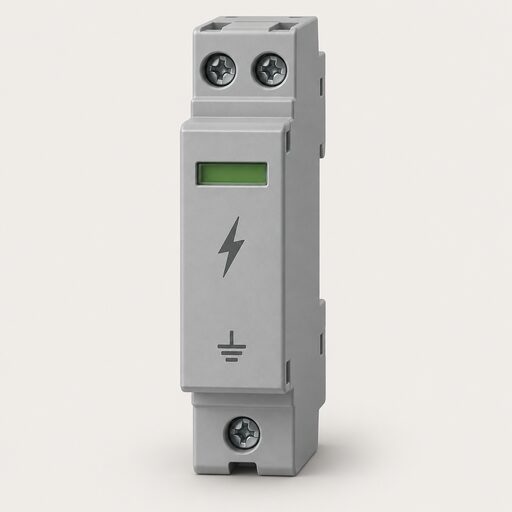
The first sign is the consumer unit itself. An SPD is a visible module on the rail, usually with its own status indicator, and a board with no spare ways and no such module does not have one. SPDs are usually installed within the consumer unit, so a board that is full of circuit breakers and RCBOs with no additional module is the clearest evidence1.
The second sign is the paperwork. The person who last worked on an altered or replaced system is responsible for its safe running and should issue a certificate showing the necessary checks have been carried out5. In a new build that certificate comes from the developer's electrician, and it should describe the protective devices fitted. If the certificate does not mention an SPD, the installation does not have one.
The third sign is the services. Different types of SPD are available to protect the installation from other incoming services, such as telephone lines and cable TV1. A new build with a mains SPD but nothing on the incoming communications services has partial protection only.
A household should also know what funding does not cover. Self-build and new build properties, including new extensions, are not eligible for NISEP funding16. That is a Northern Ireland scheme, and it means a new build household there cannot look to it for help with this kind of work.
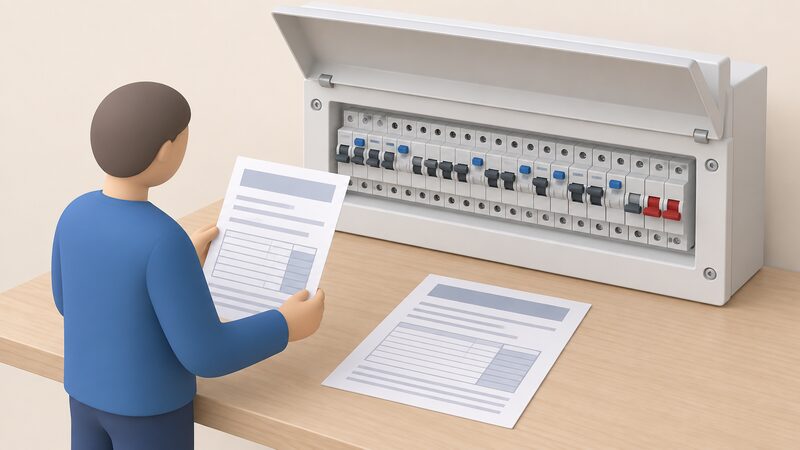
Where a new build stands on independence
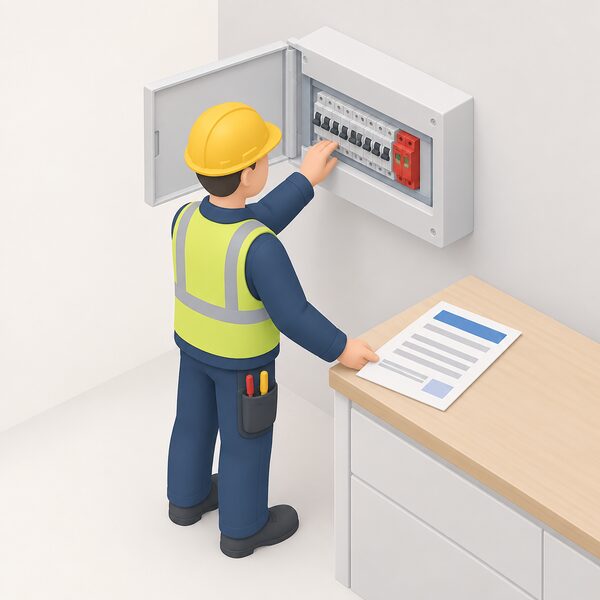
Surge protection is a small, unglamorous part of a household's electrical resilience, and it should be described as such. It protects the installation and the equipment on it from transient overvoltages1. It does not generate, store or shift a single unit of energy, and it changes nothing about dependence on the grid, a supplier or a gas connection.
What it does change is the risk attached to the equipment a household buys for independence. A solar inverter, a home battery or a backup inverter is the expensive part of a resilience plan, and the DC and AC sides of a solar installation are protected by different devices4. An SPD fitted at first fix is the cheapest version of that protection, because the board is open and the electrician is already on site.
The dependence that remains is on the electrician and the certificate. The person who last worked on the system is responsible for its safe running and should issue a certificate showing the necessary checks have been carried out5. A household that wants to know whether its new build has surge protection should read that certificate, and if it does not, ask for the SPD to be quoted as a separate item. For the wider picture of what backup equipment needs protecting, surge protection and lightning covers the devices themselves, and backup power safety and standards covers the wiring rules that apply.
Sources16 cited
- Surge protective devices: consumer guidance, IET, 2026-09-17
- New build guarantee benefits, CIGA, 2026-09-20
- Financial protection, MCS Certified, 2026-05-13
- Everything you should know about solar string inverters, Sungrow, 2026-09-17
- Building regulations approval, GOV.UK, 2026-09-17
- Building regulations for electrics: general information, Planning Portal, 2026
- Approved Document L, Conservation of Fuel and Power, Volume 1: Dwellings, UK Government, 2026-09-17
- Future Homes Standard for your home's future, Low Carbon Hub, 2026-09-01
- The Heat in Buildings Programme, Scottish Government, 2026-09-17
- Consumer units and fuse boxes, NICEIC, 2025-09
- Plug-in solar interim product specification (withdrawn), UK Government, 2026-06
- Plug-in solar consultation document, GOV.UK, 2026-06-16
- Draught-proofing, Energy Saving Trust, 2026-05-05
- Energy saving upgrades for home renovation, Energy Saving Trust, 2026-05-05
- New build FAQ, CIGA, 2026-09-20
- NISEP list of schemes 2026-27, Utility Regulator Northern Ireland, 2026-04
 Surge and Lightning ProtectionWill a surge protector stop a lightning strike from wrecking my wiring and appliances?
 Electrical RequirementsWill your home need a bigger electricity supply before a charge point can go in?
 New Electricity ConnectionWho do you contact for a new or upgraded electricity connection, and what will it cost?
 New Build Homes and EnergyWhat heating will a new build actually have, and will it be a heat pump rather than a gas boiler?
 DIY Home Battery BuildsBuilding your own home battery?
 Building Regs Part L InsulationAdding insulation or replacing windows?