In this guide
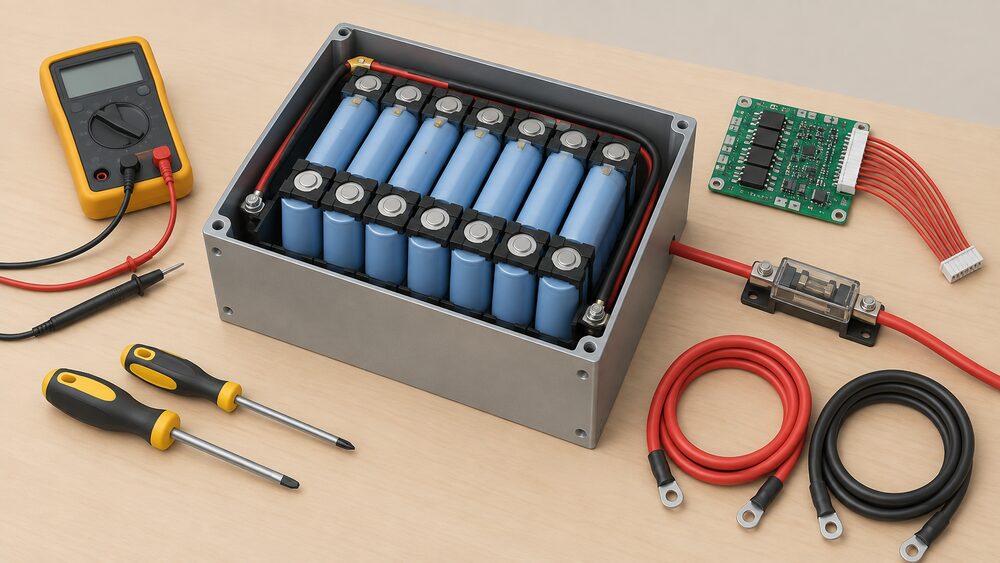
A DIY home battery bank is a self-assembled storage system: cells, a battery management system (BMS) board, an enclosure, cabling and a connection to the house. The cells and the BMS are the parts a builder chooses; the rules that apply once the bank is wired into a dwelling are not optional and do not change because the bank was built rather than bought.
The legal position is straightforward. All new electrical work in a dwelling must be designed and installed to account for Part P of the Building Regulations, which covers a house, a flat or a small commercial premises linked to domestic accommodation1. Notifiable work must be reported to the local building control body unless it is completed by someone registered on the competent person scheme2. A new circuit back to the consumer unit is notifiable, and so is the installation of a new consumer unit or fuse box3.
What a self-build does not get is the certification that comes with a listed product. A building control body does not need to be notified for certain services or fittings where the owner employs an installer registered with a relevant competent person scheme, but that exemption is about the installer's registration, not the equipment4. A householder building their own bank has no such registration to rely on.
What a DIY home battery bank involves: cells, a BMS and the rest of the kit
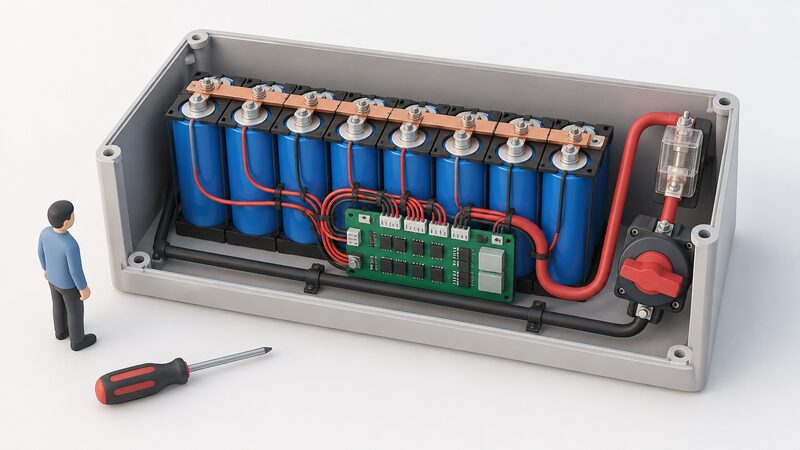
The build itself is a set of components. The cells store the energy, the BMS monitors and balances them, and the enclosure, cabling, fusing and isolation sit around those two. A home battery is usually used in combination with solar panels or a smart time of use tariff, or both, so the bank also needs a route to the house supply and, if it is to export, an inverter that meets the network operator's requirements8.
The BMS is the part that makes a self-build a system rather than a pile of cells. It manages cell voltage, temperature and current, and it is the component that decides when the bank stops discharging. Energy Saving Trust describes the behaviour in ordinary terms: when the battery gets down to a set level, maybe 20% of the total storage capacity, the system will stop taking electricity8. That reserve is a setting, not a fixed law, and on a self-build it is whatever the BMS is configured to do.
Lithium-ion cells are already in most UK homes in laptops, mobile phones, e-scooters, e-cigarettes and mobility vehicles, and the fire service treats them as a familiar but real hazard class9. A home battery bank is a much larger concentration of the same chemistry, which is why the enclosure, ventilation and siting matter as much as the cell count. The pages on battery management systems and battery siting and location cover those two subjects in detail.
What the kit does not include is a certificate. A listed product arrives with a declaration of conformity and a warranty; a self-build arrives with whatever the builder documents. That gap is the thread running through the rest of this page.
Part P: the building regulation every DIY battery install must satisfy
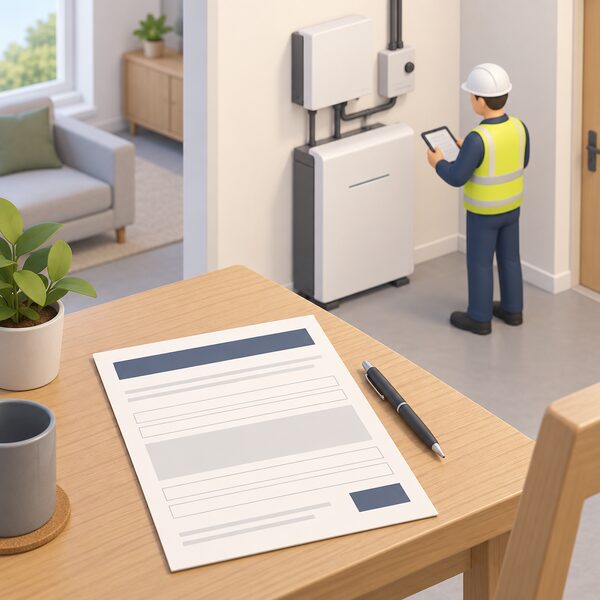
Part P is the part of the Building Regulations that deals with electrical safety in dwellings, and it is the first rule any self-build has to meet. All new electrical work in a dwelling must be designed and installed to account for it, and the guidance describes a dwelling as including a house, a flat or a small commercial premises linked to domestic accommodation1.
The standard behind Part P is BS 7671, the wiring regulations. Even work that is not notifiable should be designed and installed, and inspected, tested and certificated in accordance with BS 767110. That sentence matters for a self-build because it removes the idea that a small job escapes scrutiny: the notification threshold and the technical standard are two different things, and the technical standard applies either way.
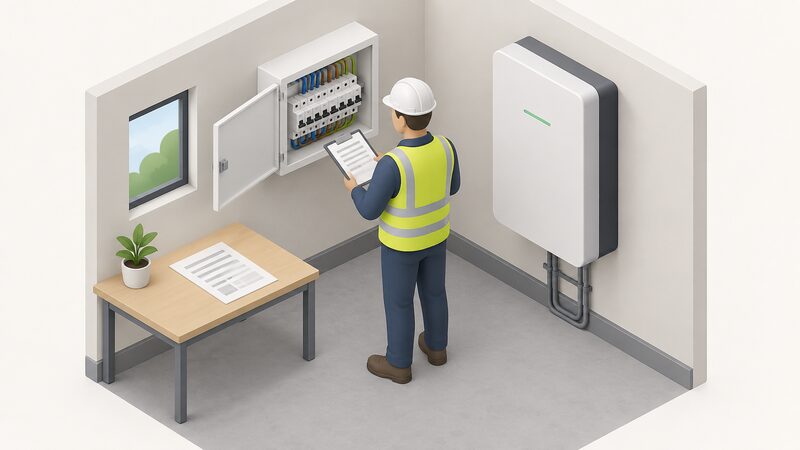
The evidence of compliance is a certificate. A copy of the Installer's Electrical Installation Test Certificate compliant with BS7671 must be obtained and supplied to the local authority11. On a self-build there is no installer to issue it, so the certificate has to come from whoever inspects and tests the work, which in practice means the building control route rather than the competent person route.
The Building Regulations themselves rest on the Building Act 1984 and the Building Regulations 2010 in England12. The same broad structure applies in Wales, where electrical work in homes and gardens is covered by the Building Regulations and the checking can be done in either of two ways: by using an electrician registered with a competent person scheme, or by notifying the building control section of the local authority2.
Notifiable or not: which battery and circuit work needs building control approval
The notification question turns on what the work is, not on what it stores. Most repairs, replacements and maintenance jobs, and alterations or additions to existing circuits outside special locations, are not notifiable3. Notifiable work includes new circuits back to the consumer unit and additions or alterations to existing circuits in kitchens, bathrooms and outdoors13. The installation of a new consumer unit or fuse box is notifiable3.
A battery bank almost always involves a new circuit, because it needs its own protected supply from the consumer unit or a dedicated sub-board. That places the typical self-build on the notifiable side of the line. Where the bank is added to an existing circuit outside a special location, the work may be non-notifiable, but it still has to be designed, installed, inspected, tested and certificated to BS 767110.
| Work | Notifiable? | Source |
|---|---|---|
| New circuit back to the consumer unit | Yes | 13 |
| New consumer unit or fuse box | Yes | 3 |
| Alterations to existing circuits in kitchens, bathrooms, outdoors | Yes | 13 |
| Most repairs, replacements and maintenance | No | 3 |
| Alterations to existing circuits outside special locations | No | 3 |
In England, special locations are the spaces around baths and showers3. A garage, plant room or outbuilding is not a special location in that sense, so the location of the bank itself does not trigger notification. What triggers it is the new circuit and any new consumer unit.
There is a separate notification duty that catches accredited installations. Ofgem must be notified for ROO-FIT installations, or the FIT licensee for MCS-FIT installations, when battery storage is connected to the accredited installation14. That is a feed-in tariff administrative duty rather than a building control one, but it is a notification that a self-build connected to an accredited array can trigger.
The compliance routes: registered electrician or building control notification
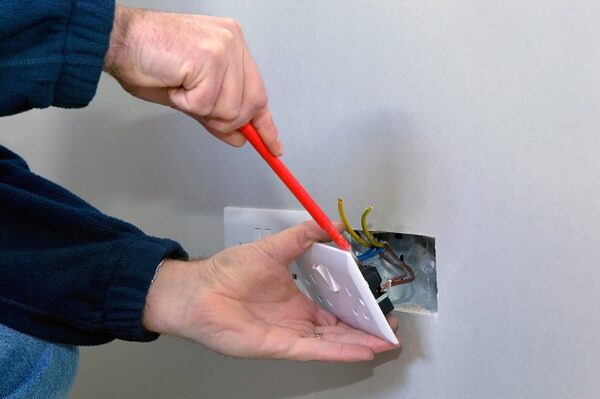
There are two routes to a compliant installation, and a self-build can only use one of them. Safety can be checked by using an electrician registered with a competent person scheme or by notifying the building control section of the local authority2. The competent person route depends on the electrician being registered by an organisation authorised by the Secretary of State and able to certify the work as safe without notifying building control2.
A householder building their own bank is not that electrician. A Building Regulations application should be made if the electrician is not registered as a competent person or if the work is done by the householder2. The application goes to a building control body, which the guidance describes as the local authority or a private registered building control approver3. In England, a private registered building control approver can be used if the work does not include a higher-risk building15.
The inspection route is the same in both nations. A building control body, whether the local authority or a private registered building control approver, inspects the work3. In England only, an electrician registered with a third-party certification scheme, a registered third-party certifier, is a further option3. That route is not available in Wales.
Where work has already been done without approval, there is a retrospective path. The guidance refers to a regularisation certificate for work that should have had approval16. That is the mechanism a householder uses when a self-build has been energised before building control was involved.
What happens if the work is not compliant
The consequences fall on two people: the person who did the work and the owner of the building. The person doing the work could be prosecuted and fined if they do not comply with building regulations5. The owner may have to correct the work or pay a fine if building regulations are not followed15.
In Wales the owner liability is stated plainly: if you are the owner of the building, it is ultimately you who may be served with an enforcement notice if the work does not comply with the regulations6. The same principle appears in English guidance on renewables, where a local authority may serve an enforcement notice if the installer does not adhere to building regulations18.
The wider cost is to the property. Unauthorised works may prejudice the sale or remortgaging of a property and may result in the works having to be regularised by building control19. That is the practical risk a self-build carries into a future sale: not a fine on the day, but a question from a buyer's solicitor that has no certificate behind it.
There is also a manufacturer-side duty in the electrical equipment regulations. A manufacturer who considers, or has reason to believe, that electrical equipment placed on the market is not in conformity with Part 2 must immediately take the corrective measures necessary, and that duty applies in England, Wales and Scotland20. It is a duty on the maker, not the builder, but it shows the regulatory chain that a self-build steps outside.
Grid connection rules: G98 and G99 and when they apply
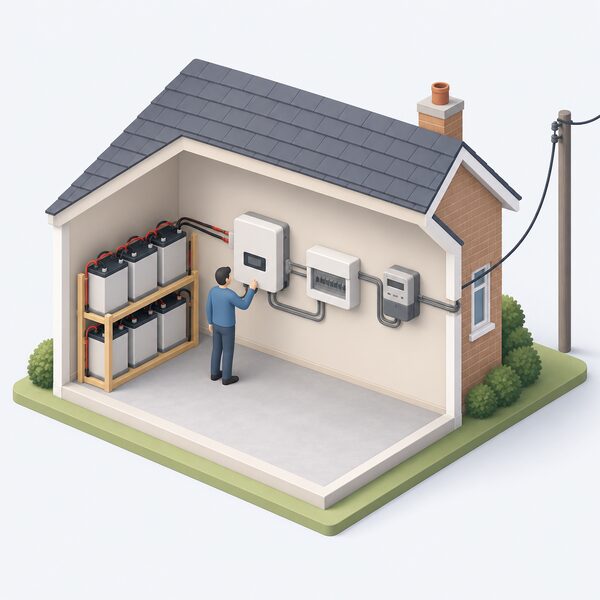
A battery that can export to the network is a generation installation in the network operator's terms, and it needs the right connection application. G98 is a UK engineering standard written by ENA, and it was previously known as G837. Its purpose is to ensure small-scale generation installations connect to the grid safely and do not compromise network stability, safety or power quality7.
The distinction between G98 and G99 is one of scale. G98 covers small-scale generation; larger installations fall under G99. A self-build bank that is charged from solar and never exports may sit outside the generation application, but a bank with an inverter that can push power to the grid does not. The application is made to the network operator before the installation is connected, and the operator's own guidance sets out the process for micro-generation and storage connections7.
The feed-in tariff rules add a notification layer for accredited installations. Ofgem must be notified for ROO-FIT installations, or the FIT licensee for MCS-FIT installations, when battery storage is connected to the accredited installation14. A self-build added to an existing accredited array therefore has an administrative step as well as a technical one.
The G98 and G99 page covers the application process in full. For a self-build the key point is that the network operator's requirements apply to the inverter and its settings, not to who assembled the cells, so a compliant inverter can carry a compliant application even on a home-built bank.
Cell safety standards: IEC 62133-2 and what it covers
Cell and battery safety standards are where a self-build meets the product safety regime. IEC 62133-2:2017 is the standard for secondary cells and batteries containing alkaline or other non-acid electrolytes, and the documents here disagree on what changed in that edition. One account describes the separation of nickel systems into a separate Part 1; another describes an update to the assembly of cells into batteries at clause 5.621. The conflict is unresolved, so both are given.
What is not in dispute is the direction of travel in appliance safety. BS EN IEC 60335-1:2023+A11:2023 covers household and similar electrical appliances, and its scope includes battery-operated appliances, with revised requirements for them21. That standard sits alongside the cell-level standards rather than replacing them, and it is the kind of conformity a listed home battery is tested against.
The installation standards for domestic batteries are separate again. Domestic batteries installed under the government scheme must be installed in compliance with the latest version of the quality and installation standards, including MCS, PAS 63100 and PAS 203522. Those are the standards a self-build does not automatically meet, because they are written for accredited installers working to a documented process.
The installation standards page sets out PAS 63100, BS 7671 and MIS 3012 in detail. For a self-build the practical reading is that cell-level conformity, appliance-level conformity and installation-level conformity are three different tests, and passing one does not pass the others.
England and Wales: where the rules differ
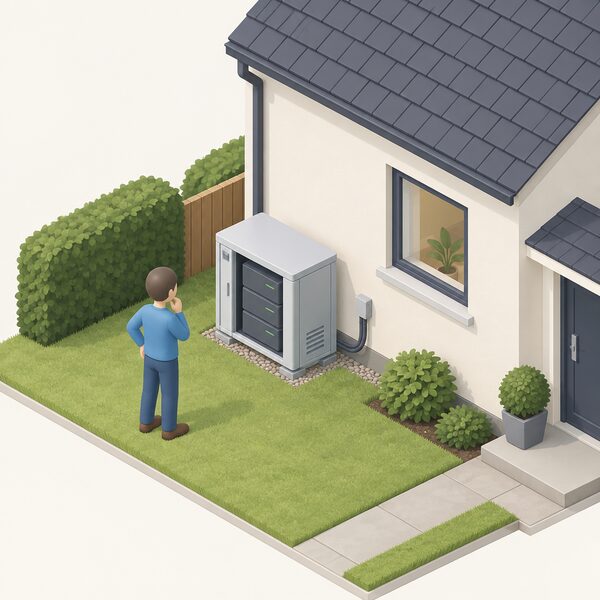
The Building Regulations cover electrical work in homes and gardens in England and Wales, and the checking routes are broadly the same in both2. The differences are in the detail of who may certify and how approval is obtained.
In England, a private registered building control approver can be used for work that does not include a higher-risk building15. In England only, an electrician registered with a third-party certification scheme can certify the work3. Neither route is described for Wales in the same terms, where the guidance points to a competent person scheme electrician or the local authority building control section2.
Wales also has its own approved documents and its own consultation versions. The Welsh Approved Document L Volume 1 sets out notification duties for new dwellings, including that the building control body must be notified once the work is complete of the as-built target primary energy rate, dwelling primary energy rate, target emission rate, dwelling emission rate, target energy use intensity, dwelling energy use intensity, fabric performance values and list of specifications23. The English equivalent carries the same structure, with the building control body notified before the work starts and once the work is complete4.
Planning guidance is territorial in a way that catches battery work indirectly. Guidance on solar panels, insulation and boilers states that the policy in Wales may differ from the English regime24. The same wording appears on the EV charging guidance27. A self-build that involves an outdoor enclosure or a new structure should check the devolved position rather than assume the English one.
Scotland and Northern Ireland have their own building standards systems, and the electrical equipment regulations cited here apply in England, Wales and Scotland20. Northern Ireland building control guidance is published separately by buildingcontrol-ni19.
Why certification matters when you come to sell or insure the home
Certification is the difference between a bank that is documented and one that is merely present. Installers under UK Government schemes must be TrustMark registered and/or Microgeneration Certification Scheme (MCS) certified28. That requirement attaches to the installer, and a self-build has no installer to carry it.
The consequences of missing certification are concrete. Unauthorised works may prejudice the sale or remortgaging of a property and may result in the works having to be regularised by building control19. A regularisation certificate is the route back, but it is an inspection of work that has already been done, and it can require changes16.
There is also a warranty dimension. A listed battery carries a maker's warranty with conditions on installation and commissioning; a self-build carries whatever the cell and BMS suppliers offer, which is usually a component warranty rather than a system warranty. The home battery warranties page explains how those conditions work on listed products.
The market has also shown that a maker's warranty is only as good as the company behind it. GivEnergy Ltd is described as the largest domestic battery manufacturer to stop trading to date in the UK29. That is a reminder that certification and warranty are separate things: a certificate proves the work was done to standard, while a warranty depends on a company still being there to honour it.
For a household, the independence question is the same either way. A self-built bank can store cheap or self-generated electricity and reduce what is drawn from the grid, but it does not remove the grid connection, the network operator's rules, the building control regime or the need for an insurer to be satisfied. The energy independence page sets out what a battery can and cannot do for a household's autonomy.
Sources29 cited
- Building regulations and electrical works, Richmond Council, 2026-06-02
- Building regulations: electrics, Welsh Government, 2026-09-17
- Building regulations for electrics: general information, Planning Portal, 2026
- Approved Document L Volume 1: Dwellings, 2021 edition incorporating 2023 amendments, Department for Levelling Up, Housing and Communities, 2026-09-17
- Building regulations approval, GOV.UK, 2026-09-17
- Building regulations: boilers and heating, Welsh Government, 2026
- Micro-generation and storage connections, Electricity North West, 2026-09-19
- Battery storage, Energy Saving Trust, 2026-08-19
- Lithium-ion batteries, North Wales Fire and Rescue Service, 2026
- Building regulations: minor electrical works, Planning Portal, 2026
- Building control application guidance notes, London Borough of Bromley, 2026-09-17
- Building regulations and the Building Act 1984, House of Commons Library, 2024
- Quick guide to the Building Regulations: questions and answers, Welsh Government, 2021-12
- Feed-in Tariffs: treatment of replacement generating equipment, Ofgem, 2021-12-13
- How to apply for building regulations approval, GOV.UK, 2026-09-17
- Retrospective approval for electric vehicle charging, Planning Portal, 2026
- Electric vehicle charging: building regulations, Planning Portal, 2026
- Building regulations: renewables guidance, Bedford Borough Council, 2026-09-17
- Replacement conservatory roofs guidance, Building Control Northern Ireland, 2026-04
- Electrical Equipment (Safety) Regulations 2016, regulation 12, legislation.gov.uk, 2026-09-17
- BS EN IEC 60335-1:2023+A11:2023, BSI, 2024-01-31
- Warm Homes: Social Housing Fund wave 3 scheme guidance addendum, Department for Energy Security and Net Zero, 2026-06
- Approved Document L Volume 1, 2026, Welsh Government, 2026-04
- Solar panels: building regulations, Planning Portal, 2026-09-17
- Insulation: planning permission, Planning Portal, 2026-09-17
- Boilers and heating: planning permission, Planning Portal, 2026-09-17
- Electric vehicle chargers, Planning Portal, 2026-09-17
- Consumer protection and certification in government schemes, House of Commons Library, 2026-05-13
- GivEnergy FAQs, Energy Storage Association UK, 2026-04-17
 Backup Power Safety RulesWho signs off a battery or backup circuit, and can you legally plug in a power station or a plug-in solar panel in the UK?
 Installation StandardsWhich rules must an installer follow when fitting a home battery?
 Home Battery Fire SafetyHow likely is a home battery to catch fire, and what keeps it safe if it does?
 Siting and LocationWhere can a home battery actually go?
 Installation ProcessA home battery installation usually starts with a survey, then the fitting itself, then a handover.
 Planning Permission in EnglandWhen a domestic battery or its enclosure falls within permitted development in England, when an application is needed, and how the position differs for outbuildings, listed buildings and conservation areas.