

In this guide
A home battery installation runs through a fixed sequence: a survey of the property and its electricity supply, a check that the position and cabling will work, the electrical work itself, commissioning to the relevant standard, and a handover that leaves the household with certificates, settings and warranty paperwork. The electrical work is the part governed by law. All new electrical work in a dwelling must be designed and installed to account for Part P of the Building Regulations, which applies in England and Wales1.
The practical shape of the job varies more than the rules do. One Energy Saving Trust case study records a solar and battery installation taking around four days2, while a separate park home project took just over two weeks3. The difference lies in the scope: a battery added to an existing solar system is a smaller job than a first installation that also mounts panels, runs new cable routes and commissions a hybrid inverter.
Two duties sit alongside the electrical work. The household should notify its local Distribution Network Operator about a storage system, and may also need to inform the local council4. And the installer's competence is not a formality: most electrical work in the home must be notified to local authority building control or carried out by an electrician registered as a competent person with a government-approved Part P scheme5.
What the installation process involves, step by step
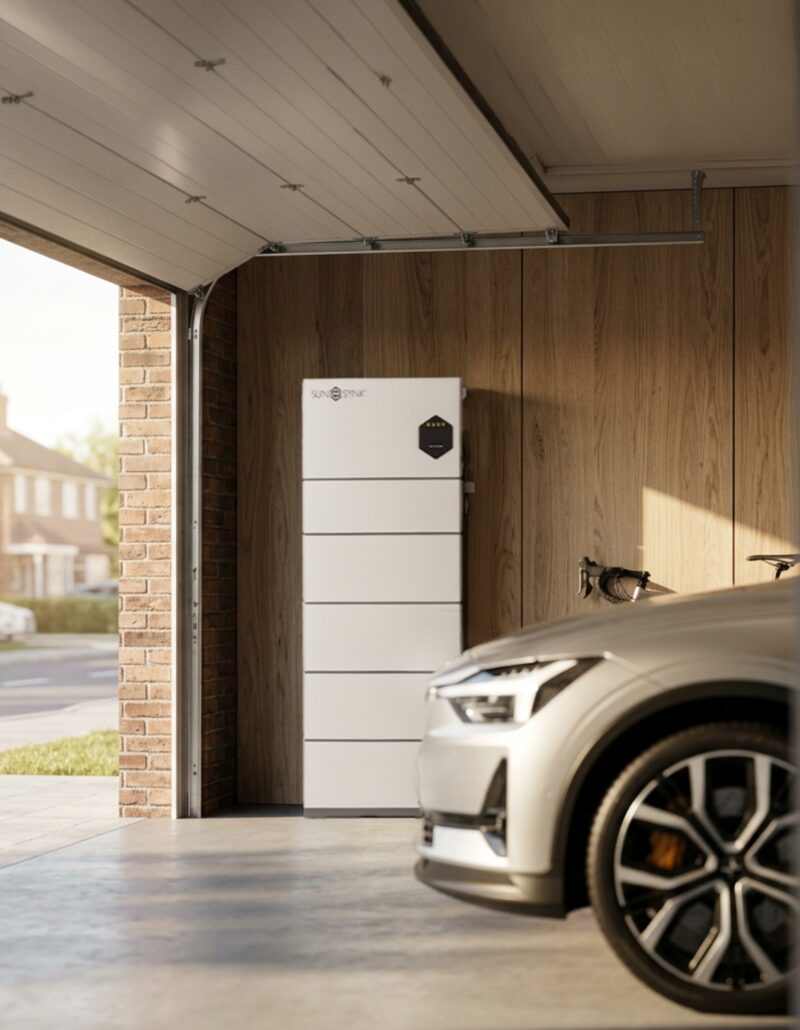
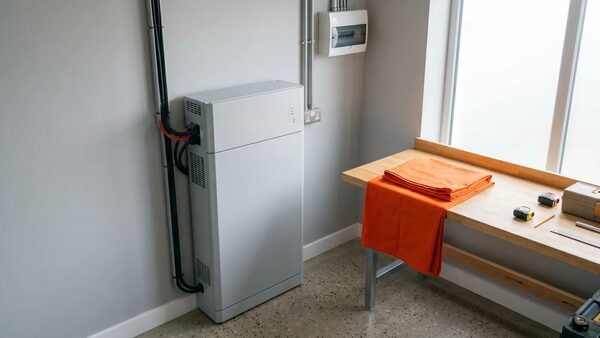
The sequence begins before any equipment arrives. A survey establishes where the battery can go, how the cable will reach the consumer unit, and whether the incoming supply and existing wiring can take the load. Energy Saving Trust guidance notes that a battery can be installed in garages, on external walls or utility rooms, depending on which one you choose7. That choice is settled at survey stage, because it determines cable routes, ventilation and access for maintenance.
The supply check matters as much as the position. Installers making pre-applications for domestic low-carbon technology work are required to supply installation details and a photo of the cut-out8, the main fuse assembly where the supply enters the property. That photograph tells the installer and the network operator what the existing connection looks like before anything is added.
The physical work then follows a recognisable order:
- Isolation of the supply and confirmation of the earthing arrangement.
- Mounting of the battery unit and, where fitted, the inverter.
- Cable runs between the battery, inverter, consumer unit and any backup circuits.
- Connection and initial power-up.
- Commissioning against the applicable standard.
- Handover of certificates, settings and warranty documents.
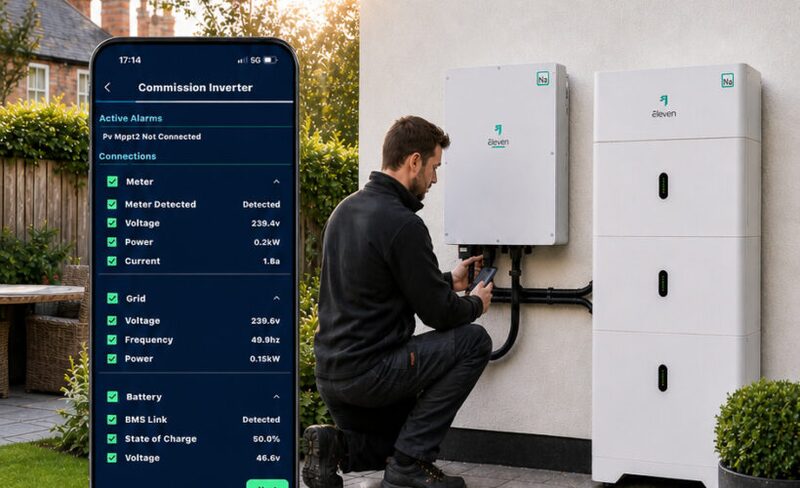
Commissioning is not optional paperwork. Official guidance states that on-site electricity storage and battery systems connected to on-site electricity generation should be commissioned to the MCS battery standard, The Battery Standard (Installation)9. Scheme rules for domestic batteries name the same family of documents, requiring installation in compliance with the latest version of the quality and installation standards, including the MCS battery standard, PAS 63100 and PAS 20356.
What drives the timescale and the cost
Duration is driven by scope, access and the state of the existing installation. The four-day figure from the Energy Saving Trust case study covers a combined solar and battery job2; the two-week figure covers a park home project3. Neither is a quotation, and neither should be read as a standard. A battery retrofitted to an existing solar system with a spare way in the consumer unit is a shorter job than a first-time installation that also needs a new circuit.
Cost data is published at a level of generality that reflects how varied the work is. The MCS domestic battery installation statistics round costs and capacities to the nearest 1010, and the cost figure explicitly does not include the cost for any additional device installed with the battery, such as solar panels, nor extended warranty or other material or works on the battery equipment10. In other words, the published cost is the battery installation alone, not the whole project.
The statistics also group installations by capacity band. The bands were chosen to cover distinct groupings in the data: batteries approximately smaller than 6kWh, approximately larger than 11kWh, and a grouping in between10. In the 2025-26 data, the 1 to 5.99 kWh band records 16,270 installations10. That band structure is useful context for a household trying to place its own project: the smallest common domestic batteries sit in the first band, and larger whole-home units sit in the third.
Where the published figures stop, prices become installer-quoted. There is no single UK price for a home battery installation, because the work depends on the property, the chosen unit and whether solar is being fitted at the same time. The MCS statistics give a rounded cost for the battery installation alone and exclude everything installed alongside it10.
Who may carry out the electrical work
The legal position is broader than many households expect. Part P applies to all electrical work in dwellings, whether carried out by professionals or DIYers1. It covers installations operating at voltages not exceeding 1000 V a.c.1, in or attached to a dwelling1, and the term dwelling includes houses, maisonettes and flats1.
What differs is the notification route. Notifiable work includes new installations, house re-wires, and the installation of new circuits, and also additions to existing circuits in special locations1. A special location is defined as a room containing a bathtub or shower1. Everything else is considered non-notifiable, namely additions and alterations to existing installations outside special locations, maintenance, replacement and repair work1.
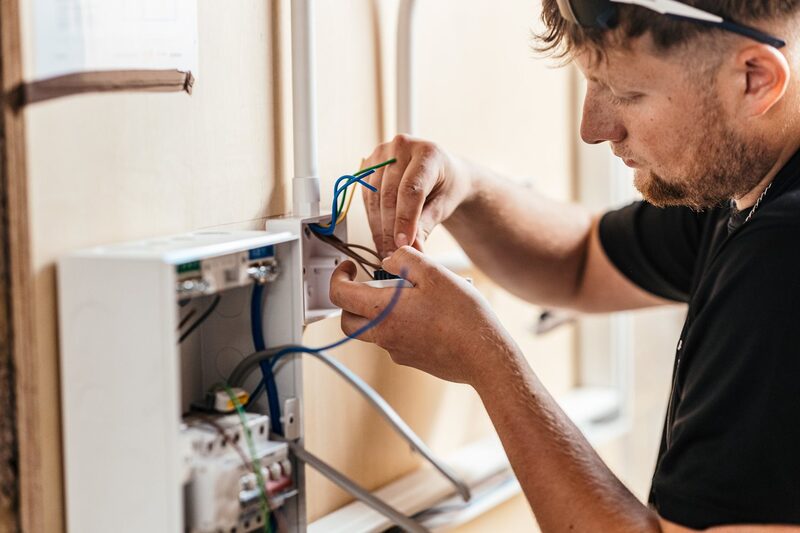
A battery installation normally involves a new circuit, which brings it into the notifiable category. The route out of a separate application is the competent person scheme. In general, notification will need to be given to, or full plans deposited with, a building control body only if the work is major, involves one or more complete new circuits, and is not carried out by an electrical contractor registered with an authorised competent person self-certification or third-party self-certification scheme1. Registered electricians can self-certify their work as compliant with the Building Regulations11, and installers accredited by bodies such as NAPIT can submit a building regulations application on the householder's behalf12.
The consequences of getting this wrong are not administrative. Failure to comply with the Building Regulations is a criminal offence and local authorities have the power to require the removal or alteration of non-compliant work1. The Electrical Safety Council has warned that failure to comply is a criminal offence and homeowners could find themselves having to undertake costly remedial work or may even be forced to remove any installations that contravene the regulations5. Electrical work that complies with Part P is reported in the Home Information Pack as part of local authority searches5, which means the record follows the property.
Choosing and checking an installer
Certification is the household's main protection, and it operates at two levels: the individual's competence and the business's registration. Which? advises checking that your installer is signed up to the Renewable Energy Consumer Code, which now covers storage, and certified by the Microgeneration Certification Scheme, or alternatively certified by Flexi-Orb4. Solar Energy UK notes that installers can help identify whether a home battery is suitable and the best type of system for your house13, which makes the survey conversation part of the selection process rather than a formality after it.
The certification bodies themselves are worth understanding. NICEIC describes itself as the UK's largest certification body for electrical businesses, with almost 70 years of operation and over 40,000 currently certified businesses14. It assesses, certifies and trains electricians, plumbers, renewable energy installers, and gas and heating engineers14, and it certifies businesses, not individuals, unless they are a sole trader14. NICEIC-registered electricians are assessed on an annual basis11.
NICEIC also offers MCS certification for four key technologies: solar heating, solar photovoltaic (PV) systems, heat pumps (air and ground source) and electrical energy storage systems (EESS)15. It is accredited by UKAS to offer the redeveloped scheme, and from 9 March all new applicants are automatically assessed under the redeveloped scheme15.
NAPIT operates a comparable role, describing itself as a certification body and training provider with over 20,000 members in the electrical industry16. Its complaints process is worth knowing about before work starts, because it sets out what the scheme can and cannot do. A complaint may be made by any person who has had work completed by a member who is certified for the relevant scope of work at the time17, and the process applies when a company certificated by NAPIT has been contracted or subcontracted to carry out work covered by the scope of their certification17.
The limits are stated plainly. The NAPIT Complaints Process does not involve paying compensation, or funding third parties to carry out rectification work17, and NAPIT will not compensate or reimburse monies in regard to non-compliant work18. The responsibility for any required remediations for technical non-compliance lies with the NAPIT Member to propose and rectify17. A household must have formally contacted the member directly and allowed a minimum of 14 days for the member to acknowledge the complaint before escalating17, and complaints must be submitted using the complaints form found on the NAPIT website17. Receipt is acknowledged within 5 working days17, and any communication will be responded to within 10 working days, unless this is outside of NAPIT's control17.
Notification: the DNO, building control and the council
Three separate notifications can arise from a single installation, and they are not interchangeable.
The first is to the Distribution Network Operator. Which? states that where a storage system is installed, the local Distribution Network Operator should be notified, and the local council may also need to be informed4. The DNO needs to know what is connected to its network so it can assess the local effect. Installers making pre-applications for domestic low-carbon technology work supply installation details and a photo of the cut-out8, which is the information the network side needs to see.
The second is building control notification, where the work is notifiable and not covered by a competent person scheme. Most electrical work carried out in the home must be notified to local authority building control or carried out by an electrician registered as a competent person with one of the government-approved Part P schemes5.
The third is planning, which is a separate regime again. Planning Portal guidance states that installing a home charger is classified as development, so it is up to the householder to ensure the correct permissions are in place19. The same principle applies to home energy work generally: understanding the planning and building regulations is crucial for safe, efficient installations and accessing incentives20. For battery storage specifically, the planning position differs between the four nations, and the pages on planning permission for home battery storage in England, Scotland, Wales and Northern Ireland set out each.
What handover should include
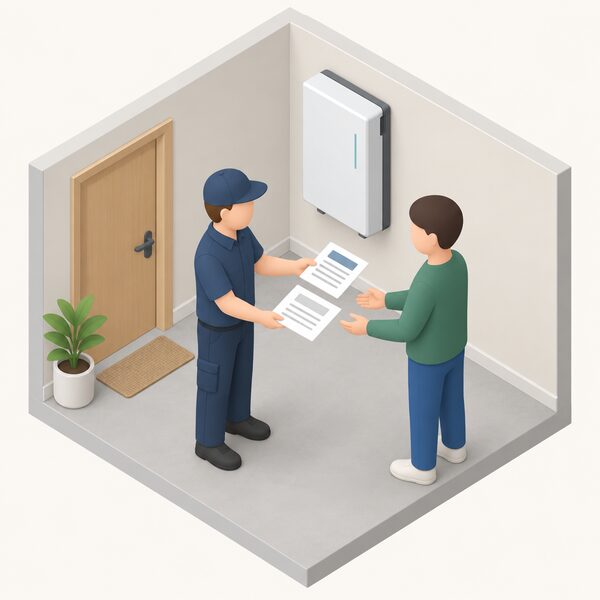
Handover is where the installation becomes the household's to live with, and it is the point at which documentation matters most. The standards named in scheme rules give the shape of what should be recorded: installation in compliance with the latest version of the quality and installation standards, including the MCS battery standard, PAS 63100 and PAS 20356. Commissioning to the MCS battery standard is the specific requirement for storage connected to on-site generation9.
Beyond the certificate, three practical items belong in the handover conversation. The first is backup capability. Which? advises that if you are looking to protect yourself against power cuts with a home battery, not all systems are suitable, and that a household should ask the installer whether the battery will work in a power outage, and for how long4. The backup power and EPS page covers how changeover arrangements work.
The second is the settings applied. Charge and discharge behaviour, tariff schedules and any export limits are configured during commissioning, and the household should know what was set and how to change it. The monitoring and apps page covers what the data shows afterwards.
The third is warranty registration. Terms vary by maker and by capacity retention, and the home battery warranties page sets out how the conditions differ. Registration is normally completed by the installer, but the household should hold the confirmation.
A household should also know what the system does not do. A battery stores excess electricity produced from a solar system13, and it is a way for homeowners to store excess electricity produced from their solar system21. It does not remove the connection to the grid, and it does not remove the need for a supplier. What it changes is the proportion of electricity drawn from the grid rather than generated and stored on site.
How the process differs across the UK nations
Part P of the Building Regulations applies in England and Wales11. Scotland and Northern Ireland have their own building standards regimes, and the electrical notification route differs accordingly. The practical effect for a household is that the paperwork at handover, and the body that receives it, depends on where the property sits.
Wales has moved further on the renewables side. An amendment to Part L of the Building Regulations in Wales makes solar a functional requirement for new homes and non-domestic buildings where construction has not started, taking effect from 4 March 2027. That is a new-build requirement rather than a retrofit one, but it signals the direction of travel in Welsh building standards.
The standards landscape itself is not fully settled. Official guidance published in 2017 recorded that there are currently no UK installation standards22. That statement predates the current scheme rules naming the MCS battery standard, PAS 63100 and PAS 20356, and the two should be read together: the framework has developed since, and the named standards are now the ones scheme rules require.
There is also a practical difference in where batteries go. Guidance notes that a battery can be installed in garages, on external walls or utility rooms, depending on which one you choose7. In flats and smaller homes, space is the binding constraint. The Electrification of Heat demonstration project recorded that a small number of homes, 33 flats, had a heat battery installed instead of a hot water tank, due to lack of space23, which illustrates how installation routes adapt where a conventional position is not available.
What the installation means for energy independence
A home battery changes the household's relationship with the grid, but it does not end it. The clearest statement of the benefit is that combining solar panels with a home battery lets you store free, renewable electricity to power your heat pump, making you less reliant on grid electricity21. The word is "less", not "not". The property remains connected, the supplier remains necessary, and the battery's contribution depends on how much is generated and how much is stored.
The dependence that remains is worth naming precisely. There is the grid connection itself, which carries the import and export. There is the supplier, which sets the tariff the battery is charged against. There is the manufacturer, whose warranty and monitoring platform sit behind the hardware. And there is the installer, whose certification and workmanship determine whether the system performs as specified.
What the installation process delivers is the physical and legal basis for the rest. A correctly surveyed, correctly commissioned system with the right certificates is what makes the later questions, sizing, tariffs, backup and warranty, answerable. The home battery storage guide covers the wider picture, and the standards governing home battery installation page sets out PAS 63100, BS 7671 and MIS 3012 in detail.

Sources23 cited
- Part P England and Wales frequently asked questions, Institution of Engineering and Technology, 2026-09-17
- Beth Martin story: solar panels and electric vehicle, Energy Saving Trust, 2025-03-03
- Insulation Solutions Scotland, Energy Saving Trust, 2026-09-17
- Solar panel battery storage, Which?, 2026-05-14
- House buyer beware: illegal electrics in hundreds of homes, Electrical Safety First, 2026-09-19
- Warm Homes Scotland heat fund wave 3 scheme guidance addendum, UK Government, 2026-06
- Battery storage advice, Energy Saving Trust, 2026-05-19
- Connect Direct, Energy Networks Association, 2026-09-17
- Approved Document L Volume 1 consultation version, Welsh Government, 2026-09-17
- MCS domestic retrofit battery installations 2025 to 2026, Department for Energy Security and Net Zero, 2026-05-28
- Wiring a shed: a guide for homeowners, NICEIC, 2026-09-17
- Building regulations renewables guidance, Bedford Borough Council, 2026-09-17
- Batteries in the home, Solar Energy UK, 2026-09-17
- Householders and landlords help hub, NICEIC, 2026-09-17
- Redeveloped MCS installer scheme: key changes and benefits, NICEIC, 2026-03-09
- NAPIT responds to the government's plug-in solar consultation, NAPIT, 2026-07-16
- Complaints against members policy, NAPIT, 2026-09-20
- NAPIT FAQs, NAPIT, 2026-09-17
- Planning permission for electric vehicle charging, Planning Portal, 2026
- Sustainable home energy solutions, Planning Portal, 2024-09-02
- How to ensure a heat pump runs efficiently, Energy Saving Trust, 2026-05-19
- Fire and solar PV systems literature review, UK Government, 2017-07-17
- Electrification of Heat: home surveys and install report, Energy Systems Catapult, 2022-12-20
 Solar Panel InstallationHow long will the panels actually take to fit, and what happens on the day?
 Installation Survey to HandoverWalks through the survey, design, pipework and electrical stages of a domestic heat pump installation and what happens on each day.
 DIY Home Battery BuildsBuilding your own home battery?
 Payback and SavingsHow long until a home battery pays for itself, and why do quoted payback times vary so much?
 G98 and G99 NotificationAdding a home battery usually means telling your network operator first, but sometimes you can just let them know afterwards.
 Home Battery Install StatisticsHow many homes in the UK actually have a battery, and is that number growing quickly?