
In this guide
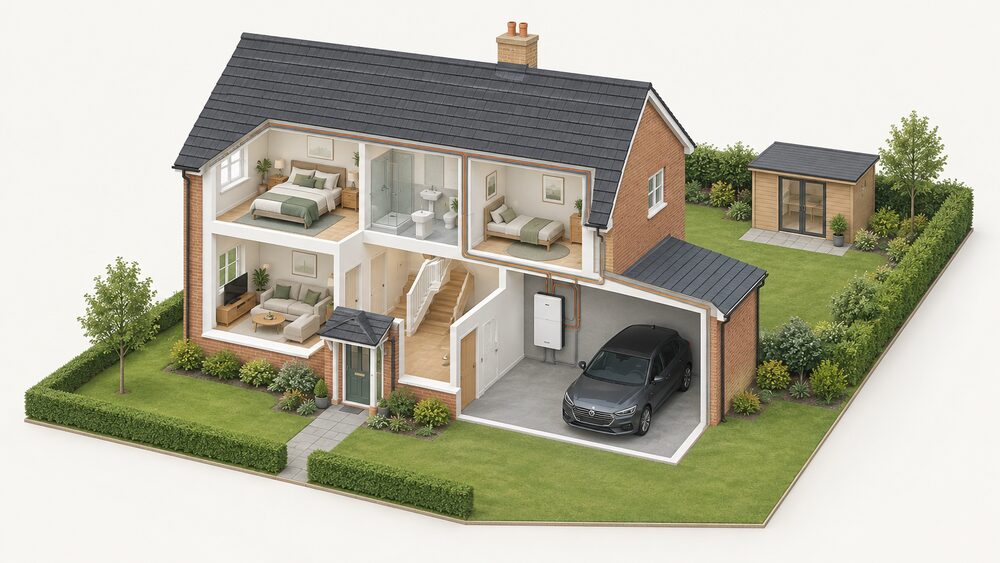
A home battery installed inside a dwelling in England does not need planning permission. The Scottish Government's 2019 consultation on permitted development rights states the position directly: "planning permission is not required for domestic battery storage within a residential building."1 That covers the common case, a battery on an internal wall of a garage, utility room or hallway, with the cabling run through the fabric of the house.
Where the battery sits outside the building, in a garden enclosure or an outbuilding, the question becomes whether the structure itself is permitted development. In England, outbuildings within the curtilage of a house are normally permitted development, and a battery housed inside one adds nothing to that position. The Planning Portal treats fuel tanks in the same way, describing installation as "permitted development, not needing planning permission, subject to the following limits and conditions."2
The exceptions matter more than the rule for a minority of homes. Conservation areas, listed buildings, article 4 directions and on-street parking all pull related electrical installations into the application process. The Planning Portal's electric vehicle charging guidance states that permission is usually required for "On-street parking; Conservation areas; Listed buildings; Areas where the installation is restricted."3 A battery in an external enclosure in one of those settings faces the same scrutiny.
What the figures show
The scale of domestic battery deployment is the context for the planning question. Parliamentary research puts certified battery installations in the UK at around 82,000 as of April 2026, and reports that around 20% of new solar installations have battery storage, "although some analysts believe this figure to be higher."5 Both figures are UK-wide and count certified work, so they understate the total if any installations proceed outside certification schemes.
At grid scale the picture is different in kind. UK grid-scale battery storage power capacity reached 7.5 GW by the end of 2025, according to the Clean Flexibility Roadmap.6 That is the transmission and distribution-connected fleet, not household units, and it is the figure that shapes national energy policy rather than the planning position for a single home.
The forecast for small-scale storage is modest against the grid total. National Grid's Future Energy Scenarios, cited in a 2017 government consultation, forecast 1.5GW of small battery storage, domestic and commercial combined, by 2040, "around a third of total battery storage deployment capacity."7 That projection predates the current installation rate and should be read as a modelled scenario rather than a target.
For a household, none of these figures changes the planning answer. They establish that domestic battery storage is an established, certified category of work with a defined regulatory treatment, not a novel installation that a planning authority will treat as an unknown.
| Measure | Figure | Scope | Source |
|---|---|---|---|
| Certified battery installations | around 82,000 as of April 2026 | UK, certified work | 5 |
| New solar installations with a battery | around 20% | UK | 5 |
| Grid-scale battery power capacity | 7.5 GW by end of 2025 | Transmission and distribution connected | 6 |
| Modelled small-scale storage by 2040 | 1.5GW | Domestic and commercial combined | 7 |
What drives the planning position

Three things determine whether a battery needs an application: where it is, what it is attached to, and whether the local authority has removed the relevant permitted development right.
Location is the first filter. A battery inside the thermal envelope of the house is not development at all in planning terms. A battery in a detached garden structure is development, but the structure is the thing assessed, and outbuildings are ordinarily permitted development in England. A battery mounted on an external wall, or standing in a purpose-built enclosure, is closer to the fuel tank and heat pump cases, where the Planning Portal applies limits and conditions rather than an outright prohibition.2
The building matters next. The Planning Portal's guidance on solar equipment, heat pumps, wind turbines and electric vehicle charging all carry the same territorial statement: "Guidance here relates to the planning regime for England, the policy in Wales may differ."7 That is a reminder that the permitted development rights being relied on are English rights, made under English legislation, and that a household in Cardiff, Edinburgh or Belfast is working from a different set of rules.
Local designations are the third driver. Conservation area status removes some permitted development rights, and article 4 directions remove others selectively. The Planning Portal lists conservation areas, listed buildings and areas where installation is restricted through article 4 directives among the situations where permission is usually required for an electric vehicle charger, and the same logic applies to external battery plant.3
How the position differs across the UK nations
Planning is devolved, and the permitted development rights that carry most domestic battery installations are made separately in each nation. The Planning Portal's guidance is explicit that it covers England and that policy in Wales may differ, on solar, heat pumps, wind turbines, electric vehicle charging and stand-alone solar equipment alike.7
Scotland has its own framework. The Town and Country Planning (General Permitted Development) (Scotland) Amendment Order 2024 created a permitted development class covering solar canopies, battery storage and equipment housing for recharging vehicles in qualifying parking areas. It defines battery storage as "equipment and apparatus for the storage of energy which is converted from electricity and is stored for the purpose of its future reconversion into electricity," and requires an application to the planning authority for a determination on whether prior approval will be required for the design and siting of the battery storage or equipment.14 That is a prior approval route, not a full application, and it applies to qualifying parking areas rather than to a battery inside a house.
Wales has its own permitted development regime, and the position there is covered separately on planning permission for home battery storage in Wales. Northern Ireland operates under a different system again, covered on planning permission for home battery storage in Northern Ireland. Scotland is covered on planning permission for home battery storage in Scotland.
The practical consequence is that a householder moving between nations, or reading guidance written for England, cannot assume the same permitted development right applies. The English position on a battery inside a dwelling is permissive; the position on an external structure in a designated area is not, and the devolved regimes each set their own limits.
| Nation | Framework | Battery inside a dwelling | Battery in an external structure |
|---|---|---|---|
| England | General Permitted Development Order | Not development, no permission needed1 | Normally permitted development, subject to limits2 |
| Scotland | Own permitted development order, amended 2024 | Not development, no permission needed1 | Prior approval route in qualifying parking areas14 |
| Wales | Own permitted development regime | Not development, no permission needed1 | Policy may differ from England7 |
| Northern Ireland | Separate system | Not development, no permission needed1 | Separate regime, covered on its own page |
The rules that apply in England
The English framework rests on the General Permitted Development Order, which grants permission for specified classes of development without an application. The government's guidance on when permission is required sets out the different types of permission available: "local authority grants, national grants under the General Permitted Development Order, local grants through Local or Neighbourhood Development Orders or Community Right to Build Orders, and development authorised by a relevant government department."15 A domestic battery inside a house falls outside this entirely, because it is not development.
Where a structure is involved, the permitted development classes that matter are those for outbuildings and for related domestic plant. The Planning Portal's fuel tank guidance is the closest analogue for a standalone external unit: installation is "considered to be permitted development, not needing planning permission, subject to the following limits and conditions."2 Those limits concern size, height, position relative to the boundary and the relationship to the dwelling.
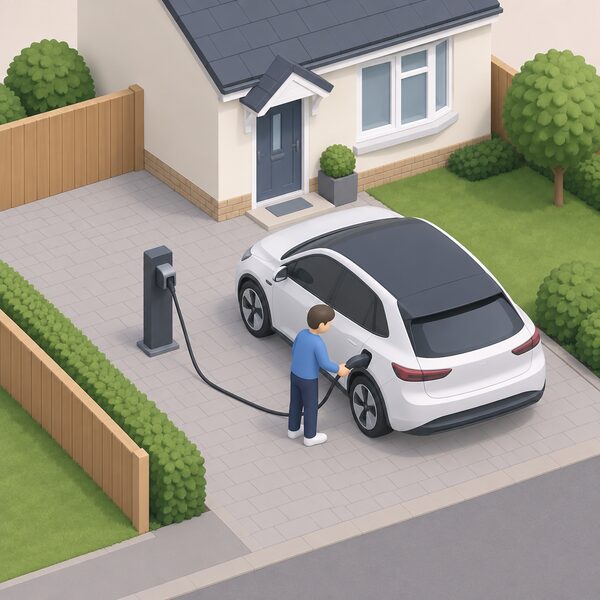
For electric vehicle charging, Class E, Part 2, Schedule 2 of the 2015 Order covers "the installation, alteration or replacement, within an area lawfully used for off-street parking, of an upstand with an electrical outlet mounted on it for recharging electric vehicles."16 A battery serving a home charging setup in an off-street parking area sits alongside that class, and the same conditions on siting and appearance apply.
Building regulations are a separate regime. The Planning Portal provides for making a building control application alongside a planning application, and Approved Document S sets the building regulation position in England for the installation of electric vehicle charge points or cable routes.17 A battery installation is electrical work governed by the wiring regulations and the relevant building standards, not by the planning system, and satisfying one does not satisfy the other.
Where an application is needed
The situations that pull a domestic battery into the application process are the same ones that affect other external electrical plant. The Planning Portal's electric vehicle charging guidance lists them plainly: permission is usually required for "On-street parking; Conservation areas; Listed buildings; Areas where the installation is restricted," and for more than one upstand per parking space.3
- Conservation areas. Designation removes some permitted development rights, and external plant visible from a public highway attracts scrutiny on appearance and siting. A battery inside the house is unaffected; a battery in a garden enclosure or on an external wall is not.
- Listed buildings. Listed building consent is separate from planning permission and covers alterations affecting the building's special architectural or historic interest. A battery installation inside a listed dwelling, with its cabling and any external unit, can require consent.3
- Article 4 directions. A local authority can remove permitted development rights in a defined area, and the Planning Portal refers to "areas where the installation is restricted through article 4 directives" as a category where permission is usually required.4 A household in such an area cannot rely on the outbuilding right for an external battery enclosure.
- On-street parking. Where the battery serves a chargepoint in an on-street parking place rather than off-street, the permitted development class does not apply.3
Where an application is needed, it can be made online. The Planning Portal states that "you can use the Planning Portal to submit most applications for planning consent online," that an application is passed to the relevant local planning authority "as soon as payment for the application has been confirmed," and that "there is a service charge for submitting some applications using the Planning Portal."17 The Portal also offers a 30-minute call with its planning experts for guidance on home improvement projects.19
Recent changes to the solar permitted development rules
The permitted development rules for domestic solar installations changed on 27 August 2026, and the changes bear on battery installations because most domestic batteries are installed alongside solar. The Planning Portal reports that the amended rules "split the eligibility requirements into distinct rules for houses and blocks of flats, with the former gaining the potential for larger installations in a wider range of locations on buildings or within the property boundary."13
The changes also clarify the position on plug-in solar, described as solar "that connects to the dwellings wiring via a standard plug socket," while blocking installation "on wooden structures or cladding to mitigate fire risk."13 A plug-in battery or a plug-in solar setup is covered further on plug-in and balcony battery storage in the UK.
A transitional provision runs alongside the new rules. Projects that are no longer eligible under the amended rights can use the rules as they stood before the changes, and that option "will be available for 12 months, until 26th August 2027."13 The Planning Portal's own guidance on stand-alone solar equipment records the same 12-month transitional period ending 27 August 2027.8
The online application system was updated on 17 September 2026, with eligibility questions revised to account for the new rules, "including the specific differences for houses and blocks of flats, and the transitional allowances."13 Where a project would exceed the permitted development limits, or does not require an application, the system flags it so that users do not proceed unnecessarily.13
What it means for household energy independence
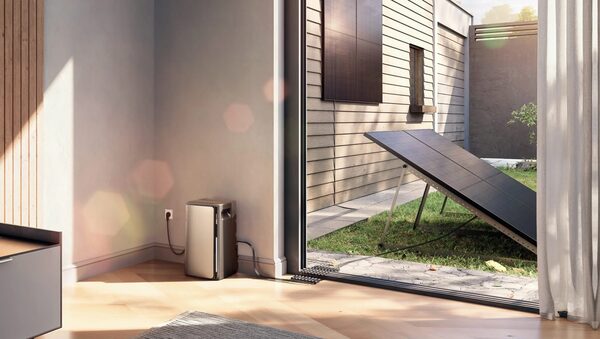
A battery changes what a household draws from the grid, and the planning position determines whether that change is straightforward or requires an application. Great British Energy's figure, cited in parliamentary research, is that adding a battery to a solar installation increases self-consumption from 30 to 40% to 70 to 80%.5 That is the direct independence gain: a larger share of generated electricity used on site rather than exported and bought back.
The dependence that remains is substantial and worth stating plainly. The household stays connected to the distribution network, and the connection itself is governed by the network operator rather than the planning system, as covered on telling the network operator about a home battery. The battery is charged from the grid as well as from solar, and HMRC's VAT guidance recognises this directly, describing "the installation of a battery for storing electricity from one or more qualifying energy-saving materials and from the grid."20
There is also a manufacturer dependence. Monitoring, firmware and warranty support run through the maker's app and cloud service, and a household's ability to diagnose or service the system depends on that continuing. The planning system does not address this, but it is part of what a battery does and does not deliver.
The evidence from funded retrofit programmes is that battery storage is treated as a standard measure alongside fabric improvements. The Building for 2050 study describes how "householder's use of solar generated electricity is maximised by battery storage and exported to the grid," and the same wording appears in the Welsh Optimised Retrofit Programme's project descriptions.21 Ofgem's ECO4 delivery guidance added a paragraph on battery storage installations in August 2025, bringing them within the funded-measures framework.23
The planning answer, in short, is that a battery inside a house in England needs no permission, and that the independence it delivers is real but partial: less electricity bought from a supplier, no less reliance on the grid, the network operator and the manufacturer.
Sources23 cited
- Extending permitted development rights in Scotland: sustainability appraisal, Scottish Government, 2019-06
- Fuel tanks, Planning Portal, 2026-09-17
- Electric vehicle charging: planning permission, Planning Portal, 2026
- Smart search: electric vehicle charging, Planning Portal, 2026
- POSTnote: Small-scale low-carbon generation, UK Parliament, 2026-06-25
- Clean Flexibility Roadmap, GOV.UK, 2025-12
- Heat pumps, Planning Portal, 2026-09-17
- Stand-alone solar equipment, Planning Portal, 2026-09-17
- Solar equipment mounted on a house or block of flats, Planning Portal, 2026-09-17
- Wind turbines, Planning Portal, 2026-09-17
- The Microgeneration Certification Scheme, Planning Portal, 2026-09-17
- Solar electricity photovoltaics, Planning Portal, 2026-09-17
- Changes to permitted development rules for domestic solar installations, Planning Portal, 2026-08-28
- The Town and Country Planning (General Permitted Development) (Scotland) Amendment Order 2024, legislation.gov.uk, 2024-05-24
- When is permission required, GOV.UK, 2014-03-06
- The Town and Country Planning (General Permitted Development) (England) Order 2015, legislation.gov.uk, 2015-03-18
- Planning permission and building regulations approval, Planning Portal, 2026-09-17
- Approved Document S, GOV.UK, 2021-12-15
- Planning Portal, Planning Portal, 2026
- VAT on energy-saving materials: batteries, HMRC, 2026-09-17
- Building for 2050, GOV.UK, 2022-12-05
- Optimised Retrofit Programme 3 funded projects, Welsh Government, 2023-04-26
- Summary of updates to ECO4 delivery guidance and measures table, Ofgem, 2025-08-07
 Planning Permission in WalesDo you need planning permission for a home battery in Wales?
 Planning Permission in ScotlandDo you need planning permission for a home battery in Scotland?
 Planning Permission in NIDo you need planning permission for a home battery in Northern Ireland, and does it matter whether it goes inside the house or in an outbuilding?
 Planning Permission for ChargersDo you need planning permission for a home EV charger, and does it change if you live in a listed building, a conservation area or a flat?
 Home Battery Install StatisticsHow many homes in the UK actually have a battery, and is that number growing quickly?
 Batteries by Home TypeLooks at how house type, occupancy pattern, electrical supply and available space change what storage can achieve, from flats and terraces to rural and off-grid properties.