
In this guide
Whether a home battery is worth fitting depends far less on the house than on how the household buys and uses electricity. A battery stores electricity for later use, for example to power the home during the night, and it makes the property's energy system more independent from the National Grid1. What changes from one house type to another is how much there is to store, when it is needed, and whether there is anywhere to put the unit.
The figures are consistent enough to plan around. Energy Saving Trust puts a typical home system at 10 kWh, with costs from £1,500 to £10,000 and a 5kWh system around £4,6001. Lifespan is given as about 10 to 12 years by the same source, and around 10 to 15 years in parliamentary briefing material1. Payback is reported in the region of 8 to 12 years, which is similar to the reported lifespan4.
The conditions that make a battery worthwhile are narrower than the marketing suggests. Independent guidance lists them as wanting backup power, not having full-retail export rates, or being able to access cheap overnight charging tariffs5. Where none of those apply, a grid-connected house may find the economics do not work at present, with batteries still quite expensive and environmental impacts in manufacture and disposal6.
What the short answer looks like in practice
A battery suits a home that already has a reason to move electricity through time. The clearest case is a house with solar panels, where the battery stores excess electricity produced from the solar system rather than exporting it at a low rate8. The second is a house on a time-of-use tariff, where the battery charges during off-peak hours at the lowest rate and discharges during the peak-rate period9. The third is a house that needs power during an outage, though this is the condition most often assumed and least often delivered.
The reasons owners actually give are instructive. In survey work reported by Which?, 65% of owners bought a battery to use more of their solar PV electricity and 16% to save money on electricity10. That ordering matters: the dominant motivation is self-consumption of generation the household already owns, not arbitrage against the grid.
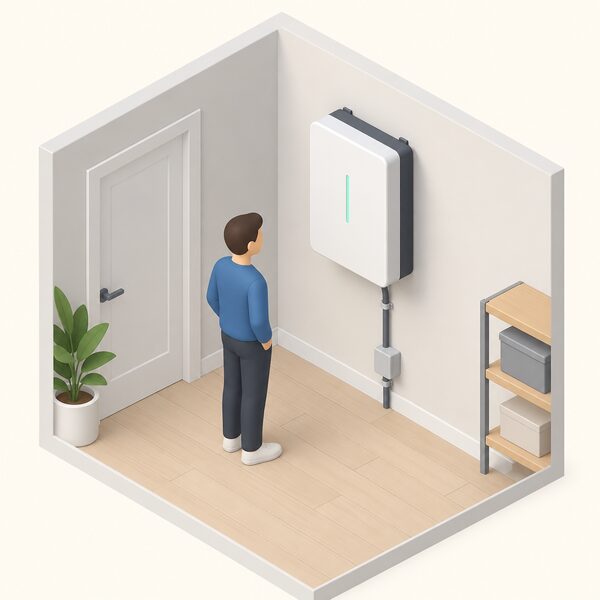
House type enters through three doors. The first is space: a battery needs a position, and a flat or a mid-terrace has fewer of them than a detached house with a garage. The second is the electrical supply: a battery is charged from the mains or from solar, and a home with a weak incoming supply or no off-street parking for an EV charger has less to gain from load shifting. The third is tenure: a tenant or leaseholder cannot usually authorise an installation that alters the building.
Anyone with a home can potentially install a battery system, so the technology is not formally restricted by property type8. The constraint is practical rather than regulatory. A flat with a communal electrical intake, a listed terrace in a conservation area, and a rural cottage off the gas grid are all eligible in principle and very different propositions in practice.
What drives the figures
The headline cost and payback figures are driven by four variables that independent guidance sets out plainly: how much energy the household generates, the size of the battery, the household's energy consumption, and the supplier's fees11. None of these is a property characteristic in the structural sense, but all four correlate with house type.
A larger house with higher consumption can absorb a larger battery, and a larger battery costs more. The official statistics for MCS-certified domestic battery installations in 2025-26 give a median cost of £1,300 per kWh for systems in the 1 to 5.99 kWh band, which is the clearest per-unit figure available12. That is a median across installations, not a quote, and it sits alongside the £4,600 figure for a 5kWh system1.
Generation is the second driver. Domestic battery systems can store as much electricity as a household typically uses in a day, enabling a PV system to provide up to 70% of a household's annual electricity demand7. That 70% is the ceiling for a well-matched solar and storage combination, not a figure any household should assume. A flat with a small shared roof array will not approach it; a detached house with a south-facing roof and a well-sized battery might.
Consumption pattern is the third. A household that is out all day and home in the evening has a natural mismatch between generation and use, which a battery corrects. A household that is home all day uses generation as it is produced and has less to store. Occupancy, not floor area, is what determines the value of time-shifting.
The fourth driver is the tariff. Time-of-use tariffs are what make a battery pay in a home with no solar at all, and the saving depends on the spread between the cheap rate and the peak rate, plus the supplier's fees11. A battery without either solar or a time-of-use tariff has nothing to arbitrage.
Homes with no solar, and homes with an EV or heat pump
A battery does not require solar panels. The mechanism is tariff arbitrage: charge during off-peak hours at the lowest rate, use the energy during the peak-rate period, typically 4pm to 8pm4. The household stores cheap electricity when prices are low and uses it later, even during peak times, which can significantly increase savings9. This is the whole case for a battery in a flat or a north-facing house where panels are not viable.
The economics of that case rest entirely on the tariff. A battery is most worthwhile where the household can access cheap overnight charging tariffs5. Where the cheap rate is not materially below the standard rate, or where standing charges and supplier fees absorb the difference, the arithmetic does not close. Independent guidance is blunt that domestic battery systems are currently very expensive and do not make financial sense for every household7.
An electric vehicle strengthens the case, because it adds a large, predictable overnight load that can share the same cheap window. In one documented household, the battery is topped up by solar during the day and by a cheaper off-peak electricity tariff at night, which also charges the EV13. The battery and the car draw from the same cheap period, and the battery covers the evening peak that the car cannot.
A heat pump changes the picture differently. Heat pumps run on electricity, and on standard electricity tariffs they can cost slightly more to run than new gas or oil boilers, because electricity is nearly four times more expensive than gas14. On a heat pump time-of-use tariff, research shows a heat pump can cost less to run than a gas boiler14. A battery is what allows a household to buy at the cheap rate and run the heat pump at the expensive hour, so the two technologies reinforce each other.
Flats, terraces and rented homes
The barriers in a flat are physical and legal rather than technical. A battery needs a position with ventilation and a cable route, and a flat typically has neither a garage nor an external wall it controls. Where the building is leasehold, the freeholder's consent is needed for equipment that touches communal areas or the structure. Where the flat is rented, the landlord's consent is needed, and the tenant carries the risk of moving before the payback period ends.
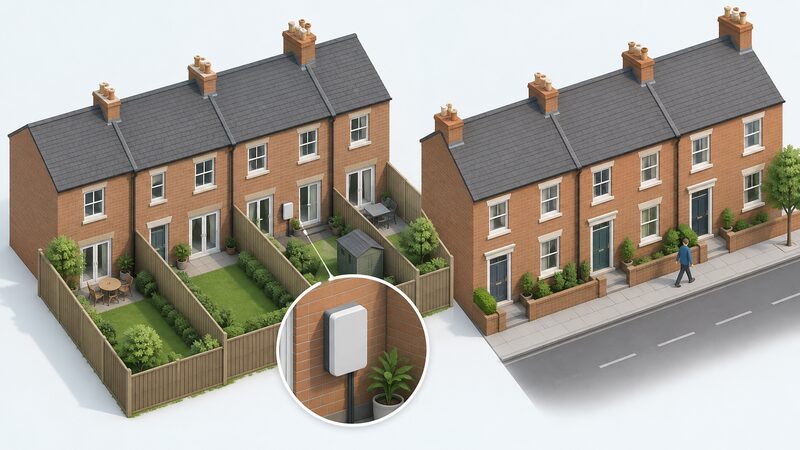
Terraced and semi-detached houses sit in the middle. They have external walls and often a rear garden, but limited space for a unit and, in conservation areas, restrictions on what can be fixed to a wall that fronts a highway. The permitted development rules for heat pumps illustrate how these restrictions work in practice: on land within a Conservation Area or World Heritage Site, an air source heat pump must not be installed on a wall or roof which fronts a highway, or be nearer to any highway which bounds the property than any part of the building15. Battery installations are governed by their own rules, but the same logic about visible street-facing equipment applies.
Detached houses have the fewest constraints. They have more external wall, more garden, and often a garage or outbuilding where a battery can sit away from living space. The permitted development position for detached houses is also more generous for related equipment: for air source heat pumps, only the first installation is permitted development on a house which is not detached or a block of flats, while for detached houses the first two are considered permitted development15.
Rented properties deserve a specific warning. A battery is a fixed installation with a payback period reported at 8 to 12 years, which is similar to its reported lifespan4. A tenant on a short tenancy cannot capture that payback, and removing the equipment at the end of a tenancy is neither simple nor cheap. The same applies to a leaseholder whose lease has fewer years left than the payback period.
Rural and off-gas homes
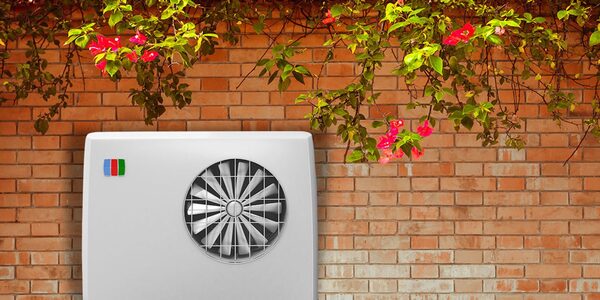
Homes off the gas grid are often the strongest candidates, because their electricity consumption is higher and their alternatives are more expensive. A rural property heating with electricity, oil or solid fuel has a large, flexible load that a battery can move onto a cheap tariff. Where a heat pump replaces an electric or coal system, it is likely to be cost-effective, whereas replacing mains gas is unlikely to save much money16.
The rural case also has a resilience dimension. A battery that can deliver power during an outage is worth more where the network is more exposed, though not all batteries can deliver electricity during a power cut and not all systems are suitable for backup4. The installer should be asked directly whether the proposed battery will work in a power outage, and for how long6.
Off-grid properties are a different category again, where the battery is not an optimisation but the whole supply. Those systems are sized around winter demand and generator or solar input rather than around tariff arbitrage, and they are covered separately in off-grid battery systems.
For a rural home that remains grid-connected, the calculation is the same as anywhere else: generation, battery size, consumption and supplier fees11. What differs is the size of the prize. A household with high electricity use and a cheap overnight rate has more to gain from shifting load than a low-use urban flat, and a household with an EV and a heat pump has more still.
How the position differs across the UK nations
The technical case for a battery does not change at the border, but the rules around it do. Planning and building regulations are devolved, and the four nations have moved at different speeds on the equipment that most often accompanies a battery.
For air source heat pumps, which are frequently installed alongside storage, changes to permitted development rights eased planning restrictions in England from 20 September 2025 and in Wales from 1 June 202617. In Wales, installation of either a ground source or air source heat pump must comply with the Building Regulations18. In Scotland, work has been under way on extending permitted development rights, and the Scottish Government has published work on energy standards for new domestic buildings19. In Northern Ireland, the Warm Healthy Homes Fund consultation sets out the role of heat pumps as the primary heating measure offered to households where a Home Assessment determines it is technically feasible and economically viable21.
The practical differences that matter to a battery installation are these:
| Nation | Position that affects a battery installation |
|---|---|
| England | Permitted development rights for air source heat pumps eased from 20 September 202517 |
| Wales | Permitted development rights eased from 1 June 2026; heat pump installation must comply with Building Regulations17 |
| Scotland | Work on extending permitted development rights; separate energy standards for new domestic buildings19 |
| Northern Ireland | Heat pumps positioned as the primary heating measure under the Warm Healthy Homes Fund where feasible and viable21 |
For the battery itself, the planning position is set out by nation in England, Scotland, Wales and Northern Ireland. The general principle is that battery storage is treated as permitted development in the same way as other microgeneration equipment, with listed buildings, conservation areas and Article 4 directions as the common exceptions.
What the rules require
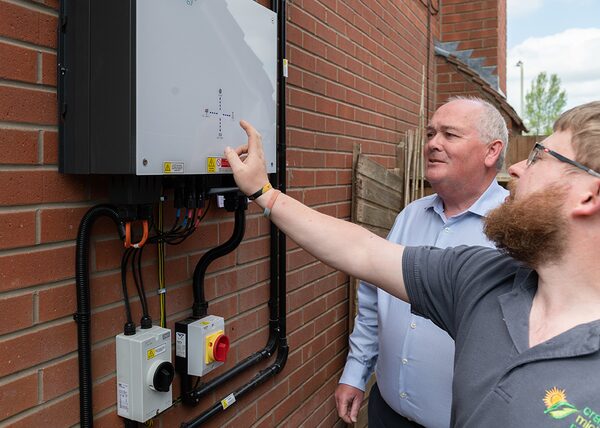
The rules that bear on a home battery fall into four groups: who may install it, what standards the installation must meet, what permissions are needed, and what safety requirements apply.
Installation must be carried out by a certified installer. Independent guidance is explicit: make sure your installer is certified by the Microgeneration Certification Scheme (MCS)4. The MCS standards cover the calculation of self-consumption and battery benefit, and the scheme's requirements are being tightened, with every MCS installer required to operate under redeveloped scheme rules by 31 March 202722.
Where a battery is used to export stored renewable energy, the installation must be MCS certified, though not all systems have this capability4. That distinction matters for any household expecting to earn from export rather than only avoid import.
For electric vehicle chargers, which often share the same cheap overnight window as a battery, installing a home charger is classified as development, and it is up to the householder to ensure the correct permissions are in place23. The same principle of householder responsibility applies to battery installations.
On safety, fire service guidance for lithium-ion batteries in the home is specific: always use the correct battery and charger for the device, and charge as per manufacturers' instructions24. It also advises charging the device in a room that has a working smoke alarm, which does not compromise the escape route, keeping the door closed while charging and away from any heat source24. Lithium-ion is the main type for domestic use, alongside lead-acid11.
What it means for energy independence
A home battery does one specific thing for independence: it stores electricity the household has generated or bought cheaply, and releases it when the household would otherwise buy at the peak rate. Solar panel battery storage stores electricity to use later, making the energy system more independent from the National Grid2. That is a real reduction in exposure to peak prices and to the timing of grid supply.
The measure of it is grid electricity independence, defined as the percentage of electricity consumed in the property over a year which is met by either behind-the-meter solar or electrical energy storage22. A related definition puts it as the fraction of electricity consumed in the property which is met by self-consumed electricity22. Both definitions are about the share of consumption the household supplies itself, not about disconnection.
What remains is substantial. A grid-connected home with a battery still depends on the grid for every unit it does not generate, on a supplier for the tariff that makes the battery pay, and on the network operator for the connection. The battery supports energy system flexibility and helps avoid peaks and troughs in supply, particularly in relation to renewable energy, which is a system benefit as much as a household one19. The combined potential of millions of homes with batteries to help balance supply and demand across the country, releasing stored power onto the grid when needed, is a national resource built from household equipment8.
There is also a manufacturer and software dependency. A battery is controlled by a battery management system and monitored through an app, and its behaviour on a time-of-use tariff is set by firmware and cloud services the household does not control. That is a form of dependence the household takes on in exchange for reduced dependence on peak grid prices.
The honest summary is that a battery reduces the cost and carbon of the electricity a household buys, and in some configurations keeps selected circuits live during an outage. It does not make a grid-connected home self-sufficient, and the sources do not claim it does. For the wider picture of what storage can and cannot deliver, see home batteries and household energy independence.
Sources24 cited
- Battery storage, Energy Saving Trust, 2026-08-19
- Home storage batteries, Which?, 2026-05-14
- Battery storage and solar PV, UK Parliament POST, 2026-06-25
- Battery storage advice, Centre for Sustainable Energy, 2025-10
- Is a home battery worth it?, Independent Advisor, 2026-09-20
- Solar photovoltaic, CAT, 2026-03-10
- Making the most of your solar PV panels, Centre for Sustainable Energy, 2026-08
- Batteries in the home, Solar Energy UK, 2026-09-17
- Should I switch to a time of use tariff, Energy Saving Trust, 2026-01-23
- Solar panel battery popularity is booming, Which?, 2019
- Electrical energy storage systems, Flexi-Orb, 2025-04-22
- MCS domestic retrofit battery installations 2025-26, Department for Energy Security and Net Zero, 2025-26
- Beth Martin story: solar panels and electric vehicle, Energy Saving Trust, 2025-03-03
- Air source heat pumps, Energy Saving Trust, 2026-07-16
- Planning permission: air source heat pump, Planning Portal, 2026-09-17
- Air source heat pumps explained, Which?, 2026-01-06
- Air source heat pump technology, MCS Certified, 2026-07-24
- Building regulations: heat pumps, Welsh Government, 2026-09-17
- Extending permitted development rights in Scotland, Scottish Government, 2019-06
- Energy standards for new domestic buildings, Scottish Government, 2026-07-24
- Warm Healthy Homes Fund consultation, Department for Communities Northern Ireland, 2026-05
- MCS 032 2025, MCS Certified, 2025-02
- Planning permission: electric vehicle charging, Planning Portal, 2026
- Lithium-ion batteries, North Wales Fire and Rescue Service, 2026
 Planning Permission in EnglandWhen a domestic battery or its enclosure falls within permitted development in England, when an application is needed, and how the position differs for outbuildings, listed buildings and conservation areas.
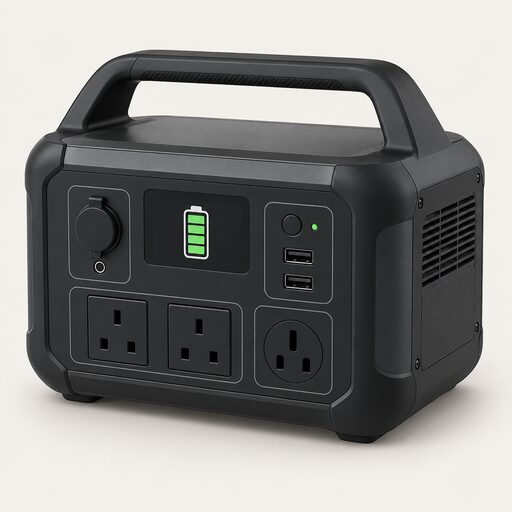 Backup Power by Home TypeWhat backup power is practical in a flat without outdoor space, in a terraced or suburban house, and in a rural or off-grid property with long restoration times, covering portable power stations, indoor safety, recharging and the limits of whole-home backup.
 Charging by Home TypeHow the practical and legal position for home EV charging changes by property type: flats and leasehold consent, terraced homes without frontage, shared car parks and metering, rural properties with long cable runs, and listed or conservation area homes.
 Technology by Home TypeWhich new energy technologies actually work in a flat, a terrace or a rural home?
 The Full Home Batteries GuideA home battery stores cheap or solar power for later, but will it really cut your bills enough to be worth it?
 Off-Grid Battery SystemsHow many days of power do you need when there is no sun?