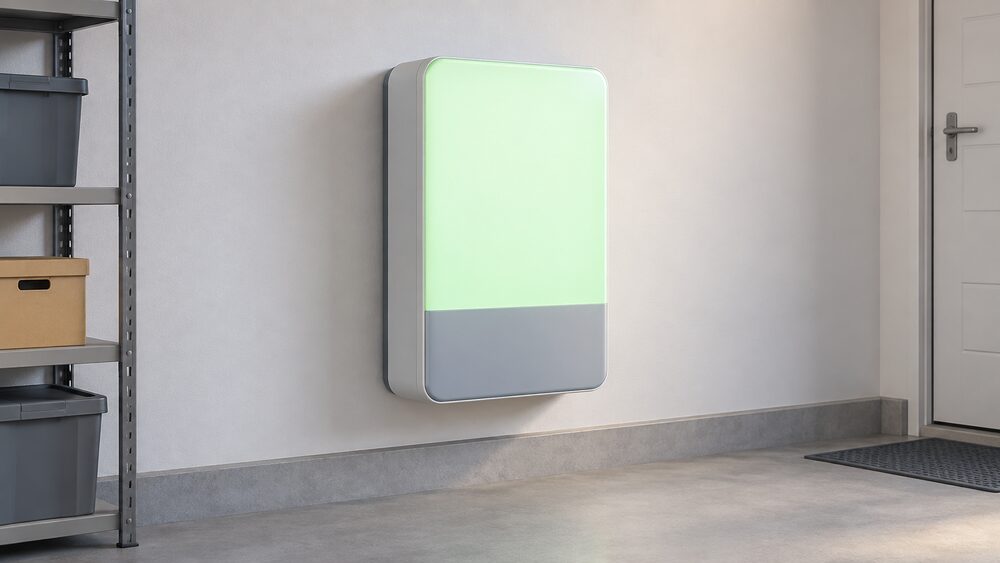
In this guide
A home battery's headline figure is its nominal capacity, the gross energy of the cells. What the household can actually draw is the usable capacity, and the two are not the same number. The MCS self-consumption calculation guide sets the relationship plainly: usable capacity is nominal capacity multiplied by the maximum depth of discharge1. A 10 kWh unit run to a depth of discharge of 80% therefore holds 8 kWh for use2, while a 10 kWh unit rated to 95% depth of discharge gives 9.5 kWh3.
The gap between the two figures is driven by chemistry and by control settings. Lithium-ion batteries typically withstand a depth of discharge of 80 to 90%4, and most installed home systems permit 90 to 95% of total capacity to protect battery life5. Lead-acid is a different matter: 50% is the working limit, and the MCS method requires a depth of discharge of 50% to be used for lead-acid batteries where nothing better is stated1. On top of that, many systems hold a floor: Energy Saving Trust describes a set level, maybe 20% of total storage capacity, at which the system stops discharging6.
For a household, the practical consequence is that sizing, payback and backup runtime should all be worked from the usable number. A typical home system might be 10 kWh nominal6, costing around £4,600 for a 5 kWh system7, and lasting around 10 to 15 years8. Whether that 10 kWh covers an evening depends entirely on how much of it the system will release.
Nominal kWh and usable kWh: not the same number
Storage capacity is specified in kilowatt-hours, and the distinction drawn by manufacturers is between gross capacity, the nominal figure, and net capacity, the usable figure2. The nominal number describes the cells; the usable number describes what the inverter and battery management system will let out of them. MCS defines usable capacity as the energy within the storage device available to the customer for any domestic energy storage application, including solar PV self-consumption1.
That definition matters because it is the figure an installer must use when calculating the benefit of storage. The MGD 003 guide directs installers to derive it as nominal capacity multiplied by maximum depth of discharge where usable capacity is not clearly stated on the datasheet9. Some datasheets state usable capacity directly, some state nominal only, and some state both without saying which is which, which is why the calculation exists. The self-consumption calculation then runs off the usable figure, not the marketing one.
Electric home batteries of the lithium-ion type typically offer capacities ranging from 5 kWh to 15 kWh10, and home battery sizes usually range from 4 kWh to 13.5 kWh11. Larger or higher-consumption households often aim for 20 kWh or more, and bigger houses with multiple air conditioners, electric vehicles or high appliance use may need several units combined into one system12. Those headline numbers are usually nominal, or gross, capacity, and the usable, or net, capacity a household can actually draw sits a little below each one.
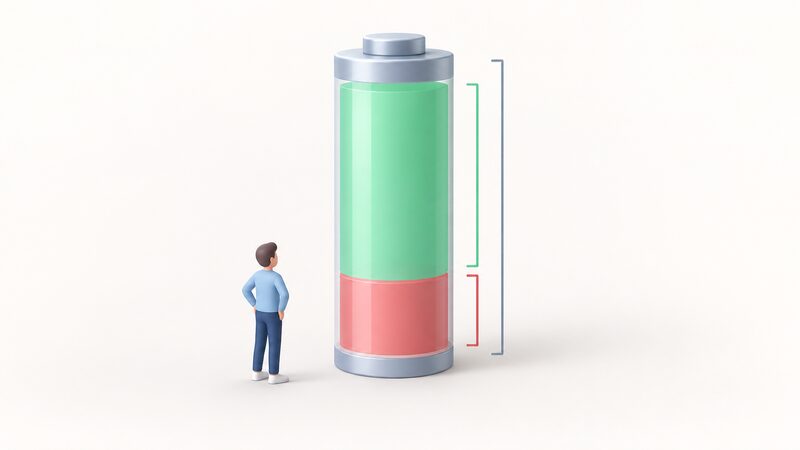
Depth of discharge: how much of the battery a home can actually use
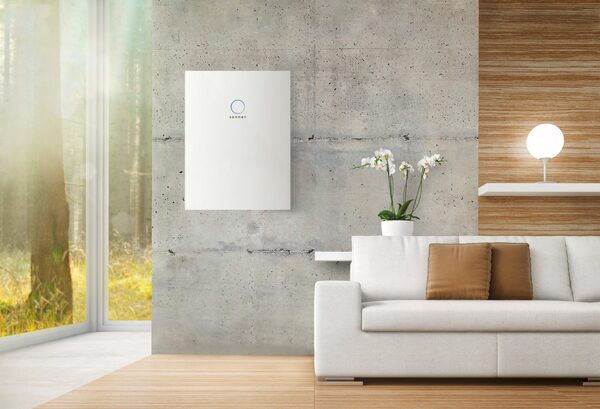
Depth of discharge is the share of nominal capacity a system will draw down before it stops. It is the single largest reason a headline kWh overstates what a home gets. The arithmetic is unforgiving: a 10 kWh unit at 80% depth of discharge stores 8 kWh for use2, while the same nominal capacity at 95% gives 9.5 kWh3. That 1.5 kWh difference is roughly an average household's evening consumption.
Chemistry sets the ceiling. Lithium-ion, and particularly lithium iron phosphate, tolerates far deeper cycling than lead-acid, which is part of why it dominates the domestic market; lithium is described as the most common material used for domestic batteries, alongside cobalt and nickel13. Flooded lead-acid tolerates deep discharges of up to 50% of nominal capacity14, and guidance suggests lead-acid should not exceed 50% depth of discharge or its lifespan will suffer4. MCS hard-codes that: the depth of discharge must be 50% for lead acid batteries in its calculation1.
| Chemistry or system type | Depth of discharge | Source type |
|---|---|---|
| Lithium-ion, general | typically 80 to 90%4 | maker guidance |
| Most installed UK home systems | 90 to 95% of total5 | maker guidance |
| Flooded lead-acid | up to 50% of nominal14 | maker guidance |
| Lead-acid, MCS calculation | 50% required1 | independent standard |
| Example configurable range | 10 to 90%15 | maker guidance |
Settings can also be imposed from outside the home. One flexibility platform operates within a 20% maximum depth of discharge that it imposes to protect battery life16. Where a household enrols in grid services, the usable capacity for the household's own purposes may be narrower still than the datasheet implies. A wider discussion sits on the page covering cycle life and degradation, since shallower cycling is generally traded against fewer usable kilowatt-hours per day.
Reserve settings and the floor the system will not cross
Separate from the chemistry limit, most systems hold back a reserve. Energy Saving Trust describes the behaviour in plain terms: when the battery gets down to a set level, maybe 20% of the total storage capacity, the system stops discharging6. Moixa set usable capacity on its 2 and 3 kWh models at 80%, meaning the battery should not fall below 20% charge, and stated that on larger capacity systems usable capacity can be increased up to 90%17.
"The usable capacity of our 2 & 3 kWh models is set at 80%, this means that your battery should not fall below 20% charge"
Where a system supports backup, the reserve does double duty: it is the energy held for an outage, and it is energy not available for daily arbitrage. For planning a backup runtime, one maker suggests multiplying battery energy by about 0.85 to 0.9, then dividing by average load18. The same guidance puts 1 to 2 kWh as suitable for shorter outages covering refrigeration, internet, lighting, phones and laptops, and 3 to 4 kWh for overnight outages with more reserve18. A separate maker figure suggests a 10 to 15 kWh battery will power essential appliances for at least 24 hours19. Raising the reserve lengthens the outage a home can ride out and shrinks the nightly cycle that pays for the battery.
What the usable figure covers, including the 4pm to 8pm peak
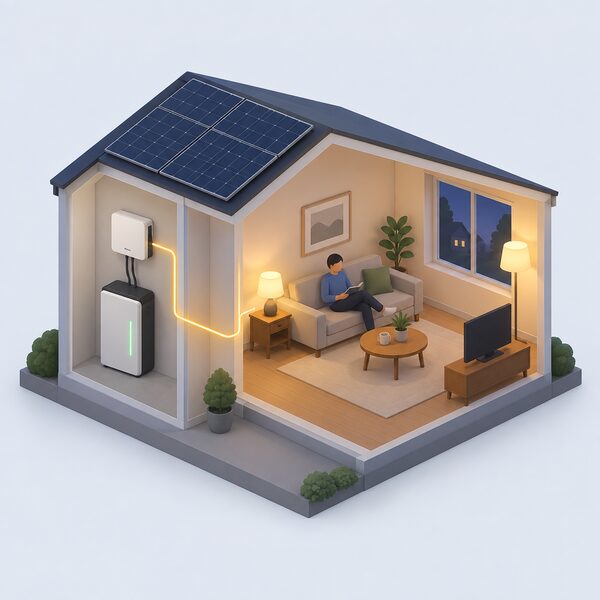
The practical test of usable capacity is whether it carries a household through the evening peak, typically 4pm to 8pm13. Power produced during the day can be stored and used at another time, for example in the evening when demand is higher20, and cheap electricity bought off-peak can be stored and used during peak-rate periods22. That works only to the extent the battery will release the energy.
Average UK household use between sunset and bedtime is put at 1.5 to 3 kWh, so a 5 kWh battery covers that with headroom5. For most UK homes, 5 to 10 kWh is said to cover evening use comfortably5, and an 8 kWh battery may be enough for basic electricity needs in homes with one to three bedrooms19. A 4 kWp array is matched with 5 to 8 kWh usable, rising to 10 kWh where a household charges extensively on overnight grid tariffs23. One Energy Saving Trust case study household has an 8.2 kW home battery, uses power from it during the daytime while solar tops it up, and exports the excess to the grid24.
Batteries, domestic and grid-scale, store electricity for up to eight hours25. That duration frames what any home battery can do: it shifts energy within a day, not across seasons. The smart tariff case rests on completing that shift reliably, which in turn rests on the usable rather than nominal figure.
Usable capacity by home size
Sizing guidance is expressed in usable kilowatt-hours by one maker and in nominal terms by others, which is a common source of confusion when comparing quotes. The table below keeps the two apart where the underlying facts do.
| Household | Suggested capacity | Basis |
|---|---|---|
| 1 to 2 person small home or flat | 3 to 5 kWh usable23 | maker guidance |
| Small households or light users | 4 to 6 kWh11 | maker guidance |
| 2 to 3 people | 8 to 10 kWh usable26 | maker guidance |
| Average UK homes using 3,000 to 4,500 kWh a year | 7 to 10 kWh11 | maker guidance |
| 3 to 4 person medium family home | 8 to 12 kWh usable23 | maker guidance |
| 3 to 4 people | 10 to 13 kWh usable26 | maker guidance |
| 4 to 5 people | 13 to 18 kWh usable26 | maker guidance |
| 5+ person large home with heat pump or EV | 10 to 15+ kWh usable23 | maker guidance |
| Larger households with high use and EVs | 10 to 13.5 kWh11 | maker guidance |
A three-bed house is reported to use about 3,000 kWh of electricity a year27. For a 100 to 120 m² home with three to four occupants, an 8 to 10 kWh battery paired with a 3 to 6 kWp solar installation is described as generally suitable28, while for larger homes or specific needs such as an electric vehicle, swimming pool or heat pump the same guidance suggests 12 to 15 kWh28. One maker recommends 10 kWh for most three to four bed homes and 10 to 15 kWh more broadly29, while another suggests 5 to 8 kWh for three to four bedroom families30 and a third gives 8 to 12 kWh for a small residential home31. A sizing exercise that starts from measured annual consumption and evening load is more reliable than any of these bands on their own.
A basic sizing rule offered for backup is battery capacity in kWh equals total device power in watts multiplied by run time in hours19. For off-grid use, 15 kWh is put forward as sufficient for an average daily consumption of 10 kWh14, the margin reflecting the depth of discharge limit and cloudy days.
Sizing for British weather: cloudy days need more capacity
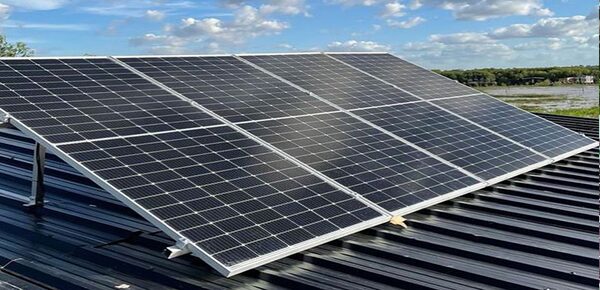
Usable capacity has to be judged against the season in which it is scarcest. Solar output in winter drops considerably and grid top-ups become more necessary, while in summer a reasonably sized system can cover a significant portion of a typical household's EV charging needs32. Where a household hopes to cover winter energy use from solar, an additional solution such as battery storage may be needed33. That does not make the battery a winter generator: it simply spreads a smaller daily harvest, or cheap imported off-peak units, across a longer dark evening.
Two consequences follow. First, a battery sized tightly to summer evening consumption will spend winter part-charged from solar and dependent on overnight grid charging to fill it. Second, a bigger nominal capacity bought for winter resilience may sit underused in June, which lengthens payback. Guidance that a small cabin or tiny home with daily consumption up to 3 kW should buy a 3 to 5 kWh battery to power critical loads during a power outage31 illustrates the alternative approach: size the usable energy to the loads that must not stop, not to total household demand.
For deeper winter independence, the pattern is different again: for true energy independence in cabins, rural homes or areas with unreliable grid, one maker suggests 5 to 12 or more batteries12. That is the territory of off-grid systems rather than grid-connected storage.
Typical sizes and costs
Published cost figures attach to nominal capacity, which is another reason to convert to usable energy before comparing pounds per kilowatt-hour. Energy Saving Trust puts home battery storage at £1,500 to £10,000, with a 5 kWh system around £4,6007, and the same £4,600 figure and a ceiling of up to £10,000 are cited in a parliamentary briefing8. Scottish retrofit analysis gives 8 to 10 kWh batteries a battery-only price of £2,800 to £4,500 and an installed price of £4,500 to £7,000 as at March 202634.
| System | Price | Source type |
|---|---|---|
| 5 kWh system | around £4,6007 | independent |
| Range, all sizes | £1,500 to £10,0007 | independent |
| 8 to 10 kWh, battery only | £2,800 to £4,500, March 202634 | independent |
| 8 to 10 kWh, installed | £4,500 to £7,000, March 202634 | independent |
| Typical starting price | around £4,00035 | independent |
| 5 kWh battery | £2,500 to £4,000 or slightly higher36 | maker |
| 5 to 10 kWh storage battery | £3,000 to £7,00030 | maker |
| 10 kWh installed | £6,000 to £8,00036 | maker |
| 10 kWh | £7,000 to £8,00029 | maker |
| Large system | £7,000 to £10,000+36 | maker |
The independent and official figures sit lower than several maker figures for comparable sizes, and the documents are not reconciled. Prices quoted here include installation where the source says so, and reflect the VAT position described below. Fuller treatment is on the home battery cost page.
Lifespan, degradation and payback
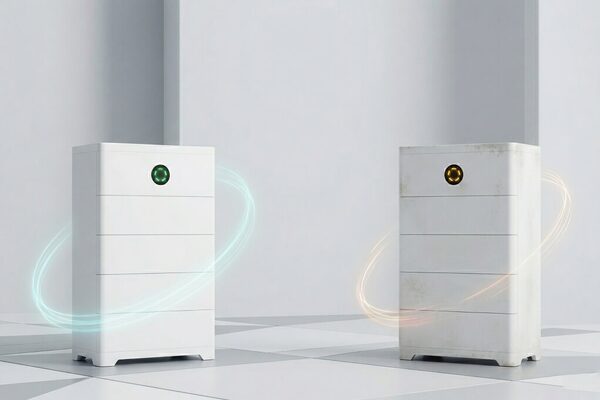
Lifespan estimates cluster but do not agree. The Centre for Sustainable Energy gives a typical battery lifespan of 8 to 12 years13; Energy Saving Trust gives about 10 to 12 years7; a parliamentary briefing gives around 10 to 15 years, shorter than solar panels8; Home Energy Scotland gives 10 to 15 years37; and one guide gives about ten years35. Maker figures run at the longer end: 10 to 15 years for better chemistry5, often 10 to 15 years or 5,000 to 10,000 cycles for lithium iron phosphate12, and 6,000 or more full charge cycles, described as roughly 15 to 20 years of daily use5.
Degradation erodes usable capacity over that life. After 10 to 15 years of use, a battery's real storage capacity usually drops to 70 to 80% of its original capacity30. A battery sized with no margin on day one will therefore fail to cover the same evening a decade later, which is why warranty retained-capacity terms are worth reading alongside the headline kWh.
Payback periods overlap with lifespan uncomfortably. CSE puts payback at 8 to 12 years, similar to the reported lifespan13. One maker gives around 8 to 15 years for a 10 kWh battery depending on energy prices, battery cost, tariff choice and usage36, while another gives 3 to 6 years for a 10 kWh family-size battery and 3 to 5 years for a 15+ kWh battery in a high-usage home or small business15. The independent and maker estimates differ by a wide margin and are not reconciled; the independent figure is the more cautious. A home battery is described as a 10 to 15 year investment3. More detail sits on payback and savings.
Backup in a power cut, and the reserve it consumes
Backup is not a standard feature. Not all batteries can deliver electricity during a power cut13, and where a household wants outage protection, not all systems are suitable38. The network operator position is that in some cases storage devices can provide back-up supplies for use in a power cut, but this is not always possible, and the installer should be asked39. CSE notes that the more expensive battery systems can also provide electricity during a power cut20.
Reserve set aside for backup is capacity removed from daily cycling, so the two objectives compete directly. The mechanics of changeover and what stays powered are covered on the backup and EPS page.
Certification: MCS, standards and who may install
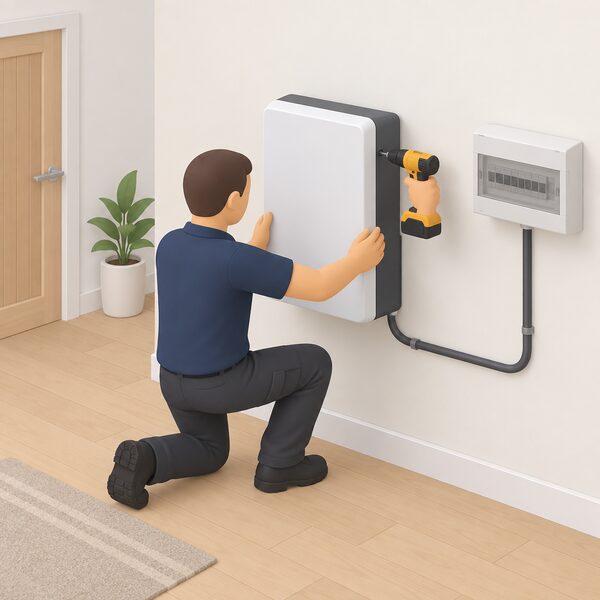
Certification is not a universal legal requirement, but it governs access to schemes and payments. Under Warm Homes: Social Housing Fund rules, a domestic battery must be installed by an MCS certified installer working to the relevant MCS battery installation standard, in compliance with that standard, PAS 63100 and PAS 2035, and must carry UKCA or CE marking as required by the MCS battery installation standard40. Ofgem recommends that Feed-in Tariff generators installing energy storage up to 50 kW use an MCS installer working to the MCS battery standard41. Where a household is paid for exported stored renewable energy, CSE states the installation must be MCS certified13.
One quirk is worth knowing: MCS certified installers delivering certified installations must install an MCS certified product, except for battery storage42. Product certification and installer certification are therefore not the same gate for batteries. Consumer guidance points households towards installers certified by MCS, signed up to the Renewable Energy Consumer Code which now covers storage, or alternatively certified by Flexi-Orb38, and towards obtaining at least three quotes from MCS certified installers7. MCS states its certification ensures installers work to the best possible quality while adhering to industry-recognised safety practices43. MCS installation statistics for domestic batteries cover the United Kingdom and are drawn from the MCS Installation Database, with capacity bands chosen around batteries smaller than about 6 kWh, larger than about 11 kWh, and a grouping in between44. The installation standards page sets out PAS 63100, BS 7671 and MIS 3012 in full.
VAT: zero-rated now, due to rise
From 1 February 2024, electrical storage batteries installed in residential accommodation, or buildings intended for use solely for a relevant charitable purpose, qualify for the temporary zero rate46. Government guidance confirms 0% VAT applies to both the qualifying products supplied by the installer and the cost of all work to install those products in the home47. Before the change, the rate was 5%48, and the 0% rate has applied to domestic battery storage systems since February 202434.
Households should note that the zero rate applies to installation, not to the electricity used to charge the battery: domestic energy is charged at 5% VAT49. The VAT rate on home battery storage page carries the detail.
What usable capacity means for grid independence
Usable capacity is the honest measure of how much of a household's demand can be met without the grid at that moment. It is also, in the MCS definition, the energy available to the customer for solar PV self-consumption1, which is the mechanism by which a battery converts daytime generation into evening independence. A Scottish modelling study assumed a domestic battery with 6 kWh useful potential across all house types34, a deliberately conservative figure compared with the 10 kWh nominal that Energy Saving Trust calls typical6.
The dependence that remains is substantial and should be stated plainly. Storage shifts electricity within a day, up to eight hours of duration for domestic and grid-scale batteries alike25, and the electricity batteries can deliver is much more limited than pumped storage50. Winter output from a paired solar array drops considerably, so grid top-ups become more necessary32. Excess energy still goes to the grid24, and the export payment depends on a supplier. Where the battery is used to buy cheap off-peak units and use them at peak22, the saving depends entirely on a tariff that a supplier sets and can change. Combining solar with a home battery to power a heat pump makes a household less reliant on grid electricity51, but not free of it. And the usable figure itself is set by the manufacturer's firmware and battery management system, adjustable within limits the maker permits, sometimes further constrained by a flexibility platform's own depth of discharge cap16.
The realistic position for a grid-connected home is a higher share of self-consumption, a smoother evening peak and some outage resilience if the system supports it, rather than independence. Genuine independence, on the figures given, means many times the usable capacity of a standard installation12. That trade-off is examined further under batteries and household energy independence and across the home battery storage guide.
Sources51 cited
- MCS 032: EESS usable capacity and depth of discharge, MCS, 2025
- Power storage glossary: nominal and usable capacity, RCT Power, 2026-09-19
- How much battery storage should you get, Spirit Energy, 2026-08-07
- How long do solar batteries last, Jackery UK, 2026-05-29
- Solar battery cost guide, BLUETTI UK, 2026-08-03
- Battery storage advice, Energy Saving Trust, 2026-08-19
- Battery storage advice, England, Energy Saving Trust, 2026-08-19
- POSTnote on domestic energy storage, UK Parliament POST, 2026-06-25
- MGD 003: solar PV self-consumption guidance, MCS, 2022-04
- Comparing electric batteries and heat batteries, Sunamp, 2025-11-13
- Guide to solar panels and battery storage, EcoFlow, 2025-06-27
- How many batteries does a home need, SAJ, 2026-07-22
- Battery storage advice, Centre for Sustainable Energy, 2025-10
- Solar battery storage: the complete guide, Zendure, 2025-11-05
- Are solar batteries worth it, Jackery UK, 2026-06-04
- Dynamic Demand Challenge prize finalists and winner, Nesta, 2026-09-17
- Smart Battery general FAQs, Moixa, 2022-02-21
- Best generator for home backup power UK, BLUETTI UK, 2026-08-31
- Backup battery for home guide, Jackery UK, 2026-04-29
- Making the most of your solar PV panels, Centre for Sustainable Energy, 2026-08
- Batteries in the home, Solar Energy UK, 2026-09-17
- Should I switch to a time of use tariff, Energy Saving Trust, 2026-01-23
- What size battery for solar panels, Jackery UK, 2026-06-17
- Beth Martin's story: solar panels and electric vehicle, Energy Saving Trust, 2025-03-03
- Statutory Security of Supply Report 2025, GOV.UK, 2025-12-17
- Solar power for your home, Jackery UK, 2026-06-11
- Average gas and electric bills in the UK, Energyhelpline, 2026-09-20
- Why solar battery storage matters, SunPower, 2026-05-19
- Why home battery storage will be key in the UK in 2026, Spirit Energy, 2025-11-07
- Home battery storage UK without solar, Jackery UK, 2026-05-29
- What size LiFePO4 battery for solar energy storage, LuxPower, 2026-07-15
- Can solar panels charge electric cars, The CPA, 2026-04-15
- Solar panel installation guide: costs, planning and savings, The IAA, 2026-09-20
- Balancing investment in clean heat and energy efficiency in Scottish housing retrofit, ClimateXChange, 2026
- Solar battery storage guide: is a home battery worth it, The IAA, 2026-09-20
- 10 kW solar battery price UK, Jackery UK, 2026-06-04
- Battery storage, Home Energy Scotland, 2026-09-20
- Solar panel battery storage, Which?, 2026-05-14
- Storage and renewable energy, Electricity North West, 2026-09-19
- Warm Homes: Social Housing Fund wave 3 guidance addendum, GOV.UK, 2026-06
- Guidance for FIT generators, version 18, Ofgem, 2026-04-01
- Certifying your product, MCS, 2026-05-18
- Battery storage for consumers, MCS, 2026-09-17
- MCS domestic retrofit battery installations 2025 to 2026, GOV.UK, 2026-05-28
- MCS certified domestic battery installation statistics, GOV.UK, 2025-05-29
- VAT on energy-saving materials and heating equipment, Notice 708/6, GOV.UK, 2024-02-01
- Tax on shopping: energy-saving products, GOV.UK, 2026-09-17
- Zero carbon, zero VAT, MCS Foundation, 2026-09-20
- EV charging VAT, Zapmap, 2026-08-24
- How does storage help us balance the grid, NESO, 2026-09-17
- How to ensure a heat pump runs efficiently, Energy Saving Trust, 2026-05-19
 Power Ratings and C-RateHow much power can your battery actually deliver, and can it run the shower, oven and kettle at once?
 What Size Battery?How much electricity does your home use in a day, and how much of that falls in the hours when power is cheap or your solar panels are generating?
 Home Battery WarrantiesHow long does a home battery warranty really last, and what does it actually promise?
 Cycle Life and DegradationHow long will a home battery actually last, and what decides that?
 Sizing a Self-Sufficient HomeHow many solar panels and how much battery storage does a home need to stop relying on the grid?
 Round-Trip EfficiencyHow much of the electricity you put into a home battery do you actually get back?