

In this answer
Short answer
Home battery storage installed with solar PV is zero-rated for VAT. The same 0% rate applies to a standalone battery retrofit, and has done since February 2024. The relief covers both the product and the labour, so a household pays nothing in VAT on a professionally installed battery rather than the standard 20%1.
The relief is temporary. Energy-saving materials installed in residential accommodation and certain charitable buildings are subject to VAT relief at 0% until 31 March 20273. After that date the position reverts unless the relief is extended, which makes the timing of an installation a live question for anyone weighing up a purchase.
Two conditions do most of the work. The installation must be carried out by a VAT-registered installer, and the installer is responsible for charging the correct rate2. Where the materials exceed 60% of the total installation cost, Northern Ireland follows a different route from Great Britain, and the product element can fall back to the standard rate4.
The VAT rate on home battery storage: 0% when installed with solar PV
Battery storage installed alongside solar PV is charged at 0%. Solar Energy UK records the rate plainly: VAT on battery storage installed with solar PV is 0%1. The relief is not a battery-specific concession bolted onto a solar rule; batteries sit inside the broader energy-saving materials list, which also covers solar panels, heat pumps and some insulation measures5.
The scope of that list matters, because it defines what the 0% rate reaches. Official guidance names electrical storage batteries and smart diverters alongside air source heat pumps, ground source heat pumps, water source heat pumps, wood-fuelled boilers, central heating and hot water controls, draught stripping, insulation, micro combined heat and power units, solar panels, and water and wind turbines3. A battery installed as part of a solar project therefore shares a rate with the panels themselves.
What the relief covers is both halves of the invoice. It applies to the products supplied by the installer and to the cost of all work to install those products in the home2. That is the difference between a zero-rated installation and a zero-rated product: labour is included, not just hardware.
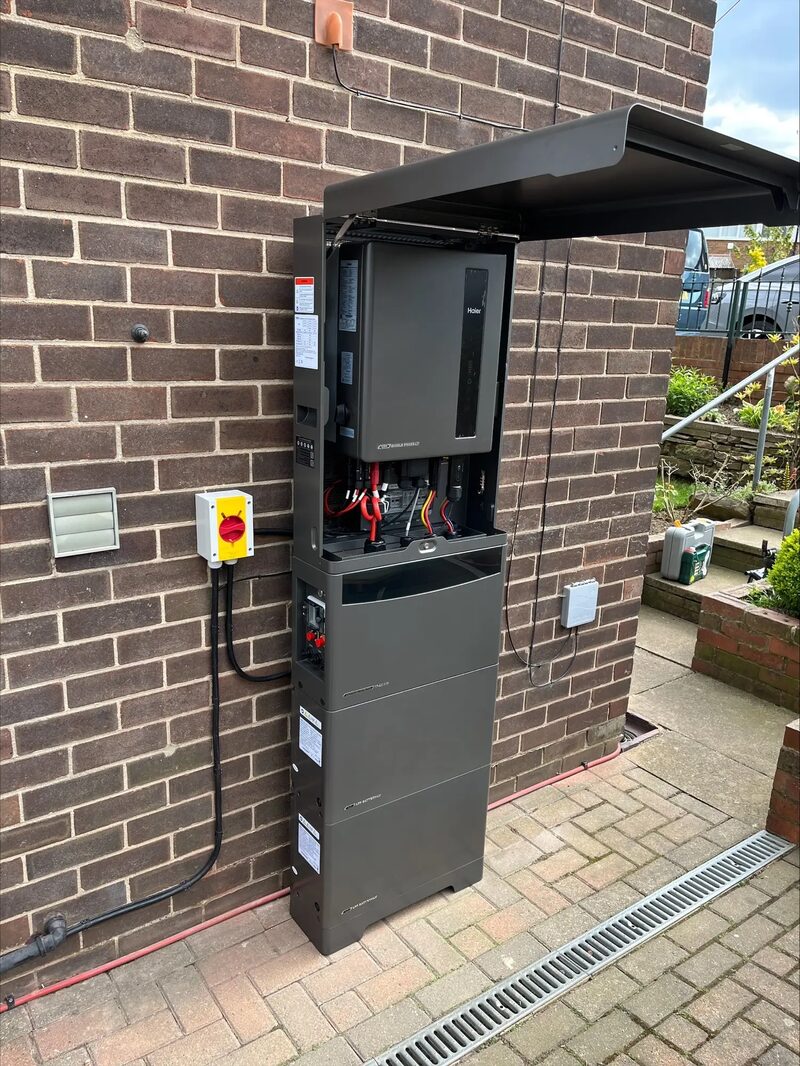
For a household, the effect is that the battery is not a taxed purchase in the way most home improvements are. The dependence that remains is on the installer: the rate is only available through a VAT-registered business, and the householder does not administer it.
Standalone battery installs: where the 20% rate still applies
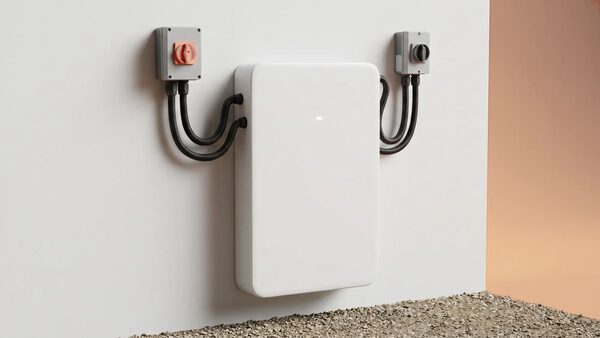
A battery fitted on its own, with no solar on the roof, is not automatically standard-rated. Electrical storage batteries qualify for VAT relief when retrofitted to a qualifying energy-saving material or installed as a standalone technology connected to the grid7. Standalone battery installations have qualified for the 0% rate since February 20245.
That change widened the relief considerably. Before it, a battery made sense for VAT purposes mainly as an add-on to a solar array. After it, a household with an existing array, or with no generation at all, could install storage on the same terms. One installer describes the position as battery storage qualifying for 0% VAT whether installed alongside solar or as a standalone retrofit6.
The 20% rate has not disappeared from the wider energy picture, and it is worth being precise about where it still sits. Public electric vehicle charging carries 20% VAT, against 5% for home electricity8. The standard rate of VAT is 20%, and domestic energy is the exception rather than the rule9. A standalone battery installation is now on the zero-rated side of that line, but the line itself has not moved.
The 5% rate that came before, and why it changed
The 0% rate is a cut, not the original position. Solar Energy UK describes it as a cut from the current rate of 5%1. For years the reduced rate of 5% applied to the installation of many energy-saving materials, subject to conditions10. The reduced rate of 5% is still the rate that applies to energy-saving materials in the circumstances where the 0% relief does not reach11.
The 5% figure is familiar because it is the rate on household energy itself. Ofgem sets out VAT at 5% on electricity and gas bills12, and Citizens Advice gives the same figure for the VAT owed on energy13. That is why the reduced rate on energy-saving materials felt coherent: it matched the rate on the energy the measures were meant to reduce.
The change to 0% came with a stated purpose. MCS framed the alternative as an up to 20% jump in the cost of renewables like battery storage, solar PV and heat pumps, and other energy efficiency measures like insulation5. The Environmental Audit Committee had earlier recommended reinstating the reduced rate of VAT payable on energy-saving materials at its former level of five per cent and expanding its scope to cover energy storage, heat pumps and electric vehicle charging14. The relief as it now stands goes further than that recommendation on the rate, while adopting its scope.
The 5% rate also survives in a specific structural role. Where the materials threshold is breached in Northern Ireland, the labour element is charged at 5% while the products are charged at 20%4. The old rate did not vanish; it was split.
What 0% VAT saves you: around 20% off the installation cost
The saving is the standard rate that is not charged. MCS puts the counterfactual at an up to 20% jump in the cost of renewables including battery storage5, and one installer describes the 0% rate as effectively saving 20% on the installation cost15. Both describe the same arithmetic: 20% of the pre-VAT price is what a household avoids.
The cash figure depends entirely on the quote, and prices for battery installations are installer-quoted rather than published. What can be said precisely is the structure. Official guidance gives a worked example of the reduced rate in operation: 5% of £1,000 is £5016. The same proportional logic applies at 0%, where the VAT line is nil.
| Element | Standard rate | With relief |
|---|---|---|
| Battery and inverter hardware | 20% VAT | 0% VAT2 |
| Installation labour | 20% VAT | 0% VAT2 |
| Retrofit battery cells and inverter | 20% VAT | 0% VAT17 |
| Energy-saving materials, supply only | 20% VAT | Standard-rated11 |
The last row is the one that catches people out. Energy-saving materials supplied on their own, without installation, are standard-rated11. The relief is attached to the supply and installation as a package, which is why the installer's VAT registration status is not a detail.
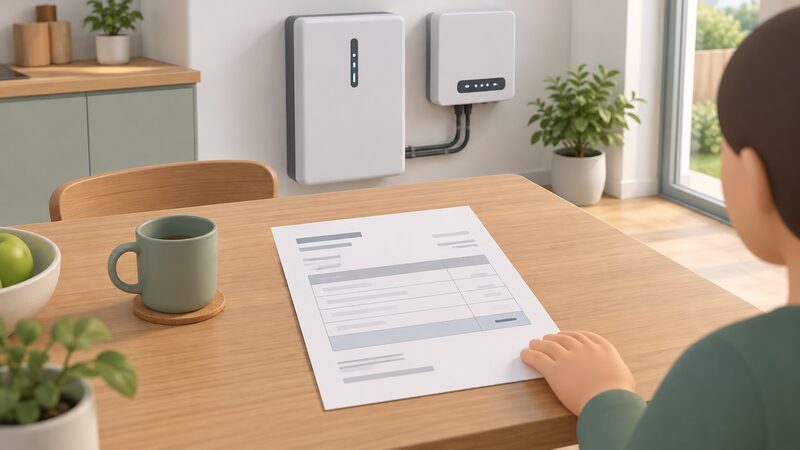
For energy independence, the effect is on the entry cost rather than on the running cost. A battery that shifts self-consumption does its work year after year; the VAT relief changes what it costs to get there, and it does so without an application, a means test or a grant body.
Who qualifies: everyone, unlike most grants
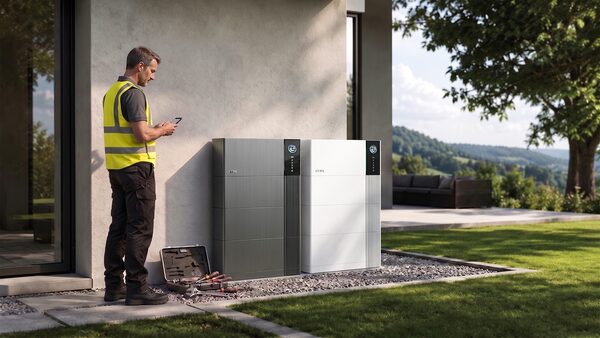
The 0% VAT rate is for everyone, while most grants are aimed at certain sections of the population18. That is the sharpest distinction between the tax relief and the grant landscape. A grant scheme typically defines an eligible household; the VAT relief defines an eligible installation.
The conditions that do exist are about the property and the installer, not the occupant's circumstances. The reduced rate applies to the supply and installation of energy-saving materials in residential accommodation19, and full relief turns on the accommodation being the qualifying person's sole or main residence16. Where a customer is 60 or over, or in receipt of certain benefits, and the accommodation is their sole or main residence, the whole supply still qualifies for the reduced rate16.
Anyone with a home can potentially install a battery system20, and the eligibility rules for the relief can vary, particularly for mixed-use or unusual properties5. Charitable buildings are within scope: energy-saving materials installed in residential accommodation and certain charitable buildings are subject to VAT relief at 0% until 31 March 20273, and electricity for domestic and residential use or for non-business use by a charity is zero-rated3.
Grant schemes sit alongside this and are narrower. The Electric Vehicle Chargepoint Grant, for example, is available for homeowners, renters and landlords21, which is broad for a grant but still a defined scheme with an application. The VAT relief has no application at all.
Do I need to claim the VAT reduction myself, or does the installer handle it?
The installer handles it. Official guidance states that the installer will be responsible for charging the correct rate of VAT2. There is no separate application, and suppliers apply the 0% rate automatically when installing22. A household does not submit a form, wait for approval or reclaim anything.
This is worth stating because it differs from the refund route that applies to some other building work. The relief is applied at the point of sale, in the price the installer quotes and invoices. The practical check for a householder is that the quote shows the correct treatment, and that the business is VAT-registered, since the relief covers the supply of materials and the cost of installation when carried out by a VAT-registered installer6.
The dependence here is straightforward and worth naming. The household does not control the relief; the installer does. A quote that applies the standard rate to a qualifying installation is a pricing error to be raised before work starts, not a tax bill to be reclaimed afterwards.
Battery storage versus other energy-saving materials

Batteries are one entry on a list, and the list is where the rate is set. Energy-saving materials installed in residential accommodation and certain charitable buildings are subject to VAT relief at 0% until 31 March 2027, and that list includes electrical storage batteries and smart diverters alongside heat pumps, insulation, solar panels and controls3.
The 60% threshold is the main structural difference between materials. Energy-saving materials permanently installed in dwellings and buildings used for a relevant residential purpose qualify at 5% where the total cost of them, not including VAT, is not over 60% of the cost of the installation of the products, not including VAT11. The value of the energy-saving materials must not exceed 60% of the total value of the supply of installing them7.
| Nation | Treatment where materials exceed 60% of total cost |
|---|---|
| Great Britain | 0% VAT on products and on the cost of all work to install them2 |
| Northern Ireland | 5% VAT on labour only, standard 20% VAT on products4 |
The Northern Ireland position is the one place the four nations diverge on this relief, and the documents do not fully agree on the boundary. One official statement describes 5% VAT on labour only and standard 20% VAT on products where products cost more than 60% of the total installation cost4. Another describes 5% VAT on everything where the cost of the products, excluding VAT, is 60% or less of the total installation cost, excluding VAT4. The two describe the same threshold from opposite sides, and the treatment at exactly 60% is not resolved by the guidance.
Battery storage is not the only technology with a rate question attached. Home charging carries just 5% VAT20, and public charging carries 20%8, a split that mirrors the domestic energy rate of 5%12. A battery charged at home sits on the 5% side of that line for the electricity it stores, and on the 0% side for the hardware that stores it.
For a household, the comparison that matters is between the battery and the other measures it might be installed with. All of them share the same relief and the same end date, so the choice between them is not a VAT question. What the relief does for energy independence is reduce the cost of the equipment that makes a home less dependent on grid supply at peak times, while leaving the grid connection, the installer relationship and the 2027 deadline in place.
Sources22 cited
- VAT on solar and battery storage, Solar Energy UK, 2026-09-17
- Tax on shopping: energy-saving products, GOV.UK, 2026-09-17
- VAT rates on different goods and services, GOV.UK, 2026-07-10
- VAT on energy-saving products, HM Revenue & Customs, 2026-09-20
- Zero Carbon, Zero VAT, MCS Foundation, 2026-09-20
- Solar panel installation in Greenwich, Fuse Energy, 2026-09-17
- Summary of responses: VAT energy saving materials relief, GOV.UK, 2023-12-11
- Cost to charge an electric car, Fuse Energy, 2026-07-29
- After Brexit the UK could cut VAT on energy, but should it?, Resolution Foundation, 2019-09-02
- The Value Added Tax (Reduced Rate) (Energy-Saving Materials) Order 2019, legislation.gov.uk, 2026-09-17
- VAT rates on goods and services, HM Revenue & Customs, 2026-07-10
- Understand your electricity and gas bills, Ofgem, 2026
- What your landlord can charge for energy, Citizens Advice, 2026-09-17
- Environmental Audit Committee: energy efficiency and VAT, UK Parliament, 2026-09-17
- Battery storage for home, Fuse Energy, 2026-05-18
- VAT Energy Saving Materials and grant funded heating supplies: VENSAV3310, HM Revenue & Customs, 2026-09-17
- Adding batteries to an existing solar system, Jackery UK, 2026-08-26
- Government grants for battery storage systems, Duracell Energy, 2024-05-12
- VAT Energy Saving Materials and grant funded heating supplies: VENSAV4050, HM Revenue & Customs, 2026-09-17
- Batteries in the home, Solar Energy UK, 2026-09-17
- Home and business grants, schemes and advice, East Herts Council, 2026-09-17
- 5kW solar battery price UK, Jackery UK, 2026-06-04
 Home Battery Install StatisticsHow many homes in the UK actually have a battery, and is that number growing quickly?
 VAT on Energy InstallationsExplains the VAT treatment of energy-saving materials installed in homes, which products and jobs qualify and which are charged at the standard rate.
 The Full Home Batteries GuideA home battery stores cheap or solar power for later, but will it really cut your bills enough to be worth it?
 Solar and Battery Import TariffsWhat does a special import tariff actually get you when you have solar panels or a home battery?
 The Full Solar Panels GuideHow much do solar panels cost, and what could they save you each year?
 Payback and SavingsHow long until a home battery pays for itself, and why do quoted payback times vary so much?