
In this answer
Short answer
Solar panels and batteries installed in Northern Ireland are covered by a temporary 0% VAT rate that runs to 31 March 2027. The rate opened in Northern Ireland on 1 May 2023, later than in Great Britain, where it began on 1 April 20221. Heat pump installations are described as exempt from VAT, and the 0% rate on the installation of energy-saving materials including heat pumps and biomass boilers runs for the next five years3.
The relief is not automatic for every product. Outside it, solar is subject to 20% VAT unless a reduced rate of 5% applies5. Heating equipment not funded through an energy efficiency grant, energy efficient boilers, secondary or double glazing, low emission glass, energy efficient fridge freezers, and wind and water turbines in Northern Ireland only, all remain at 20%6.
For a household, the practical effect is that the installation element of a qualifying job carries no VAT while the temporary rate lasts, which lowers the up-front cost of moving heating and generation off imported fuel. What remains is the grid connection, the installer's competence, and the fact that the relief has an end date.
The zero rate: what it covers and when it started
The temporary zero rate for energy-saving materials was extended to Northern Ireland to align its treatment with Great Britain, where it had been introduced on 1 April 2022 and applied until 31 March 20272. In Northern Ireland the zero rate opened on 1 May 2023 and closes on 31 March 20271. The statutory instrument that made the change introduced a temporary zero rate of VAT for the installation of qualifying energy-saving materials in residential accommodation in Northern Ireland2.
The relief is written around installation, not just goods. Schedule 8, Group 23 of the VAT Act 1994 specifies when installations of energy-saving materials in Northern Ireland are zero-rated during the period 1 May 2023 to 31 March 20279. From 1 April 2027 the treatment of installation of energy-saving materials in Northern Ireland moves to the reduced rate10.
Controls for central heating and hot water systems are zero rated UK wide to March 2027, now applicable to Northern Ireland, with eligibility conditions removed permanently in Northern Ireland1. Water source heat pumps qualify for the temporary zero rate until 31 March 2027 when installed in, or in the curtilage of, residential accommodation or buildings intended for use solely for a relevant charitable purpose4.
The rate was widened again from 1 February 2024, applying to 31 March 20273. For a household, the sequence matters: a job completed before 1 May 2023 in Northern Ireland did not have the same treatment as one completed after, and a job completed after 31 March 2027 will not either.
Northern Ireland's separate VAT position on solar PV
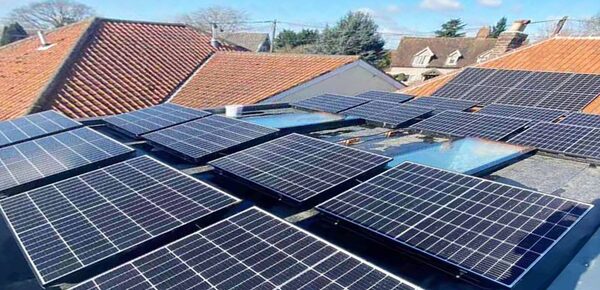
Northern Ireland does not simply mirror Great Britain. The rate a household pays and its eligibility depend on whether the property is in Great Britain (England, Scotland and Wales) or Northern Ireland7. Solar thermal and PV systems are included on the list of energy-saving materials, and their supply and installation are now subject to 0% VAT in Great Britain5. In Northern Ireland the same relief exists but on a different clock, opening on 1 May 2023 rather than 1 April 20222.
The older reduced rate history also differs. Energy-saving materials qualified for the reduced rate of 5% subject to the 60% test for supplies made in Great Britain between 1 October 2019 and 31 March 2022, and for supplies made in Northern Ireland from 1 October 201912. That 60% test, which looked at the proportion of the cost represented by materials, applied to supplies made in Great Britain between 1 October 2019 and 31 March 2022 and to supplies made in Northern Ireland from 1 October 201912.
There is a live example of the divergence. The Plug-in Solar Device Interim Product Specification states that its application to Northern Ireland is subject to further consideration and may require amendment13. So a product standard being developed for Great Britain is not automatically extended to Northern Ireland.
"The rate you pay and your eligibility depends on whether you are in Great Britain (England, Scotland and Wales) or Northern Ireland"
Great Britain versus Northern Ireland: where the 20% rate still applies
The 20% rate has not disappeared. Solar is subject to 20% VAT unless a reduced rate of 5% applies5. The list of non-qualifying energy products that stay at 20% includes heating equipment that is not funded through an energy efficiency grant, energy efficient boilers, secondary or double glazing, low emission glass, energy efficient fridge freezers, and wind turbines and water turbines in Northern Ireland only6.
Grant-funded work sits at 5%. In Great Britain or Northern Ireland, a household pays 5% VAT on heating equipment work funded through an energy efficiency grant if eligible7. That is a different route from the zero rate and applies to a different set of circumstances.
| Situation | VAT treatment | Where |
|---|---|---|
| Solar panels and batteries, qualifying installation | 0% until March 2027 | UK wide, including Northern Ireland14 |
| Heat pump installation | Exempt from VAT (0%) | 3 |
| Heating equipment work funded through an energy efficiency grant | 5% | Great Britain or Northern Ireland7 |
| Heating equipment not grant funded, energy efficient boilers, glazing, low emission glass, fridge freezers | 20% | 6 |
| Wind and water turbines | 20% | Northern Ireland only6 |
| Qualifying supplies of electricity | 5% reduced rate | Northern Ireland8 |
The wind and water turbine entry is the clearest Northern Ireland-only exclusion on the list, and it is worth noting because it runs in the opposite direction to the general alignment: here Northern Ireland carries a 20% charge that the relief does not reach6.
What the zero rate means for installation costs

The zero rate removes VAT from the qualifying installation, which changes the arithmetic of a quote. An official worked example for a solar panel and battery installation in Northern Ireland, where materials are more than 60% of the total cost, has the installer charging £5,385 excluding VAT, made up of £3,500 for materials and £1,885 for labour, with standard 20% VAT on materials and 5% VAT on labour6. The example shows how the split between goods and labour drives the outcome when the relief does not cover the whole job.
The wider saving case is separate from VAT. Solar panels are estimated to save £440 a year in Northern Ireland15. That figure is an estimate of bill savings, not a tax figure, and it sits alongside the up-front reduction the zero rate gives.
There is a supply chain condition attached to the transition. Sufficient supply chain capacity is needed for the maintenance and repair of zero carbon heating systems as well as installation in Northern Ireland16. A household weighing a heat pump is therefore weighing not only the VAT position at the point of installation but the availability of someone to service the system afterwards.
Eligibility: which installations qualify
The relief turns on where the equipment is installed and what it is. Heat pumps qualify when installed in, or in the curtilage of, residential accommodation or buildings intended for use solely for a relevant charitable purpose11. Water source heat pumps, electrical battery storage and smart diverters are named within the relief11.
Planning rules sit alongside the tax rules. Northern Ireland has new permitted development for domestic air-source heat pumps17. In England, Class G permitted development for air source heat pumps on domestic premises carries a condition that the pump is, so far as practicable, sited so as to minimise its effect on the external appearance of the building18. These are separate regimes, and a qualifying installation for VAT is not automatically a permitted one for planning.
Support schemes in Northern Ireland are narrower than in Great Britain. There are no dedicated heat pump schemes in Northern Ireland19. For ground source heat pumps, there is not a specific grant currently available, though a household can still get heat pump ready and apply for funding for insulation via NI Energy Advice20. The Home Heating Oil Support Scheme is open to households who use oil as their primary source of heating, are resident in Northern Ireland, and, in either of the qualifying months, are in receipt of a qualifying benefit, or a single person or couple, including pensioners, with an annual income of less than £30,000 net of allowable deductions22. The Priority PV Scheme is for Northern Ireland Housing Executive tenants only, outside a natural gas area, in a single storey Housing Executive property with oil or electric heating, for a couple or single parent family with an income or pension less than £35,000 gross23.
Heat pump deployment statistics cover installations in the UK, but some devolved administration schemes in Scotland and Northern Ireland are currently not included24. The heat pumps included in those figures are MCS certified and have a capacity of less than or equal to 45 kW25. A Vaillant aroTHERM Split air source heat pump is described as MCS accredited and RHI eligible26. Air, ground or water source heat pumps are eligible works under a Home Improvement loan category for heating27.
The direction of travel is set out in official guidance: by 2040, more than two-thirds of homes in Northern Ireland are heated by low-carbon electric heating, predominately heat pumps28. The VAT relief is one of the cost levers on that path, and it has a date on it.
Confirming the rate with an installer
The primary references are HMRC's VAT Notice 708/6: energy saving materials and the VENSAV manual13. The manual covers the scope of the relief, the 60% test and the Northern Ireland position12. Further guidance is available in VAT Notice 708/6: energy saving materials and VENSAV300013.
For the electricity connection side, Northern Ireland Electricity Networks expects a household to nominate an EV Charge Point or Heat Pump installer, who carries out checks at the property and submits the application, managing the whole application on the customer's behalf29. That places the technical and administrative responsibility with the installer rather than the householder.
Case law has touched the boundary of the relief. Keeping Newcastle Warm C-353/00 concerned the question of whether a payment by a national agency to Keeping Newcastle Warm in connection with energy advice provided to householders was liable to VAT30. It is a reminder that the treatment of a service can turn on what is actually being supplied.
For households comparing the VAT position with grant funding, the wider picture is set out in home energy grants in Northern Ireland and in the pillar guide to home energy grants and schemes. The general rules on which materials qualify are covered in VAT relief on energy-saving materials, and the end date is examined in how long the 0% VAT relief lasts.
Sources30 cited
- VENSAV2083: controls for central heating and hot water systems, GOV.UK, 2026-09-17
- Explanatory memorandum: VAT energy-saving materials, legislation.gov.uk, 2026-09-17
- The Value Added Tax (Energy Saving Materials) (Amendment) Regulations 2024, legislation.gov.uk, 2024-01-10
- VENSAV3081: water source heat pumps, GOV.UK, 2024-02-01
- VAT on solar and battery storage, Solar Energy UK, 2026-09-17
- Energy-saving products and VAT, HMRC, 2026-09-20
- Tax on shopping: energy-saving products, GOV.UK, 2026-09-17
- VAT on fuel and power: Notice 701/19, GOV.UK, 2026-10-01
- VAT Act 1994, Schedule 8, Group 23, legislation.gov.uk, 2026-09-17
- VENSAV1100: scope of the relief, GOV.UK, 2027-04-01
- VENSAV4300: qualifying energy-saving materials, GOV.UK, 2026-09-17
- VENSAV2082: the 60% test, GOV.UK, 2026-09-17
- Draft VAT guidance on changes to energy-saving materials, GOV.UK, 2026-09-17
- Are solar panels worth it?, Uswitch, 2026-09-16
- Energy-saving upgrades for home renovation, Energy Saving Trust, 2026-05-05
- Northern Ireland low carbon heating in buildings, Energy Saving Trust, 2025-07-03
- New permitted development for domestic air-source heat pumps, legislation.gov.uk, 2026-09-17
- Class G permitted development: air source heat pumps, legislation.gov.uk, 2026-09-17
- Heat pumps, Energy Saving Trust, 2026-06-11
- Ground source heat pumps, Energy Saving Trust, 2026-07-16
- Air source heat pumps, Energy Saving Trust, 2026-07-16
- Home Heating Oil Support Scheme, Department for Communities, 2026-09-17
- NISEP list of schemes 2026-27, Utility Regulator, 2026-04
- Heat pump deployment quarterly statistics, UK 2025 Q3, GOV.UK, 2025-12-04
- Heat pump deployment quarterly statistics, UK 2025 Q2, GOV.UK, 2025-09-04
- Vaillant aroTHERM Split air source heat pump, Quiet Mark, 2026-09-17
- Eligible and non-eligible works, Cornwall Council, 2025-10-01
- Northern Ireland's fourth carbon budget, Climate Change Committee, 2025-03-19
- Your connections process, Northern Ireland Electricity Networks, 2026-09-19
- VENSAV3210: Keeping Newcastle Warm C-353/00, GOV.UK, 2026-09-17
 Home Energy Planning Rules in NIDo you need planning permission for solar panels or a heat pump in Northern Ireland?
 Planning Permission NIDo you need planning permission for solar panels in Northern Ireland?
 Planning Permission in NIDo you need planning permission for a heat pump in Northern Ireland?
 Home HeatingWhy do so many homes in Northern Ireland run on heating oil, and will that ever change?
 Energy Bills in Northern IrelandNorthern Ireland has no price cap.
 VAT on Energy InstallationsExplains the VAT treatment of energy-saving materials installed in homes, which products and jobs qualify and which are charged at the standard rate.