

In this guide
For most homes in Northern Ireland, a heat pump does not need a planning application. The Planning (General Permitted Development) Order (Northern Ireland) 2015 grants planning permission for air source heat pumps under Part 2, Class G, and for ground or water source heat pumps under Part 2, Class F, within the curtilage of a dwellinghouse1. The Order came into operation on 1 April 2015 and was made under sections 32 and 247(6) of the Planning Act (Northern Ireland) 20112.
That grant is not unconditional. It applies subject to the exceptions, limitations and conditions set out in the Schedule, and the Order states plainly that applicants still have to make sure their development complies with any environmental and other consents that may be needed, including building regulations2. Permitted development removes the need for a planning application. It does not remove the need for a building control approval, an electrical certificate, or any other statutory consent that applies to the work.
The practical picture is unusual. Northern Ireland has a permissive planning regime for domestic heat pumps, and almost no installations under the government-supported schemes that the rest of the UK's statistics are built on. Official statistics record 0 installations in Northern Ireland in 2024 Q3, 2024 Q4, 2025 Q1 and 2025 Q3, and 6 installations in 2026 Q23. The Committee on Climate Change has said annual installation rates will need to reach nearly 20,000 by 20305. Planning permission is not the bottleneck.
What the Northern Ireland Order actually grants
The Planning (General Permitted Development) Order (Northern Ireland) 2015 is the legal instrument that matters here. It is numbered 2015 No. 70, was declared on 25 February 2015, and came into operation on 1 April 20152. It was subject to the negative resolution procedure, and the consolidation it represents was stated not to alter the policy principle of permitted development2. Its territorial extent is Northern Ireland only2.
The Order works by granting planning permission for the classes of development described as permitted development in its Schedule, subject to the relevant exceptions, limitations and conditions1. Two classes cover domestic heat pumps:
- Class G covers the installation, alteration or replacement of an air source heat pump within the curtilage of a dwellinghouse1.
- Class F covers the provision of a ground or water source heat pump within the curtilage of a dwellinghouse1.
The phrase "within the curtilage" is doing real work. Curtilage means the garden or grounds that belong to the house, so a unit placed in a neighbouring field, on shared land outside the property, or on a separate commercial building is not covered by these classes. The classes also cover alteration and replacement of an air source unit, not only a first installation, which is a broader grant than the equivalent English rules give.
Planning powers in Northern Ireland sit with district councils, following the transfer of planning functions to them2. That matters for a household because the council is the body that will confirm whether permitted development applies to a particular property, and the body that enforces against development that does not.

What the figures show
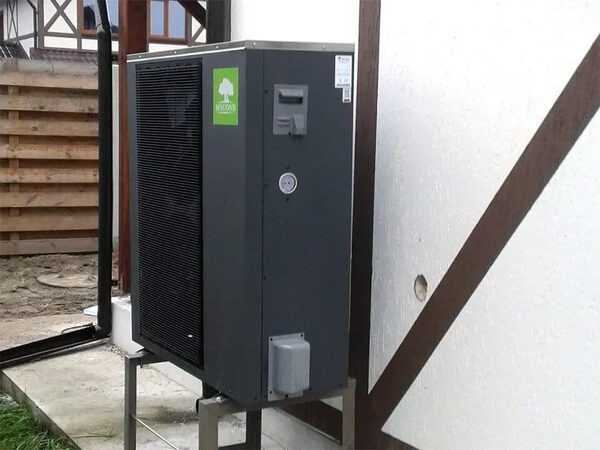
The planning position is generous. The installation figures are not. Official statistics on government-supported heat pump installations record Northern Ireland at 0 in 2024 Q3, 0 in 2024 Q4, 0 in 2025 Q1 and 0 in 2025 Q33. The 2026 Q2 tables record 6 installations for Northern Ireland4, and the June 2026 summary records 36 retrofit domestic installations in the same period10. The 2026 Q1 tables record 30 retrofit installations, described as quarter-on-quarter growth from 9 installations in 2025 Q411.
Those figures need reading carefully, because the statistics themselves carry a coverage limitation. The deployment statistics cover DESNZ Government-supported heat pump installations only, and some devolved administration schemes in Scotland and Northern Ireland are currently not included3. The heat pumps counted are MCS certified and have a capacity of less than or equal to 45 kW3. So the zeros are not a claim that no heat pump was fitted in Northern Ireland in those quarters. They are a claim that no installation supported by the schemes the statistics cover was recorded there.
| Period | Northern Ireland installations recorded | Source |
|---|---|---|
| 2024 Q2 | 0 | 12 |
| 2024 Q3 | 0 | 7 |
| 2024 Q4 | 0 | 9 |
| 2025 Q1 | 0 | 8 |
| 2025 Q2 | 0 | 3 |
| 2025 Q3 | 0 | 3 |
| 2026 Q1 | 30 retrofit domestic | 11 |
| 2026 Q2 | 6 (36 retrofit domestic in the June 2026 summary) | 4 |
The gap between the planning regime and the installation rate is the central fact about heat pumps in Northern Ireland. The Order has permitted domestic air source and ground source heat pumps since 2015. Eleven years later, the recorded installation rate under the supported schemes is in single figures per quarter.
What drives the installation figures
The drivers are not planning. They are money, scheme coverage and the shape of the housing stock.
The Boiler Upgrade Scheme, which is the main grant route in England and Wales, does not operate in Northern Ireland. Its published grant values are £7,500 for a ground source heat pump, including water source heat pumps and those on shared ground loops, with vouchers valid for 6 months13. Cumulative figures to July 2026 show 2,388 voucher applications received, 2,024 vouchers issued and 1,567 redemptions paid for ground source heat pumps in England and Wales14. None of that spending reaches Northern Ireland households.
The cost figures that accompany the scheme give a sense of the sums involved. The nominal median cost of a ground source heat pump installation in England and Wales in 2026 Q2 was £27,232 including the grant value, with a lower quartile reported cost of £18,136 and an upper quartile of £42,110, at a median capacity of 10.5 kW14. Those are England and Wales figures, and they are the closest published cost data available for the technology, but they are not Northern Ireland prices.
The Committee on Climate Change, in its advice on Northern Ireland's fourth carbon budget, stated that annual installation rates will need to accelerate rapidly, reaching nearly 20,000 in 20305. That is the scale of the gap: single figures per quarter against a target of nearly 20,000 a year.
How Northern Ireland differs from England, Scotland and Wales

The four nations have four different planning regimes, and the differences are not cosmetic.
England. Air source heat pumps have been permitted development on domestic premises since 1 December 2011, provided all the limits and conditions are met6. Those conditions are detailed: the outdoor compressor unit must not exceed 1.5 cubic metres on a house or 0.6 cubic metres on a block of flats; only the first installation is permitted development on a house that is not detached or on a block of flats, while the first two are permitted on a detached house; installations on pitched roofs are not permitted development; on a flat roof all parts must be at least one metre from the external edge; and the installation must comply with the Microgeneration Certification Scheme Planning Standards (MCS 020a)6. Permitted development rights do not apply within the curtilage of a listed building or within a scheduled monument, and there are additional restrictions in conservation areas and World Heritage Sites6.
Scotland. The Scottish Government consulted on permitted development rights for domestic air source heat pumps in 2015, noting that noisier installations would require planning permission and that the method includes a maximum noise level for air source heat pumps to be considered permitted development15. Development falling within the criteria and thresholds established by the rights would not require planning permission but would remain required to gain non-planning consents such as a building warrant15. For non-domestic air source heat pump applications, the planning fee would fall under Section 5 of the fee schedule of the 2014 Regulations, at £401 for each 0.1 hectare16.
Wales. The Planning Portal states that its heat pump guidance relates to the planning regime for England and that the policy in Wales may differ17. Welsh building regulations guidance confirms that installation of either a ground source or air source heat pump will have to comply with the Building Regulations18.
Northern Ireland. The Order grants permitted development for both air source and ground or water source heat pumps within the curtilage of a dwellinghouse, without the volume, quantity, roof and boundary conditions that the English rules carry1. The listed building and scheduled monument restriction still applies6.
| Nation | Air source permitted development | Ground source permitted development | Noise condition in the permitted development rules |
|---|---|---|---|
| Northern Ireland | Yes, Class G1 | Yes, Class F1 | Not set as a decibel figure in the Order |
| England | Yes, since 1 December 2011, with volume, quantity, roof and boundary limits6 | Usually permitted development17 | MCS 020a compliance required6 |
| Scotland | Consulted on in 2015, with a maximum noise level for permitted development15 | Not covered by the 2015 consultation | Maximum noise level applies15 |
| Wales | Policy may differ from England17 | Policy may differ from England17 | Building Regulations compliance required18 |
The conditions that still apply
Permitted development is a grant of planning permission, not an exemption from every other rule. The Order is explicit that applicants still have to make sure their development complies with any environmental and other consents that may be needed, including building regulations2.
Building regulations. Installation of a ground source or air source heat pump has to comply with the Building Regulations18. In England, the Planning Portal notes that Building Regulations parts A to T apply to air source heat pumps plus Regulation 719. The equivalent Northern Ireland requirement is that the work is subject to building control approval, and the Order confirms building regulations are among the consents that still apply2.
Listed buildings and scheduled monuments. Permitted development rights do not apply for installations within the curtilage of a listed building or within a site designated as a scheduled monument6. Planning permission and, for listed buildings, listed building consent are required17. Councils advise that if a property is a listed building or in a conservation area, the householder should contact the council to check on local requirements17.
Article 4 directions. Councils can withdraw permitted development rights in defined areas through an Article 4 direction. Where rights have been withdrawn, an application is needed even for a development that would otherwise fall within Class F or Class G. The Planning Portal notes that guidance is based on national rules, but additional local rules may also affect what permissions are needed19.
Noise. The Northern Ireland Order does not set a decibel threshold in the way the English rules do. The English permitted development rules require compliance with the MCS Planning Standards, and development is permitted only if the air source heat pump installation complies with the Microgeneration Certification Scheme Planning Standards (MCS 020a)20. Where those standards are not met, planning permission is needed20. In Northern Ireland, noise is handled through the general planning framework, building regulations and statutory nuisance law rather than a single permitted development threshold.
Where a heat pump sits and how it is installed
Siting is the part of a heat pump installation that most often decides whether permitted development applies, and it is worth understanding before an installer surveys the property.
For an air source unit, the practical constraints are the ones that apply across the UK. The unit needs clear air on the intake and discharge sides, it should not discharge into a confined space or directly at a neighbouring window, and it should be mounted on a base that keeps it clear of the ground and reduces vibration. The English rules express some of this as hard limits: all parts of the unit must be at least one metre from the property boundary, installations on pitched roofs are not permitted development, and on a flat roof all parts must be at least one metre from the external edge20. Those specific distances come from the English regime, but they reflect the same physical and amenity concerns that apply in Northern Ireland.
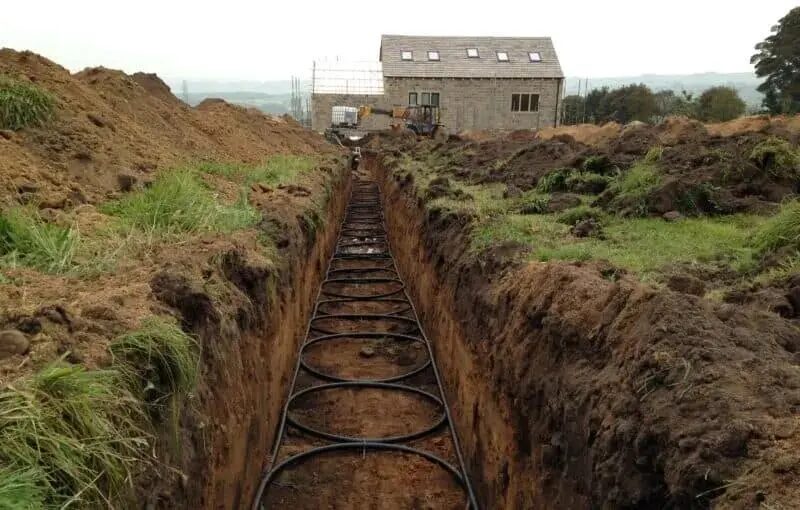
For a ground source unit, the visible equipment is small and the ground works are large. The ground array, including header pipes and manifolds, should be flushed as one system to remove all debris and purged to remove all air, and a pressure test in accordance with BS EN 805, section 11.3.3.4 should be conducted on a closed-loop installation21. Commissioning information provided to the dwelling owner should include details of the fluids used and their commissioned concentrations21. None of that is a planning matter, but it is the part of a ground source installation that a household should expect to see documented at handover.
What it means for household energy independence

A heat pump changes what a household depends on. It moves space heating and hot water off a delivered fuel, whether that is gas, oil or LPG, and onto electricity. The Order's grant of permitted development for domestic air source heat pumps is described in the legislation as new permitted development, and it removes one of the practical barriers that would otherwise sit between a household and that switch2.
What remains is a set of dependencies that permitted development does not touch.
- The electricity grid. A heat pump runs on electricity, so the household remains connected to the network and exposed to its prices, its carbon intensity and its outages.
- A supplier. There is no self-supply in a grid-connected heat pump installation. The household buys electricity from a supplier, on a tariff it does not control.
- The manufacturer. The unit is a piece of equipment with a service life, a warranty and a supply chain. Parts and support come from the maker or its distributor.
- The installer. Commissioning, servicing and fault-finding depend on a competent installer being available locally.
- The council. Permitted development is a grant that can be withdrawn by an Article 4 direction, and the council is the body that decides whether a particular installation falls within the classes.
The planning regime is therefore the least of the constraints. Northern Ireland grants permitted development for both air source and ground source domestic heat pumps, and has done since 20151. The recorded installation rate under the supported schemes is in single figures per quarter, against a Committee on Climate Change target of nearly 20,000 a year by 20304. The barrier is not the paperwork.
For a household weighing the decision, the planning question has a short answer and the energy question has a long one. The planning answer is that a domestic air source or ground source heat pump within the curtilage of a dwellinghouse is permitted development, subject to building regulations and the listed building and scheduled monument exclusions1. The energy answer is that the household trades one set of dependencies for another, and the new set is electrical.
Sources21 cited
- The Planning (General Permitted Development) Order (Northern Ireland) 2015, legislation.gov.uk, 2015
- The Planning (General Permitted Development) Order (Northern Ireland) 2015, explanatory document, legislation.gov.uk, 2015
- Heat pump deployment quarterly statistics United Kingdom 2025 Q3, GOV.UK, 2025
- Heat pump deployment tables Q2 2026, GOV.UK, 2026
- Northern Ireland's fourth carbon budget, Committee on Climate Change, 2025
- Planning permission: air source heat pump, Planning Portal, 2026
- Heat pump deployment quarterly statistics United Kingdom 2024 Q3, GOV.UK, 2024
- Heat pump deployment quarterly statistics United Kingdom 2025 Q1, GOV.UK, 2025
- Heat pump deployment quarterly statistics United Kingdom 2024 Q4, GOV.UK, 2024
- Heat pump deployment statistics: June 2026, GOV.UK, 2026
- Heat pump deployment quarterly statistics United Kingdom 2026 Q1, GOV.UK, 2026
- Heat pump deployment quarterly statistics United Kingdom June 2024, GOV.UK, 2024
- Boiler Upgrade Scheme guidance for installers v5.1, Ofgem, 2026
- Boiler Upgrade Scheme statistics, July 2026, GOV.UK, 2026
- Permitted development rights: non-domestic solar panels and domestic air source heat pumps, Scottish Government, 2015
- Permitted development rights: impact assessments, Scottish Government, 2015
- Heat pumps, Planning Portal, 2026
- Building regulations: heat pumps, Welsh Government, 2026
- Heat pumps: building regulations, Planning Portal, 2026
- Building regulations and renewables guidance, Bedford Borough Council, 2026
- Approved Document L Volume 1, consultation version, Welsh Government, 2025
 Home Energy Planning Rules in NIDo you need planning permission for solar panels or a heat pump in Northern Ireland?
 Planning Permission NIHow Northern Ireland's planning rules apply to external air conditioning and air-to-air heat pump units, when consent is needed, and how the position differs from England, Scotland and Wales.
 Planning Permission in EnglandDo you need planning permission for an air source heat pump?
 Planning Permission in ScotlandDo you need planning permission for a heat pump in Scotland?
 Wind Turbine Planning in NIDo you need planning permission for a home wind turbine in Northern Ireland?
 Planning Permission NIDo you need planning permission for solar panels in Northern Ireland?