

In this answer
Short answer
Most home solar installations in Northern Ireland need no planning permission at all. Installing solar panels will generally not need planning permission, and for most homes solar panels are considered permitted developments1. What every installation does need is a grid connection process with NIE Networks, and the size of the system decides which process applies.
The dividing line is 3.68kW on single phase. Equipment that exports a maximum of 3.68kW on single phase, or under 11.04kW on three phase, or under 16 amps per phase, can be connected under the fit and inform route: the installer fits and commissions the system, then notifies NIE Networks afterwards3. Above that, a full generation connection application is required, and NIE Networks states it will process applications and provide a quote within 90 days of receiving the application with all supporting documentation and the fee4.
Planning permission becomes necessary in specific circumstances rather than as a rule: conservation areas and listed buildings, flat roofs, and installations that breach the permitted development limits on height and projection5. The rest of this page sets out where each rule bites, what the connection paperwork involves, and what a household can expect in practice.
The short answer: permitted development, but always a connection process
Two separate regimes apply to a Northern Ireland solar installation, and households often conflate them. The first is planning, which governs whether the panels may be fixed to the building. The second is the electricity connection, which governs whether the system may export to the distribution network. A system can be entirely lawful in planning terms and still require notification to NIE Networks, and the two processes run on different timescales with different paperwork.
On planning, the position is permissive. Installing solar panels will generally not need planning permission, and homes can often have solar panels without requiring planning permission from the council, covered by permitted development so long as certain conditions apply1. The same general position is repeated across official guidance: solar panels are considered permitted developments and do not usually need planning permission, and installation on residential buildings and land may be permitted development with no need to apply to the council2. Northern Ireland's own permitted development framework introduced a wide range of changes including small-scale domestic and commercial renewable energy projects, which is the legislative basis for treating domestic solar as permitted development9.
On connection, the position is procedural rather than discretionary. In Northern Ireland, your installer will register your system with NIE Networks10. That registration is not optional and is not something the household can skip by choosing a particular installer; it is a condition of connecting generation to the network at all. The practical consequence for a household is that the installer's competence with the connection paperwork matters as much as the installation itself, because an incomplete notification leaves the system unregistered.
The independence picture is worth stating plainly. Solar reduces the amount of electricity a household buys, but it does not remove the connection: the home remains tied to the distribution network, to a supplier for import and export, and to NIE Networks for the physical connection and for any change to it. Self-sufficiency in the sense of disconnection is a different proposition, covered in solar panels and household energy independence.
When planning permission is required: roofs, flats, conservation areas and listed buildings
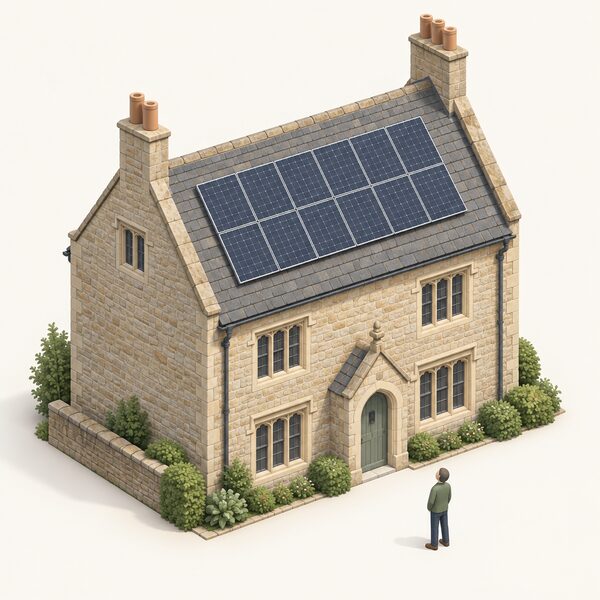
Permitted development is a default, not a guarantee, and there are important limits and conditions to permitted development rights which must be met to benefit from them8. Where those conditions fail, an application is needed.
The clearest cases are these:
- Listed buildings. Solar panels on listed buildings will need planning permission and listed building consent2. The same applies to a building within the curtilage of a dwelling which is a listed building11. If a property is listed, planning permission and listed building consent are always required5.
- Conservation areas. In conservation areas and on listed buildings, planning permission may be required1. The position is not uniform: solar panels fitted to roofs in conservation areas do not require planning permission provided they meet the general rules, so a roof-mounted array that stays within the limits can proceed, while other installations in the same area may not5.
- Flat roofs. Planning permission is required for panels on flat roofs5.
- Projection and height. The equipment would protrude more than 0.2 metres beyond the plane of the wall or the roof slope, which takes the installation outside permitted development12. Ground-mounted equipment is caught if any part of the equipment is taller than 4 metres, or if any part of the installation including its housing measures more than 3m in size in length, height or depth13.
Where an installation falls outside permitted development, the route is a planning application, and for listed work a listed building consent application alongside it. For a household that wants written confirmation before proceeding, a Lawful Development Certificate can be applied for to prove an existing or proposed solar panel does not require planning permission and complies with the permitted development limitations and conditions14. That certificate is not a permission; it is evidence that permission was never needed, and it is useful when a future buyer, solicitor or lender asks the question.
"Solar panels on listed buildings require planning permission and listed building consent."
The Northern Ireland position on listed buildings follows the same principle as the rest of the UK, and the practical advice is to establish the building's status before ordering equipment. A listed building consent application runs on its own timetable and its own fee, separate from any planning application.
Grid connection: notify NIE Networks under the fit and inform process
The connection regime for small domestic generation in Northern Ireland is built around the fit and inform principle. Under it, your installer can usually connect the system under the fit and inform process, which means they install and commission the equipment and then notify NIE Networks afterwards6. The installer's responsibility to inform NIE Networks is met by submitting an online application16.
This is a notification regime, not an approval regime, and the distinction matters. The system is energised first and reported second, which is why the eligibility conditions are strict: only installations within the size limit and using approved equipment qualify. Systems with the ability to export up to 3.68kWp can be notified to the distribution network operator within 28 days of being installed7. The 28 day window is the deadline for the notification, not a waiting period before the system can run.
Two further points sit alongside the generation notification. First, NIE Networks needs to know about any work on the consumer unit or fuse board before it begins, so if the installation involves work on the consumer unit or fuse board, NIE Networks must be told in advance17. Second, the metering and supply side has its own step: a household will need to register with an electricity supplier and submit the connection card to NIE Networks18. The connection card is the physical record of the connection, and without it the supply arrangements are incomplete.
For a household, the sequence in practice runs:
- The installer confirms the system falls within the micro-scale limit and uses approved equipment.
- Any consumer unit or fuse board work is notified to NIE Networks before it starts.
- The installer fits and commissions the system.
- The installer submits the online notification within 28 days of installation.
- The household registers with an electricity supplier and submits the connection card.
The dependence that remains is straightforward: the household still relies on NIE Networks for the connection and on a supplier for the account. Solar changes the direction and volume of flows, not the existence of the relationship. The wider mechanics of the connection standards are set out in connecting solar to the grid: G98 and G99 explained.
Size limits: 3.68kW single phase, 11.04kW three phase and the G98 threshold
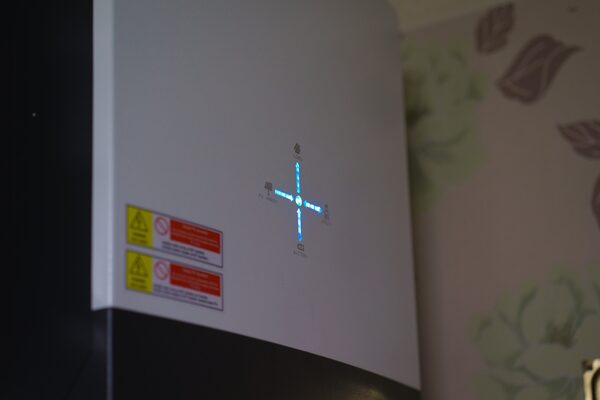
The size thresholds are the single most consequential set of numbers for a Northern Ireland installation, because they decide whether the household uses the notification route or a full application.
| Parameter | Threshold | Consequence |
|---|---|---|
| Single phase export | 3.68kW maximum | Qualifies as micro-scale, fit and inform route3 |
| Three phase export | Under 11.04kW | Qualifies as micro-scale, fit and inform route3 |
| Per phase current | Under 16 amps | Qualifies as micro-scale, fit and inform route3 |
| Notification deadline | Within 28 days of installation | Required for systems exporting up to 3.68kWp7 |
| Above the limit | Over 3.68kW single phase or 11.04kW three phase | Full generation connection application required19 |
The standard is expressed in two ways that describe the same boundary. Generation up to 3.68kW single phase or 11.04kW three phase falls under the micro-scale route, while generation over 3.68kW single phase or 11.04kW three phase falls under the larger application route19. The threshold is also described in terms of array size for smaller systems: the notification arrangement is for smaller solar PV systems that are under 3.68kWp in size20.
The array size and the inverter rating are not the same figure, and this is where households most often misread the rule. NIE Networks gives a worked example: a standard 3.98kWp solar PV installation using a certified 3.68kW rated inverter would be acceptable4. The array's peak output exceeds 3.68kWp, but the inverter's export rating does not, and it is the export rating that governs eligibility. A household planning a system around this boundary should expect the inverter specification, not the panel count, to be the deciding document.
The same 3.68kWp ceiling appears in scheme rules elsewhere in the UK, which confirms it as the recognised boundary for install and notify arrangements: one scheme specification covers all on-roof installations up to 3.68kWp, described as the maximum capacity for install and notify installations, with solar capacity no greater than 3.68kW21. That is a Welsh scheme document rather than a Northern Ireland rule, but it reflects the same network standard.
For a household, the practical reading is that a system sized at or below the single phase threshold keeps the simpler route, and a system above it moves into an application process with a queue and a 90 day processing window. Sizing decisions are covered in more detail in what size solar system does a home need.
What happens above the limit: small scale applications and connection offers
Above the micro-scale threshold, the installation needs a generation connection application rather than a notification. NIE Networks handles solar, wind and other generation connections alongside connections for businesses and farms, so the application route is a general one rather than a domestic-only process22.
The application is assessed and priced, and the output is a connection offer. NIE Networks will process all applications and provide a quote, which will outline the work required to connect, within 90 days of receiving the application and all supporting documentation and fee4. Three things must therefore be in place before the clock starts: the application itself, the supporting documentation, and the fee. An application missing any of the three does not begin its 90 day window.
Queue position is fixed by arrival. NIE Networks states it is obliged to ensure fairness to all applicants, provides connection offers on a first come, first served basis and operates a strict queuing process to achieve this4. There is no published priority fee that accelerates an offer, so a household cannot buy its way up the queue. The practical implication is that the date a complete application lands is the date that determines the offer date, which puts a premium on getting the documentation right first time.
The connection offer itself sets out the work required, and the cost of that work depends on what the network needs at that point. NIE Networks publishes a budget estimate tool for connections, which gives an indication of cost before a formal application23. That estimate is not the offer; it is a planning aid.
Where the installation is on a building rather than a purpose-built generation site, the planning side may also need attention. Ground-mounted equipment above the permitted development limits, and any installation on a listed building, requires a planning application in parallel with the connection application. The two processes are independent and neither substitutes for the other.
The dependence here is at its most visible. A system above the threshold cannot simply be switched on and reported; it waits for a network offer, and the offer reflects what the network must do to accept the export. That is the point at which a household's solar plans are most exposed to a process outside its control.
How long it takes and what the application must include
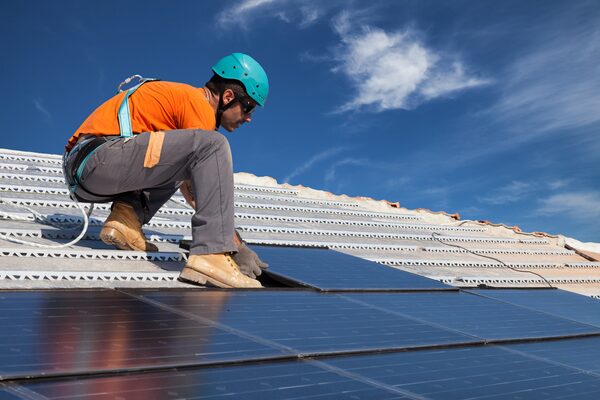
The headline timing figure is the 90 day processing window for generation connection applications, running from receipt of the application with all supporting documentation and the fee4. That is the period in which NIE Networks provides a quote outlining the work required to connect.
For the notification route, the timing is different in kind. The installer notifies NIE Networks after commissioning, and the notification must be made within 28 days of installation for systems exporting up to 3.68kWp7. There is no approval wait before the system runs, because the fit and inform model places the notification after the event.
Documentation for a small scale application centres on completeness. The application must arrive with its supporting documentation and fee for the 90 day window to begin4. Where a household wants written confirmation that the installation does not need planning permission, a Lawful Development Certificate application can be made to prove the position and confirm compliance with the permitted development limitations and conditions14. That certificate is a planning document, not a connection document, and it does not form part of the NIE Networks application.
On the ground, installation itself is quicker than the paperwork suggests. One documented Northern Ireland installation took around two weeks, with one week to put the solar panels in and another week to install and test the battery24. That is a single reported case rather than a standard, but it illustrates the gap between the physical work and the administrative steps around it.
For comparison, grant-funded energy work in Northern Ireland can take considerably longer: the Northern Ireland Housing Executive states it can take up to six months to provide an Approval of Application25. That is a grant approval process rather than a connection process, and the two should not be conflated, but it shows that publicly administered energy processes in Northern Ireland run on their own timetables.
Queries about an application in progress go through the NIE Networks connections help and advice section, which covers frequently asked questions about generation connections26. Because offers are issued on a first come, first served basis under a strict queue, a query cannot change a queue position4.
Where the rules leave a household
The planning and connection regimes in Northern Ireland are, on the whole, permissive for domestic solar. Planning permission is generally not needed, permitted development covers most roof installations, and the micro-scale connection route is a notification rather than an approval1. The conditions that remove those defaults are specific and identifiable: listed buildings, conservation areas where the general rules are not met, flat roofs, projection beyond 0.2 metres, and ground-mounted equipment above the height and size limits2.
The connection side is where the process, rather than the permission, does the work. Every installation is registered with NIE Networks, the installer carries the notification obligation, and the 28 day deadline applies to systems exporting up to 3.68kWp10. Above the threshold, the household enters a queued application process with a 90 day processing window and no priority route4.
What solar does for independence in Northern Ireland is reduce imported electricity and, with a battery, shift when that electricity is used. What it does not do is remove the grid connection, the supplier relationship, or the need for a network offer above the micro-scale limit. The household remains connected, and the connection is the thing that makes the export possible in the first place. Households weighing the wider case can read solar panel savings and payback periods and solar panel installation: the process from survey to handover.
Sources26 cited
- Solar Together Norfolk, South Norfolk and Broadland Council, 2026
- Solar panels and planning permission, Cornwall Council, 2026
- Micro-scale generation connections, NIE Networks, 2026
- Generation connections FAQs, NIE Networks, 2026
- Planning and solar, Frome Town Council, 2025
- What is G98/NI, NIE Networks, 2026
- Solar panels, Electrical Safety First, 2026
- Solar panels, Lambeth Council, 2026
- The Town and Country Planning (General Permitted Development) (Amendment) Regulations (Northern Ireland) 2015, legislation.gov.uk, 2015
- Solar panels, Energy Saving Trust, 2026
- Solar panels, City of York Council, 2026
- Solar panels and planning permission, Bath and North East Somerset Council, 2026
- Planning permission for solar panels, Bristol City Council, 2026
- Solar panels and permitted development, Richmond upon Thames Council, 2026
- Solar panels guidance, Islington Council, 2026
- EVs and heat pumps, NIE Networks, 2026
- Safe isolation, NIE Networks, 2026
- Connections FAQs, NIE Networks, 2026
- Help to select, NIE Networks, 2026
- Building regulations and renewables guidance, Bedford Borough Council, 2026
- Barcud Solar Panel Installation Scheme Specification, Sell2Wales, 2026
- Connections, NIE Networks, 2026
- Budget estimate, NIE Networks, 2026
- Your solar panel stories, Which?, 2024
- How long will the whole process take, Northern Ireland Housing Executive, 2026
- Plug-in solar interim product specification, Department for Energy Security and Net Zero, 2026
 Planning Permission NIDo you need planning permission for solar panels in Northern Ireland?
 Home Energy Planning Rules in NIDo you need planning permission for solar panels or a heat pump in Northern Ireland?
 Planning Permission in NIDo you need planning permission for a home battery in Northern Ireland, and does it matter whether it goes inside the house or in an outbuilding?
 Wind Turbine Planning in NIDo you need planning permission for a home wind turbine in Northern Ireland?
 Planning Permission in NIDo you need planning permission for a heat pump in Northern Ireland?
 Home Energy Planning ScotlandDo you need planning permission for solar panels or a heat pump in Scotland?