
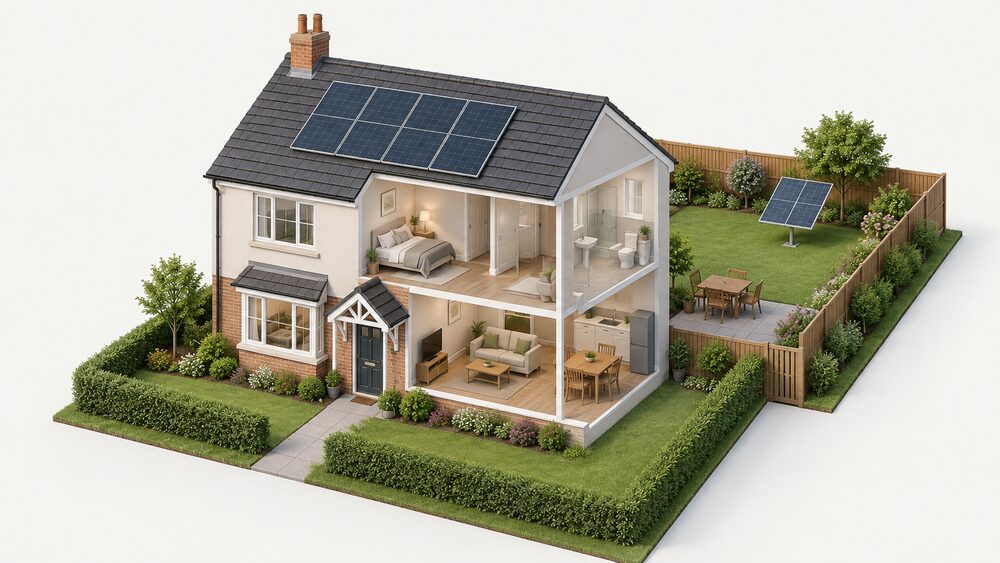
In this guide
Most domestic energy equipment in Northern Ireland does not need a planning application. The Planning (General Permitted Development) Order (Northern Ireland) 2015 grants planning permission for the classes of development described as permitted development in its Schedule, subject to the relevant exceptions, limitations and conditions1. Stand alone solar within the curtilage of a dwellinghouse is one of those classes2. The Order was made on 25 February 2015, came into operation on 1 April 2015, and applies to all land in Northern Ireland1.
The Order is the Northern Ireland equivalent of the permitted development regimes that operate in England, Scotland and Wales, but it is a separate instrument with its own classes, its own conditions and its own amendment history. It was amended by an Order made on 30 November 2020 and coming into operation on 21 December 2020, which set the period in Article 7(1) at 28 days, and the consolidated text has since been maintained as a point in time view as at 4 July 20234.
What follows is what the Order and the guidance around it actually say: which installations are covered, which are not, what a certificate of lawfulness does, and what remains outside a household's control even when no application is needed.
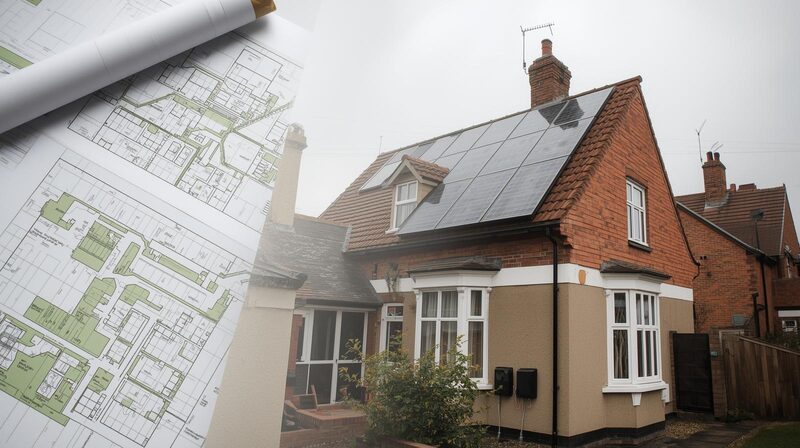
What the Order grants, and what it does not
The operative words are short. Planning permission is granted for the classes of development described as permitted development in the Schedule, and any permission granted is subject to any relevant exception, limitation or condition specified in the Schedule1. That structure matters more than the headline: the right exists, but it is conditional, and the conditions are where most domestic disputes arise.
The Order was made under sections 32 and 247(6) of the Planning Act (Northern Ireland) 2011 and was subject to the negative resolution procedure1. It applies to all land in Northern Ireland, and it was published alongside a note of commencement of its provisions3. It did not alter the policy principle of permitted development; it consolidated and restated it3.
Two consequences follow for a householder. First, permitted development is a real grant of permission, not a tolerance or an exemption, so an installation that complies is lawful without any application. Second, the Order does not displace other consents. Applicants still have to make sure their development complies with any environmental and other consents that may be needed, including building regulations3. A solar array can be permitted development for planning purposes and still require a building control application for the additional loading on the roof structure or for the associated electrical works7.
The figures: what uptake looks like district by district
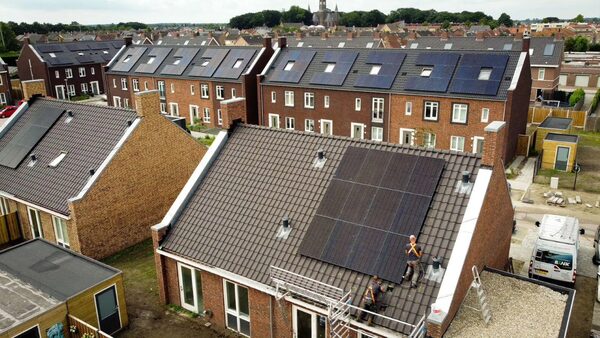
Northern Ireland's solar uptake is uneven, and the district pattern is the clearest published measure of it. Lisburn and Castlereagh has the most solar panels in Northern Ireland, with 109 installations per 10,000 people6. Newry, Mourne and Down follows at 104, Ards and County Down at 101, and Causeway Coast and Glens at 996.
| District | Installations per 10,000 people |
|---|---|
| Lisburn and Castlereagh | 1096 |
| Newry, Mourne and Down | 1046 |
| Ards and County Down | 1016 |
| Causeway Coast and Glens | 996 |
| Antrim and Newtownabbey | 976 |
| Mid and East Antrim | 906 |
| Mid Ulster | 626 |
| Fermanagh and Omagh | 576 |
The spread is wide: 109 at the top against 57 at the bottom, a difference of 52 installations per 10,000 people. The figures are independent statistics for 2026 and describe installations, not applications, so they capture the outcome of the planning regime rather than its workload6.
Two readings are possible and the data does not settle between them. The high-uptake districts are largely the commuter belt around Belfast, where household incomes and owner-occupation are higher. The low-uptake districts include Fermanagh and Omagh, which is rural and has a large share of off-gas-grid housing. Rural Northern Ireland is often described as the natural market for solar because so much of it runs on heating oil, yet the district with the lowest recorded uptake is one of the most rural. That gap is worth stating plainly rather than explaining away: the published figures show where installations are, not why.
For a household, the practical point is that permitted development rights are the same across all land in Northern Ireland1. A district with low uptake is not a district with tighter rules. The variation is in the market, not the Order.
What drives the need for an application
The triggers are specific and mostly physical. Ground-mounted equipment needs permission if any part of it is taller than 4 metres8. More than one stand alone solar panel would also take an installation outside the class9. Systems bigger than 50 kW need prior approval from the local planning authority, and ground-mounted installations need planning permission unless the array is less than nine square metres10.
Roof and wall installations have their own conditions. Panels must be sited, so far as is practicable, to minimise their effect on the external appearance of the building and the amenity of the area8. In the English regime the equivalent conditions are expressed as not installing above the ridgeline and not projecting more than 200mm above the roof or wall surface, and those thresholds are widely used as the practical test10. The Northern Ireland Order sets its own conditions in the Schedule, and the Schedule is the document that governs2.
Industrial and warehouse buildings carry a separate set. Planning permission is required if the installation is used for any purpose other than those of the undertaking concerned, if it is within 5 metres of any boundary of the curtilage of the premises, or if the external appearance of the building is materially affected11.
Where the right is removed: listed buildings, conservation areas and Article 4
Designation is the main route by which permitted development disappears. Solar panels on listed buildings require planning permission and listed building consent13. For non-residential listed buildings, planning permission will still be required, and for both residential and non-residential listed buildings, the installation of solar panels on buildings within the listed building's curtilage will require planning permission14.
Conservation areas are more nuanced. Across the UK, solar panels are considered permitted developments and do not usually need planning permission, but that does not apply in a listed building, a conservation area or a national park6. In some cases, such as in conservation areas and on listed buildings, planning permission may be required16. Within a conservation area, planning permission is required when installing solar panels or other equipment on a wall fronting a highway, where highway means adopted roads and not footpaths12. Planning permission is also required for panels on flat roofs in a conservation area12.
Article 4 directions remove the right entirely in defined places. In the Swindon Railway Village area and in the Bishopstone Conservation Area, Article 4 Directions apply, so planning permission is required to install solar panels17. These are local designations, made area by area, and they are the reason a householder cannot rely on the national position alone.
| Location | Position |
|---|---|
| Listed building | Planning permission and listed building consent13 |
| Curtilage of a listed building | Planning permission required14 |
| Conservation area, wall fronting a highway | Planning permission required12 |
| Conservation area, flat roof | Planning permission required12 |
| Conservation area without Article 4 | Permitted development rights apply18 |
| Article 4 direction area | Planning permission required17 |
The pattern is consistent: the more sensitive the designation, the more likely the right is withdrawn. A household in a designated area should treat the national permitted development position as a starting point rather than an answer.
Certificates of lawfulness and how applications are handled

A Lawful Development Certificate proves that an existing or proposed solar panel does not require planning permission and complies with the permitted development limitations and conditions19. It is the formal way to convert an assumption into a record. It is not required in order to install, but it is the document that answers the question at the point of sale, when a buyer's solicitor asks whether the array on the roof was lawful.
Where an installation does not meet the government requirements, an application for planning permission is needed20. The same applies where any of the conditions in the Schedule are breached8. Applications go to the district council, which holds planning powers in Northern Ireland3.
The Order itself sets a procedural period. The Planning (General Permitted Development) (Amendment) Order (Northern Ireland) 2020 was made on 30 November 2020 and came into operation on 21 December 2020, and it changed Article 7(1) so that for "21" there is substituted "28"4. That is a 28 day period within the Order's own procedure, not a general decision deadline for planning applications.
The Order has been amended since. The Planning (General Permitted Development) (Amendment) Order (Northern Ireland) 2023 will amend the Planning (General Permitted Development) Order (Northern Ireland) 2015 to introduce new permitted development rights for the installation of microgeneration equipment, and it was made on 12 June 20235. The consolidated text as it stands at 4 July 2023 is the version to read21.
How Northern Ireland differs from England, Scotland and Wales
The four nations share a common architecture: each has a general permitted development order that grants permission for defined classes of domestic development, subject to conditions. They differ in the instrument, the classes and the amendment history.
England's equivalent is the Town and Country Planning (General Permitted Development) (England) Order 2015, Schedule 2, Part 14, Class J, under which placing solar panels on the roof of a house or flat, or on a building within its grounds, is considered permitted development in most cases9. Planning permission is not normally needed for solar panels on domestic roofs, with some exceptions, as they are covered by permitted development rights22. The installation of solar panels and equipment on residential buildings may be permitted development with no need to apply to the council23.
Scotland has consulted on its own permitted development rights for non-domestic solar panels and domestic air source heat pumps, and its non-domestic regime has permitted development rights for non-domestic solar panels up to 45 kW electricity or 50 kW thermal24. Non-domestic solar applications in Scotland attract a fee of £202 for each 0.1 hectare of the site area, subject to a maximum of £2,01624.
Wales and Northern Ireland both operate their own instruments, and the Welsh position is set out separately in planning rules for home energy equipment in Wales. The Scottish position is set out in planning rules for home energy equipment in Scotland.
One Northern Ireland specific point is worth flagging. The Plug-in Solar Device Interim Product Specification states that application of the specification to Northern Ireland is subject to further consideration and may require amendment25. That is a live uncertainty for plug-in solar, and it means the position on small plug-in kits is less settled in Northern Ireland than the position on fixed roof-mounted arrays.
What it means for household energy independence
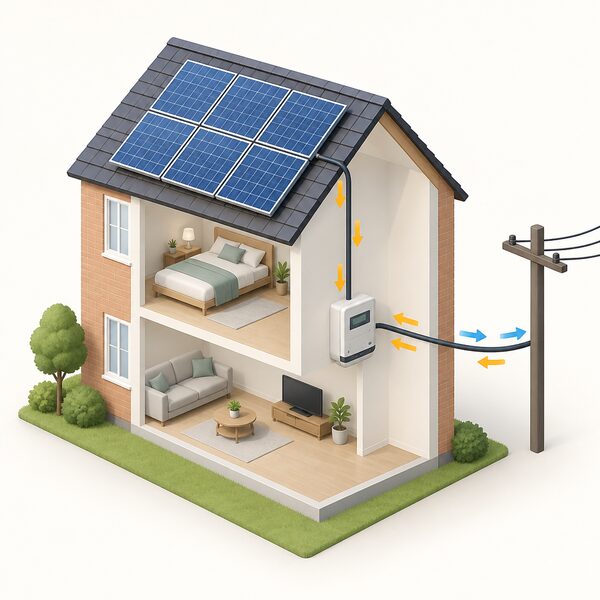
Permitted development rights do real work for energy independence. They remove the cost, delay and uncertainty of a planning application from the most common domestic installation, which is a roof-mounted solar array. A household that can install without an application is a household that can generate its own electricity on its own timetable, and the Order grants that permission across all land in Northern Ireland1.
The dependence that remains is not planning. It is the grid. A solar array installed under permitted development still connects to the distribution network, still relies on a meter and a supplier, and still exports or imports according to the connection arrangements. Northern Ireland also has its own support history: the Energy Price Guarantee scheme document for domestic electricity consumers in Northern Ireland was published on 31 October 202226. Planning law does not touch any of that.
There is a second dependence, and it is the one the Order cannot resolve. The right to install is not the right to install anything. The 4 metre height limit for ground-mounted equipment, the single stand alone panel limit, the 50 kW prior approval threshold and the conditions on siting all constrain what a household can build without an application8. A household wanting a larger array, a taller ground mount or a second stand alone panel is back in the application process.
The designations are the third limit. A listed building, a conservation area or an Article 4 direction area removes the right, and the household is then dependent on a consent decision made by the district council12. That is a slower and less certain route, and it is the reason the first question for any household in a designated area is not what the Order says in general but what applies to that specific address.
For the wider picture of how planning, support and fuel poverty policy diverge across the four nations, home energy in Scotland, Wales and Northern Ireland sets out the full comparison, and which energy powers are devolved and which are reserved explains why planning sits where it does. Households weighing up an installation alongside the support available may also find the Affordable Warmth Scheme in Northern Ireland and how Northern Ireland homes are heated useful context.
Sources26 cited
- The Planning (General Permitted Development) Order (Northern Ireland) 2015, legislation.gov.uk, 2015
- Schedule to the Planning (General Permitted Development) Order (Northern Ireland) 2015, legislation.gov.uk, 2015
- Planning (General Permitted Development) Order (Northern Ireland) 2015 (S.R. 2015 No. 70), Department for Infrastructure, 2015
- The Planning (General Permitted Development) (Amendment) Order (Northern Ireland) 2020, legislation.gov.uk, 2020
- Changes to permitted development rights for domestic heat pumps, Department for Infrastructure, 2023
- UK solar panel hotspots, Energy Saving Trust, 2026
- Solar panels guidance, City of York Council, 2026
- Planning permission for solar panels, Bristol City Council, 2026
- Solar panels, Wirral Council, 2026
- Renewable energy FAQs, Electricity North West, 2023
- Solar panels, City of York Council, 2026
- Planning and solar, Frome Town Council, 2025
- Solar panels guidance, Islington Council, 2026
- Clifton Local Listed Building Consent Order guidance, Bristol City Council, 2025
- Draft LLBC order for the Clifton Conservation Area, Bristol City Council, 2025
- Solar Together Norfolk, South Norfolk and Broadland Council, 2026
- Solar Together, Swindon Borough Council, 2026
- Solar Together domestic planning guidance, Southampton City Council, 2026
- Solar panels and permitted development, Richmond upon Thames Council, 2026
- Guidance on retrofitting homes: solar panels, Lambeth Council, 2026
- The Planning (General Permitted Development) Order (Northern Ireland) 2015, point in time view, legislation.gov.uk, 2023
- Solar panels on domestic roofs, House of Commons Library, 2024
- Solar photovoltaic (PV) panels, London Borough of Bromley, 2026
- Permitted development rights for non-domestic solar panels and domestic air source heat pumps, Scottish Government, 2015
- Plug-in Solar Device Interim Product Specification, Department for Energy Security and Net Zero, 2026
- Energy Price Guarantee scheme documents, GOV.UK, 2022
 Wind Turbine Planning in NIDo you need planning permission for a home wind turbine in Northern Ireland?
 Planning Permission NIDo you need planning permission for solar panels in Northern Ireland?
 Planning Permission in NIDo you need planning permission for a heat pump in Northern Ireland?
 Planning Permission NIHow Northern Ireland's planning rules apply to external air conditioning and air-to-air heat pump units, when consent is needed, and how the position differs from England, Scotland and Wales.
 Home Energy Planning ScotlandDo you need planning permission for solar panels or a heat pump in Scotland?
 Permitted Development RightsDo you need planning permission for solar panels or a heat pump?