
In this guide
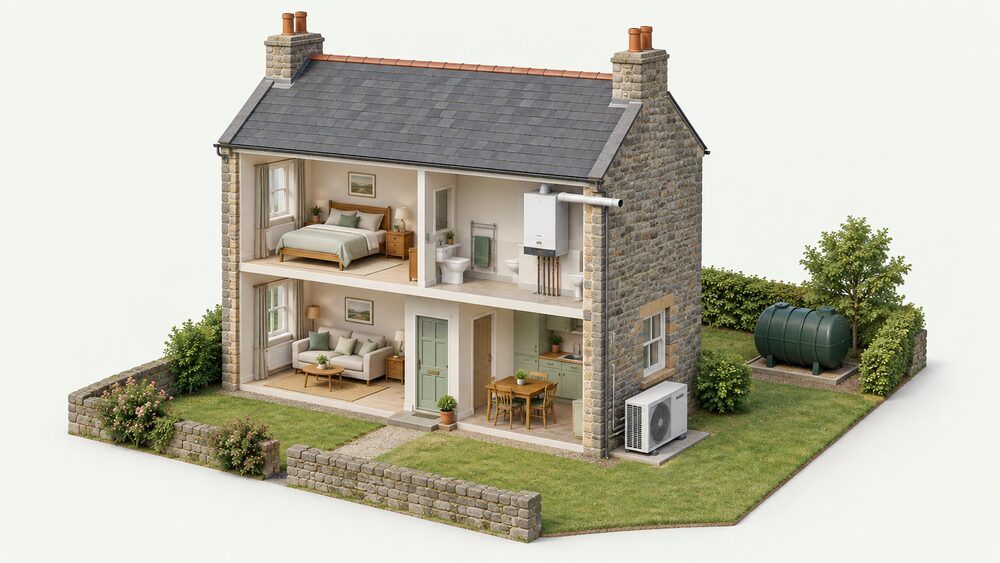
Welsh homes are heated overwhelmingly by mains gas, with a rural minority on heating oil and a small but growing number on heat pumps. Welsh Government housing statistics for 2017-18 found that 82% of dwellings in Wales used gas to heat their homes, and 98% of homes had central heating1. Heat is the single largest use of energy in the country: 40% of the energy used in Wales provides heat to homes, businesses and industry, and domestic heat alone accounted for 15.7 TWh in 20191.
The direction of travel is set out in policy rather than in the current stock. The Heat Strategy for Wales states that individual heat pumps are expected to be the dominant solution for homes in Wales, and the Climate Change Committee advises that by 2033 nearly a quarter of existing homes in Wales are heated by low-carbon electrified heating, predominantly heat pumps3. Against that, ONS energy efficiency statistics published in March 2025 put heat pump use at 1.5% of properties with EPCs in Wales, rising to 3.0% for detached properties5.
The gap between the two numbers is the story of Welsh heating. It is a gas country with a rural oil fringe, a large old housing stock, a devolved government with limited control over the gas grid and the electricity market, and a target of 580,000 heat pumps installed by 20356.
What are the figures?
The current stock and the renewable heat base are two different pictures, and both matter.
On the stock, the Welsh Housing Conditions Survey found that most dwellings in Wales (82%) used gas to heat their homes, and the Welsh Housing Quality Standard progress report recorded that 98% of homes now have central heating1. Gas is not only a heating fuel: 60% of gas use in Wales goes to domestic space heating, cooking and hot water1.
On renewable heat, Welsh Government energy generation statistics counted 22,067 heat pump projects in Wales by 2023, bringing the total number of heat pumps in Wales to 22,000, with approximately 6,900 new heat pumps installed during 20236. Renewable heat capacity reached 869 MW in 2023, an increase of 67 MW during the year, and Welsh renewable heat projects produced nearly 2.7 TWh in 20236. The mix is not dominated by heat pumps: 63% of all renewable heat capacity is from biomass heat, followed by 16% from heat pumps8.
Government-supported installations give a quarterly view of the pace. In Wales, the figures for 2024 were 1,786 installations in Q1, 1,803 in Q2, 1,617 in Q3 and 1,484 in Q49. Wales took a 6% share of UK government-supported heat pump installations in the year ending June 2019, compared with 19% in the year ending June 202410.
| Measure | Figure | Period | Source |
|---|---|---|---|
| Dwellings using gas for heating | 82% | 2017-18 | 2 |
| Homes with central heating | 98% | 2016 | 11 |
| Properties with EPCs using heat pumps | 1.5% (3.0% detached) | March 2025 | 5 |
| Heat pump projects in Wales | 22,067 | 2023 | 6 |
| New heat pumps installed | approximately 6,900 | 2023 | 6 |
| Renewable heat capacity | 869 MW | 2023 | 6 |
| Renewable heat generation | nearly 2.7 TWh | 2023 | 6 |
| Government-supported installations | 1,786 / 1,803 / 1,617 / 1,484 | 2024 Q1 to Q4 | 9 |
What drives them

Three forces shape how Welsh homes are heated: the gas network, rural geography, and the age and fabric of the housing stock.
The gas network explains the headline. Mains gas reached most of urban and semi-urban Wales, and 82% of dwellings connected to it2. Where gas is available, it has historically been the cheapest and simplest option, and the Welsh housing stock was built around it.
Rural geography explains the oil fringe. A 2026 Trading Standards news item reports that in Wales roughly 28% of rural homes use heating oil as their primary heating source, and that over 860,000 homes across England and Wales rely on heating oil7. Older parliamentary evidence put heating oil as the second most common heating fuel in Wales at 11 per cent of homes, and found it accounted for 46 per cent of remote rural homes in Wales12. Those homes are off the gas grid by distance, not by choice, and they carry the consequences: 35 per cent of oil-heated homes in Wales have solid walls, against 25 per cent of homes in Britain as a whole12.
Fabric explains the pace of change. The Warm Homes Programme has been the main delivery route, and the Climate Change Committee's 2023 progress report identified the scheme's reliance on fossil fuel heating and slow roll-out as issues to address13. The current programme takes a fabric, worst and low carbon first approach to improve the long term energy efficiency of the least thermally efficient low-income households in Wales14. The Welsh Government's long term vision is that homes are thermally-efficient and served in the main by heat pumps, with a whole building approach taken to the transition4.
"Homes are thermally-efficient and served in the main by heat pumps, a whole building approach has been taken to the transition"
How does it differ across the UK nations?
Wales sits between England and Scotland on most heating measures, and the differences are consistent enough to be useful.
On non-gas homes, older parliamentary evidence found that 60 per cent of non-gas heated homes in Wales were F and G rated on the EPC scale, against 49 per cent in England and 22 per cent in Scotland, compared with less than 10 per cent of gas-heated homes12. That is the sharpest single figure on Welsh heating: the homes outside the gas network are also the homes least able to retain heat.
On oil, the same evidence found detached homes and bungalows accounted for 52 per cent of all homes with oil heating in Wales, against 60 per cent in England and 71 per cent in Scotland, compared with 31 per cent of all homes in Britain12. Oil heating in Wales is less concentrated in detached property than in Scotland, which reflects a different rural housing pattern.
On rural oil specifically, the 2026 Trading Standards figure of roughly 28% of rural Welsh homes using oil as the primary source sits alongside the older parliamentary figure of 46 per cent of remote rural homes7. The two are measuring different geographies, rural and remote rural, so the shares are not directly comparable.
On funding, the UK Government allocation for households in Wales that use oil for heating and hot water is based on the number of households using heating oil rather than on the Barnett formula15. That is a deliberate departure from the usual block grant mechanism, and it recognises that off-gas homes in Wales face costs the formula would not capture.
| Measure | Wales | England | Scotland |
|---|---|---|---|
| Non-gas homes EPC F or G | 60 per cent | 49 per cent | 22 per cent |
| Oil-heated homes with solid walls | 35 per cent | 33 per cent | 47 per cent |
| Oil heating in remote rural homes | 46 per cent | 34 per cent | 32 per cent |
| Detached homes and bungalows among oil-heated homes | 52 per cent | 60 per cent | 71 per cent |
Source: parliamentary written evidence, 2011-1212.
What are the rules?

Welsh heating policy operates within a partly devolved settlement, and the boundaries matter for what a household can access.
Heat and cooling networks, but not the regulation of them, and schemes providing incentives to generate or produce heat or cooling from sources other than fossil fuel or nuclear fuel, together with the encouragement of energy efficiency otherwise than by prohibition or regulation, are devolved matters to Wales16. That gives the Welsh Government control over support schemes and heat planning, but not over the gas market, electricity market or the regulation of heat networks. The division is set out in more detail in which energy powers are devolved and which are reserved.
On new build, Welsh Government policy states that by 2025 there will be no gas connections in new build homes in Wales to support decarbonisation efforts17. New dwellings are also subject to Part L and Part O requirements. Part L changes include improved fabric, PV, wastewater heat recovery, air tightness tests for all new homes, removing the fuel factors, and self-regulating devices in all new homes18. Part O requires that dwellings shall be designed and constructed in such a way as to provide reasonable mitigation from the risk of summertime overheating, and that any mitigation measures shall be safe, secure and reasonably practical for occupants18. The planning side is covered in planning rules for home energy equipment in Wales.
On fuel poverty, Wales uses a satisfactory heating regime as part of its definition. For households with older or disabled people, that is 23°C in the living room and 18°C in other rooms, required for 16 hours in a 24-hour period19. For all other households, 21°C in the living room and 18°C in other rooms is required for nine hours in every 24-hour period on weekdays, and 16 hours in a 24-hour period on weekends19. The rate and strategy are set out in fuel poverty in Wales.
Support for heating improvements
Welsh support for home heating runs through the Warm Homes Programme and its successor arrangements, with a separate loan route through the Development Bank of Wales.
The Warm Homes Programme, delivered through Nest and Arbed, improved the energy efficiency of more than 61,400 homes in Wales by the end of March 2020, following investment of more than £366m16. Nest provides all householders in Wales with access to advice and support to help them reduce their energy bills, and for eligible householders it includes a referral for a package of free home energy efficiency measures such as a new boiler, central heating system, loft or cavity wall insulation, or renewable technologies20. The scheme makes Welsh homes warmer and more energy efficient places to live21.
The current programme takes a demand-led approach to support all households across Wales with advice to help improve energy efficiency, reducing fuel bills and carbon emissions22. The Welsh Government has said it will prioritise low carbon heat as part of the next iteration of the Warm Homes Implementation Programme to support households in fuel poverty in owner-occupied and private rented homes4.
Green Homes Wales is run by the Development Bank of Wales and helps homeowners in Wales to improve their homes with energy efficiency upgrades, whether that is installing a heat pump, upgrading their insulation, or modernising their heating system23. The scheme is designed to support eligible homeowners in making energy-efficiency and low carbon heat improvements to their homes24.
On bills, the Welsh Government Fuel Support Scheme was extended to more than 400,000 low-income households in Wales, with a £200 payment to help keep their homes warm25. A separate Heat Fund was expected to help an estimated 2,000 households across Wales24.
- Warm Homes Programme: fabric, worst and low carbon first approach, advice for all households and measures for eligible ones14
- Nest: advice and support for all householders, plus free measures for eligible householders20
- Green Homes Wales: energy efficiency and low carbon heat improvements for eligible homeowners23
- Fuel Support Scheme: £200 payment extended to more than 400,000 low-income households25
The closed Arbed scheme is covered in Arbed: the closed Welsh energy efficiency scheme, and the social housing standard in the Welsh Housing Quality Standard and home energy.
Wales' renewable heat base
Renewable heat in Wales is larger than the heat pump headline suggests, and its composition explains why.
At the end of 2021, total renewable heat capacity installed in Wales was 742 MW, with production of renewable heat estimated at approximately 2.42 TWh, compared with 2.37 TWh generated in 20208. Of that capacity, 63% was from biomass heat, followed by 16% from heat pumps8. Biomass heat alone accounted for 465 MW across 3,550 projects, with estimated generation of 1,425 GWh, while heat pumps accounted for 122 MW across 11,171 projects, with 199 GWh estimated generation8.
The project count tells a different story from the capacity count. Approximately 94% of renewable heat projects commissioned in Wales in 2021 were heat pumps, from over 2,000 individual projects, but the majority of new capacity came from 2,073 heat pump projects adding 21 MW of electrified heat8. Heat pumps are numerous and small; biomass is fewer and larger.
By 2023 the picture had grown. Renewable heat capacity reached 869 MW, with 67.5 MW installed during 2023, and an estimated total of 2.6 TWh of Welsh renewable heat generation6. Regionally, Mid Wales accounts for the greatest proportion of renewable heat capacity in Wales (32%), followed closely by North Wales (31%), with the Cardiff Capital and Swansea Bay City regions at 18% each8. In 2023, Mid Wales and North Wales were reported at 31% each6.
Wales also has a geothermal option under examination. The Welsh Government has published a mine water heat opportunity map, and has described the legacy of Welsh coal mines as a key industrial resource that could heat homes in future26. That is a heat network proposition rather than a household one, and it depends on the devolved heat network powers described above.
What it means for energy independence

Heat is where Welsh energy dependence is concentrated, and the numbers make the case plainly.
Energy consumption for heat, such as in homes, businesses and industry, in Wales is more than four times the consumption of electricity8. Most of that heat comes from gas, a fuel Wales does not produce or control at scale, and 60% of gas use in Wales goes to domestic space heating, cooking and hot water1. A household on mains gas is dependent on the grid, a supplier and an imported fuel market simultaneously.
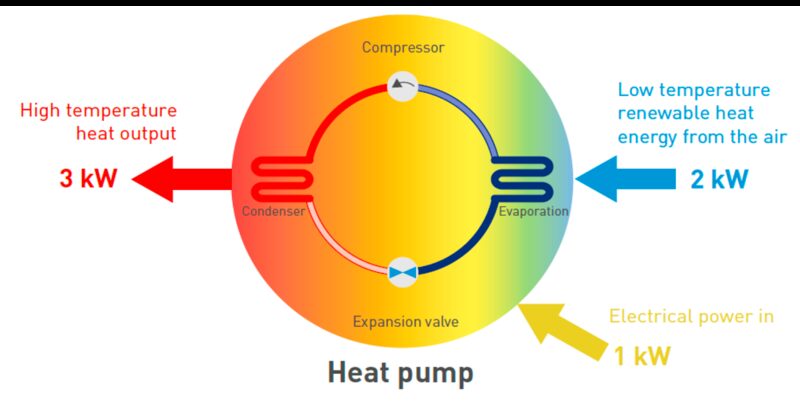
Electrified heat changes the shape of that dependence rather than removing it. A heat pump household still depends on the electricity grid and a supplier, and on the manufacturer of the unit for parts and warranty support. What it removes is the direct dependence on a combustion fuel delivered to the property, which is the dependence that bites hardest for the roughly 28% of rural Welsh homes on heating oil7. For those households, a heat pump or another renewable source substitutes a delivered fuel for a networked one.
The scale of the shift is the constraint. The target of 580,000 heat pumps in Wales by 2035 compares with 22,067 heat pump projects counted by 20236. The Climate Change Committee's advice that nearly a quarter of existing Welsh homes should be on low-carbon electrified heating by 2033 sets the pace required3. Improved energy efficiency has already done part of the work: it has led to an estimated 37% decrease in average energy consumption required to maintain a satisfactory heating regime between 2008 and 201816.
The domestic investment implied is substantial. The Heat Strategy for Wales puts domestic investment to 2050 at £56.7bn, 23% of the total, covering social housing at roughly 223,000 homes, private rental at roughly 231,000 homes and owner-occupied at roughly 895,000 homes4. Wales' carbon budgets and net zero target are covered in Wales' carbon budgets and net zero target, and the wider renewable generation picture in Wales' renewable energy targets and household generation.
Sources26 cited
- Energy Use in Wales report, Welsh Government, 2022
- Welsh Housing Conditions Survey: energy efficiency of dwellings, April 2017 to March 2018, Welsh Government, 2017-18
- Wales fourth carbon budget, Climate Change Committee
- Draft heat strategy for Wales, Welsh Government, 2023
- Energy efficiency of housing in England and Wales, Office for National Statistics, 2025
- Energy generation in Wales 2023, Welsh Government, 2025
- Cost of living pressures and soaring prices expose gaps in bulk fuel checks, Trading Standards, 2026
- Energy generation in Wales 2021, Welsh Government, 2022
- Heat pump deployment quarterly statistics, United Kingdom, June 2024, Department for Energy Security and Net Zero, 2024
- Heat pump deployment quarterly statistics, United Kingdom, 2024 Q3, Department for Energy Security and Net Zero, 2024
- Progress on the Welsh Housing Quality Standard, Welsh Government, 2016
- Written evidence on fuel poverty, UK Parliament, 2011-12
- Heat pumps used in central heating, England and Wales, Office for National Statistics, 2025
- New Warm Homes Programme integrated impact assessment, Welsh Government, 2024
- Main fuel type or method of heating used in central heating, England and Wales, Office for National Statistics, 2025
- Outcome summary: tackling fuel poverty 2020 to 2035, Welsh Government, 2021
- Legacy of Welsh coal mines could heat homes of the future, Welsh Government
- Part L Wales impact assessment: domestic existing and new build, Welsh Government, 2022
- Fuel poverty modelled estimates for Wales, October 2024, Welsh Government, 2025
- £104m to heat Wales' most vulnerable households, Welsh Government
- Warm Homes Nest report reveals benefits for homes and businesses, Welsh Government
- New Warm Homes Programme children's rights impact assessment, Welsh Government, 2024
- £5 million to help Welsh households invest in greener homes, Welsh Government
- Choosing a retrofit coordinator: what you need to know, Development Bank of Wales
- Welsh Government Fuel Support Scheme extended to more than 400,000 low-income households, Welsh Government, 2022
- Written statement: publication of Wales' mine water heat opportunity map, Welsh Government
 Home HeatingMost Scottish homes are heated by mains gas, so what happens to the rest?
 Energy Policy in WalesWhat help can you get in Wales to make your home warmer and cheaper to run?
 Home HeatingWhy do so many homes in Northern Ireland run on heating oil, and will that ever change?
 Housing Stock Data for WalesHow energy efficient are Welsh homes, and how many have a rating?
 Hydrogen Heating PolicyWill hydrogen ever heat your home, and when will the government decide?
 Energy Supply in WalesWales makes more electricity than it uses, but how much of it comes from renewables, and will that reach all of it by 2035?