
In this guide
Heating oil and bulk LPG are the fuels of the homes the gas grid never reached. Around 1.5 million UK homes use oil for heating, including many in Northern Ireland, and around two hundred thousand households use LPG1. Liquid Gas UK puts the wider off-grid population at some two million properties that depend on alternative fuels for heating and cooking, against 84% of domestic properties connected to the gas grid2.
Neither fuel is delivered by pipe. Oil arrives by tanker into a tank the householder usually owns; bulk LPG arrives by tanker into a tank the supplier usually owns, under a contract that runs for years3. Neither fuel is covered by Ofgem's energy price cap, so households carry the full movement of the international product markets that set the price4. The Commons Library is explicit that heating oil prices "aren't regulated by Ofgem and aren't covered by the energy price cap"4.
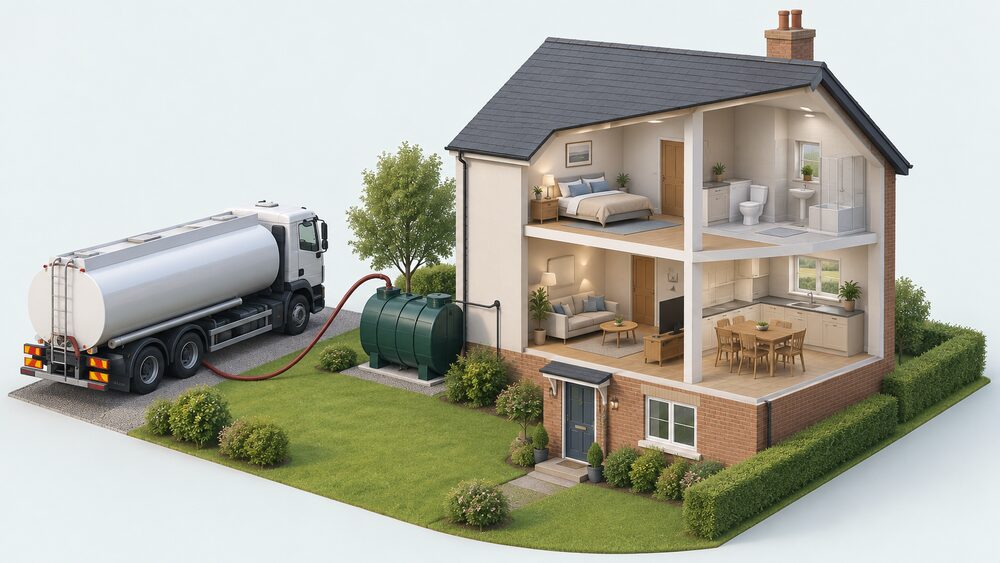
The practical consequence is that off-grid fuel security is a household matter: ordering ahead, watching the tank, and understanding that a winter price spike passes straight through to the bill. This page sets out how the two fuels are supplied, what they cost, how they compare on emissions, who owns and sites the tank, why no price cap applies, and how safety is managed.
Who heats with oil and LPG: the two million homes off the gas grid
The off-grid population is small in national terms and heavily concentrated in particular places. Which? reports around 1.5 million UK homes using oil for heating, including many in Northern Ireland, and around two hundred thousand households on LPG1. Oftec describes liquid fuel heating as the fuel of choice for around one million homes in Great Britain and a similar number in Ireland3. The Commons Library's 2024 figure was around 1.6 million homes across the UK using heating oil7, and a 2026 Commons debate referred to 1.5 million UK households using heating oil8. The figures differ by period and by what is counted, and the direction of travel is broadly flat rather than sharply falling.
The geography matters more than the total. Northern Ireland has a much higher share of oil heating than Great Britain, which is why oil-specific support schemes have been designed around it. In England, government support has been directed at "targeted areas with higher rates of oil heating" rather than spread nationally9. Wales and Scotland have run their own schemes for the same households10.
For a household, the significance is structural. A home on oil or LPG sits outside the gas network, so it cannot fall back on a piped supply when a tank runs low or a delivery is delayed. It also sits outside the retail market protections that come with a gas connection. The dependence is not on a pipe or a supplier's network in the ordinary sense; it is on a distributor's lorry reaching the property, and on the household having ordered in time. That is a different kind of exposure from a grid connection, and it shapes everything else on this page.
What LPG is and where it comes from
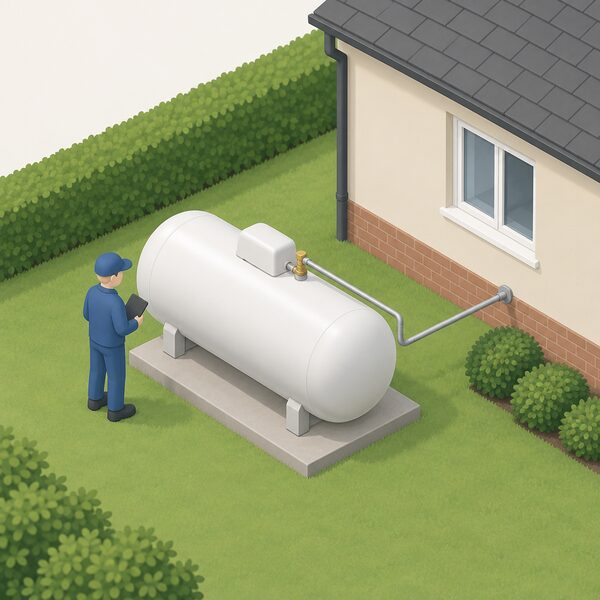
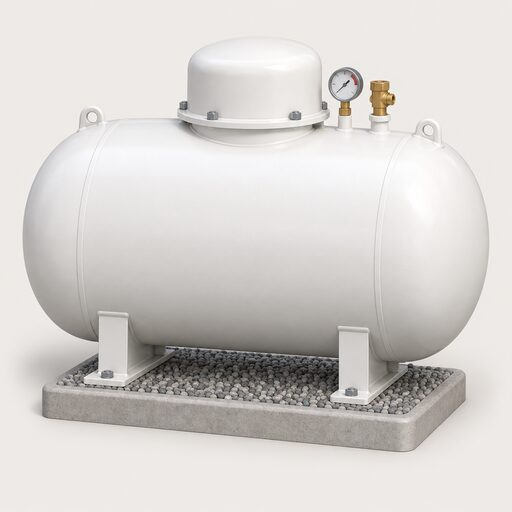
Liquefied petroleum gas is a pressurised fuel. Scottish building standards guidance describes the installations it covers as those where LPG "is stored under pressure at ambient temperatures in fixed vessels larger than 75 kg LPG capacity"12. That is the defining physical characteristic: LPG is kept as a liquid under pressure and released as a gas for burning, which is why it needs a pressure vessel rather than a simple tank.
It burns in the same appliances as mains gas. Liquid Gas UK states that LPG fuels all familiar domestic gas appliances, including central heating boilers, gas fires, gas ranges, AGAs and cookers2. For a household moving from mains gas, or already off-grid, that means the appliance market is familiar rather than specialist.
On combustion, Liquid Gas UK states that LPG produces 90% less carbon monoxide and 50% less smog than mains natural gas2. Those are the supplier body's own figures for its own fuel and should be read as such. On carbon dioxide, Which? is blunt that LPG "is a fossil fuel and produces carbon dioxide when it's burnt so it's not environmentally-friendly"1. Oftec states that the carbon emissions from LPG are slightly lower than oil3, and Liquid Gas UK puts LPG at 12% less than oil2.
The supply chain behind the tank is international. LPG is a product of oil refining and gas processing, so its price and availability track the same global markets as other petroleum products. A household with a bulk tank is therefore exposed to import and shipping conditions it cannot influence, in the same way as a household buying heating oil.
Heating oil and LPG supply: how fuel reaches your home
Both fuels are delivered by road tanker, and the arrangements around that delivery are where the two diverge most.
For heating oil, the householder owns the tank and orders from a distributor. The market is competitive: a 2026 Commons statement noted that "Heating oil, by contrast, is supplied through a highly competitive market"8. That competition is the main consumer protection available, and it is why shopping around between distributors is the normal practice.
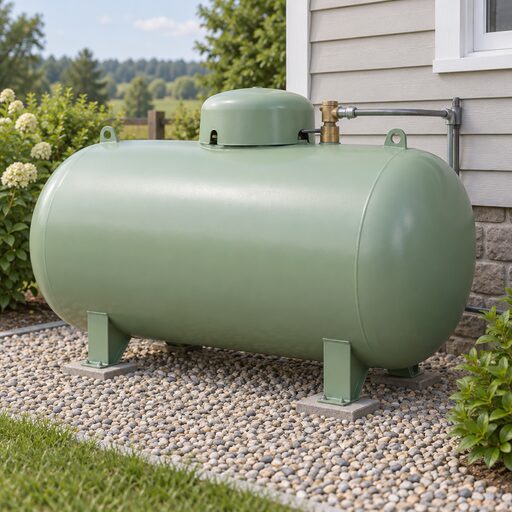
For bulk LPG, the supplier owns the tank and the relationship is contractual. Oftec states that "unlike liquid fuel tanks, the tank is usually owned by the company that supplies the gas"3. That ownership brings an ongoing annual rental charge3, and Oftec adds that homeowners "are usually tied into long contracts, which limits your options when it comes to finding a better deal"3. Which? confirms the switching position: a bulk tank customer can switch supplier only if they are not within a contract, and the supplier should tell them a month before the contract finishes1.
Monitoring has improved on the LPG side. Liquid Gas UK states that telemetry systems can alert the supplier when fuel is low, making deliveries manageable and efficient2. That reduces, but does not remove, the risk of running out.
Cost: what oil and LPG cost to buy and to run
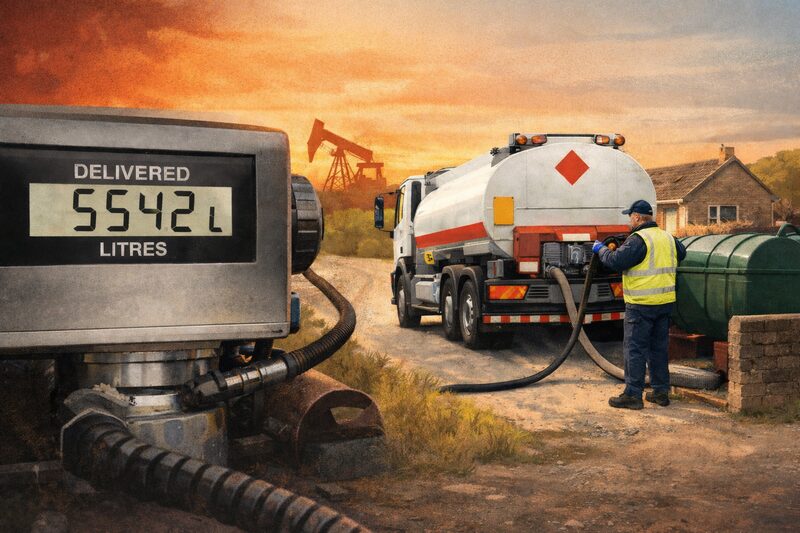
Heating oil prices moved violently in 2026. Typical mid-month prices were 104 pence per litre in March and April 2026, surpassing the previous peak4. The Commons Library records that the average price of home heating oil in the UK increased by over 100%, from approximately 60 pence per litre to over 120 pence per litre, between the end of February and mid-March 20264. Prices had been 53 pence per litre in February 20267, and 58 pence per litre in mid-June 20247. The March 2026 spike was linked to supply disruption following the start of the Israel/US-Iran conflict4.
The UK compares well internationally on this fuel. In mid-June 2026 the UK figure was 76.6 pence per litre, cheaper than anywhere in the EU, where the cheapest was Malta at 86.9 pence per litre4.
LPG is a different proposition. Oftec states plainly that "The biggest disadvantage of LPG is that it is one of the most expensive heating fuels"3. The Commons Library gives bulk propane at £1,800 to £2,200 a year for a three-bedroom semi-detached house in Great Britain, as of March 20265. Which? reports that an average medium-use household requires around 11,500 kWh a year for heating and hot water, costing around £923 a year on LPG, and that in July 2025 LPG cost an average 57p per litre according to Sutherland Tables1. The two running-cost figures differ because they describe different houses, usage levels and periods.
Against mains gas, the gap is stark. The Commons Library records the cost of heating a typical three-bedroom house as 100% higher with LPG than with mains gas13. On efficiency, Which? notes that LPG is an efficient fuel, so a household gets a good return on every unit of energy, and that the government estimates a litre of LPG converts to 7.1 kWh1.
| Fuel | Figure | Period | Source |
|---|---|---|---|
| Heating oil | 104 pence per litre | March and April 2026 | 4 |
| Heating oil | 76.6 pence per litre (UK, vs Malta 86.9) | mid-June 2026 | 4 |
| Heating oil | 53 pence per litre | February 2026 | 7 |
| LPG | 57p per litre average | July 2025 | 1 |
| Bulk propane running cost | £1,800 to £2,200 a year, three-bed semi | March 2026 | 5 |
| LPG vs mains gas | 100% higher heating cost | 2026 | 13 |
Emissions: how oil and LPG compare with each other and other fuels
Heating with fossil fuels carries a national emissions weight. The Welsh Government states that heating with fossil fuels like gas and oil contributes to 17% of the UK's total emissions14. That figure covers the heating sector as a whole rather than off-grid fuels alone, but it sets the context in which oil and LPG are judged.
Between the two off-grid fuels, the difference is modest. Oftec states that the carbon emissions from LPG are slightly lower than oil3, and Liquid Gas UK puts LPG at 12% less than oil2. Neither is a low-carbon fuel. Which? states that LPG is a fossil fuel and produces carbon dioxide when burnt, so it is not environmentally-friendly1.
The comparison that matters for a household considering a change is against a heat pump. A Northern Ireland consultation on building regulations worked through the delivered energy of an LPG boiler replacing an oil-fired boiler and arrived at 1.075 kWh per kWh of heat output, which it recorded as acceptable in the Scotland worked example15. That is a measure of delivered energy rather than emissions, but it shows the frame regulators use when comparing the two liquid fuels.
The direction of policy is away from both. The Climate Change Committee's assessment of the UK's Heat and Buildings Strategy found that the strategy "sets a new policy direction, focusing on a rapid scale-up of supply chains through a market-based approach", while concluding that plans are not yet comprehensive or complete and that significant delivery risks remain16. For an off-grid household, that means the fuels remain legal and available, but the policy current runs against them.
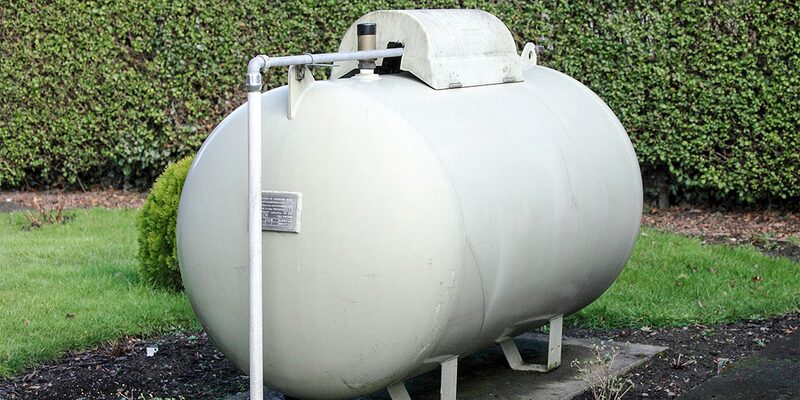
Tanks and storage: ownership, rental and siting
Ownership is the single biggest practical difference between the two fuels. A heating oil tank belongs to the householder. A bulk LPG tank usually belongs to the supplying company3, which brings an ongoing annual rental charge3 and the long contracts that go with it3.
Siting has options. Liquid Gas UK states that tanks can be buried below ground to improve the aesthetics of a building2. That is a recognised route for households that do not want a visible vessel, though it changes the installation work involved.
On planning, the general position for internal heating work is permissive. The Planning Portal states that planning permission is not normally required for the installation or replacement of a boiler or heating system if all the work is internal18. For external plant, the picture varies by technology and property. Ground source heat pump installation within the curtilage of a house or block of flats does not require planning permission, but listed building consent may be required if the property is listed19. Air source heat pumps are permitted development, with planning permission and listed building consent required for listed buildings20. Ground source heat pumps are typically considered permitted development, with listed building consent needed for listed buildings20.
For a household weighing a tank against a heat pump, the planning position is therefore not the obstacle in most cases. The obstacles are cost, the physical space a tank needs, and the contract that comes with a supplier-owned LPG vessel.
Contracts, suppliers and why LPG has no price cap
The absence of a price cap is the defining consumer fact about both fuels. The Commons Library states that heating oil prices "aren't regulated by Ofgem and aren't covered by the energy price cap"4. Trading Standards frames the consequence directly: heating oil is not covered by Ofgem's energy price cap, "leaving consumers fully exposed to sudden market increases"6.
The rationale given for the oil market is competition. A 2026 Commons statement contrasted heating oil, "supplied through a highly competitive market", with the loyalty penalty that led to the gas and electricity price cap8. In other words, the argument is that oil customers can and do shop around, so a cap is not needed.
Northern Ireland sits differently again. The Energy Price Guarantee guidance records that energy prices were not capped in Northern Ireland and that suppliers there have flexibility to set tariffs independently to reflect their costs of operating21. Heat networks are a further category outside the cap: Edinburgh's guidance notes that they are not covered by the Ofgem energy price cap or the Energy Price Guarantee because they are classed as commercial supplies22.
For LPG, the contract is the mechanism in place of a cap. Oftec notes that homeowners are usually tied into long contracts, which limits their options when finding a better deal3. Which? sets out the switching conditions: a bulk tank customer can switch as long as they are not within a contract, and the supplier should tell them a month before the contract finishes1.
Safety and handling: what the hazards are and how they are managed
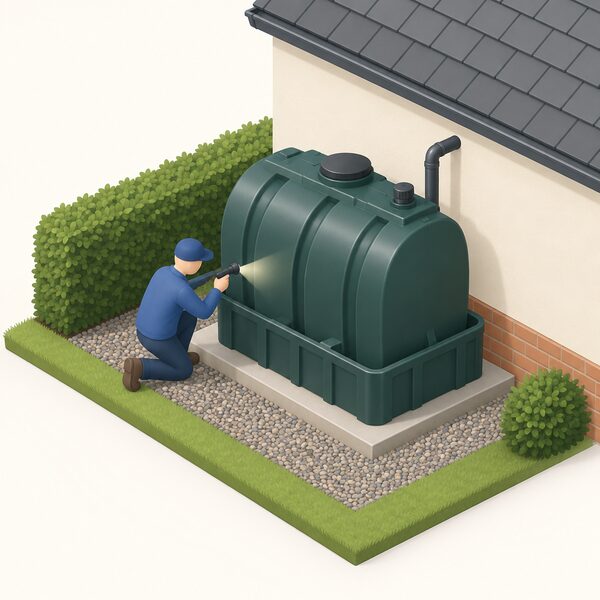
The environmental risk from heating oil is specific and expensive. nidirect states that oil can pollute rivers, harm wildlife and contaminate ground and drinking water, and that clean-up costs can be significant and are not always covered by household insurance policies23. That is the reason tank condition matters more than the fuel itself.
Inspection is the routine control, and tank life is the longer-term one. LPG tanks can be left on site for up to 30 years, against oil tanks that need replacing every 15 to 20 years23. LPG is very safe when used and transported correctly, but it remains a flammable fuel: in liquid form the tank pressure is about twice the pressure in a normal truck tyre. Spillage carries no environmental risk, because the liquid readily evaporates rather than soaking into ground or watercourses23.
For LPG, the safety frame is the pressure vessel. Scottish building standards guidance covers installations where LPG is stored under pressure at ambient temperatures in fixed vessels larger than 75 kg capacity12. That is the regime that governs how such vessels are sited and maintained.
Landlord obligations touch heating controls in the social housing context. Welsh guidance for landlords lists controllable heating systems among the actions relevant to heat hazards24. That is a narrower point than domestic fuel safety, but it shows that heating control is treated as part of habitability.
"It can pollute rivers, harm wildlife and contaminate ground and drinking water. It's not just the cost of losing the oil"
Oil and LPG in a changing energy market
The market these fuels sit in has been volatile for years. The Commons Library records that the high gas price rise forced several energy suppliers out of the market25. The Spring Statement of 2022 described the UK as "a net energy importer with a high dependence on gas and oil"26. That dependence is the backdrop to every price movement an off-grid household experiences.
The 2026 oil spike showed how fast it can move. Prices almost doubled in one month in March 2026, with a 95% increase in a single month recorded7, and the spike was linked to supply disruption following the start of the Israel/US-Iran conflict4.
Policy is pushing in the other direction. The Heat and Buildings Strategy is intended to help protect UK consumers from future price spikes and increase energy security by reducing energy needs and shifting demand from gas to electricity, which in future will be predominantly supplied from UK-based renewable generation16. The Warm Homes Plan sets a UK-level ambition for heat pumps27. Support is also available for installers and manufacturers to expand supply chains28.
For a household, the honest reading is that oil and LPG remain available and functional, but they are the fuels policy is designed to move away from. The dependence they carry is on international product markets, on a distributor's lorry, and, for LPG, on the company that owns the tank. None of those is within a household's control. What is within reach is ordering ahead, keeping the tank and pipework in condition, and understanding the contract terms before signing.
Sources28 cited
- LPG central heating, Which?, 2025-09-22
- New to LPG, Liquid Gas UK, 2026-09-20
- What heating options are available off the grid?, Oftec, 2026-09-20
- Heating oil prices and the energy price cap, House of Commons Library, 2026
- LPG and heating costs, House of Commons Library, 2026
- Cost of living pressures expose gaps in bulk fuel checks, Trading Standards, 2026
- Heating oil statistics, House of Commons Library, 2026
- Heating Oil Support, Hansard, 2026-03-16
- Over £50 million to help families struggling with soaring heating oil costs, GOV.UK, 2026-03-16
- Thousands of Welsh households get help with oil and LPG heating costs, Welsh Government, 2026-03-31
- Fund opens for Scots to claim heating oil support, Advice Direct Scotland, 2026-04-01
- Liquefied petroleum gas storage, Scottish Government, 2017-03-01
- Comparison of heating costs by fuel, House of Commons Library, 2026-09-17
- Your essential guide to heat pumps, Welsh Government, 2025-02-20
- Building regulations discussion document, Northern Ireland Department of Finance, 2023-10-11
- Independent assessment of the UK's Heat and Buildings Strategy, Climate Change Committee, 2022-03-16
- Greater protections to restore families' trust in home upgrades, GOV.UK, 2026-06-17
- Boilers and heating: planning permission, Planning Portal, 2026-09-17
- Heat pumps, New Forest District Council, 2026-09-17
- Air and ground source heat pumps, London Borough of Croydon, 2026-09-17
- Energy Price Guarantee up until 30 June 2023, GOV.UK, 2026-09-17
- Edinburgh LHEES, City of Edinburgh Council, 2023-12
- Check your oil tank, nidirect, 2026-09-17
- Fitness for human habitation guidance for landlords, Welsh Government, 2022-01-13
- Energy suppliers and the gas price rise, House of Commons Library, 2022-01
- Spring Statement 2022, HM Treasury, 2022-03
- Warm Homes Plan technical annex, GOV.UK, 2026-09-17
- Heat pumps and supply chains, Parliamentary Office of Science and Technology, 2026-09-19
 LPG and Heating Oil SuppliersWho owns the tank in your garden, and can you switch supplier if they do?
 Heating Oil and LPG PricesHeating oil and LPG prices change fast, so what is a fair price today and why did it jump so sharply this year?
 LPG Boilers and HeatingWhat LPG is, how LPG boilers differ from natural gas appliances, and how bulk tanks and cylinder supply work for off-grid homes.
 Heating Off the Gas GridThe options for the four million UK households with no mains gas connection: oil, LPG, electric, heat pump, biomass and solid fuel, and how their costs, storage and supply security compare.
 Oil Boilers and Heating OilHow oil-fired boilers work, the kerosene they burn, and the tanks, burners and servicing they need.
 The Full Statistics GuideHow many homes in the UK have solar panels, heat pumps or batteries?