In this guide
LPG and heating oil sit outside the regulated gas and electricity market. LPG is delivered by road and stored in a tank rather than being piped directly into your home, and the tank is usually owned by the company that supplies the gas1. That single fact shapes everything else: the contract, the switching rules, the rental charge and who is responsible for testing the vessel.
Around two million UK properties are off-grid and depend on alternative fuels for heating and cooking3. Those households use heating oil, liquefied petroleum gas, solid fuels, mains electricity and microgeneration, and there is limited opportunity for such consumers to switch fuel source4. LPG averaged 57p per litre in July 20251, and it is a lower-carbon alternative to oil that does not contain sulphur2.
The practical questions for a household are narrower than the fuel debate: who owns the tank, how long the exclusivity period runs, how the tanker finds you before the tank empties, and what happens when something goes wrong. This page sets out the arrangements for both LPG and heating oil, and where the consumer protections differ from those attached to a licensed gas or electricity supplier.
What LPG is and where it comes from
LPG stands for Liquefied Petroleum Gas7. It is a by-product of two large energy industries: the processing of natural gas liquids and the refining of crude oil7. The two forms generally available in the UK are commercial butane and commercial propane8. Bulk domestic heating systems run on propane, which is why the terms bulk propane and bulk LPG are used interchangeably in quotes and contracts.
The supply chain is physical rather than networked. LPG is delivered by road and stored in a tank on the property, which is the main difference from mains gas1. There is no pipe under the street to fall back on and no national transmission system balancing supply minute by minute. A household's fuel security is therefore a tank level and a delivery schedule, not a connection.
That has a sovereignty dimension worth stating plainly. A household with a full tank and a working boiler is independent of the gas grid and of electricity for heating, and is not exposed to the wholesale gas price movements that feed through to the price cap. What replaces that dependence is a commercial one: a single supplier with exclusive rights to fill the tank, a road tanker that has to reach the property, and a fuel whose price is set by the supplier rather than by a regulator.
Liquid Gas UK is the trade association representing the LPG and bioLPG industry in the UK9. Its codes of practice and customer charter set much of the framework that member companies operate within, including the ombudsman scheme that covers domestic bulk LPG, cylinder, autogas and equipment customers of member companies10.
Who LPG suits: the off-grid household
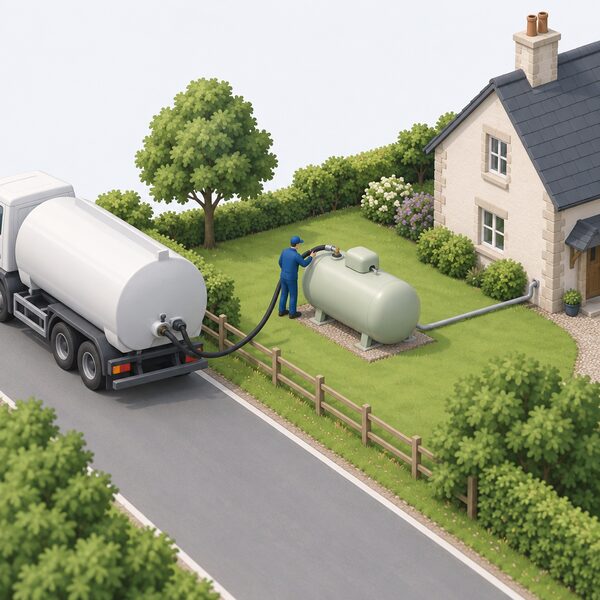
LPG suits properties with no mains gas connection and no realistic prospect of one. Some two million properties are off-grid and therefore depend on alternative fuel sources for heating and cooking3. Off-gas grid households use heating oil, LPG, solid fuels, mains electricity and microgeneration, and there is limited opportunity for such consumers to switch fuel source4.
The case for LPG over oil rests on installation cost and on the tank. The cost of LPG installation, compared with electric, oil and air source heat pumps, is significantly cheaper3. The tank itself is usually owned by the supplier, which can make a new installation cheaper than buying an oil tank outright, but means an ongoing annual rental charge applies2. LPG is stored as a liquid in tanks or cylinders and turns into gas when it is needed, and it is more versatile than oil in the home: the same supply can run gas hobs, radiators and ovens as well as the boiler1. It can also form part of a blended set-up alongside heat pumps, solar panels, EV chargers or wind turbines, so a household need not treat the choice as all or nothing1. The dependence that remains is plain: the fuel is bought from a supplier, delivered by road, and the tank on which the whole system rests belongs to that supplier.
The case against is cost and lock-in. One independent guide states that the biggest disadvantage of LPG is that it is one of the most expensive heating fuels, and homeowners are usually tied into long contracts, which limits your options when it comes to finding a better deal2. That is the trade a household is making: lower upfront cost and a longer-lived tank, in exchange for a higher running cost and a supply relationship that is harder to leave.
On emissions, LPG emits 12% less than oil3, and the carbon emissions from LPG are slightly lower than oil11. Liquid Gas UK describes LPG as emitting 33% less CO2 than coal and as the lowest carbon conventional fuel available to off-grid homes5. The England, Scotland and Wales carbon dioxide equivalent factor for LPG is 0.240 kgCO2e/kWh12.
Cylinders, bulk tanks or metered supply: which fits which home
There are three ways LPG reaches a property, and the choice is mostly determined by how much heat the home needs and how much space is available.
Cylinders suit low-demand properties, cooking, and homes where a tank cannot be sited. Flogas supplies four 47kg gas bottles in a storage unit for home heating, with automatic changeover valves so the supply switches when one bottle empties13. Cylinders are exchangeable rather than contracted: Flogas says its national stockists can supply bottles as and when you need them, and it has hundreds of stockists nationwide13.
Bulk tanks suit whole-house heating. The tank is filled by road tanker and the household draws from it until the level falls, at which point another delivery is scheduled. This is the arrangement that carries an exclusive supply contract and a tank rental charge.
Metered supply applies where a communal or landlord-owned installation serves more than one property, with the household billed for what it uses rather than buying the fuel itself.
| Arrangement | Who owns the storage | Typical fit | Contract position |
|---|---|---|---|
| Cylinders | The supplier, exchanged on use | Cooking, low demand, tight sites | No exclusivity; stockist exchange13 |
| Bulk tank | Usually the supplying company2 | Whole-house heating | Exclusive supply contract, tank rental10 |
| Metered | Landlord or operator | Communal or multi-property | Billed on consumption |
For heating oil, the equivalent guidance covers appliances up to 70kW output and tanks not greater than 3,500 litres in capacity, serving domestic properties14. Above that, the installation falls outside the domestic guidance and into commercial territory.

Tank ownership, rental and what the contract commits you to
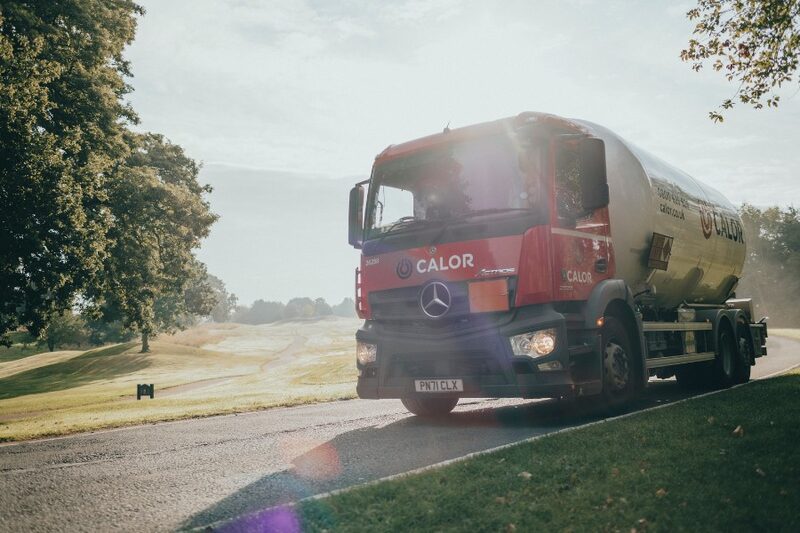
This is the part of LPG supply that catches households out, and it is worth being exact about it. Unlike liquid fuel tanks, the tank is usually owned by the company that supplies the gas11. The terms of the supply contract will include confirmation of tank ownership and that only the tank owner may supply gas to that tank10. In other words, the exclusivity is not a marketing preference; it is written into the contract as a condition of the tank being on the property.
The consequences follow directly. If you switch supplier, you'll need to transfer ownership of your tank to the new supplier or get a new tank installed1. You might need to buy or rent your LPG tank from your supplier, which adds to the cost1. All bulk domestic LPG customers whose gas is supplied via a bulk tank are able to switch their LPG supplier along with the ownership of their tank once no longer bound by any exclusivity period in a supply contract10.
Switching is therefore possible, but only at the right moment. You can switch supplier as long as you have LPG supplied into a bulk tank and are not within a contract; your supplier should tell you a month before your contract finishes1. The window matters, because a household that misses it and rolls into a new term is bound for the length of that term.
Where a household owns its own tank, the position is different. Liquid Gas UK notes that tank transfer between suppliers was, in its opinion, the appropriate remedy in a dispute over customer-owned bulk tanks15. But customer ownership brings its own obligations: consumers will have to ensure that there is appropriate formal Emergency cover for their installation, and this is not available via the Emergency Services15. The legislative framework for a customer-owned tank includes the Pressure Systems Safety Regulations and the Gas Safety (Installation & Use) Regulations15.
For heating oil, ownership is simpler and the responsibility is clearer. It is your responsibility to maintain the fuel storage tank on your property14. There is no exclusivity contract, because there is no supplier-owned vessel on the site.
Costs: price per litre, annual bills and why LPG sits outside the price cap
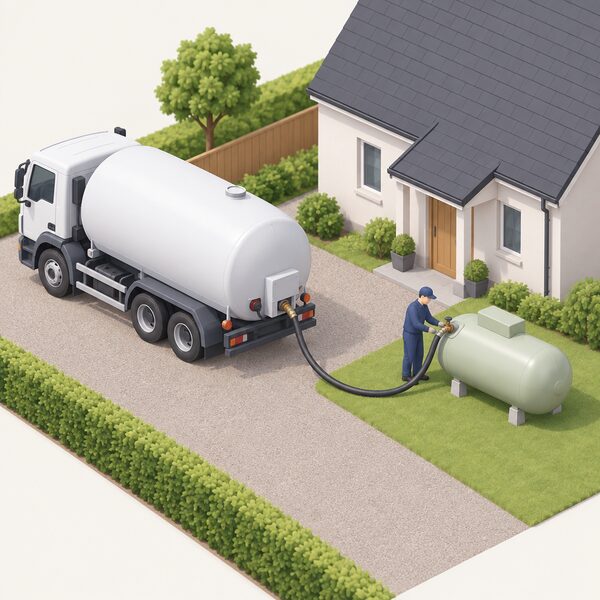
LPG is not covered by the energy price cap, and the reason is structural rather than political. The cap applies to domestic gas and electricity supplied through the grid by licensed suppliers. LPG arrives by road, is priced by the supplier, and is bought under a private contract. No cap level applies to it.
For comparison, the regulated gas benchmark maximum charges for 1 July to 30 September 2026 include a £127.52 standing charge and an £842.13 annual bill at 9,500 kWh on London Standard Credit, and a £127.57 standing charge with an £819.26 annual bill in the Eastern region16. Earlier cap periods give a sense of how much these move: London prepayment at 12,000 kWh per annum was £816.25 for 1 July to 30 September 202517, £826.21 for 1 October to 31 December 202518, and £809.82 on Other Payment Method for 1 April to 30 June 202419. None of these figures has any bearing on an LPG bill.
What an LPG household actually pays:
| Measure | Figure | Date and basis |
|---|---|---|
| Average LPG price | 57p per litre | July 2025, Sutherland Tables1 |
| Unit price | 9.1 pence/kWh | England, Scotland and Wales12 |
| Standing charge | £67 per year | England, Scotland and Wales12 |
| Standing charge | £63 per year | Northern Ireland12 |
| Gas standing charge | £106 per year | 29.04p per day, July to September 2026 price cap13 |
The standing charge differs between Northern Ireland and Great Britain: £63 a year in Northern Ireland against £67 in England, Scotland and Wales12. That is a small difference in absolute terms but it reflects a separate market with separate arrangements.
Heating oil is priced differently again. In mid-June 2026 the UK figure was 76.6 pence per litre, and the cheapest in the EU was Malta at 86.9 pence per litre, making UK heating oil cheaper than anywhere in the EU6. Comparing that with LPG's 57p per litre requires the energy conversion: a litre of LPG converts to 7.1kWh1, so the two fuels are not priced on the same unit.
Deliveries, telemetry and running out of fuel
A bulk LPG household has no reserve. There is no cylinder in the garage and no immersion heater on a bulk system, so the tank level is the whole of the fuel security. Deliveries are scheduled either from the supplier's own monitoring or from the household's readings.
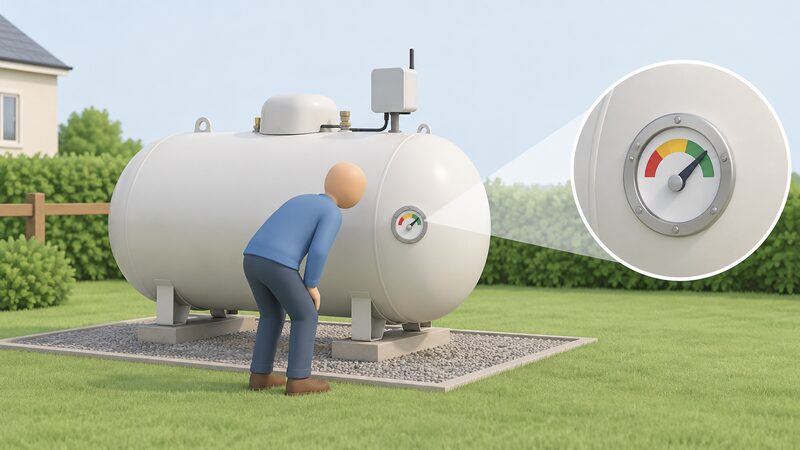
Telemetry and remote monitoring exist precisely to remove the guesswork. A gauge sends the tank level to the supplier, which schedules a tanker before the level becomes critical. Households without telemetry depend on checking the gauge and calling in, which works until a cold snap raises consumption or a delivery is delayed.
Running out has immediate consequences: no heating and no hot water until a tanker reaches the property. There is no equivalent of the supplier of last resort arrangements that protect domestic gas and electricity customers. The Supplier of Last Resort standard approach applies to both gas and electricity suppliers to residential users in the UK, excluding Northern Ireland20, and it has no application to LPG or heating oil at all.
The wider energy market shows how much protection licensed supply carries. The high gas price rise forced several energy suppliers out of the market21, and the supplier of last resort process moved their customers to a new supplier. Even within that protected market, performance has varied: Which? reported that suppliers including EDF, Scottish Power, Energy Plus Supply Limited, Good Energy and Utilita were falling short in making sure energy bill support reached their traditional prepayment customers22. Ofgem has also reviewed how suppliers support customers in vulnerable situations, including providing free gas safety checks to eligible customers23.
For an off-grid household, the practical implication is that continuity depends on the supplier's commercial health and on the delivery network, not on a statutory backstop. Great Britain's gas import capacity, at 150mcm/d from LNG24, is a system-level figure that has no bearing on whether a tanker reaches a rural property in January.
Safety: storage, leaks and handling
LPG safety is governed by codes of practice and building regulations rather than by supplier discretion. All Liquid Gas UK members sign up to abide by the Liquid Gas UK Codes of Practice and other guidance as published from time to time, including safe siting of LPG storage vessels10. That gives a household a baseline to check a supplier against.
The design standard for the installation itself is the UKLPG Code of Practice 1: Bulk LPG Storage at Fixed Installations, covering tanks and associated pipework connecting the system to a combustion appliance8. In Scotland, LPG storage should be designed, constructed and installed in accordance with the requirements set out in the UKLPG Code of Practice8.
Testing is a continuing obligation, not a one-off. Tanks need to be tested by a competent person to meet obligations under the Pressure Systems Safety Regulations25. The owner, usually the LPG supplier, holds the written scheme that sets out how and when that examination happens25. A household that owns its own tank carries that duty itself.
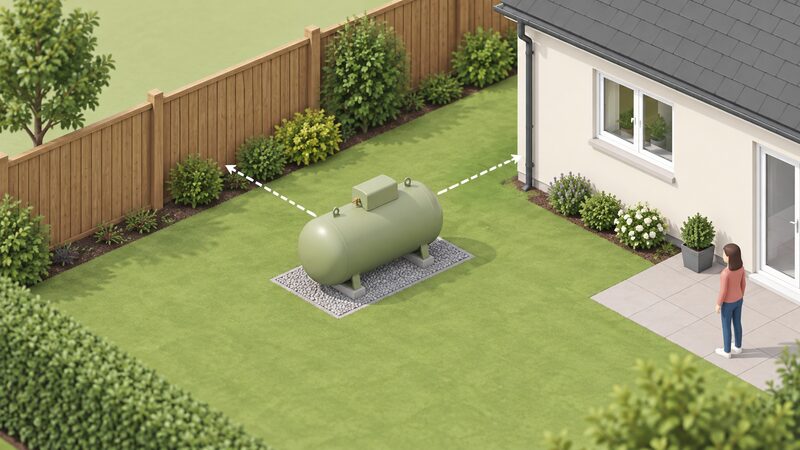
Approved Document J covers combustion appliances and fuel storage systems, and its guidance scope extends to LPG storage installations with capacities up to 1.1 tonne8. Requirement J6 states that liquid fuel storage systems and the pipes connecting them to combustion appliances shall be so constructed and separated from buildings and the boundary of the premises as to reduce to a reasonable level the risk of the fuel igniting in the event of fire in adjacent buildings or premises. That requirement applies to fixed oil storage tanks with capacities greater than 90 litres and fixed LPG storage installations with capacities greater than 150 litres located outside the building8.
One practical safety point favours LPG: it is not odourless, making it easier to detect leaks5. That is a genuine advantage over some alternatives, and it is why the smell is added deliberately.
Planning permission and installing a tank
For houses in England, installing a fuel tank is considered to be permitted development, not needing planning permission, subject to limits and conditions27. The permitted development regime includes liquid petroleum gas tanks as well as oil storage tanks27. That means the default position is that no application is needed, provided the siting conditions are met.
The conditions are where installations fail. Separation distances from buildings and boundaries, the position relative to a fire escape route, and the distance from a boundary wall all fall within the limits. A site that cannot meet them needs either a different position or a planning application.
Building regulations sit alongside planning permission and are not satisfied by it. In Wales, if you are installing an oil tank and connecting pipework and you employ an installer registered with OFTEC, you will not need to involve a Building Control Service28. That concession is specific to registered installers and to oil tank and pipework work.
For comparison, ground source heat pump installation within the curtilage of a house or block of flats does not require planning permission, but listed building consent may be required if the property is listed29. The same listed building consideration applies to any external fuel storage on a listed property.
Support is also available for installers and manufacturers to expand supply chains30, which matters for households waiting on an installation slot.
BioLPG: the drop-in renewable alternative
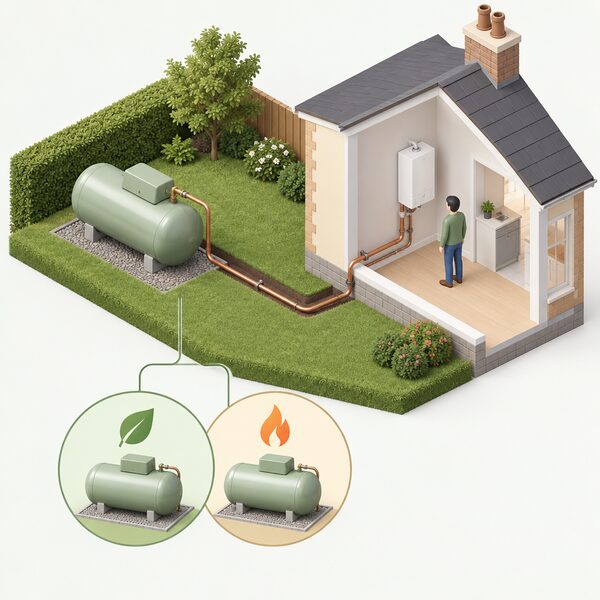
BioLPG is the renewable variant of the same fuel, and it is the reason the LPG industry argues it has a route into a lower-carbon future rather than a dead end. Liquid Gas UK is the trade association representing the LPG and bioLPG industry in the UK9, and it has published a biomass strategy setting out the case9.
The practical attraction is that bioLPG is a drop-in replacement. It uses the same tank, the same pipework and the same appliances as conventional LPG, so a household does not need to replace its heating system to use it. That is a materially different proposition from a heat pump, which requires a different system, different emitters in many cases, and often a cylinder.
The limits are equally worth stating. BioLPG availability depends on production volumes and on what suppliers choose to offer, and no published figure sets out how much of the UK's LPG supply is currently bioLPG. A household cannot assume that a bulk tank will be filled with bioLPG on request.
For context on where the wider energy system is heading, Britain continues to break clean power records31, and the government has set out proposals affecting the off-grid heating market. Plug-in solar panels are expected to be available in shops within months and to save people money on their bills31, which is a reminder that the alternatives to a fossil-fuel tank are broadening.
The honest position for a household is this: LPG with a supplier-owned tank delivers independence from the gas grid and from the price cap, at the cost of a long exclusive contract, a rental charge and a fuel that one independent guide calls one of the most expensive heating fuels2. BioLPG may reduce the carbon position over time without changing the equipment, but it does not change the contract, the tank ownership or the delivery dependence. Those are the terms on which off-grid LPG supply is offered, and they are worth reading in full before signing.
Sources31 cited
- LPG central heating, Which?
- What heating options are available off the grid?, OFTEC
- New to LPG, Liquid Gas UK
- Off-gas grid households, House of Commons Library
- What is LPG?, Liquid Gas UK
- Research briefing CBP-10958, House of Commons Library
- What is LPG?, Liquid Gas UK
- Building Standards 2017 domestic: LPG storage, Scottish Government
- Biomass strategy, Liquid Gas UK
- Liquid Gas UK Customer Charter, Liquid Gas UK
- What heating options are available off the grid?, OFTEC
- Our data, Energy Saving Trust
- Gas bottles, Flogas
- Your home guide to liquid fuel heating, OFTEC
- Can I own my own bulk LPG tank?, Liquid Gas UK
- Energy price cap levels 1 July to 30 September 2026, Ofgem
- Energy price cap levels 1 July to 30 September 2025, Ofgem
- Energy price cap levels 1 October to 31 December 2025, Ofgem
- Default tariff cap level 1 April to 30 June 2024, Ofgem
- Supplier of Last Resort information, Energy Ombudsman
- Research briefing CBP-9340, House of Commons Library
- Which? responds to energy bill support scheme prepayment meter voucher redemption rates, Which?
- Ofgem completes review of how suppliers support customers in vulnerable situations, Ofgem
- Statutory security of supply report 2025, Department for Energy Security and Net Zero
- How often should my tank be tested and by whom?, Liquid Gas UK
- BPI Boiler Plumbing Installations, Which? Trusted Traders
- Fuel tanks, Planning Portal
- Quick guide to the Building Regulations Q and A, Welsh Government
- Heat pumps, New Forest District Council
- Research briefing POST-PN-0699, Parliamentary Office of Science and Technology
- Britain continues to break clean power records, Department for Energy Security and Net Zero
 Heating Oil and LPG SupplyHow heating oil and bulk LPG reach off-grid homes, who owns the tank, what the fuels cost, why neither is covered by the price cap, and what supply risk looks like in winter.
 Heating Oil and LPG PricesHeating oil and LPG prices change fast, so what is a fair price today and why did it jump so sharply this year?
 Replacing a Gas or Oil BoilerSwapping a gas, oil or LPG boiler for a heat pump changes how your home is heated and how much it costs.
 LPG Boilers and HeatingWhat LPG is, how LPG boilers differ from natural gas appliances, and how bulk tanks and cylinder supply work for off-grid homes.
 Heat Network SuppliersWho supplies the heating in your home if it runs on a communal or district system?
 Domestic Oil TanksWhere can you legally put a heating oil tank at home, and how close can it sit to your house, a door or a fence?