


In this guide
AvantiGas is a bulk LPG supplier serving homes that sit off the mains gas network. It supplies liquefied petroleum gas into a tank at the property, either by automatic top-up or on a manual ordering basis, and it manages the account, the meter or gauge reading and the delivery schedule that go with it. LPG itself is a by-product of two large energy industries: the processing of natural gas liquids and the refining of crude oil1.
For a household, the appeal is straightforward. A bulk tank removes the need for a mains connection, and the fuel can be bought in advance of winter rather than drawn from a pipe on someone else's schedule. The dependence that remains is real, though: the household still relies on a supplier to deliver, on a tank that is usually owned by that supplier, and on a contract that governs when it can move elsewhere. Bulk domestic LPG customers whose gas is supplied through a bulk tank can switch supplier along with ownership of the tank once they are no longer bound by any exclusivity period in a supply contract2.
This page sets out what AvantiGas supplies, how a quote and switch work, the tank options, how deliveries and metered accounts operate, and where the household's responsibility ends and the supplier's begins.
What AvantiGas supplies and who it suits
Bulk LPG is delivered by road tanker into a fixed vessel at the property and drawn off as gas for heating, hot water and cooking. It suits homes beyond the gas network, where a mains connection is either unavailable or priced beyond reason, and where a cylinder supply would be impractical because demand is too high. LPG is a by-product of two large energy industries: the processing of natural gas liquids and the refining of crude oil1.
The case for bulk over cylinders is volume and automation. A bulk tank holds far more than a cylinder pair, and where the supplier fits telemetry the tank can be topped up without the household watching a gauge. The case for bulk over oil is cleanliness and convenience: no storage of a liquid fuel that needs its own bunding and annual inspection regime, and no exposure to the delivery lead times that affect oil in a cold snap.
The trade-off is contractual. A bulk tank is normally owned by the supplier, which means the household does not simply buy fuel on the open market; it enters a supply relationship that includes the vessel, its siting and its maintenance. The Liquid Gas UK customer charter sets out what bulk domestic customers can expect, including the right to switch supplier along with ownership of the tank once any exclusivity period in the supply contract has ended2. That exclusivity period is the single most important term to understand before signing, because it determines how long the household is tied to one company.
For homes that already have a tank, the practical question is often simpler: which company supplies it. The supplier's name is normally on the tank, on delivery paperwork and on statements, and a household that has inherited a tank with a property should establish the position before ordering fuel. The wider market of LPG and heating oil suppliers, contracts and delivery arrangements is covered in LPG and heating oil suppliers.

Getting a quote and switching: the four steps

The switch to a new LPG supplier follows a recognisable sequence, and the general shape of it matches the customer journey that official guidance describes for home energy decisions: a trigger event, a comparison, a decision and a weighing of benefits against costs6. For LPG the trigger is usually a house purchase, a renovation or a heating system replacement, which are the three events official guidance names as the point at which households engage with their heating arrangements6.
The four steps in practice are:
- Establish the current position: who owns the tank, what contract applies and when any exclusivity period ends. The existing supplier will advise one month before the customer becomes eligible to switch2.
- Request quotes. Comparison and switching in the wider energy market takes only a few minutes to initiate, with the supply start date confirmed afterwards7. For LPG the quote depends on tank ownership and siting, so it takes longer than a tariff switch.
- Agree the tank arrangement. If the tank transfers with the supply, the incoming supplier takes on the vessel; if not, a new tank is installed.
- Weigh up benefits and costs before committing, which is the final step official guidance identifies in the household energy journey6.
The timescales quoted across the sector vary. One documented switch to bulk LPG saw a household signed up within a couple of days of contacting a supplier, with the tank installed and gas delivered shortly after8. Where a new connection or a new tank base is needed, the work runs longer: a new domestic electricity connection is quoted at an estimated four days to obtain a quote9, and complaint-handling standards require quotes for rectification works within two working days of receiving acceptance from the customer10. Those figures are from adjacent processes rather than LPG itself, but they indicate the order of magnitude for the paperwork stage.
Grant-funded work follows its own clock. Under the Boiler Upgrade Scheme, Ofgem contacts the applicant and consent must be given within 14 days11. ECO4 applications begin by contacting an approved supplier to express interest12. Neither scheme funds an LPG tank, but both illustrate how tightly administrated the funded routes are.
Switching from oil to bulk LPG
Oil to LPG is a common move for off-grid homes, and the evidence on it is mixed rather than uniformly favourable. One case study documents a household that had switched from oil to LPG once before at a previous property and did so again, reporting that they were signed up within a couple of days and had a bulk tank installed shortly after8. That is a supplier-side case study, so it describes a smooth installation rather than a typical one.
The environmental comparison is more nuanced than a simple fuel swap. Analysis of switching to biomass from oil puts the monetised air quality damage at +£831, compared with -£42 for the alternative being assessed13. That figure concerns biomass rather than LPG and should not be read across, but it makes the point that off-grid fuel choices carry air quality consequences that vary by fuel and by how it burns.
What oil to LPG changes for a household is the nature of the dependence. Oil is bought from a distributor and stored in a tank the household usually owns; LPG is bought from a supplier and stored in a tank the supplier usually owns. The household gains automatic top-up and loses some freedom over where it buys. It also gains a different maintenance regime: an oil installation requires the boiler and tank to be serviced at least once a year by an OFTEC technician, including any underground pipework14. LPG installations have their own inspection requirements, and the tank remains the supplier's asset to maintain.
For a household weighing independence, the honest position is that LPG does not deliver fuel independence. It delivers a secure, storable, off-grid fuel with a delivery dependency. The comparison with other off-grid options, including cylinders and oil, sits in LPG and heating oil suppliers.
Tank options: above ground, underground or semi-mounded
The tank is the largest physical decision in an LPG installation, and planning rules constrain where it can go. A fuel tank must not be sited forward of a wall forming the principal elevation of the original house3. Within two metres of a boundary, the maximum height is 2.5 metres3. These are the constraints that most often rule out the obvious spot in a small front garden.
The base matters as much as the position. A tank base must be non-combustible, imperforate and level4. Imperforate means no drainage holes or gaps that would let a leak escape beneath the vessel; level means the tank sits true so that the gauge reads correctly and the vessel is not stressed.
| Option | What it involves | Where it fits |
|---|---|---|
| Above ground | The standard installation, visible and accessible for filling and inspection | Most gardens, subject to the 2.5 metre boundary height rule3 |
| Underground | The vessel is buried, leaving only the dome and fittings visible | Where space or appearance rules out a surface tank |
| Semi-mounded | Partly buried, with the upper section above ground | A middle option where full burial is impractical |
Siting also has to account for delivery access. A road tanker needs to reach the tank with a hose run that is practical in all weathers, and a tank placed behind a locked gate or at the end of a soft driveway creates a delivery problem that no amount of tank capacity solves. The planning position for fuel tanks generally is set out by the Planning Portal3, and the installation standards for tank support come from OFTEC4.
For a household, the choice between above ground, underground and semi-mounded is usually settled by the site rather than by preference. Underground tanks cost more to install and are harder to inspect, but they free the garden. Above-ground tanks are simpler to fill and to check. In every case the vessel remains the supplier's property under a typical domestic contract, which means the household cannot simply remove or relocate it without agreement.

Deliveries and ordering: how the manual service works

A manual LPG account works on the household ordering fuel rather than the supplier monitoring the tank. The trigger is the gauge, and the discipline is to order before the tank runs low rather than when it empties. Winter demand lengthens lead times across the off-grid sector, and a tank that is empty cannot be part-filled while a delivery is scheduled.
The industry works well ahead of the point of need. The existing supplier will advise a bulk customer one month before that customer becomes eligible to switch2, which shows how far in advance supply arrangements are planned. Emergency support schemes operate on a different clock: the Scottish Government's Emergency Heating Oil Scheme quotes an additional five days for a payment to reach an oil or LPG account15. That is a payment timescale rather than a delivery one, but it illustrates how quickly off-grid fuel logistics can stretch.
Where telemetry is fitted, the supplier reads the tank remotely and schedules the delivery, which removes the ordering decision from the household. Where it is not, the household reads the gauge and places the order. The difference matters for independence: telemetry is convenient but it deepens the reliance on the supplier's systems, while a manual gauge keeps the household in control of when it buys.
Power cuts affect off-grid heating differently from mains gas. Guidance on what to do in a power cut covers the household steps to take when electricity fails5, and an LPG boiler needs electricity for ignition, controls and pumping in the same way a mains gas boiler does. A tank full of gas is no use if the boiler has no power.
Metered accounts: readings and quarterly invoices
Where an LPG supply is metered rather than billed by delivery, the account runs on readings and periodic invoices. The metering discipline is well established in the domestic renewable heat sector: the installer must give the initial meter reading for each meter once the installation has been commissioned16. That first reading anchors every subsequent bill.
Missed readings create the disputes that ombudsman casework is full of. Where a reading is missed, the guidance for one metered scheme provides that it is submitted three months later and payment for the previous six months is made in one payment16. That is a specific scheme rule rather than an LPG rule, but it shows the pattern: a missed reading does not disappear, it accumulates.
The consequences of getting it wrong are documented. In a disputed usage case turning on estimated meter readings, the ombudsman required the supplier to re-bill the account and provide an apology along with a time and trouble award for poor account management and poor complaint handling17. Estimated readings are the common thread in billing disputes, and a household on a metered LPG account has the same interest in submitting actual readings as any other energy customer.
There is support for households that cannot read their own meter. For consumers unable to read their meter due to age, disability or terminal or chronic illness, the supplier can arrange to read the meter on their behalf, free of charge, at least once every three months18. That obligation sits in the Northern Ireland consumer code, so it applies there specifically rather than uniformly across the UK.
Where a supplier fails, the account moves. Customers of a failed supplier are transferred to another company, and the new supplier provides information on how to get new key cards and tokens19. The same principle applies to account numbers and billing references: a transfer produces new details, and the old ones should be quoted alongside them during the transition. The process for a supplier going out of business is set out by Ofgem19, and the route for complaining when billing goes wrong runs through the supplier first and then the ombudsman20.
Owning an AvantiGas account: tank, pipework and responsibilities
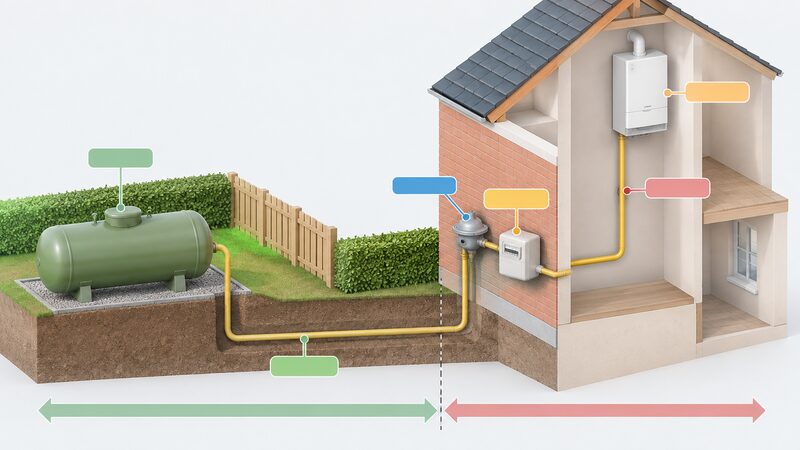
Responsibility in an LPG installation splits at clear points, and knowing where they fall prevents most disputes. The network operator is responsible for the pipes and wires that move energy to the property21. Beyond the meter or regulator, the pipework inside the home belongs to the property owner.
In a rented home the position is more layered. A landlord has responsibilities for parts of the associated installation and pipework but not for the actual appliance where a tenant has their own gas appliance that the landlord did not provide22. That distinction matters for LPG as much as for mains gas: the flue, the pipework and the safety of the installation are the landlord's concern, while an appliance the tenant installed is the tenant's.
The tank itself is normally the supplier's asset. That is why the switching right is expressed as switching supplier along with ownership of the tank2: the vessel changes hands with the contract rather than staying with the household. A household that wants to own its tank outright needs to establish that at the outset, because it changes both the switching position and the maintenance obligation.
Maintenance obligations differ by fuel. For an oil installation, the household must arrange for the boiler and tank to be serviced at least once a year by an OFTEC technician, including any underground pipework14. For LPG, the tank is the supplier's responsibility and the appliance is the household's, which means an annual boiler service remains good practice even where it is not a regulatory requirement.
Costs and what switching means for your supply

There is no published AvantiGas list price for LPG in the material available here, and bulk LPG is quoted per property according to tank size, annual consumption and contract terms. Prices are therefore supplier-quoted rather than published, and any figure a household sees should be treated as specific to its own circumstances.
What can be said with confidence is how the switching rules work. A switch that is completed late triggers compensation: if the switch does not happen on the agreed date, the new supplier must pay the customer £4024. An erroneous transfer, where a supply is switched by mistake, also carries £4024. Those figures are from the mains energy market rather than the LPG market, and they should not be assumed to apply to a bulk tank switch, but they show the direction of travel in consumer protection.
The economics of switching are also shaped by exit fees. Research on consumer tariff choices found that the probability of a household taking a deal with £300 annual savings and a five-star rated supplier fell to 61% when a £300 fee was present25. That is a mains energy finding, but the principle transfers: a fee large enough to cancel the saving changes the decision.
VAT treatment is a further variable. Where gas piped directly to a customer's home is used partly to fuel a car and partly for domestic purposes, the supply should be apportioned accordingly26. That rule concerns piped gas rather than delivered LPG, and it illustrates that mixed-use supplies are apportioned rather than treated as a single category.
For a household, the practical position on cost is that the tank arrangement, the contract length and the delivery terms matter as much as the pence per litre. A cheap unit rate behind a long exclusivity period is not cheap. The wider context on supplier contracts, tank ownership and delivery terms is in LPG and heating oil suppliers, and the mains market comparison sits in energy suppliers.
Sources26 cited
- What is LPG?, Liquid Gas UK, 2026
- Liquid Gas UK customer charter, Liquid Gas UK, 2026
- Fuel tanks: planning permission, Planning Portal, 2026
- Tank support, OFTEC, 2026
- What to do in a power cut, Met Office, 2026
- Customer journey map, GOV.UK, 2026
- Standard rate tariffs guide, Uswitch, 2026
- Bungalow owners switch from oil to LPG, Liquid Gas UK, 2026
- How much will my new supply cost?, Electricity North West, 2026
- CWISC complaints procedure, CIGA, 2026
- Boiler Upgrade Scheme guidance for property owners, Ofgem, 2026
- ECO4 consumer grants and incentives, MCS Certified, 2026
- BioLPG, Liquid Gas UK, 2026
- Check your oil tank, nidirect, 2026
- Home heating advice: FAQs, Home Heating Advice Scotland, 2026
- Domestic RHI: guide to metering, Ofgem, 2022
- Billing case study, Energy Ombudsman, 2026
- Code of Practice for Consumers in Vulnerable Circumstances, Utility Regulator, 2025
- What happens if your energy supplier goes out of business, Ofgem, 2026
- Complain about your energy supplier, Ofgem, 2026
- Switch your home energy supplier, Ofgem, 2026
- Gas safety in the home: frequently asked questions, Health and Safety Executive, 2026
- Registration to carry out gas work, GOV.UK, 2026
- Understanding consumers' energy tariff choices, Ofgem, 2025
- Ofgem forward work programme 2025/6 consultation, Energy Ombudsman, 2025
- VAT fuel and power: VFUP2100, HM Revenue and Customs, 2026