
In this guide
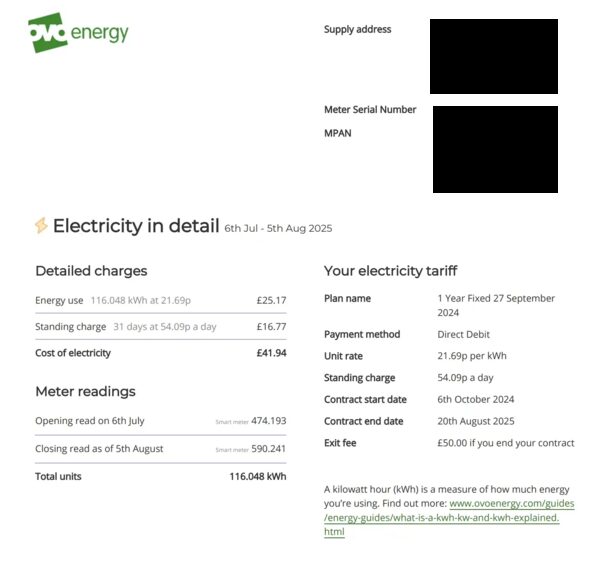
An exit fee is the amount a supplier charges to leave a fixed energy contract before it ends1. It is normally charged per fuel, so a dual fuel household pays it twice. The most commonly quoted current level is £100 per fuel on a 12-month fix, and some deals go to £1502. Ofgem's own guidance confirms the basic position: a household on a fixed rate tariff that chooses to leave early may have to pay its previous supplier an exit fee4.
The single most important rule is the 49-day window. A supplier cannot charge exit fees if the switch is made within 49 days of the current deal ending, roughly the last seven weeks of the contract5. Inside that window a household can move to a new deal or a new supplier for nothing, without waiting for the contract to run out6. Outside it, the fee applies, and it can be substantial: quoted ranges run from £0 to £50 per fuel at the low end, through £30 to £60, up to reported fees of £50 to £400 on some affected tariffs7.
Exit fees have grown. Campaigners report an increase of 345% over the last three years, and that the majority of fixed tariffs now carry exit fees of more than £1009. Suppliers are reported to be increasing them again11. That matters for a household's freedom of movement: a fee large enough to outweigh a year's saving turns a 12-month contract into a genuine lock-in rather than a nominal one.
What an exit fee is and when it bites
Exit fees are typically applied only to fixed energy deals2. Most fixed tariffs include exit fees for each fuel, payable if the customer switches to a different deal before the contract ends6. On a dual fuel contract the fee is payable for both gas and electricity, which is why the headline "per fuel" figure understates the real cost of leaving.
The fee is not confined to switching supplier. Ofgem research found that 88% of consumers correctly recognised that exit fees may apply to fixed contracts, but only 57% identified that they may still apply when moving to another deal with the same supplier12. That gap matters, because a household that assumes staying put avoids the charge may be wrong.
Some sources describe the trigger slightly differently. One consumer body states exit fees apply on any defined length tariff and are paid if the household switches to a different tariff more than four weeks before the tariff end date13. The regulator-derived rule used across the rest of the market is 49 days. Where documents disagree on the size of the exemption, the 49-day figure is the one repeated by the great majority of guidance and by Ofgem-citing sources.
Not every fixed deal charges one. Some tariffs have no exit fees at all14, and in Northern Ireland one listed Budget Energy electricity offer is advertised with no exit fees15. Some tariffs allow early exit without penalty in defined circumstances: Octopus fixed-price tariffs are reported to let a customer switch without an exit penalty if energy prices fall below what they are paying16.
Exit fees: what householders are actually charged
There is no single number, and the published figures differ widely by source and by date. The table below sets them out as given.
| Figure quoted | Basis | Date |
|---|---|---|
| £0 to £50 per fuel | fixed-rate tariffs, consumer charity guidance8 | Jan 2026 |
| around £25 to £30 per fuel | typical, varies by supplier7 | 2025 |
| upwards of £60 observed | same source, later in year7 | 2025 |
| typically £30 to £60 | fixed-rate tariffs17 | 2026 |
| £25 per gas or per electricity, £50 dual fuel | quoted per fuel example18 | Apr 2026 |
| around £100 on 12-month deals, some up to £150 | current market18 | Apr 2026 |
| often £100 per fuel | leaving before contract end1 | May 2026 |
| at least £50 per fuel, sometimes as much as £250 | fixed tariffs, early exit19 | Sep 2026 |
| often £100 on a 12-month fixed tariff, almost universal | current market3 | Sep 2026 |
| £50 to £400 | affected fixed tariffs9 | Sep 2026 |
| £150 average, Ecotricity | highest average among suppliers9 | Sep 2026 |
One comparison source states fees can be at least £50 per fuel and sometimes as much as £250, while elsewhere the same publisher gives as much as £200 per fuel: the two figures conflict and both are recorded here19. An earlier market snapshot found 337 fixed price tariffs more expensive than the then price cap carrying an average exit fee of £13820. Older deals were cheaper to leave: E.On Charge was listed in 2021 with £30 of exit fees for both gas and electricity21.
The direction of travel is clear enough. Exit fees climbed to more than £100 per fuel during the last energy crisis11, and the 345% three-year rise reported by campaigners is the headline behind calls for the rules to be reviewed10.
The 49-day window: when a household can leave free

Ofgem's rule is that an energy supplier cannot charge exit fees if the customer switches within the last 49 days of the contract22. Put the other way, a household cannot be charged early exit fees with 49 days or less left to run23. The exemption is described consistently across consumer guidance: from 49 days before the plan end date, suppliers should not charge any exit fees24, and a household inside that window has the right to switch freely without being charged25.
"if you are in the last 49 days of your fixed-term contract, you don't have to pay an exit fee and have the right to free"
Citizens Advice puts the same rule in weeks: a supplier should not charge a fee to switch supplier if the contract ends in the next seven weeks26. Forty-nine days and seven weeks are the same period.
Timing within that window is a practical matter. One switching guide notes that starting a switch with 21 to 49 days left avoids spending days or weeks on the supplier's standard variable rate between deals27. Switching earlier than 49 days out means the fee applies28. The window is a right, not an obligation: a fixed tariff that has already ended can still be switched away from at any time, with no charge26.
Fixed tariffs: what is locked in, and for how long
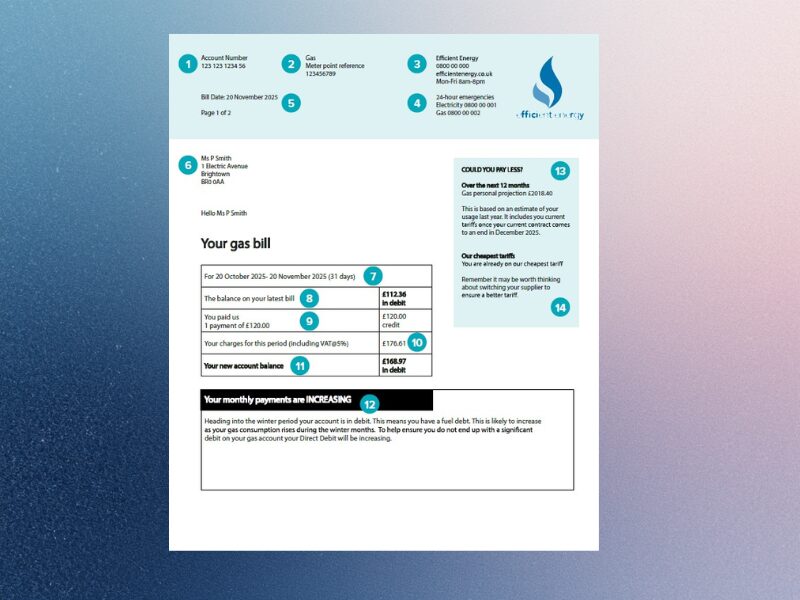
A fixed tariff fixes the unit cost of energy and the daily standing charge26. It does not fix the bill. The amount charged is set by the amount of energy used, the unit cost and the daily fee, so consumption still drives the total. During the term, the supplier cannot increase the price unless the government has raised VAT26.
Contract lengths cluster around a year. Fixed tariffs usually last for a year26; a fixed rate tariff locks in prices for normally a minimum of 12 months29; other guidance gives usually 12 to 24 months1, usually 12 to 18 months30, or 12 or 24 months31. Home Energy Scotland describes contracts that last a set amount of time, such as 12 months32. A 12-month fix gives at least 12 months of protection from higher prices27.
Identifying the tariff is straightforward on the bill: if it says the contract has an end date, the tariff is fixed26. The bill section that names the tariff also shows whether it is fixed or variable, the unit rates, standing charges and any exit fees33. That check matters, because households frequently get it wrong. Ofgem research found considerably more people claiming to be on fixed tariffs (38%) than official data suggested (11%), and among those who said they were on a fixed electricity tariff, 55% were "very confident" this was the case and 38% only "somewhat" confident12. Further detail sits on the fixed-rate energy tariffs page.
Fixed, variable and where exit fees do not apply
Standard variable tariffs do not often come with exit fees34, and Which? states plainly that a household will not be charged exit fees to leave a variable tariff35. ScottishPower's Standard Variable is described as having no exit fees and no contract end date36. Leaving a standard or default tariff carries no exit fee37.
| Fixed tariff | Standard variable tariff | |
|---|---|---|
| Price movement | unit cost and daily fee fixed for the term26 | set by the price cap, changes every three months1 |
| Contract end date | yes, shown on the bill26 | none36 |
| Exit fee | usually charged, often £100 per fuel1 | not usually charged34 |
| Fee-free exit | final 49 days22 | at any time37 |
The trade-off is price certainty against freedom to move. A fix protects the unit rate but attaches a cost to changing mind; a variable tariff leaves the household exposed to cap changes but free to leave. The choice is examined further on fixed vs variable energy tariff and on the wider energy tariffs guide. Guidance from the Welsh Government's climate action service notes the option of choosing a tariff with low or no exit fees in case circumstances change and the household wants to cancel early38.
Evidence from Ofgem shows how strongly the fee shapes behaviour. Among consumers who thought they had an exit fee on their current contract, 93% would switch to a deal with no exit fee, falling to 70% where the new deal carried a £300 exit fee12. In a separate modelled scenario with £300 of annual savings and a five-star rated supplier, the switch rate fell to 61% when a £300 fee was present, against 81% with a £50 exit fee, with a figure of 65% also recorded in the same research12.
What happens when a fixed deal ends
When the fixed term expires, the supplier automatically moves the household onto its standard variable tariff26. StepChange puts it the same way: with a fixed rate, the household rolls onto the provider's standard variable rate when the tariff ends5. Some suppliers may instead offer the chance of another deal28. The supplier should remind the customer when the contract is about to end39.
The default rate is determined by the energy price cap and changes every three months1. A household that does nothing has not lost anything permanent: there are no exit fees on the standard tariff, so it can still switch supplier or tariff afterwards26. But it will be paying the cap rate rather than a chosen one. One switching guide suggests treating switching as a habit every 12 to 18 months rather than waiting to be rolled over27. A typical household has been reported as able to save around £115 per year compared with the October price cap3. The fixed deal ends what happens page covers the rollover in more detail.
Moving home, tenancy and supplier failure

Moving house does not normally trigger the charge. Where the tariff moves with the household to the new property, exit fees do not apply40, and uSwitch states that for energy a household usually will not pay an exit fee when moving house2. Citizens Advice notes that a household might still be charged to break its contract early, which is what an exit fee is, so the position depends on whether the contract is carried over or ended41. The exception for fewer than 50 days remaining applies here too40.
Tenants moving into a property already signed up to a fixed deal face the same calculation: unless the switch falls within the final 49 days of the contract, exit fees would likely need to be paid42. Related questions are covered on take fixed tariff when moving and tariff when moving into a new home.
Supplier failure removes the fee entirely. If an electricity supplier fails, the household can switch to another provider without incurring any exit fees, even if it was previously on a fixed contract43.
Switching protections when something goes wrong
Ofgem states that a household could get £40 if its energy supply is switched by mistake4. Erroneous transfers are covered by the Erroneous Transfer Customer Charter, which all energy suppliers must follow, and compensation may be payable44. Separate supplier Guaranteed Standards figures of £30 or £15 appear in older consultation material; those documents disagree and the amounts are not settled here.
Practical checks before switching are widely advised: understand any exit fees, fixed-term conditions or other charges that might apply45, and compare any exit fee against the savings the switch would make, since moving to a cheaper tariff could still leave the household better off overall46. National Energy Action's home energy checklist makes the same point, that switching is an option but an exit fee may be payable47. Bills should be reviewed regularly, with exit fees among the things to check48.
Contract terms beyond the exit fee
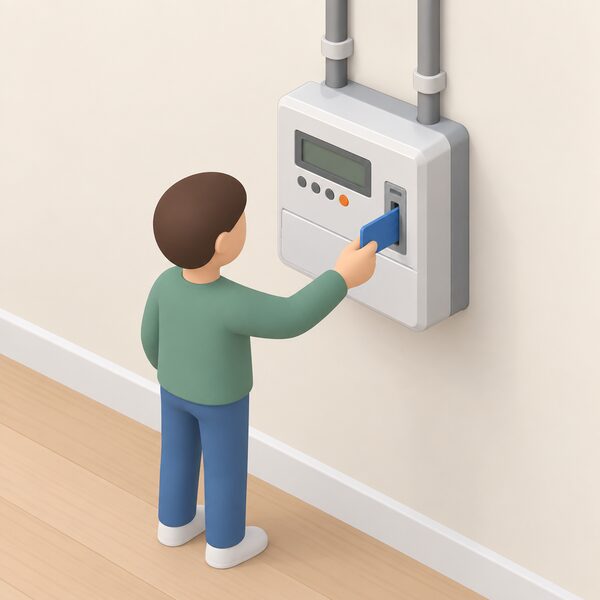
The exit fee is one clause among several. Payment method and meter type both shape what a household can get.
- Prepayment meters. Being on a prepayment meter does not prevent a customer from switching tariff or supplier, and the process is the same as for credit meter customers; tenants responsible for paying bills have the right to switch provider49. The choice of fixed tariffs is more limited, but some exist23. Prepayment tariffs are paid for before use, topped up by token, key, smartcard, online or app6. Prepay customers with a smart meter may be offered time-of-use prices50. See prepayment and pay as you go tariffs.
- The prepayment cap. Tariff caps for prepayment meter customers were introduced in April 201751, and a price cap has protected prepayment meter tariffs since 1 April 201752.
- Standing charges. Lower usage customers are often on prepayment meters and must pay standing charges in advance before they can access energy in the home53.
- Time-of-day pricing. Some suppliers offer cheaper energy at certain times of day as well as variable or fixed tariffs48. Those are covered on time-of-use tariffs.
What exit fees mean for household energy independence
Exit fees are a limit on one specific freedom: the freedom to change supplier when the market moves. A household with solar, a battery or a heat pump that later wants a tariff better matched to its generation or its load profile is not blocked from moving, but it may pay £100 per fuel to do so, and possibly more1. Over the three-year rise of 345% that constraint has tightened rather than loosened9.
The dependence does not end there. A fixed tariff holds the unit rate but not the bill, because consumption still drives the total26. When it ends, the household lands on the supplier's standard variable rate, which follows the price cap and changes quarterly1. Reducing the amount of energy bought is the part that does not expire with a contract, which is the argument set out on tariffs and household energy independence.
The rules do preserve a genuine exit. The 49-day window gives every fixed-tariff household a seven-week period, once a year on a typical 12-month contract, in which it can move without charge22. Supplier failure removes the fee43, and moving home with the tariff does not trigger it40. Knowing the contract end date, which appears on the bill26, is what makes that window usable rather than theoretical. Further comparison mechanics are set out on comparing energy tariffs and the rules themselves on tariff rules and consumer protections.
Sources53 cited
- How to switch energy supplier, Which?, 2026-05-15
- Energy exit fees explained, uSwitch, 2026-07-17
- One thing to do now to control your energy bills this winter, Which?, 2026-09-17
- Switch your home energy supplier, Ofgem, 2026
- Understanding energy bills, StepChange, 2026-09-20
- Energy tariffs explained, uSwitch, 2026-02-17
- How do I avoid exit fees when switching energy, Energyhelpline, 2026-09-20
- Dealing with your energy supplier, Centre for Sustainable Energy, 2026-01
- Tariff Watch: hidden costs in your energy bill, End Fuel Poverty Coalition, 2026-09-20
- Ministers urged to review nine nightmare energy rules, End Fuel Poverty Coalition, 2024-08-19
- Heating oil prices surge as conflict pushes up energy costs, End Fuel Poverty Coalition, 2026-03-10
- Understanding consumers' energy tariff choices, research report 2024, Ofgem, 2025-07
- Understanding your gas or electricity bill, Centre for Sustainable Energy, 2026-02
- How to beat the soaring price cap, Which?, 2026-05-28
- Electricity price comparison table, Consumer Council for Northern Ireland, 2026-09-18
- Octopus price changes, uSwitch, 2026-07-10
- Gas only energy tariffs, Confused.com, 2026
- What the Middle East conflict means for your energy bills, Which?, 2026-04-10
- Compare gas and electricity, uSwitch, 2026-09-17
- Tariff Watch: the hidden costs in your energy bill, Warm This Winter, 2023-10-06
- Best energy providers for EV owners, Carwow, 2021-04-23
- Fixed energy deals, uSwitch, 2026-09-07
- Avoiding the price cap, Act on Energy, 2026
- How do I read my OVO Energy bill, uSwitch, 2025-09-10
- How to complain about your electricity, gas or energy bill, Which?, 2026-07-30
- Your gas or electricity supplier has put up its prices, Citizens Advice, 2026-09-17
- When is the best time to switch my energy deal, uSwitch, 2026-08-26
- How to switch energy supplier, Confused.com, 2025-12-15
- Compare gas and electricity deals, Confused.com, 2026
- Scared switchless: households unsure how to reduce bills, uSwitch, 2026-02-04
- Three weeks to switch energy supplier to avoid record price rises, Which?, 2021-09-17
- Fixed-rate tariffs and switching, Home Energy Scotland, 2024-02
- How do I read my E.ON energy bill, uSwitch, 2025-09-10
- Fixed and variable tariffs: what's the difference, Energyhelpline, 2026-09-20
- How to understand your energy bill, Which?, 2022-03-14
- ScottishPower tariffs, Energyhelpline, 2026-03
- Energy customers could face bigger bills than before the price cap, Which?, 2019-02-07
- Five top tips from Which? to cut your energy bills, Welsh Government Climate Action, 2026-03-18
- Your gas or electricity supplier has put up its prices (Wales), Citizens Advice, 2026-09-17
- Moving house energy checklist, Energy Saving Trust, 2026-05-01
- Moving home: dealing with your energy supply, Citizens Advice, 2026-09-20
- Tenants' guide to switching, uSwitch, 2026-05-29
- Electricity only tariffs, Confused.com, 2026
- Energy terms explained, Ofgem, 2026
- Energy bills support, British Gas Energy Trust, 2026-08-11
- How to check your energy tariff and switch, British Gas Energy Trust, 2026-07-30
- Your home energy checklist, National Energy Action, 2026-09-10
- Energy saving tips, British Gas Energy Trust, 2026-02-27
- Prepayment meters, Centre for Sustainable Energy, 2025-08
- What is a smart meter, easy read, Smart Energy GB, 2026-03-16
- Energy price caps research briefing, House of Commons Library, 2026-09-20
- The history of Ofgem's energy price cap, Energyhelpline, 2026-09-20
- Standing charges, National Energy Action, 2026-04-28
 Fixed-Rate Energy TariffsWhat a fixed energy tariff fixes and what it does not, the contract lengths sold in the UK, exit fees and the 49-day window, how fixed rates compare with the price cap, and what happens when the term ends.
 Fixed and Variable TariffsCompares capped standard variable tariffs with fixed deals, including exit fees, contract end and rollover.
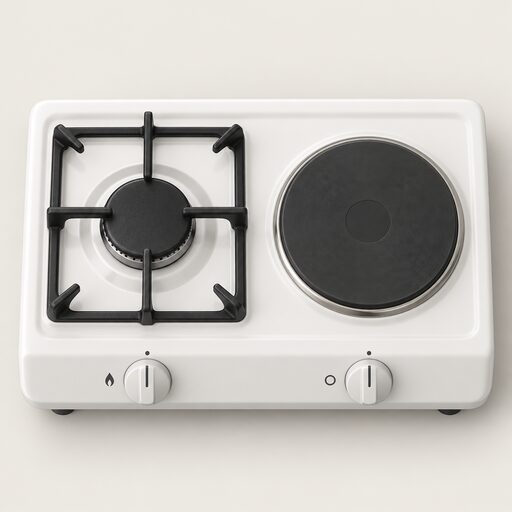 Dual Fuel TariffsExplains what a dual fuel tariff is, how discounts and single billing work, and where separate gas and electricity contracts remain available.
 The Full Tariffs GuideWhich energy tariff suits how you live, and will switching really save you money?
 Financial Resilience RulesYour supplier going bust raises two questions: who takes over and what happens to your credit balance?
 Tariff Rules and ProtectionsOfgem decides which energy tariffs suppliers can offer you, so it's worth knowing what they must provide.