

In this answer
Short answer
Switching supplier is free of charge in itself. The only cost that can arise is an exit fee on a fixed tariff left before its term ends, and that fee is waived once you enter the final 49 days of the contract. Ofgem's own guidance is direct on the point: "You may have to pay your previous supplier an 'exit fee' if you were on a fixed rate tariff and chose to leave before it"1. Outside that window, most fixed tariffs carry an exit fee for each fuel, so a dual fuel contract can carry two2.
The 49-day rule is the practical answer to the question. You can switch for free in the final 49 days of the contract rather than having to wait for it to end completely, and one supplier-facing guide puts the same window at "less than 50 days left on your contract"2. Inside it, no exit fee applies and the switch can be arranged so that supply moves across without a gap.
On a standard variable tariff there is no exit fee at all and no contract term, so switching is free at any time. The trade-off is that the price moves with Ofgem's energy price cap, which only affects standard variable tariffs and can rise as well as fall4. A fixed tariff is insulated from cap changes for its term, which is the main reason households fix in the first place.
Switching is free when 49 days or less remain on your fixed tariff
The 49-day window is a consumer protection, not a supplier courtesy. It exists so that a household nearing the end of a fixed deal can shop around and line up a new tariff without paying to leave the old one. The rule is consistent across the guidance: you can switch for free in the final 49 days of the contract rather than having to wait for it to end completely2; if you are inside the final 49 days, you can switch without paying any exit fees3; and you can switch penalty-free at any point in the last 49 days of your fixed term9.
The window also matters because of timing. Switching with 21 to 49 days left on the current tariff avoids spending a few days or weeks on the current supplier's standard variable tariff, which is where households land if a fixed deal ends with nothing arranged5. Your supplier is required to contact you 42 to 49 days before the end date of your fixed-term tariff, informing you that the deal is ending, so the notice and the free-switching window open at roughly the same point7.
Fixed energy tariffs usually run 12 to 24 months, with 12 months the most common length, so the end date is rarely more than two years from signing8. One switching guide frames the habit as reviewing every 12 to 18 months10. The practical effect is that a household can diarise the end date, wait for the supplier's notice, and then switch inside the free window with no fee at all.
For energy independence, the 49-day rule is what makes a fixed tariff a genuinely reversible commitment. A household can lock in a rate for a year or two without losing the ability to move if circumstances change, provided it acts in the final weeks. The dependence that remains is on the supplier's notice arriving and on the household reading it: miss the window and the deal rolls onto a variable tariff, where the price is set by the cap rather than by the contract.
What exit fees apply before the 49-day window

Before the final 49 days, leaving a fixed tariff early normally costs money. Most fixed tariffs include exit fees for each fuel which customers have to pay if they want to switch to a different deal, and the amount varies by supplier2. Ofgem's guidance confirms the principle: you may have to pay your previous supplier an exit fee if you were on a fixed rate tariff and chose to leave before it ended1. The fee is charged per fuel, so a dual fuel contract can carry two separate charges.
The waiver is equally consistent. If there is an exit fee attached, but you are within the last 49 days of your contract, you can switch for free12. Customers are entitled to switch to a new deal or supplier from 49 days before the end of their contract10. In the last 49 days of a fixed-term contract you do not have to pay an exit fee and have the right to switch freely without being charged7. The exit fee is waived when you enter the final 49 days of your contract13. Exit fees only apply to fixed-term deals, including some tracker tariffs, and cannot be charged in the last 49 days8.
Awareness of the rule is not universal. Ofgem's 2024 research on consumer tariff choices found that 88% of consumers knew exit fees may apply to fixed contracts, but only 57% identified that they may still apply when moving to another deal with the same supplier14. That second figure matters: switching to a new tariff with your existing supplier inside a fixed term is still leaving the contract, and the fee can follow.
The Welsh Government's consumer advice, drawn from Which?, suggests choosing a tariff with low or no exit fees in case circumstances change and you want to cancel your contract early15. That is a tariff-selection point rather than a switching one, but it bears on the same decision: the size of the exit fee is part of the cost of the contract, not an afterthought.
How the price cap affects the case for switching
The price cap and fixed tariffs sit in different worlds. The cap only affects standard variable tariffs, which can increase or decrease over time4. Fixed tariffs will not be impacted by cap changes16. If you are on a fixed tariff, your costs are fixed and won't change when the price cap changes17. That separation is the whole point of fixing: it converts an unknown future price into a known one for the length of the term.
The cap itself is reset quarterly. Ofgem moved from setting the cap every six months to every quarter in summer 2022 in response to the high and volatile wholesale market18. Quarterly resets mean a variable tariff can move four times a year, which is why the cap is a poor fit for a household that wants a predictable bill.
Fixed tariffs are not automatically cheaper than the cap. The average fixed tariff offered in May 2026 was above the price cap, reflecting supplier expectations that the cap would increase in the future19. A fix priced above the current cap is a bet on future cap movements, and the household carries that bet for the term. One comparison guide frames the threshold as no more than 40% more expensive than the current price cap, which is a rule of thumb rather than a rule20.
For independence, the cap is the mechanism that keeps a variable tariff tethered to wholesale prices and to Ofgem's quarterly decisions. A fixed tariff cuts that tether for its term, at the cost of a possible exit fee if the household wants out early. The 49-day window is what reconciles the two: a household can take the certainty of a fix and still retain a free route out as the term closes.
Switching to a dynamic tariff: usually free and quick

Dynamic time-of-use tariffs are the other main destination for a household leaving a fixed deal, and switching to one is normally free because the switch happens at the end of the fixed term or from a variable tariff. A dynamic time-of-use tariff offers a different price per unit of energy depending on the time of day, with times and rates that can change from day to day21. These tariffs suit people who can shift their electricity use at short notice to take advantage of cheaper rates when demand is low22.
The rate structure is the attraction and the risk. Rates change throughout the day based on real-time demand and supply on the grid, and can include zero cost or negative cost electricity22. That is a genuine opportunity for a household with a battery, an electric vehicle or a flexible heat pump, and a genuine exposure for one without. The Energy Saving Trust notes that times and rates typically change from day to day, so a dynamic tariff rewards attention in a way a fixed tariff does not23.
Switching mechanics are the same as any other switch. Under the Energy Switch Guarantee, customers can switch to a new tariff within five working days, and the guarantee covers switching to a new tariff whether changing supplier or moving tariff with the existing supplier6. The guarantee was extended in 2023 so that switches between tariffs, where a customer stays with the same supplier, are processed within the same timescales as supplier switches24.
The dependence a dynamic tariff leaves is on the household's own flexibility and on the supplier's app or half-hourly data. A fixed tariff leaves the household dependent on the contract term instead. Neither removes the grid, and neither removes the supplier; both change which risk the household carries.
Standard variable tariff customers can switch at any time without exit fees
A standard variable tariff is the most flexible place to switch from. If you are on a standard variable tariff, you can switch at any time without incurring any fees5. There is no exit fee and you are free to switch provider25. Standard variable rate plans do not have an exit fee, and you are not tied into a contract, so you do not pay any exit fees if you change supplier26. If you have a variable rate tariff, it should not cost you a penny to move to another tariff27.
The trade-off is price exposure. A standard variable rate tariff is tied to Ofgem's energy price cap, so when the cap goes up or down, the tariff changes with it11. Suppliers move households onto this tariff automatically when a fixed deal ends, which is how many households arrive on one without choosing it28. The signs are recognisable: never having switched supplier, not having switched for a year or more, a fixed deal having ended, or a tariff name containing words like "Simpler", "Flex", "Basic", "Standard" or "Variable"26.
Awareness of the flexibility is patchy. Ofgem's research found that only half of consumers correctly identify that switching deals without being charged an exit fee is a benefit of a variable tariff14. The freedom is real and unconditional, but it is not universally understood.
For independence, a variable tariff is the least locked-in position a household can hold: no term, no fee, no notice period to serve. What it gives up is price certainty, because the cap resets quarterly and the household absorbs each movement. A household that values the ability to leave at any moment over a known rate is better served by a variable tariff; one that values the known rate accepts the 49-day constraint in exchange.
What the switching process involves
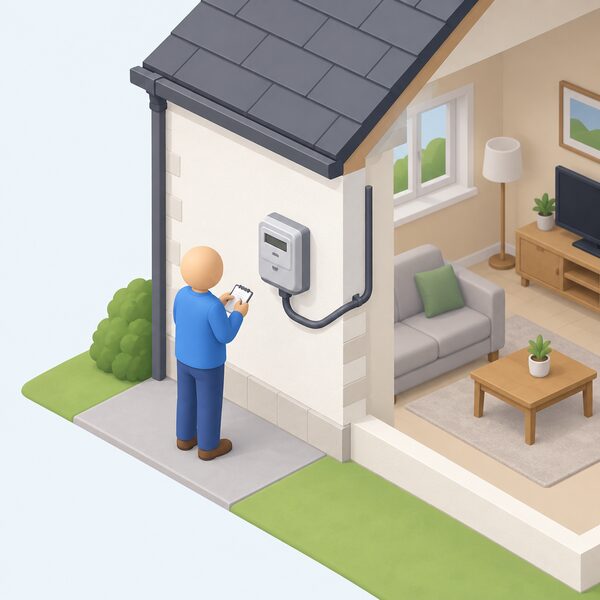
The switch itself is administrative. If you pay a supplier directly for the electricity or gas you use at home, you can choose to switch to a different supplier or tariff at any time1. It is easy to switch energy supplier providing you are on a variable rate tariff or if your current fixed rate contract is ending shortly29. The process runs to a fixed timetable under the Energy Switch Guarantee.
- Check the end date of the current fixed contract and whether the final 49 days have begun.
- Compare tariffs and choose a new supplier or tariff.
- Apply to the new supplier, which manages the switch.
- The switch completes within five working days under the Energy Switch Guarantee6.
- Meter readings are passed between suppliers; supply continues without interruption.
Switching supplier does not change the energy you receive at all, just who you pay for it, so there is no need to change any pipes or cables and no interruption to supply30. Existing arrangements survive the switch: switching energy suppliers will not change your Feed-in Tariff payment rate31. If you are moving home, the supplier might let you keep the same contract and tariff at your new home without charging you a fee, which is worth asking about before the move32.
Prepayment customers switch on the same terms as everyone else. Ofgem's guidance records that pre-payment customers are switching at the same rate as customers on standard credit tariffs33. The Energy Switch Guarantee applies to the switch regardless of payment method.
The dependence that remains after any switch is on the new supplier and, for a fixed tariff, on the new contract term. The grid, the pipes and the meter do not change. What changes is the price mechanism and the exit terms, and the 49-day window is the point at which those exit terms stop costing anything.
Sources33 cited
- Switch your home energy supplier, Ofgem, 2026
- Energy tariffs explained, Uswitch, 2026-02-17
- Energy switching, Uswitch, 2026-09-17
- Rising energy bills deepen affordability pressures ahead of winter, Consumer Scotland, 2026-08-26
- How to switch energy supplier, Confused.com, 2025-12-15
- Energy Switch Guarantee, Energy UK, 2026-07-08
- How to complain about your electricity, gas or energy bill, Which?, 2026-07-30
- How to switch energy supplier, Which?, 2026-05-15
- Energy your questions answered, Confused.com, 2026-07-03
- When is the best time to switch my energy deal?, Uswitch, 2026-08-26
- Switching your energy supplier, Energy Saving Trust, 2026-06-26
- Electricity only, Confused.com, 2026
- Gas only, Confused.com, 2026
- Understanding consumers' energy tariff choices, Ofgem, 2025-07
- Five top tips from Which? to cut your energy bills, Welsh Government, 2026-03-18
- Energy UK explains typical domestic consumption values, Energy UK, 2026-07-01
- Energy price cap October 2026: what we know so far, Uswitch, 2026-08-20
- Energy price cap methodology: backwardation deadband decision, Ofgem, 2025-11-21
- Energy prices and the price cap, House of Commons Library, 2026
- The average gas and electric bills in the UK, Energy Helpline, 2026-09-20
- Time of use tariffs: the benefits, Smart Energy GB, 2026-04-24
- Cheaper bills with energy flexibility, Centre for Sustainable Energy, 2026-09-15
- Time of use tariffs: all you need to know, Energy Saving Trust, 2026-05-20
- Energy Switch Guarantee best practice guide 2023-24, Energy UK, 2023
- The Great Energy Savings Switch FAQs, Uswitch, 2026-09-19
- Standard rate tariffs, Uswitch, 2026-08-26
- Green energy tariffs, Confused.com, 2025-11-03
- Your gas or electricity supplier has put up its prices, Citizens Advice Wales, 2026-09-17
- How to read your energy bill, Confused.com, 2025-12-15
- Getting the best energy deal, Age UK, 2026-09-10
- Feed-in Tariff, Uswitch, 2026-07-13
- Moving home: dealing with your energy supply, Citizens Advice, 2026-09-20
- Factsheet 0102, Ofgem, 2002-01-29
 Fixed-Rate Energy TariffsWhat a fixed energy tariff fixes and what it does not, the contract lengths sold in the UK, exit fees and the 49-day window, how fixed rates compare with the price cap, and what happens when the term ends.
 Switching SupplierHow long does switching energy supplier actually take, and what happens if you owe money?
 Supplier Licensing and FailureWhat happens when your energy supplier goes bust?
 The Full Tariffs GuideWhich energy tariff suits how you live, and will switching really save you money?
 Exit Fees and Contract TermsExplains exit fees on fixed energy contracts, how they are charged per fuel, and the Ofgem switching window in which a supplier cannot apply them.
 Final Bills and Credit RefundsHow final bills and credit refunds work when you leave an energy supplier: the six-week deadline for the final bill, the ten-working-day deadline for refunding credit, the twelve-month back billing limit, and the automatic compensation that applies when suppliers miss these standards.