
In this guide
A time-of-use tariff is an electricity plan where the price of a unit of energy varies during a 24 hour period1. When demand on the grid is low, usually overnight, the unit rate is cheaper; when demand is high, typically in the early evening, it is more expensive2. A household that can move washing, water heating, car charging or battery charging into the cheap hours pays less for those units, and one that cannot may pay more.
There are two broad families. The older, fixed-window tariffs are Economy 7, which gives cheaper prices for 7 hours during the night, usually between midnight and 7 am3, and Economy 10, which gives 10 set cheaper hours split across the afternoon, evening and night4. The newer smart time-of-use tariffs need a smart meter5, which sends a reading to the supplier every 30 minutes so each half hour can be priced separately6.
The smart meter itself is free from the supplier7 and is not compulsory8. What a time-of-use tariff does for a household's energy independence is limited but real: it rewards control over when electricity is drawn from the grid. It does not reduce dependence on the grid, on a supplier, or on the supplier's willingness to keep offering the tariff.
One price per unit, changing through the day
Every time-of-use tariff shares one principle: the price of a unit of electricity depends on when it is used. Official guidance describes the usual shape as prices that vary through the day with a cheaper overnight window9, and the purpose is to encourage households to shift use to periods of lower demand and lower prices10. Some tariffs vary the price on different days as well as at different times11, and a few tariffs apply the same idea to gas as well as electricity12.
Within that principle the tariffs sort into two kinds.
| Type | How prices are set | Examples |
|---|---|---|
| Static | The same prices at the same times each day1 | Economy 7, Economy 10, many EV and off-peak tariffs |
| Dynamic | Different price per unit by time of day, with times and rates that can change from day to day6 | Agile and other half-hourly tariffs |
Static tariffs give fixed rates through the day, cheaper off-peak and higher at peak13, which makes planning straightforward: the cheap window is always in the same place. Dynamic tariffs move with conditions on the grid, so the cheap periods shift and a household has to watch prices or let automated kit respond. Energy Saving Trust notes that on dynamic tariffs times and rates typically change from day to day5. The mechanics of those are covered in agile and dynamic tariffs and the related tracker tariffs, which link price to the wholesale market over a whole day rather than by the half hour.
The flip side of a cheap window is a dear one. A time-of-use tariff charges a higher price for electricity used in peak periods5, so the comparison with a single-rate tariff depends entirely on the share of use a household can place off-peak. That is why the same tariff can cut one home's bill and raise its neighbour's. For how these tariffs sit among fixed, tracker and export deals, see the full guide to energy tariffs.
The smart meter logs use and bills by time window
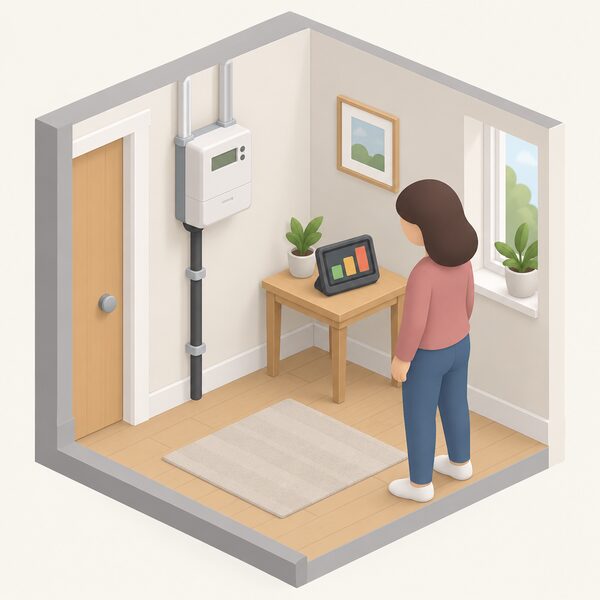
On a modern tariff the smart meter does the work. Welsh Government guidance puts it simply: these tariffs use the smart meter to log electricity use and charge different rates during different time windows14. The government's statement of consumer rights adds that smart meters enable accurate billing by automatically recording energy use in half-hour periods15.
The sequence runs like this:
- The meter records electricity use continuously and stores it in half-hour blocks.
- Readings are sent automatically to the supplier, so the householder does not submit them7.
- The supplier matches each block to the tariff's rate for that time window.
- The bill is built from actual readings rather than estimates7.
The same data has other uses. The supplier uses it to bill, and the network operator uses it to carry out essential tasks16. Ofgem lists three uses: billing, offering new products and services such as new tariffs (where the customer has given permission), and helping make the energy system more efficient by recording demand more accurately17. National Energy Action describes the practical result as an accurate bill based on how much energy has actually been used18.
Inside the home, the in-home display shows how much electricity and gas is being used in near-real time and what it is costing at the household's unit rates19. Which? lists further monitor functions: historical use, setting a budget, showing meter readings and showing tariff information16. On a time-of-use tariff that display is the easiest way to see whether heavy loads really are landing in the cheap window. Practical ways to do that are covered in shifting electricity use to cheap rates.
The meter you need: half-hourly readings, free from your supplier
Smart time-of-use tariffs use half-hourly smart meter readings to let companies charge lower rates when demand is lower and electricity is cheaper20. A smart meter can send readings half-hourly, daily or, in some cases, monthly11; the Data Communications Company, which runs the national network, lists monthly, weekly, daily or even half-hourly readings21. For a smart time-of-use tariff only the half-hourly setting will do: Energy Saving Trust states these tariffs need a smart meter that communicates with the supplier every half hour2.
For gas, the meter records every half hour; for electricity, it records in near-real time22. Citizens Advice notes that choosing half-hourly readings may give access to some new tariffs23, and Smart Energy GB states that customers need a smart meter to get all the benefits from new flexible energy tariffs24. The same requirement appears across guidance for each nation: Home Energy Scotland says smart time-of-use tariffs also require a smart meter25, the Energy Ombudsman says many EV-specific tariffs need a working smart meter9, and Ofgem's ECO4 guidance describes smart technologies combined with a time-of-use tariff and used with a functioning electricity smart meter26.
A household that has had a smart meter for a while can usually download its half-hourly usage data from the supplier or its online account2. That history is the most reliable basis for judging whether a time-of-use tariff would suit, because it shows how much use already falls in off-peak hours.
The meter is free: Ofgem's instruction is to contact the supplier to get one7. The requirement is covered in more detail in whether a smart meter is needed for an EV or heat pump tariff and which tariffs your meter allows.
Economy 7: seven overnight hours at a cheaper rate
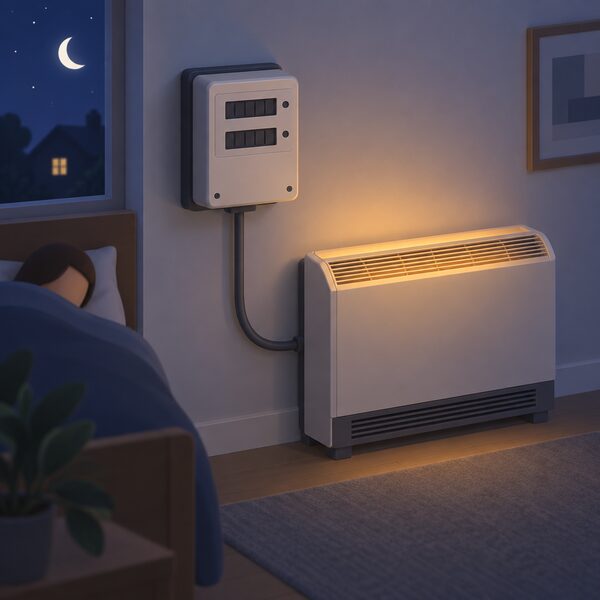
Economy 7 is the most familiar static time-of-use tariff: cheaper electricity for seven hours overnight2. It has two set prices, an on-peak rate and an off-peak rate, with the cheaper rate applying for 7 hours out of every 24, usually at night24. The cheap window usually runs between midnight and 7 am3, though exact times vary by area and meter.
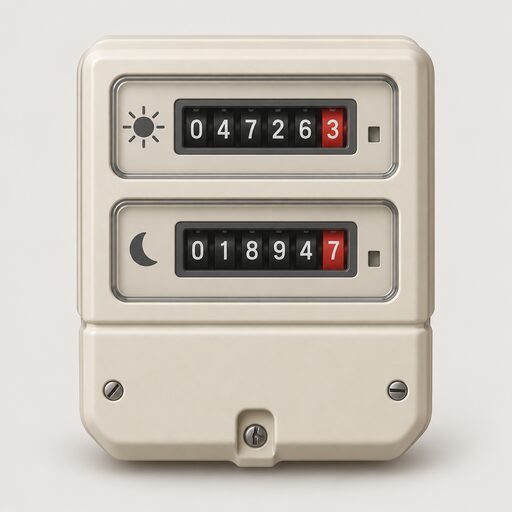
Economy 7 depends on hardware. Smart Energy GB describes Economy 7 and Economy 10 as older tariffs that need compatible meters24, and a specific Economy 7 meter records peak and off-peak use separately and is only compatible with Economy 7 tariffs27. If a home does not already have an Economy 7 meter, the chosen supplier has to install one3. Two-rate readings on digital and prepayment Economy 7 meters are usually reached by pressing a button on the meter, sometimes marked Rate 1 and Rate 228. A bill that shows different day and night rates, or a tariff named Economy 7 or Economy 10, is another sign of such a set-up29.
The tariff was built around storage heaters, which charge overnight and release heat through the day. Which? states that storage heaters need a time-of-use tariff such as Economy 7 or Economy 10 to access cheaper electricity prices30. More on that pairing is in Economy 7 and storage heaters, and full rates and hours are covered in Economy 7 tariffs. A smart meter can also run an Economy 7 tariff; see Economy 7 with a smart meter.
For independence, Economy 7 is a fixed arrangement: the household knows its cheap hours in advance but cannot move them, and the value depends on having loads, such as storage heaters or a hot water cylinder, that can be timed into the night.
Economy 10: three cheaper windows, but a niche market
Economy 10 extends the idea to 10 cheaper hours, usually in three time periods through the day31. National Energy Action gives one common split: three hours in the afternoon, two in the evening and five through the night4. Energy Helpline describes a different pattern, 7 hours during the night and 3 during the day, most likely in the afternoon or evening32. Both describe the same 10-hour total; the split depends on the region and the meter.
| Economy 7 | Economy 10 | |
|---|---|---|
| Cheap hours per day | 73 | 104 |
| When | Usually midnight to 7 am3 | Usually three blocks: afternoon, evening, night4 |
| Meter | Specific Economy 7 meter or smart meter27 | Compatible meter24 |
| Availability | Widely used | Not as widely used; not all suppliers offer it4 |
Energy Helpline states that during the off-peak hours the price of electricity could fall by up to half of the average rate32. That is a general description rather than a published rate for any particular tariff, and actual rates vary by supplier and region.
The limit is availability. National Energy Action says Economy 10 is not as widely used as Economy 7 and that not all suppliers offer tariffs that support it4. Which? adds that Economy 10 gives 10 hours of cheaper electricity usually in three blocks33, which suits homes whose heating or hot water can recharge in the afternoon as well as overnight. Some Economy 10 homes use meters controlled by the radio teleswitch service, discussed below34. More detail is in Economy 10 and restricted meter tariffs and the side-by-side Economy 7 vs Economy 10.
Where time-of-use tariffs fall short: meters, switching and coverage
The evidence on these tariffs is mixed, and the limits are as important as the savings.
Bills can go up. The Centre for Sustainable Energy warns that households using most of their energy at peak times, and unable to move it, could see higher bills13. Energy Saving Trust says in that case it could even cost a little more, so a time-of-use tariff probably is not suitable2. A government report on the heat pump transition found that where heating patterns are not well aligned to the tariff, time-of-use tariffs can increase fuel bills35.
Take-up is held back. Ofgem's tracking research from June 2025 found consumers citing a lack of guaranteed savings, inertia and limited knowledge as reasons for not switching36.
The old tariffs are shrinking. Which? reports that Economy 7 and Economy 10 are becoming less common as the legacy meters that support them are phased out20. At the same time a wider variety of time-of-use tariffs is appearing now that most British consumers have smart meters27.
They are hard to compare. Which? notes that time-of-use tariffs are not typically found on price comparison websites, so suppliers' own sites have to be checked31. Energy Saving Trust lists the points that decide whether a tariff pays: off-peak rates and times, peak rates, and any standing charges or exit fees2, and it advises checking early termination fees, contract length, and any ability to switch tariffs or opt out of time-of-use pricing5.
Some are restricted by equipment. Some tariffs are only available with certain equipment installed, such as an EV charger or solar panels5. Welsh Government guidance says these tariffs especially suit homes with a heat pump, battery storage or an electric or hybrid car14. See EV tariffs, heat pump tariffs and a home battery with time-of-use.
Switching can break the smart link. Having a smart meter does not stop a household switching23, and SMETS2 meters keep their smart functions across all suppliers through the national network; they are now the meter type for any new installation37. Trading standards guidance still warns that a new supplier might not offer all smart meter services, such as remote readings, and the meter may need replacing38. Which? states smart meters should make switching quicker, since they can send information to a new supplier instantly39.
Getting a smart meter: who installs it, cost and your right to refuse
Smart meters are installed by the household's energy supplier at no extra cost21. The Data Communications Company states installation is free for UK energy customers40, and Confused.com notes there may be a wait for an appointment but it should not cost anything28. Ofgem's guidance is to contact the supplier to get one for free41.
A smart meter is not compulsory. Energy Saving Trust states:
"No, it's not compulsory to have a smart meter installed. If your energy supplier offers you a one, you can refuse."
That right has a cost in tariff choice. Smart Energy GB states that access to any new flexible time-of-use tariff needs a smart meter set to send readings every half hour24, so a household that refuses keeps only legacy options where a compatible meter already exists.
The practical steps:
- Contact the current supplier, which installs the meter.
- At or after installation, choose the half-hourly reading setting if a smart time-of-use tariff is intended23.
- Keep the in-home display, which shows energy use through the day41.
Supplier rules and consumer protections around installation are covered in tariff rules and consumer protections. Arrangements in Northern Ireland differ from Great Britain; see tariffs in Northern Ireland.
What happens when things go wrong: faults, lost connections and estimated bills
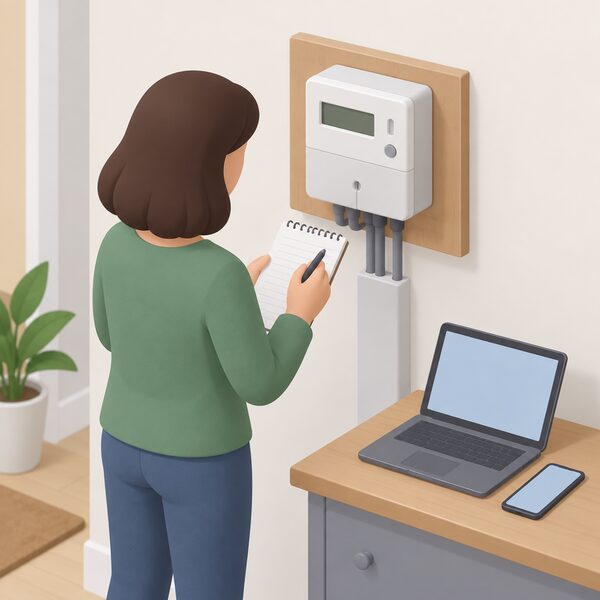
A time-of-use tariff only works if the meter keeps recording and reporting. Ofgem warns that a smart meter may stop recording energy use or may no longer send readings to the supplier7. When readings stop, the supplier cannot price each half hour, and billing can fall back to estimates.
Changing supplier is a common trigger. Ofgem states that a meter may not work in smart mode after moving to a new supplier, and the householder may need to take manual readings and submit them instead; it may work in smart mode again after a later change of tariff or supplier42.
Legacy meters face a harder deadline. The radio teleswitch service switches many older meters between rates and turns heating on and off. National Energy Action warns that if these meters are not upgraded, heating or hot water could be left continually on or off, charging could happen at the wrong time of day, and the supplier cannot confirm peak or off-peak use, which could mean higher bills34.
Ofgem lists the problems to take first to the supplier: late, incorrect or missing bills; back billing; being overcharged; a faulty meter; poor customer service; and refusing to refund credit from an account43. The same list appears in its guidance on complaints about suppliers and network operators44. If a household is switched to a supplier in error, all suppliers must follow the Erroneous Transfer Customer Charter, and compensation may be payable45.
Data, privacy and how your readings are shared
Readings from a smart meter are sent automatically via the Data Communications Company's secure network to the energy supplier46. That data is used for three purposes set out by Ofgem: billing, offering new products and services such as new tariffs where the customer has given permission, and helping make the energy system more efficient by recording demand more accurately17. Which? adds that the network operator also uses it to carry out essential tasks16.
The half-hourly setting is the one that matters for time-of-use pricing. Citizens Advice frames it as a choice: choosing half-hourly readings might give access to some new tariffs23. The consequence runs both ways: finer data unlocks the tariffs, and a household that prefers less frequent reporting gives up access to them.
The data is also the householder's to use. A household with a smart meter can usually download its half-hourly usage from the supplier or its online account2, and the in-home display shows historical use and tariff information16. The Data Communications Company describes the result as ensuring the household only pays for the energy it has used, not the approximate costs of an estimated bill46.
What owning a smart meter means for your energy independence
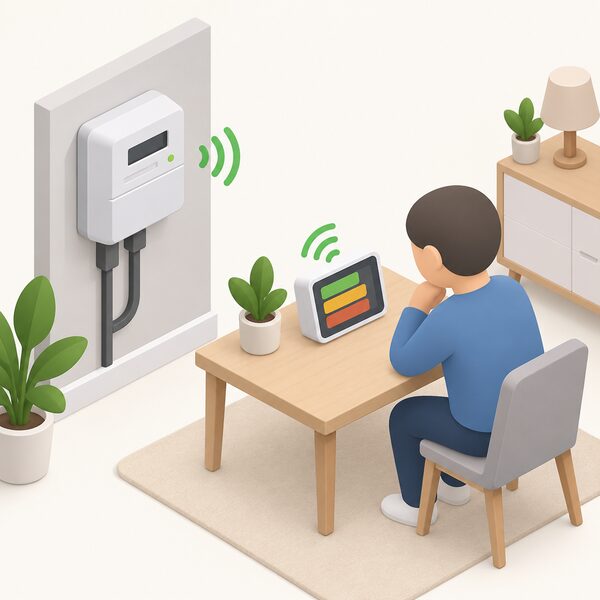
Ofgem lists the benefits of meters operating in smart mode as real-time information on energy use, more accurate bills, and access to more flexible tariffs47. The Data Communications Company describes greater control of energy use and access to the most appropriate tariffs48, and elsewhere automatic readings, access to the widest range of tariffs and a better understanding of energy use49. Smart Energy GB points to tariffs and schemes that offer rewards or cheaper rates for off-peak use50, and Welsh Government guidance adds incentives for using energy on high-supply days51. Which? notes these tariffs particularly benefit plug-in electric and hybrid vehicle owners39. The decarbonisation case is that the data puts a household in control of its use so it can cut CO2 emissions52.
For independence, the picture has clear limits:
- Still grid-dependent. A time-of-use tariff changes the price of grid electricity; it does not replace it. Only generation or storage in the home does that, and those pair with time-of-use through solar and battery import tariffs.
- Still supplier-dependent. The Data Communications Company is plain: except by switching, a household does not control the tariff its supplier sets46.
- Network-dependent. The meter's smart functions run over a national network, and faults or supplier changes can interrupt them7.
- Solar-compatible. For Feed-in Tariff generators, Ofgem states generation payments will not be affected by a smart meter53.
Prepayment households keep options too. Smart prepayment meters may be topped up online or through the supplier's app54, and in England cash top-ups can be made at a Post Office, Payzone or any shop with a PayPoint logo, with credit that should be added immediately55. See prepayment and pay as you go tariffs and the wider view in tariffs and energy independence.
Sources55 cited
- Time-of-use tariffs (POSTnote 655), UK Parliament POST
- Should I switch to a time of use tariff?, Energy Saving Trust, 2026-01-23
- What is Economy 7?, Energy Helpline, 2026-09-20
- Getting the most from Economy 7, National Energy Action, 2026-09-10
- Time of use tariffs: all you need to know, Energy Saving Trust, 2026-05-20
- Time-of-use tariffs: the benefits, Smart Energy GB, 2026-04-24
- Getting a smart meter, Ofgem, 2026
- Guide to smart meters, Energy Saving Trust, 2026-07-15
- EV tariffs and home charging, Energy Ombudsman, 2026-09-11
- Energy glossary, Low Carbon Hub, 2026-08-05
- How to use a smart meter to save money, Smart Energy GB, 2026-04-24
- Types of energy tariff, Confused.com, 2025-11-03
- Cheaper bills with energy flexibility, Centre for Sustainable Energy, 2026-09-15
- Five top tips from Which? to cut your energy bills, Welsh Government, 2026-03-18
- Smart meters: your rights and expectations, GOV.UK, 2025-08-08
- How to use your smart meter data, Which?, 2026-07-14
- Get help with your smart meter, Ofgem, 2026-09-17
- Get prepared, National Energy Action, 2026-06-02
- Smart meter installation, Which?, 2026-02-26
- How to switch energy supplier, Which?, 2026-05-15
- How to get a smart meter, Smart DCC, 2026
- What is a smart meter?, Smart Energy GB, 2026-08-10
- Getting a smart meter installed, Citizens Advice, 2026-09-17
- Energy flexibility, Smart Energy GB, 2026-08-17
- Get the best deal on energy, Home Energy Scotland, 2026-09-20
- ECO4 new measures and products guidance, Ofgem, 2026-03-26
- What is Economy 7?, Smart Energy GB, 2026-04-07
- How to read your gas and electricity meter, Confused.com, 2025-12-15
- RTS: what you need to know, Act On Energy, 2026
- Storage heaters, Which?, 2026-06-01
- Time-of-use tariffs explained, Which?, 2026-04-23
- What is Economy 10?, Energy Helpline, 2026-09-20
- Gas meters and electricity meters, Which?, 2026-01-16
- Radio Teleswitch Service switch-off, National Energy Action, 2026-07-29
- Heat pump transition report, GOV.UK, 2026-05
- Tracking energy consumers' use of low carbon and flexible products 2025, Ofgem, 2025-06
- Smart meters, Energy Ombudsman, 2026-09-20
- Problems with services, Isle of Anglesey County Council, 2025-10
- What is a smart meter?, Which?, 2026-04-07
- Does a smart meter save money?, Smart DCC, 2024
- Get help with your smart meter, Ofgem, 2026
- What happens if your energy supplier goes out of business, Ofgem, 2026
- Complain about your energy supplier, Ofgem, 2026
- How accurate are smart meters?, Smart DCC, 2026
- Energy terms explained, Ofgem, 2026
- How do smart meters save energy?, Smart DCC, 2026
- Smart meter performance, Ofgem, 2026
- New technology helping more homes connect to the smart meter network, Smart DCC, 2026
- New smart meter technology to help lower bills, Smart DCC, 2025
- Smart meter benefits for you, Smart Energy GB, 2026-08-18
- Smart meters, Welsh Government, 2026
- Smart meters and decarbonisation, Smart DCC, 2026
- Feed-in Tariffs: generators, Ofgem, 2026-09-17
- Prepayment meters consumer guidance, Ofgem, 2026
- Problems getting to or topping up your prepayment meter, Citizens Advice, 2026-09-17
 Economy 7 TariffsEconomy 7 gives you seven hours of cheaper electricity at night, but the exact hours depend on where you live and who supplies you.
 Meters and Time-of-Use TariffsDo you need a smart meter for a time-of-use tariff, and does it have to send readings every half an hour?
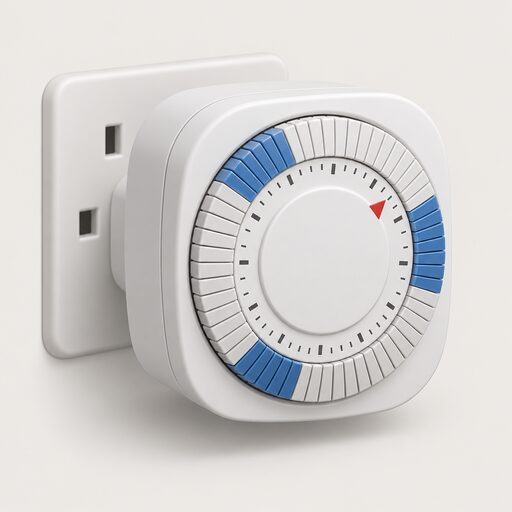 Controls and Time-of-Use TariffsCheaper electricity at night only saves money if your heating actually uses it then.
 The Full Tariffs GuideWhich energy tariff suits how you live, and will switching really save you money?
 Agile and Dynamic TariffsAgile tariffs change the price of your electricity every half hour, so what you pay depends on when you use power.
 Economy 7 and Restricted MetersEconomy 7 and Economy 10 meters give you cheaper electricity for a set number of hours overnight and charge you more the rest of the day.