
In this guide
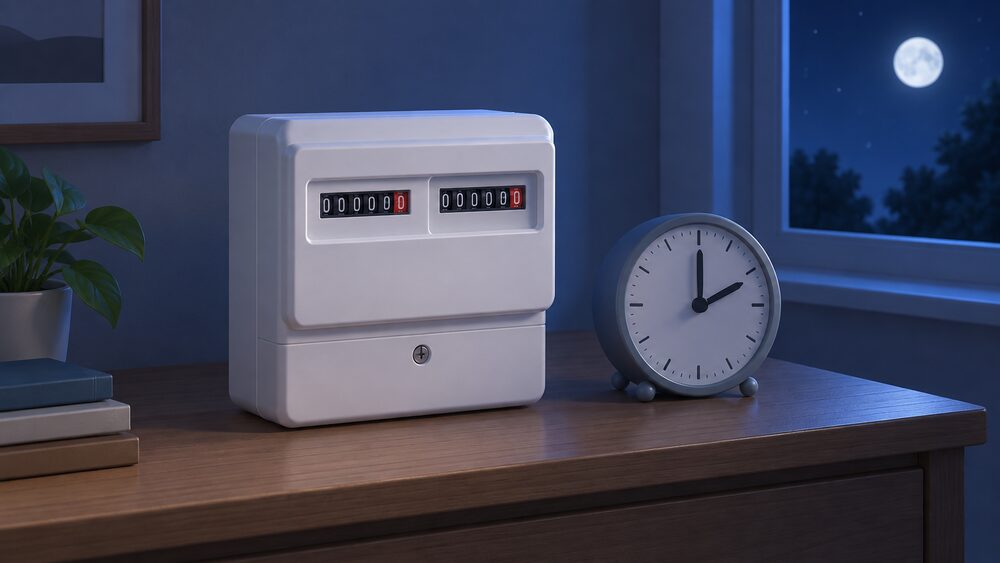
Economy 7 is a dual-rate electricity tariff: seven hours of cheaper units at night, and a higher price for the other 17 hours of the day1. The cheap window falls somewhere between 11.00pm and 8.00am, with the exact start set by the supplier and the regional network operator rather than by the household3. The tariff is electricity only; it is not possible to get an Economy 7 meter for a gas supply1.
The rates differ sharply either side of that boundary. Figures used in independent heating cost work for 2026 assume 34.38p per kWh on-peak and 15.43p per kWh off-peak, with consumption split 58:42 between the two4. In Northern Ireland, tariffs listed on 18 September 2026 ranged from a night unit rate of 17.291p per kWh on the Click Energy Economy 7 tariff to 19.641p on Budget Energy Keypad Economy 7, with day rates of 39.771p and 42.912p on the two Budget Energy and Click tariffs listed5. Some Economy 7 tariffs charge almost double the night rate during the day, and the daytime rate is usually higher than on a single-rate tariff1.
That trade is the whole question. Economy 7 rewards a household that can move a large share of its consumption after midnight, typically one heating with night storage heaters or an immersion heater on a timer6. It penalises a household that cannot. Guidance disagrees on where the line sits: at least 30 per cent of electricity used at night, more than 35 per cent, or at least 40 per cent8.
A dual-rate tariff with seven cheap hours at night
Economy 7 charges two different prices for the electricity used, depending on the time of use10. The cheaper off-peak rate applies for seven hours out of every 24, usually at night, and the on-peak rate applies the rest of the time6. The tariff has been on the market long enough that it is now described as one of the older types of time-of-use tariff, using fixed cheaper periods where newer electric vehicle and tracker tariffs are more dynamic6.
Mechanically, nothing about the tariff is clever. It does not respond to wholesale prices, to grid conditions or to what the home is doing. The supplier sets two numbers, the meter counts units into two registers, and the boundary between them never moves. That simplicity is also why the tariff survives: a household needs no app, no internet connection and no controllable appliance to use it, only a clock and a habit.
Variations exist. Some tariffs offer 8.5 or 10 hours rather than seven, and some suppliers add extra hours during winter11. Economy 10, the closest relative, splits its off-peak time into seven hours at night and three during the day, most likely in the afternoon or evening12. The difference between the two matters mainly to homes whose heating needs a daytime top-up.
In Scotland, Economy 7 meters are widely known as white meters, because the meters supplied by energy companies were white10. The tariff itself is the same. More detail on regional differences sits on the pages for tariffs in Scotland and tariffs in Northern Ireland.
How the rates work, and what the gap between them is worth

The saving on Economy 7 is not the night rate. It is the gap between the night rate and what the same units would have cost otherwise, minus the extra paid on every daytime unit. Independent heating cost work for 2026 uses 34.38p per kWh on-peak against 15.43p per kWh off-peak, roughly a 19p spread4. Storage heater running cost comparisons published in January 2026 used the same 15.43p per kWh as the average Economy 7 off-peak rate13.
For context on the single-rate alternative, the price cap unit rate for electricity was 27.69p per kWh for 1 January to 31 March 2026, alongside a 54.75p daily standing charge14. In one South Wales region, most suppliers were charging around 26.3p per kWh on single-rate standard variable tariffs in September 20263. A household paying 34.38p for daytime units is therefore paying a clear premium for every kettle boiled at lunchtime4.
Northern Ireland has its own published comparison of Economy 7 tariffs, with annual costs calculated on a typical annual consumption of 3,200kWh, based on unit rate and standing charge where applicable and including VAT at 5 per cent5.
| Tariff (Northern Ireland, 18 September 2026) | Night rate, p/kWh | Day rate, p/kWh |
|---|---|---|
| Click Energy Economy 7 | 17.291 | 39.7715 |
| Budget Energy Bill Pay Economy 7 | 18.138 | 42.9125 |
| Budget Energy Keypad Economy 7 | 19.641 | not listed here5 |
| Budget Energy Keypad Promotional 1 Economy 7 | 18.070 | not listed here5 |
| Power NI Standard Rate (E7) | 18.950 | not listed here5 |
| Power NI Standard Rate with online billing (E7) | 18.570 | not listed here5 |
Comparison tables are correct only on the day they are read, and are updated when a price change takes effect rather than when it is announced15. Newer flexible tariffs open a wider gap: one dual-rate arrangement studied by Energy Systems Catapult charged 7.5p/kWh between 23.30 and 05.30 against 31.5p/kWh for the rest of the day, and a Cosy-style tariff ran a 29.73p day rate, low rates of 17.84p from 04.00 to 07.00 and 13.00 to 16.00, and a 47.56p high rate from 16.00 to 19.0016.
When the off-peak hours fall
The seven cheap hours are not a national standard. The cheaper period runs for a seven-hour block at some point between 11.00pm and 8.00am, with the regional network operator defining a window of between seven and nine hours within which the supplier sets the exact times3. Midnight to 7am is the most commonly quoted pattern, but precise timings vary by supplier1. Some descriptions place the night period between 12am and 7am as standard17. Others give narrower or later blocks, such as 12.30am to 7.30am, or an example window of 11pm to 6am, so two homes in different regions on the same tariff name can be charged the night rate at different hours.
Two practical consequences follow. First, the times must be confirmed with the supplier before appliances are timed, because setting a washing machine for 11.30pm on a tariff whose cheap rate starts at midnight buys peak units. Because Economy 7 has a cheap and a more expensive rate, knowing exactly when the on-peak and off-peak hours fall is what makes the tariff work18. Second, clocks on older meters do not always follow British Summer Time, so the window can shift by an hour relative to the kitchen clock.
The fixed nature of the window is the tariff's defining limitation for independence. The household does not choose when its cheap electricity arrives; the supplier and the network operator do. Where more control is wanted, the time-of-use and agile and dynamic pages cover tariffs whose pricing moves with the grid.
Who Economy 7 suits
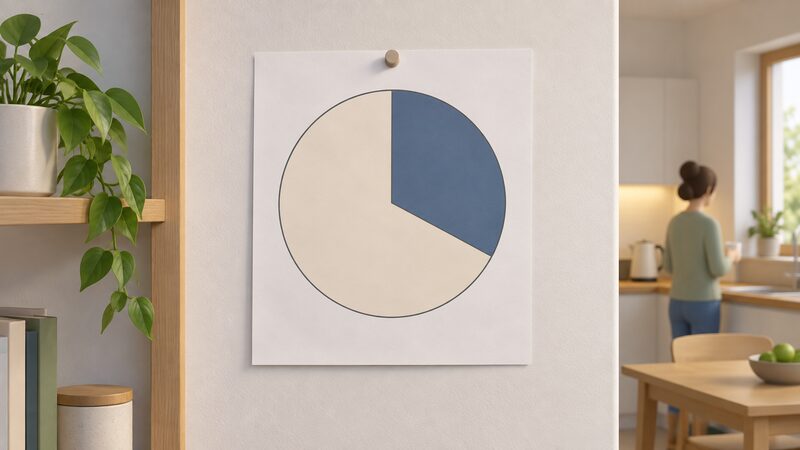
The tariff was built around night storage heaters, and that remains its core market. Economy 7 and Economy 10 are mainly intended for homes that run an electric heating system and use storage heaters7. Storage heaters draw cheap off-peak electricity overnight to heat high thermal capacity bricks, releasing that heat through the following day19. They are described as designed to work with Economy 7, where night-time electricity is much cheaper, typically about half the price, and daytime electricity is more expensive18. Guidance is blunt that they should always be used on an Economy 7 tariff4.
Beyond heating, three groups can make the numbers work:
- Homes with an immersion heater and a hot water cylinder, where a timer can bring the immersion on overnight20.
- Households with an electric vehicle charged at home. Some Economy 7 tariffs are tailored to EV owners, and many dedicated EV tariffs work similarly, with a lower unit rate for seven hours during the night1.
- Homes with a battery alone and no other flexible load, for which independent guidance points to either a dynamic tariff or Economy 723.
The tariff suits homes that use only electricity, or use a very large amount of it, and it does not fit every household6. It is typically used with electric storage heaters but is available to anyone23. Where the home also has a heat pump, the same guidance points instead to a heat pump tariff, since an EV-shaped cheap window cannot supply much of the heat pump's demand23. Dynamic storage heaters do not work with Economy 7 at all, which is part of why their running costs stay higher than night storage heaters4.
In Northern Ireland the tariff intersects with public schemes. The Affordable Warmth Scheme lists replacing Economy 7 with natural gas or oil central heating, and converting Economy 7 to a high efficiency electrical storage system where gas and oil are unavailable, among its heating measures24. Under the Northern Ireland Sustainable Energy Programme, properties with Economy 7 at the time of application are provided with replacement electric high heat retention storage heaters25. The Northern Ireland decent homes standard counts electric storage heaters on an off-peak or Economy 7 tariff as efficient heating26.
The 40% rule, and the range around it
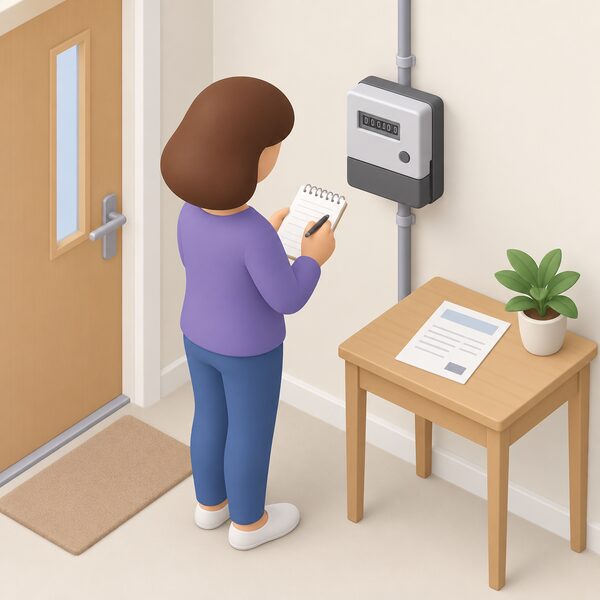
There is no single published threshold. Three independent bodies give three answers, and a household comparing them should treat the spread as genuine uncertainty rather than choose the most flattering figure.
| Source type | Minimum share of electricity used at night |
|---|---|
| Fuel poverty charity guidance | at least 40%2 |
| Switching site guidance, September 2026 | more than 35%3 |
| Consumer body guidance | at least 30%, and below 30% a single-rate tariff may cost less8 |
One guide puts the same point the other way round: a household would have to use more than 40 per cent of its electricity during the night for switching to be worthwhile1. Consumer guidance warns that using less than 30 per cent of electricity during the cheaper night-time hours could mean paying less on a single-rate tariff27.
The reason the thresholds differ is that the break-even point is not a constant. It moves with the size of the gap between the two rates and with the level of the day rate against the single-rate alternative. On a tariff where the day rate is almost double the night rate, a larger night share is needed to break even1. Where the spread is only 7p, the tariff has less to give in either direction28. The 58:42 peak-to-off-peak split assumed in 2026 heating cost work is a modelling assumption about storage-heated homes, not a measurement of any particular household4.
The practical test is the household's own two meter readings over a full billing period, compared against the two unit rates on the bill. That is the only figure that reflects the actual home. The comparing energy tariffs page covers how annual cost projections are built.
Where Economy 7 falls short
Three limits recur. The first is the day rate: it will usually be higher than on a normal tariff, and on some Economy 7 tariffs it is close to double the night rate1. Every daytime hour of a 17-hour peak period is charged at that premium3. A home that switches to Economy 7 and then fails to move its consumption pays more, not less, and does so quietly, month after month.
The second is the fixed window. Seven hours in the middle of the night suit a storage heater and an immersion timer. They suit a dishwasher on a delay start. They do not suit a household at home during the day, an electrically heated home with poor fabric that needs a daytime top-up, or a heat pump running a steady low-temperature output. Because the timing is set by supplier and network operator, there is no way to move it3.
The third is price movement. Economy 7 customers are not insulated from increases. An earlier analysis flagged a 7.6 per cent increase affecting electricity-only Economy 7 tariffs, and later commentary identified those on Economy 7 tariffs as a group continuing to lose out on standing charge arrangements30. Default Economy 7 customers are covered by the energy price cap: Ofgem lists the cap as applying to default tariff customers paying by standard credit, Direct Debit, prepayment meter or Economy 7 meter32. The cap limits unit rates and standing charges, not the bill, and it does not make a badly matched tariff cheap.
A fourth, structural point sits behind all of these. Economy 7 does not reduce dependence on a supplier; it restructures it. The household still buys every unit from the grid, at prices it does not set, in hours it does not choose. What it gains is a cheaper price for behaviour it was arguably going to adopt anyway. The tariffs and household energy independence page sets out how tariff choice fits alongside generation and storage.
The Economy 7 meter: two readings
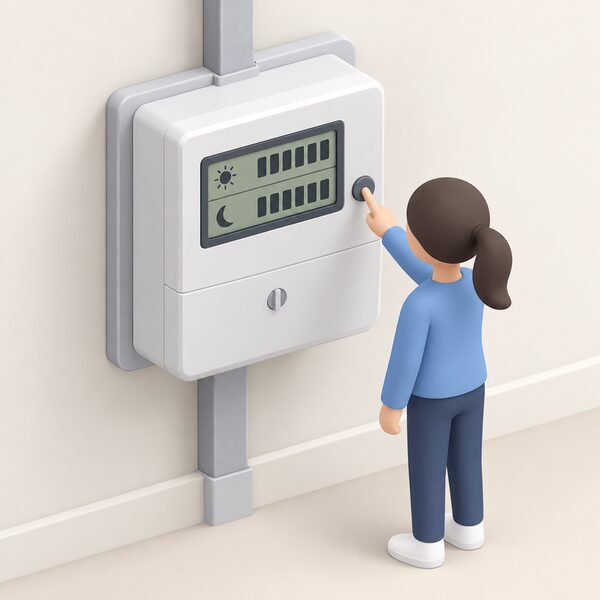
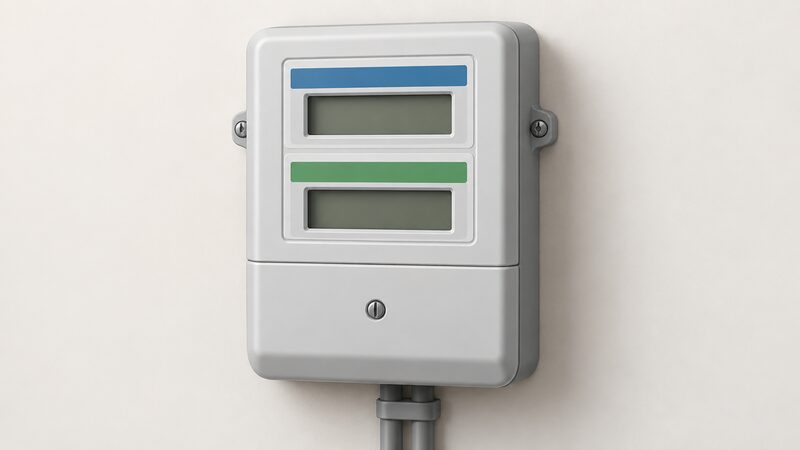
Economy 7 requires a special multi-rate meter installed at the property33. A household without one will need the chosen supplier to install a new meter before the tariff can start1. Electricity unit rates are either a single unit rate or a dual rate, which provides two meter readings and is usually called Economy 734. The meter records peak and off-peak usage separately, offering a two-tier system where day and night are charged at different rates7.
Identifying one is straightforward:
- Check the bill for two different rates charged for day and night, or for a tariff named Economy 7 or Economy 1036.
- Look at the meter for two sets of numbers. One is for on-peak hours, marked normal or day, and one for off-peak hours, marked low or night; they may instead appear as Rate 1 and Rate 2, or R1 and R237.
- On an electronic meter, look for a button to press to see each rate2. Some meters show a single figure marked "day rate" with a red button that reveals the night rate1.
When reading it, the daytime or on-peak figure is usually the top one, marked normal or day, or shown by default; the night or off-peak figure is the bottom one, marked low or night38. On digital and prepayment meters each reading is reached by pressing a button on the meter38. On some smart meters, pressing 6 repeatedly until "IMP R02" appears followed by eight digits gives what is usually the peak or normal reading39. On an import and export meter in Northern Ireland, the blue button is pressed repeatedly until a small "1" appears in the corner of the display for the normal day rate40.
Smart meters and Economy 7
All smart meters can support tariffs charging different prices at different times through the day and night, and Economy 10 meters are also available43. A household on Economy 7 or Economy 10 can get a smart meter, but not all suppliers can offer this, and one listed reason for a household being unable to get one is having storage heaters on Economy 7 or 10 where the supplier does not yet offer a compatible smart meter44. Smart meters are compatible with Economy 7 and fixed-rate tariffs and allow tariff switching without changing the meter; a traditional Economy 7 meter is compatible only with Economy 7 tariffs7. Some time-of-use tariffs such as Economy 7 do not require a smart meter, but access to the growing range of newer smart tariffs relies on a functioning smart meter, and some cheaper tariffs are available only to smart meter households45. See also which tariffs your meter allows.
Using the cheap hours well
Storage heaters are the original case: they use cheap off-peak electricity available with an Economy 7 tariff to heat high thermal capacity bricks, releasing the heat the following day19. They are sometimes simply called Economy 7 heaters7. Independent advice is that night storage heaters are a cheap form of electric heating provided the controls are understood, the settings are updated regularly to match the heat needed, and the household is on the Economy 7 tariff47. The input and output controls matter more than the tariff: a heater charged full on a mild night wastes cheap units, and a heater charged too little needs expensive daytime boost.
Hot water is the second lever. Where a home has a time-of-use tariff such as Economy 7, the immersion heater can be set to switch on when electricity is cheaper20. A timer is particularly useful on an Economy 7 supply because it allows the cylinder to be heated on overnight cheap electricity21. The same principle applies to an immersion tank generally: making sure it only comes on at night is what captures the off-peak rate47.
Beyond heat, the candidates are appliances with delay timers and any battery or vehicle charging. EV tariffs commonly mirror the Economy 7 shape, charging a lower unit rate for seven hours during the night22. Households running several of these together should note that the seven hours are shared: a storage heater bank, a cylinder and a car all drawing between midnight and 7am compete for the same window, and the last load to finish may spill into peak hours. Practical sequencing is covered on the page about shifting electricity use to cheap-rate periods.
Availability and the direction of travel
Economy 7 remains on offer as a tariff from most energy suppliers3. It is not, on that evidence, being withdrawn as a product. What is changing underneath is the metering: these older time-of-use tariffs are becoming less common as the legacy meters that support them are phased out42. The tariff's long history is visible in policy modelling too: a 2014 impact analysis assumed a 20 per cent take-up of static time-of-use tariffs in Great Britain from 2016, counting existing Economy 7 customers within that figure48.
Northern Ireland is the one part of the UK with a regularly published, named comparison of Economy 7 tariffs, issued by the Consumer Council and correct on the day of comparison15. In Great Britain, Economy 7 rates sit within the standard price cap framework for default tariffs32.
For households, the sensible reading is that Economy 7 is a stable, unambitious tariff whose value depends entirely on the shape of the home's demand. It remains the right structure for a storage-heated home with a working clock, and the wrong one for a home that uses most of its electricity in daylight. Beyond switching supplier, a household does not control the tariff its supplier sets; what it controls is how and when it uses energy49.
Sources49 cited
- What is Economy 7?, energyhelpline, 2026-09-20
- Getting the most from Economy 7, National Energy Action, 2026-09-10
- Economy 7 guide, Uswitch, 2026-09-08
- Electric heating advice, Centre for Sustainable Energy, 2026-06
- Economy 7 tariffs in Northern Ireland, Consumer Council for Northern Ireland, 2026-09-18
- Energy flexibility, Smart Energy GB, 2026-08-17
- What is Economy 7?, Smart Energy GB, 2026-04-07
- Time-of-use tariffs explained, Which?, 2026-04-23
- Types of energy tariff, Confused.com, 2025-11-03
- What is Economy 7?, Confused.com, 2025-08-20
- Should I switch to a time of use tariff?, Energy Saving Trust, 2026-01-23
- What is Economy 10?, energyhelpline, 2026-09-20
- Storage heaters, Which?, 2026-01
- Energy price cap explained, Welsh Government, 2026
- Economy 7 price comparison table, Consumer Council for Northern Ireland, 2026-01-28
- Understanding the opportunity of flexibility for households, Energy Systems Catapult, 2025-04-30
- Balancing the grid, Uswitch, 2026-02-09
- Night storage heaters, Centre for Sustainable Energy, 2025-10
- Heating fuel guide, Uswitch, 2026-01-27
- Immersion heaters, Which?, 2026-06-01
- Hot water guide, Uswitch, 2025-01-31
- Electric cars and energy bills, Uswitch, 2026-04-27
- Tariffs for renewable technology, Energy Saving Trust, 2026-08-12
- Affordable Warmth Scheme, Northern Ireland Housing Executive, 2026-09-17
- Northern Ireland Sustainable Energy Programme, Energy Saving Trust, 2026-09-07
- Decent homes standard summary table, Department for Communities, 2025-08-05
- Gas meters and electricity meters: what you need to know, Which?, 2026-01-16
- Vehicle to Grid Britain, Cenex, 2026-09-17
- Good energy habits could save households hundreds of pounds in 2026, Uswitch, 2026-01-08
- Millions of energy customers hit by 7.6% hidden price hike, End Fuel Poverty Coalition, 2023-01-01
- Tariff watch: are our standing charges being inflated?, Warm This Winter, 2024-01-24
- Changes to the energy price cap between 1 January and 31 March 2026, Ofgem, 2025-11-21
- Energy: your questions answered, Confused.com, 2026-07-03
- Understanding your gas or electricity bill, Centre for Sustainable Energy, 2026-02
- Moving house gas and electricity guide, Uswitch, 2026-08-26
- RTS: what you need to know, Act on Energy, 2026
- Reading your gas or electricity meter, Centre for Sustainable Energy, 2026-08
- How to read your gas and electricity meter, Confused.com, 2025-12-15
- Energy meters, energyhelpline, 2026-09-20
- Import and export meters, NIE Networks, 2026-09-20
- Radio Teleswitch Service switch-off, Age UK, 2026-08-26
- How to switch energy supplier, Which?, 2026-05-15
- Smart meters, Energy Ombudsman, 2026-09-20
- Can I get a smart meter?, Smart Energy GB, 2026-03-16
- Supporting households with low carbon technology combinations, Energy Saving Trust, 2026-07-15
- Do you have to have a smart meter by law?, Smart DCC, 2026
- Energy saving myths, Centre for Sustainable Energy, 2026-07
- Science and Technology Committee report on evidence checks, UK Parliament, 2014
- How do smart meters save energy?, Smart DCC, 2026
 Time-of-Use Tariffs ExplainedCan you pay less for electricity by using it at different times of day?
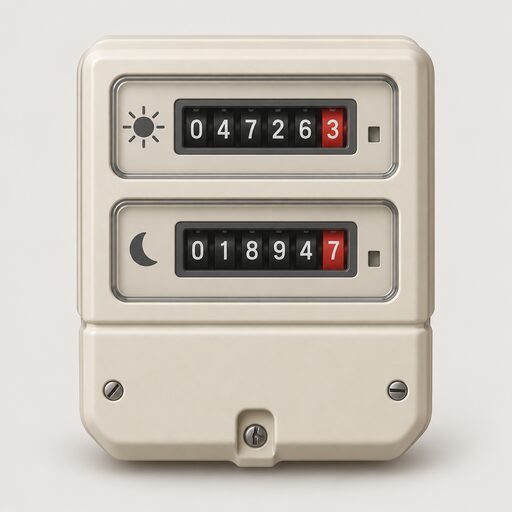 Economy 7 and Restricted MetersEconomy 7 and Economy 10 meters give you cheaper electricity for a set number of hours overnight and charge you more the rest of the day.
 Meters and Time-of-Use TariffsDo you need a smart meter for a time-of-use tariff, and does it have to send readings every half an hour?
 Electric Vehicle TariffsCharging an electric car at home can cost far less overnight, but only on special electricity plans.
 EV Charging Bolt-OnsCan you get cheap electricity for your car without changing the tariff for the rest of your home?
 Tariffs and Energy IndependenceA tariff decides what you pay for power from the grid and what you get paid for sending solar back.