
In this answer
Short answer
Economy 7 gives seven hours of cheaper electricity overnight1. That is the whole of the headline answer: seven cheap hours in every 24, with the remaining 17 hours of the day charged at a higher peak rate2. The cheaper period usually runs between midnight and 7am, but this varies across suppliers, and the regional network operator, the company responsible for physically supplying electricity to your property, defines the hours that apply to your meter1.
The window is not a national standard. One guide describes the cheaper Economy 7 time period as running for a seven-hour period at some point between 11.00pm and 8.00am, and puts the regional variation at between 7 and 9 hours3. Another describes the cheaper rate as usually running between midnight and 7am4. Both are describing the same tariff from different angles: the nominal entitlement is seven hours, and the clock times are set locally.
What the tariff does for a household is move the price signal, not the supply. The electricity still comes from the grid, and the household still buys it from a supplier. What changes is that a large share of consumption can be bought at the cheap rate if it can be shifted into the window. That is the independence Economy 7 offers: control over when energy is bought, not where it comes from.
Economy 7 gives seven cheap hours a day, overnight
The entitlement is consistent across the guidance. Economy 7 tariffs offer a low-cost rate for electricity for 7 hours each night2. The tariff offers cheaper prices for 7 hours during the night4. It offers cheaper electricity for seven hours overnight5. The National Energy Action leaflet puts it as seven hours, usually between midnight and 7am6.
The structure is what makes it a time-of-use tariff rather than a discount. Economy 7 is a time-of-use electricity tariff that charges 2 different prices for the electricity you use7. The cheaper off-peak rate will apply for 7 hours out of every 24 hours, usually at night8. There is one cheaper period of electricity during the night, and more expensive electricity during the day9.
That shape has consequences beyond the seven hours themselves. Because Economy 7 has a cheap and a more expensive rate, it is important to make sure that the on-peak and off-peak hours suit the household's pattern of use10. A household that cannot move load into the night pays the higher daytime rate without capturing much of the cheap rate, and the guidance on time-of-use tariffs generally notes that savings may not materialise if use cannot be shifted away from peak times, typically 4-7pm on newer tariffs11.
For a household's energy independence, the seven hours are a lever rather than a source. They allow a home to buy a large block of its electricity at a known cheap rate, which is useful for storage heaters, hot water cylinders and electric vehicle charging. They do not reduce reliance on the grid, the supplier or the wholesale market that sets the underlying price. The tariff is a pricing arrangement layered on top of the same supply.
The exact window: usually midnight to 7am, but set by your supplier
The most common description in the guidance is a window running from midnight to 7am. The cheaper rate usually runs between midnight and 7 am4. Night runs between 12am and 7am on Economy 7 tariffs12. The cheaper period usually runs between midnight and 7am, however, this varies across suppliers1.
The variation is real and it is local. The regional network operator defines the hours, and the range across regions is between 7 and 9 hours3. One guide frames the same fact from the household's side: the cheaper Economy 7 time period runs for a seven-hour period at some point between 11.00pm and 8.00am3. A supplier's own statement of the off-peak times for a given meter is therefore the only reliable source for that property.
There is a further wrinkle. Some energy companies also offer extra hours during winter1. Some variations offer 8.5 or 10 hours5. These are variations on the standard product rather than the standard itself, and they are set by the supplier or the network arrangement rather than chosen by the household.
| Feature | Typical position | Source |
|---|---|---|
| Cheap hours per day | 7 | 1 |
| Common window | Midnight to 7am | 4 |
| Outer range quoted | 11.00pm to 8.00am | 3 |
| Regional variation | 7 to 9 hours | 3 |
| Longer variations | 8.5 or 10 hours | 5 |
| Winter extras | Offered by some companies | 1 |
The practical consequence is that two households on nominally the same tariff in different parts of the country can have different cheap windows. A storage heater set to charge on one schedule may not align with the cheap hours in a different region. Confirming the times with the supplier, rather than assuming midnight to 7am, is the step that makes the rest of the tariff work.
How the tariff works: cheap night units, dearer daytime units
Economy 7 gives a set number of hours of cheap electricity through the night, with daytime electricity charged at a higher peak rate13. The meter tracks the two periods separately, which is why an Economy 7 meter requires specialist installation and tracks electricity usage using two separate rates: a 17-hour day (peak) period and the seven-hour night period3.
The daytime rate is the part households most often underestimate. The daytime rate will usually be higher than on a normal tariff4. This rate is cheaper than the rate charged during the other 17 hours of the day, which is the trade being made2. The tariff is not a discount applied to a standard rate; it is a reweighting of the whole day.
That reweighting is why the tariff is usually paired with a particular kind of heating. Economy 7 and Economy 10 are older types of time-of-use tariff that offer cheaper overnight rates, typically used with electric storage heaters14. For energy customers who have electric storage heaters, the Economy 7 tariff is an ideal option as they can be heated overnight and used to give off heat the following day4.
The same logic extends to hot water and, more recently, to vehicles. Electric vehicle tariffs often work similarly to domestic Economy 7 tariffs, where electricity is charged at a lower unit rate for seven hours during the night15. These tariffs usually offer a lower rate per unit of electricity used at night, similarly to domestic Economy 7 tariffs16.
For independence, the structure means the household is buying a predictable block of cheap energy and accepting a predictable block of expensive energy. The grid connection, the supplier relationship and the wholesale price exposure all remain. What the household gains is the ability to decide which hours its largest loads run in, provided the appliances and heating can be scheduled.
Economy 7 and Economy 10: tariffs with more than seven cheap hours
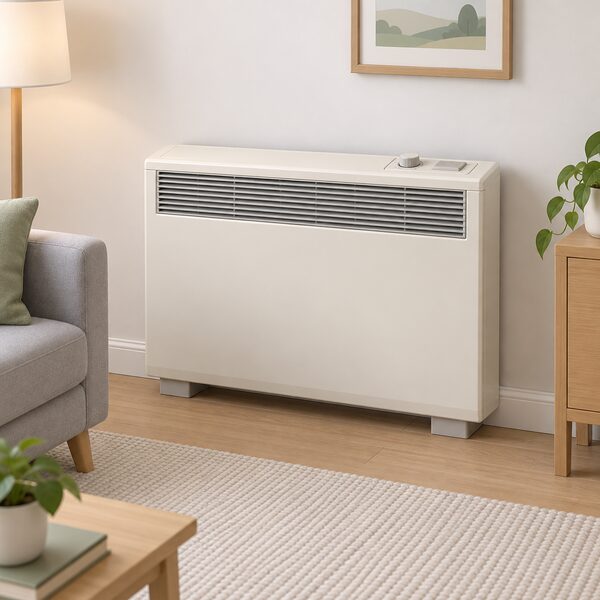
Economy 7 and Economy 10 give seven or 10 hours of cheaper electricity, mostly overnight17. Economy 10 is the direct extension of the same idea: Economy 10 tariffs provide consumers with the same 7 cheaper hours of electricity during the night as Economy 7, but the remaining cheap hours fall during the day18.
The split is usually described as 7 hours during the night and 3 hours during the day, most likely sometime in the afternoon or evening19. The tariff offers much cheaper usage rates during 10 off-peak hours of the day19. For households that cannot concentrate their load overnight, the three daytime cheap hours are the point of the product.
The trade-off is that Economy 10 is less widely available and is tied to particular metering arrangements. Economy 7 and Economy 10 are older types of time-of-use tariff that offer cheaper overnight rates, typically used with electric storage heaters14. The off-peak hours on Economy 7 and Economy 10 are around 12pm-7am is typical, times vary14.
| Tariff | Cheap hours | Shape of the cheap period |
|---|---|---|
| Economy 7 | 7 | One overnight block1 |
| Economy 10 | 10 | 7 overnight plus 3 in the day18 |
| Economy 10 split | 10 | 7 night, 3 afternoon or evening19 |
There is a wider point about how much of the value of flexibility a simple tariff captures. Analysis of vehicle-to-grid work found that a simple Economy 7 tariff would unlock most of the value achievable with a responsive half-hourly tariff20. That is a statement about the ceiling on complexity: for many households, the seven-hour product already captures the bulk of what a more sophisticated tariff would deliver.
For independence, Economy 10 changes the shape of the cheap window without changing the underlying dependence. The household still draws from the grid and still buys from a supplier. It gains a second cheap period in the day, which suits homes with loads that cannot wait until night.
What the seven hours mean for storage heaters and hot water
Storage heaters work by using cheaper, off-peak night-time electricity to create and store heat, which can be used the day18. They are designed to work with Economy 7, an electricity tariff where night-time electricity is much cheaper, typically about half the price, but day-time electricity is more expensive21. The seven hours are the charging window for the heat that carries the home through the following day.
The same principle applies to hot water. Typically, electricity suppliers offer a 7-hour night tariff22. Manufacturer guidance for restricted-meter products describes the arrangement in the same terms: seven hours of cheaper, off-peak electricity for stored heat and hot water, and seven hours at the cheapest rate for stored heat and hot water23. Storage heating products from one maker use a 7-day timer to manage the charging cycle24.
The scheme rules in Northern Ireland show how tightly the two are linked. Properties with Economy 7 at the time of application will be provided with replacement electric high heat retention storage heaters under the Northern Ireland Sustainable Energy Programme25. The tariff and the appliance are treated as a single package.
"They are designed to work with Economy 7, an electricity tariff where night-time electricity is much cheaper (typically about half the price) but day-time electricity is more expensive"
For a household, this is where the seven hours do the most work. A storage heater charged overnight converts cheap units into daytime warmth without drawing on the grid at peak. That is a genuine form of daily independence from peak pricing, though not from the grid itself. The heat is stored in the fabric of the appliance, not generated on site, and the household remains exposed to the supplier's day rate for everything else.
Checking your meter and tariff to confirm your off-peak times
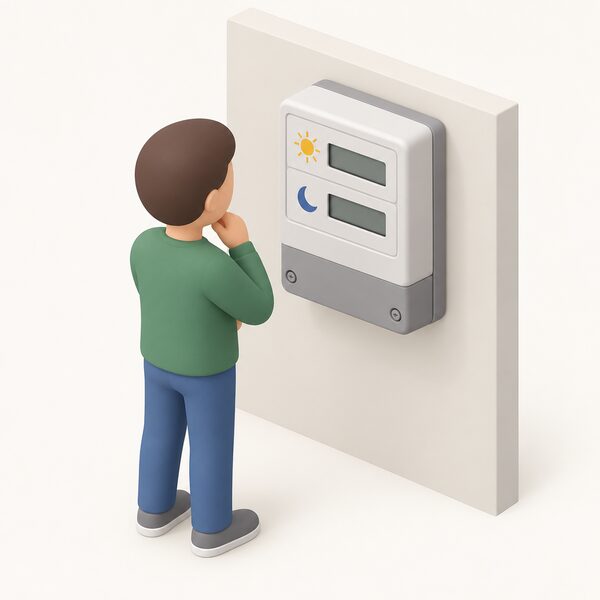
An Economy 7 meter displays two readings. One is for on-peak hours, which could be marked as normal or day, and one is for off-peak hours, marked low or night10. These may also be shown as Rate 1 and Rate 2, or R1 and R210. The night-time or off-peak reading is the bottom one, marked low, or night26.
Reading the meter confirms which register is which, but it does not confirm the clock times. Those come from the supplier. Because Economy 7 has a cheap and a more expensive rate, it is important to make sure that the on-peak and off-peak hours suit the household's pattern of use10. The supplier's own statement of the off-peak window is the document that settles the question.
Smart meters change the mechanics without changing the entitlement. You can get a smart meter if you are on an Economy 7 or Economy 10 tariff18. All smart meters can support tariffs which charge different prices at different times throughout the day and night, and Economy 10 meters are also available27. Availability is not universal: you can get a smart meter if you are on an Economy 7 tariff, but not all suppliers can offer this3.
Switching supplier is a separate process from changing the meter or the window. It takes up to five working days for a switch to be completed, and the new supplier will give a date17. The off-peak times attached to the property are set by the network arrangement, so a change of supplier does not by itself move the window.
For independence, the checking step is what converts a general tariff into a usable one. Knowing the exact hours allows a household to schedule storage heating, hot water and vehicle charging into the cheap period. Without that, the household pays the higher daytime rate for load that could have been shifted, and the tariff delivers less than it could.
Sources27 cited
- Time of use tariffs explained, Which?, 2026-04-23
- Types of energy tariff, Confused.com, 2025-11-03
- Economy 7 guide, Uswitch, 2026-09-08
- What is Economy 7, Energy Helpline, 2026-09-20
- Should I switch to a time of use tariff, Energy Saving Trust, 2026-01-23
- Getting the most from Economy 7, National Energy Action, 2026-09-10
- What is Economy 7, Confused.com, 2025-08-20
- Energy flexibility, Smart Energy GB, 2026-08-17
- Tariffs for renewable technology, Energy Saving Trust, 2026-08-12
- Reading your gas or electricity meter, Centre for Sustainable Energy, 2026-08
- Air source heat pump costs and savings, Which?, 2026-04-14
- Balancing the grid, Uswitch, 2026-02-09
- Heating fuel guide, Uswitch, 2026-01-27
- The best heating for your home, Which?, 2025-09-22
- Electric cars and energy bills, Uswitch, 2026-04-27
- EV energy tariffs, Uswitch, 2025-09-17
- How to switch energy supplier, Which?, 2026-05-15
- What is Economy 7, Smart Energy GB, 2026-04-07
- What is Economy 10, Energy Helpline, 2026-09-20
- V2GB vehicle to grid Britain, Cenex, 2026-09-17
- Night storage heaters, Centre for Sustainable Energy, 2025-10
- Electric hot water, BEAMA, 2026-09-19
- Three rate tariffs, OVO Energy, 2026-09-17
- Storage heating, Stiebel Eltron, 2026-09-17
- Northern Ireland Sustainable Energy Programme, Energy Saving Trust, 2026-09-07
- How to read your gas and electricity meter, Confused.com, 2025-12-15
- Smart meters, Energy Ombudsman, 2026-09-20
 Economy 7 TariffsEconomy 7 gives you seven hours of cheaper electricity at night, but the exact hours depend on where you live and who supplies you.
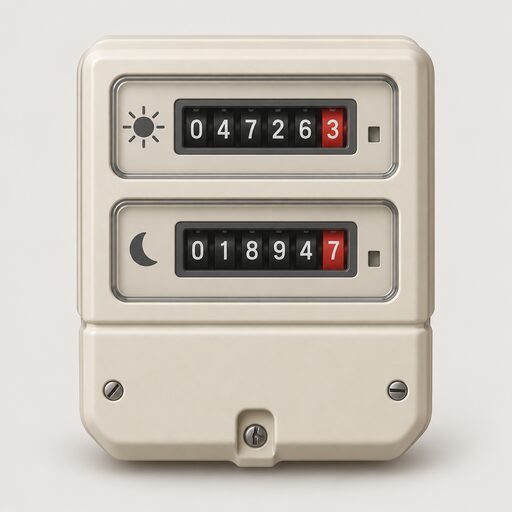 Economy 7 and Restricted MetersEconomy 7 and Economy 10 meters give you cheaper electricity for a set number of hours overnight and charge you more the rest of the day.
 Time-of-Use Tariffs ExplainedCan you pay less for electricity by using it at different times of day?
 Free Electricity and RewardsCovers tariffs and offers that give free or half-price electricity in set windows, including recurring weekly free hours, weekend offers and savings challenges.
 EV Charging Bolt-OnsCan you get cheap electricity for your car without changing the tariff for the rest of your home?
 Meters and Time-of-Use TariffsDo you need a smart meter for a time-of-use tariff, and does it have to send readings every half an hour?