
In this answer
Short answer
Economy 7 is an electricity tariff in which the cost of the electricity you use is different, depending on the time of day1. It charges two different prices for electricity depending on time of use: one cheaper period of electricity during the night, and more expensive electricity during the day2. The cheap window runs for seven hours each night, somewhere between 11.00pm and 8.00am4.
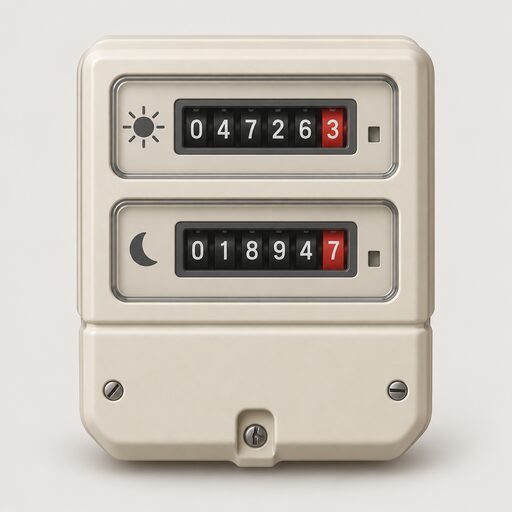
The quickest way to find out whether you are on it is to look at a recent bill. If you are charged two different rates for day and night, or your tariff type is listed as Economy 7 or Economy 10, you are on a multi-rate supply5. Your meter will confirm it: an Economy 7 meter displays two readings, one for on-peak hours marked normal or day and one for off-peak hours marked low or night6.
What follows is how to check each of those three places, what the readings mean, and what to weigh up if the tariff no longer fits how your home uses electricity.
What Economy 7 is and how it differs from a standard tariff
A standard single-rate tariff charges one unit price whatever the hour. Economy 7 splits the day in two: a seven-hour overnight window at a lower unit rate, and the other 17 hours at a higher one10. The tariff is a time-of-use structure, and it is one of the older forms of it, typically used with electric storage heaters11.
That structure is why the tariff is not simply cheaper or dearer than a standard one. It is a trade: a discount for load moved into the night, paid for by a premium on everything used during the day. Some Economy 7 tariffs charge almost double the night rate during the day, so the daytime rate is the figure that decides the outcome for a given household7.
The split is not fixed by the meter. Precise timings and costs can vary depending on your supplier, so two households on Economy 7 in the same region can face different windows and different rates7. The tariff is also distinct from newer time-of-use products: Economy 7 tariffs and EV tariffs are both examples of tariffs that charge a lower price for electricity at night, but they are separate products with separate eligibility12.
For a household's energy independence, the tariff changes when power is cheap, not where it comes from. It rewards a home that can store or defer demand, such as a storage heater or a battery charged overnight, and it leaves the household exposed to the daytime rate for everything that cannot wait. The time-of-use tariffs page sets out how that family of products compares, and Economy 7 tariffs covers rates and night hours in more detail.
Checking your bill: the quickest way to tell
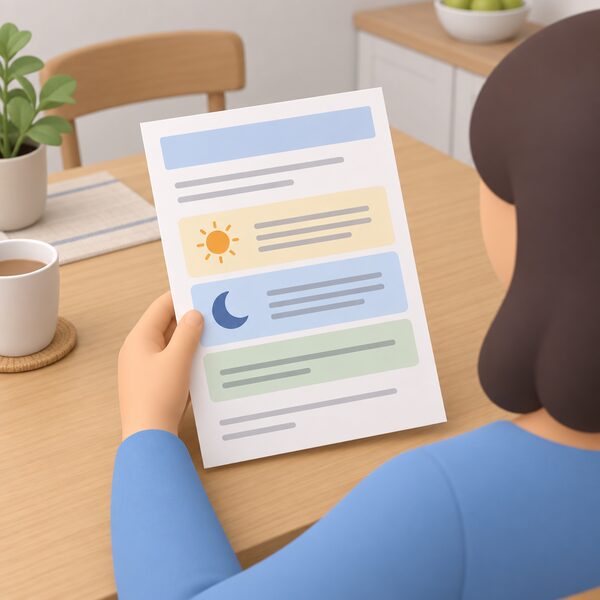
The bill is the fastest check because it reflects what you are actually charged, not what the meter is capable of. Look for two rates: a day rate and a night rate, or a tariff type named as Economy 7 or Economy 105. A bill showing a single unit rate and a single standing charge is a single-rate supply.
Two further signals appear on some bills. Two different readings and two different supply numbers point to a white meter arrangement, which is a two-meter version of the same idea13. And if a reading has been estimated rather than read, it is marked with an E or the word estimate, which matters because an estimated multi-rate bill can misstate how much of your use fell into the cheap window14.
Bill presentation is not uniform, and comprehension varies. In Ofgem's consumer satisfaction survey for August to September 2023, 71% of respondents paying by direct debit or on receipt of bills were satisfied with the ease of understanding their bill15. That leaves a substantial minority for whom the two-rate structure is not obvious from the document alone, which is why the meter and the supplier account are worth checking as well.
If the bill is unclear, the supplier can confirm the tariff in writing. Tariff details are usually available on your latest energy bill or statement, or in your supplier's app or online account16.
Your meter: white meters, two registers and what they show
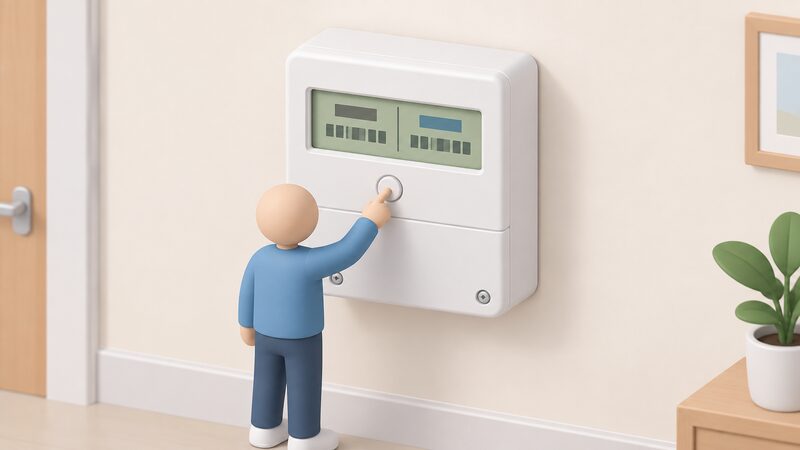
An Economy 7 meter requires a special multi-rate meter to be installed at your home9. In practice it shows two sets of numbers: one marked low, meaning night, and one marked normal, referring to the day7. On digital and prepayment meters you usually reach each reading by pressing a button, sometimes marked Rate 1 and Rate 217. The same two registers may be labelled normal or day for on-peak hours and low or night for off-peak hours, or shown as R1 and R26.
Northern Ireland's import and export meters follow a similar logic with a different button sequence. Pressing the blue button repeatedly until a small 1 appears in the corner of the display brings up the normal, day rate reading; repeating until a small 2 appears brings up the low, night rate reading18.
A white meter is the older arrangement: two different meters showing two different readings, one for normal consumption and one for off-peak consumption13. Seeing two readings and two supply numbers on a bill is the usual sign of it13.
Asking your supplier: what to say and what to ask for
A supplier contact is the definitive check, because the supplier holds the tariff record and the meter configuration. The questions worth putting in writing are: which tariff am I on, is it a single-rate or multi-rate supply, what are my day and night unit rates, what are my standing charges, and what exactly are my off-peak hours?
The last of those matters most. Economy 7 gives seven hours of cheaper electricity overnight, and the window commonly runs between midnight and 7am, but this varies across suppliers20. The cheaper period runs for a seven-hour span at some point between 11.00pm and 8.00am4. Only the supplier can confirm the exact hours for a given property and region.
If the answer is unsatisfactory, the complaint route is defined. Before contacting the Energy Ombudsman, a household should notify the supplier and work with them to try to resolve the issue21. When complaining, tell the supplier what you want to complain about, when the problem happened, what you want to happen, and the first date you contacted them, along with letters, emails and phone calls about the complaint22. The Ombudsman can tell suppliers to take practical action, such as crediting or cancelling an account or changing a tariff, to make an apology, or to offer a financial award, or a combination of these23.
Supplier service quality varies. In Which?'s energy company reviews, Utilita scored 7 out of 12 for contacting your supplier24. That is one supplier's score in one review, not a general measure, but it illustrates why putting the tariff question in writing and keeping the reply is worth the effort.
If you are on Economy 7: whether it still suits your home
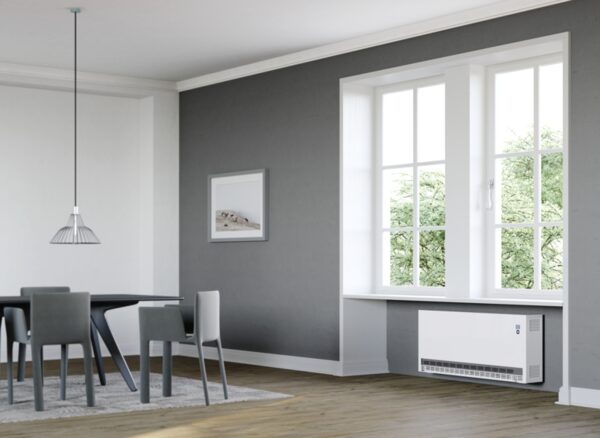
The eligibility rule is narrower still: Economy 7 is only available for electricity-heated homes and not those with a gas supply20. The tariffs are typically used with electric storage heaters but they are available to anyone3.
The practical test is the proportion of use that falls into the cheap window. For Economy 7 to be economical, a household should be able to use at least 40% of its electricity at night8. A home that heats its water and its rooms overnight, or charges a battery in the cheap hours, can clear that bar. A home that is out during the day and heats with gas is unlikely to.
The consumption split assumed in official work is 58:42, with Economy 7 tariffs modelled at 34.38p for on-peak and 15.43p for off-peak25. Ofgem's review of typical domestic consumption values confirmed there would be no updates to the consumption split as part of that review, remaining unchanged from the previous review26. That split is a modelling assumption for a typical household, not a prediction for any individual one.
For a household with a battery, the tariff question is not Economy 7 alone. Guidance on battery-only homes suggests either a dynamic tariff or Economy 73. The shifting electricity use to cheap rates page covers the wider set of options, and Economy 7 with a smart meter deals with metering.
What are the Economy 7 cheap hours in my region?
Economy 7 offers cheaper prices for seven hours during the night7. The cheaper period usually runs between midnight and 7am, but this varies across suppliers20. The window sits somewhere between 11.00pm and 8.00am4.
There is no single national timetable. The hours are set by the supplier and can differ by region and by meter, which is why the same seven-hour tariff can start at different times in different homes. 00pm and 8.00am. Both are reported here because the conflict is unresolved, and the supplier's own confirmation is the only reliable answer for a specific property.
The timing matters for anything that runs on a timer. An immersion heater or storage heater set to come on at the wrong hour will draw at the day rate, which is the expensive side of the tariff27. The Economy 7 night rate start time page deals with that question directly, and how many hours of cheap electricity Economy 7 gives covers the duration.
Switching off Economy 7 if it no longer pays
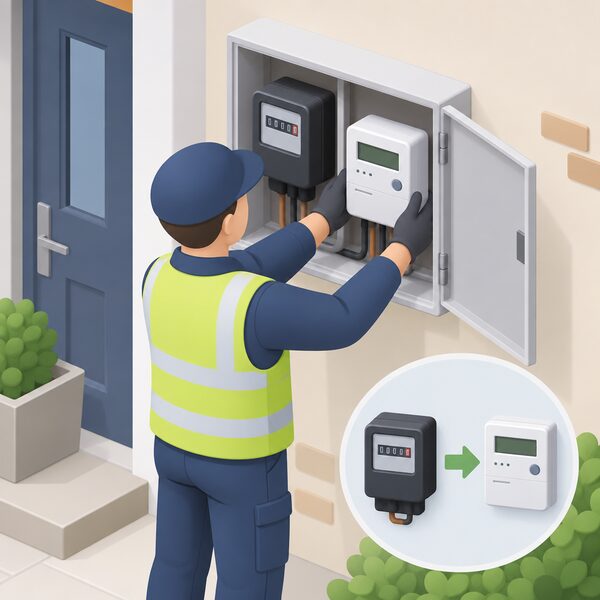
Economy 7 has not been withdrawn. It remains on offer as a tariff from most energy suppliers4. Moving to a single-rate tariff is therefore a tariff change, not the loss of a scheme, and it depends on what the supplier offers for the meter installed at the property.
The contract terms decide the cost of moving. Some Economy 7 products carry no exit fee: the Budget Energy Keypad Economy 7 tariff, for example, is listed with no exit fee28. Others do. Octopus Energy's fixed-price tariffs allow a switch without incurring an exit penalty if energy prices fall below what you are paying29. The exit fees and tariff contract terms page sets out how those terms work.
A smart meter is not required to leave Economy 7, but it changes what is possible. You can get a smart meter if you are on an Economy 7 tariff, but not all suppliers can offer this4. Where one is fitted, it can support time-of-use billing and give half-hourly visibility of when electricity is used, which is the information a household needs to judge whether a multi-rate tariff still pays.
Northern Ireland households face a different supplier landscape, and the Consumer Council publishes Economy 7 price comparison tables for the region, updated on the date a new increase or decrease comes into effect rather than when it is announced31. The tariffs in Northern Ireland page covers that market. For the wider picture of how tariff choice affects what a home can do for itself, see tariffs and household energy independence.
Sources31 cited
- Economy 7 advice, Centre for Sustainable Energy, 2026-07
- What is Economy 7?, Confused.com, 2025-08-20
- Tariffs for renewable technology, Energy Saving Trust, 2026-08-12
- Economy 7 guide, Uswitch, 2026-09-08
- RTS: what you need to know, Act on Energy, 2026
- Reading your gas or electricity meter, Centre for Sustainable Energy, 2026-08
- What is Economy 7?, Energy Helpline, 2026-09-20
- Getting the most from Economy 7, National Energy Action, 2026-09-10
- Energy: your questions answered, Confused.com, 2026-07-03
- Types of energy tariff, Confused.com, 2025-11-03
- The best heating for your home, Which?, 2025-09-22
- Using energy flexibly, Smart Energy GB, 2026-04-14
- White meters guide, Uswitch, 2026-04-23
- How to understand your electricity and gas bills, Energy Ombudsman, 2025-04-24
- Energy Consumer Satisfaction Survey findings, Ofgem, 2023-09
- How to check your energy tariff and switch, British Gas Energy Trust, 2026-07-30
- How to read your gas and electricity meter, Confused.com, 2025-12-15
- Import and export meters, NIE Networks, 2026-09-20
- How to read your electric meter: import and export meters, NIE Networks, 2026-09-19
- Time-of-use tariffs explained, Which?, 2026-04-23
- How we can help: energy suppliers, Energy Ombudsman, 2026-09-20
- Complaints process, Smart Energy GB, 2026-03-16
- What to expect, Energy Ombudsman, 2026-09-19
- Energy company reviews: Utilita, Which?, 2026-06-16
- Electric heating advice, Centre for Sustainable Energy, 2026-06
- Review of typical domestic consumption values decision, Ofgem, 2026-05-27
- Energy saving myths, Centre for Sustainable Energy, 2026-07
- Economy 7 price comparison table, Consumer Council for Northern Ireland, 2026
- Octopus price changes, Uswitch, 2026-07-10
- RTS meters, National Energy Action, 2026-07-08
- Economy 7 price comparison table, 28 August 2026, Consumer Council for Northern Ireland, 2026-08-27
 Meters and Time-of-Use TariffsDo you need a smart meter for a time-of-use tariff, and does it have to send readings every half an hour?
 Economy 7 TariffsEconomy 7 gives you seven hours of cheaper electricity at night, but the exact hours depend on where you live and who supplies you.
 Time-of-Use Tariffs ExplainedCan you pay less for electricity by using it at different times of day?
 Meter Readings and EstimatesWhy is my energy bill estimated, and how often should my meter be read?
 Economy 7 and Restricted MetersEconomy 7 and Economy 10 meters give you cheaper electricity for a set number of hours overnight and charge you more the rest of the day.
 Which Tariffs Your Meter AllowsHow meter type decides which energy tariffs a household can access, from single-rate and two-rate meters to smart, prepay and restricted configurations, and the constraints faced by flats, rented homes and homes without a working smart connection.