In this guide
An agile or dynamic electricity tariff prices every half hour of the day separately, following the wholesale market rather than holding one flat unit rate. The mechanism that makes this possible is half-hourly metering: a smart meter records energy use automatically in half-hour periods, which allows the supplier to bill on actual rather than estimated consumption and to charge different rates for use at different times of the day or week1. Without that half-hourly record there is nothing to price against, which is why a smart time-of-use tariff needs a meter communicating with the supplier every half hour3.
On Octopus Energy's Agile tariff, the price changes every half hour in line with the changing wholesale price of electricity, and customers find out the unit rates they will pay for the next 24 hours between 4pm and 8pm daily4. That day-ahead publication is the defining feature of a dynamic tariff as against a fixed or standard variable one: the rates are known in advance, but only a day in advance, and they are not the same tomorrow as today.
For a household pursuing energy independence, the honest framing is that a dynamic tariff does not reduce dependence on the grid or on a supplier. It changes the terms of that dependence, rewarding a home that can move demand into cheap periods, and exposing a home that cannot. A smart meter will not automatically save money on its own, and except by switching supplier a household does not control the tariff its supplier sets, only how much energy it uses and when5.
Why half-hourly tariffs depend on a smart meter
Smart meters enable accurate billing by automatically recording energy use in half-hour periods, which is what lets suppliers charge for what was actually consumed rather than an estimate1. That same half-hourly record is what enables a supplier to charge different rates for use at different times of the day or week10. A conventional meter cannot do this: it holds a single running total that a person reads occasionally.
The requirement is stated the same way across official and independent guidance. Smart time-of-use tariffs need a smart meter that communicates with the supplier every half hour2. To access new flexible time-of-use tariffs, the meter must be set to send readings every half an hour11. The meter must be set up to provide automatic meter readings every 30 minutes so the provider can price each block3. A smart meter is also needed to get the full benefit of flexible schemes and smart tariffs, and, in most cases, to take part in household flexibility schemes at all10.
The same metering underpins payment for export. To sign up to a tariff that pays for exporting solar electricity, a meter capable of half-hourly readings is needed, and generally that means a smart meter13. Households on the closed Feed-in Tariff can note that generation payments are not affected by having a smart meter fitted14.
What this means in practice is that the meter is both the enabler and the constraint. It is the piece of equipment that gives a household access to time-of-use tariffs and to the Smart Export Guarantee, and it is also a piece of supplier-installed, supplier-maintained infrastructure that the household does not own or control.
How prices are published a day ahead, in half-hour blocks
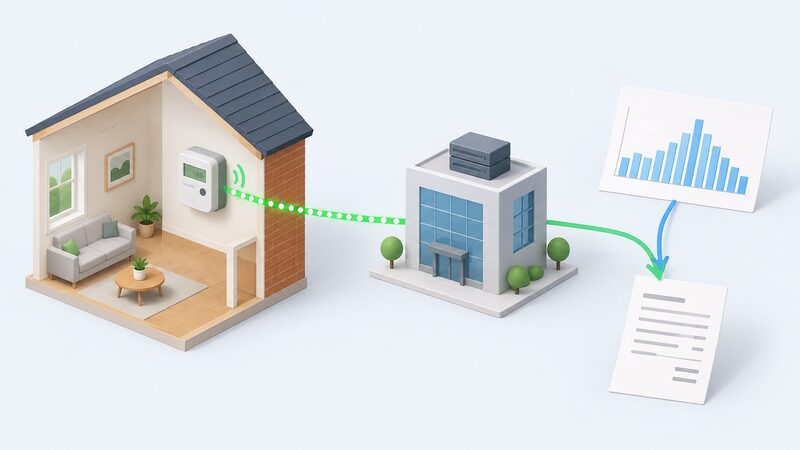
A dynamic tariff replaces a single unit rate with 48 of them. On Octopus Agile, the price paid changes every half hour in line with the changing wholesale price of electricity4. The rates for the following 24 hours are published between 4pm and 8pm daily, so a household plans against known figures rather than a forecast3.
That advance publication is what separates an agile tariff from a tracker tariff, where the rate changes but on a daily rather than half-hourly cycle. It also creates the window in which very low prices, and in volatile conditions negative ones, can appear: the price is set by the market for each block, and a household with a battery, an electric vehicle or a heat pump can decide the night before which blocks to use.
Availability of the most aggressive dynamic products moves with the market. Intelligent Octopus Flux was recorded as temporarily unavailable on 16 September 2026, with the page giving particularly volatile energy prices as the reason, while the standard Octopus Flux tariff remained available on that date. Withdrawal and reopening of dynamic tariffs in response to wholesale volatility is a normal feature of this part of the market, and is covered further under closed and withdrawn tariffs.
Time-varying pricing is not new in principle. 100Green was the first energy supplier to launch a tariff using a smart meter to charge customers different electricity rates depending on the time of day15. What the half-hourly settlement infrastructure added was the granularity to price every block separately rather than two or three fixed windows, as Economy 7 does.
Half-hourly, daily or monthly: choosing how often the meter shares data
Every smart meter offers a choice of how often it sends data to the supplier. Monthly is the minimum, with daily and half-hourly offered as options7. The preference can be changed with the supplier at any time17. Readings may be sent monthly, daily or half-hourly depending on the household's preferences and the supplier's arrangements18.
| Setting | What the supplier receives | Effect on tariff choice |
|---|---|---|
| Monthly (minimum) | One reading a month, in some cases only17 | Accurate billing, but no half-hourly pricing |
| Daily | One reading a day19 | Supports daily-cycle products, not half-hourly ones |
| Half-hourly | A reading every 30 minutes3 | Required for dynamic and smart time-of-use tariffs11 |
The practical consequence is that choosing monthly, which is the most privacy-protective setting, closes off dynamic tariffs entirely. Independent guidance is explicit that the half-hourly setting is what a new flexible time-of-use tariff requires11. A household weighing privacy against price is really choosing between those two settings.
Half-hourly data has a second use before any switch happens: some suppliers and comparison tools let a household upload its half-hourly data to estimate what it would pay on their smart tariff2. That gives a modelled figure based on the home's own consumption shape rather than a generic annual estimate, which matters when the whole economics of the tariff depend on when electricity is used. See also comparing energy tariffs.
Not every metering arrangement reads this frequently. Behind-the-meter arrangements can settle on a much slower cycle: Egni Co-op's electricity usage is automatically metered and billed quarterly20.
How time-of-use pricing works once the meter is set up
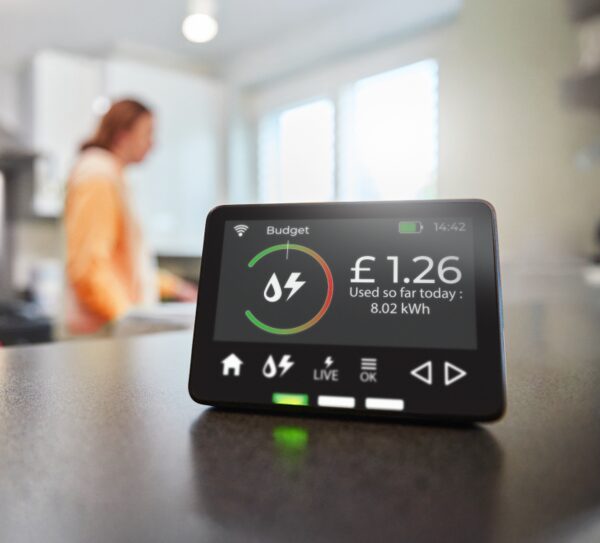
Time-of-use tariffs use the smart meter to log electricity use and charge different rates during different time windows21. Smart time-of-use tariffs use half-hourly smart meter readings to allow companies to charge lower rates when demand is lower and electricity is cheaper22. They are offered by some suppliers to their customers with smart meters23, and all smart meters can support tariffs that charge different prices at different times throughout the day and night, including Economy 7, with Economy 10 meters also available24.
An important protection sits alongside this. A supplier cannot charge based on when energy is used unless the household chooses such a tariff9. Having a smart meter does not by itself expose a home to peak pricing; being on a time-of-use tariff does.
The reward direction runs both ways. Smart tariffs and demand-flexibility events can reward a household for using energy during off-peak times or when a lot of clean electricity is available10, and access to time-of-use tariffs means cheaper rates during off-peak hours and incentives for usage on high-supply days25. The in-home display shows energy use during the day in pounds and pence, which is the feedback loop that makes shifting deliberate rather than accidental26.
Where the load is large and controllable, the arithmetic improves: ECO4 guidance notes that smart technology measures can be combined with a time-of-use tariff and used with a functioning electricity smart meter. Households with an EV, a heat pump or storage are the ones best placed to use half-hourly pricing, which is developed in shifting electricity use to cheap-rate periods and heat pump tariffs.
Where a dynamic tariff falls short
The limits are as important as the benefits. A smart meter will not automatically save money5. Except by switching, a household does not control the tariff its supplier sets, though it can change how much energy it uses6. A home with a flat, inflexible demand profile, one that cannot move its heating, cooking or hot water, is buying exposure to half-hourly price movement without the means to exploit it.
Dependence also remains structural. The meter is installed and maintained by the supplier, and suppliers are required to maintain smart meters for 12 months after installing them27. Readings travel over a network run by the Data Communications Company, not over equipment the household owns28. The tariff itself is a commercial product that can be withdrawn, as the September 2026 unavailability of Intelligent Octopus Flux shows. None of this is a reason against a dynamic tariff; it is the shape of the dependence that remains, and it is discussed further in tariffs and household energy independence.
Data and privacy: who sees half-hourly readings
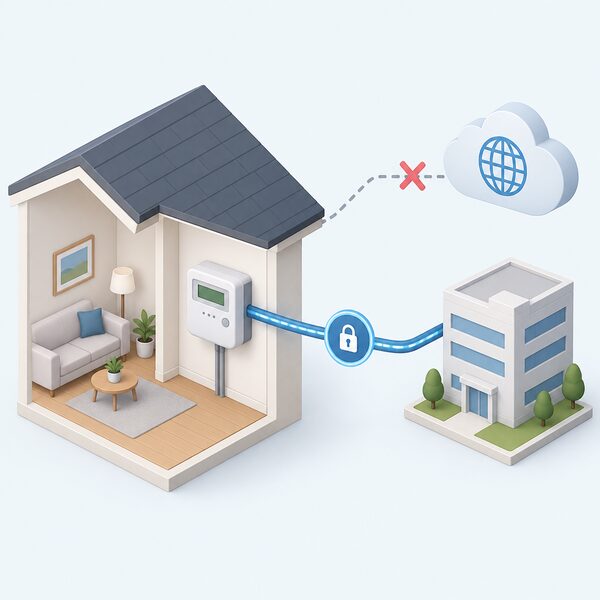
Half-hourly data is detailed data. On the DCC network, only the energy supplier can see how much energy a household is using and when28. The data shared through a smart meter is used to bill for energy used, to offer new products and services such as new tariffs where permission has been given, and to help make the energy system more efficient by recording demand more accurately8.
Smart meters have been designed with top cyber security experts, including the government and GCHQ, and use a closed, dedicated communications system rather than the internet17.
Network operators handle data on a different basis. National Grid Electricity Distribution states that all meter reading data is held anonymously in a secure database that does not contain names and addresses or other customer data, and that Ofgem has approved its privacy plan26. In Northern Ireland, the Consumer Council states that smart electricity meter data will be used only for accurate billing by the supplier and NIE Networks, and for anonymous system-wide analysis by SONI, the System Operator for Northern Ireland, to improve grid operation29. Flexibility providers certified under Flex Assure commit that energy data is handled responsibly and securely12.
"Only your energy supplier can see how much energy you are using and when."
Ofgem monitors energy suppliers and network operators closely to make sure they meet the rules set out in licences, regulations and law, provide good customer service and reply quickly to customers who contact them30.
Faults, lost connections and estimated bills
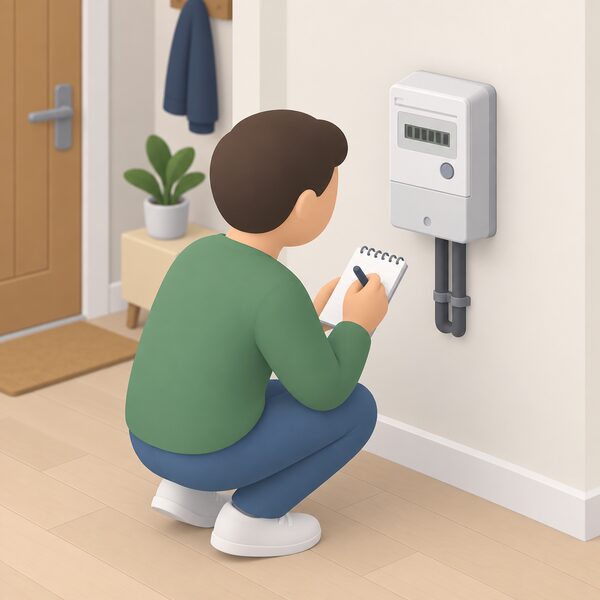
A smart meter may stop recording the energy used, or may no longer send readings to the supplier8. When the meter cannot communicate over the designated wireless network, the supplier may ask for a temporary manual reading so that bills remain accurate until the problem is resolved17. A smart meter usually sends readings automatically, but manual readings may still be needed when switching supplier, checking usage or resolving an account issue5.
Reading one is not always a single number. Some electricity smart meters show separate readings for day and night tariffs, Economy 7 pricing, and peak and off-peak usage, so each register has to be recorded5.
On a dynamic tariff a communications failure is more consequential than on a flat rate, because the whole bill depends on knowing which half hour each unit was used in. Ofgem's guidance lists the problems to take to a supplier: late, incorrect or missing bills, back billing, being overcharged, a faulty meter, poor customer service, and refusal to refund credit from an account30.
Switching supplier while on a half-hourly tariff
A household that pays a supplier directly for the electricity or gas it uses at home can choose to switch to a different supplier or tariff at any time31. Switching is straightforward on a variable rate tariff, or where a fixed rate contract is ending shortly; exit terms are covered in exit fees and tariff contract terms. On switching, the old supplier refunds any credit in the final bill, and compensation may be due if it does not32.
The risk specific to a smart meter is loss of smart functionality. Ofgem states that a meter may not work in smart mode after moving to a new supplier, in which case manual readings have to be taken and submitted instead33. For a dynamic tariff this is fatal to the product: no half-hourly reading, no half-hourly pricing. Ofgem also notes that a meter may work in smart mode again if the household changes tariffs or suppliers33. The DCC is running a programme to upgrade Britain's first-generation smart meters, which addresses part of this problem.
Some tariffs are available only to customers with smart meters, or to those who agree to have one fitted22, and a 2023 parliamentary briefing recorded that certain tariffs are available only to smart meter customers, including some of the cheapest on the market34. Where a supplier goes out of business, no action is needed from the customer: Ofgem automatically moves the household to a new supplier and makes sure the energy supply is not interrupted31.
Prepayment, renting and other special cases
A smart meter in prepayment mode can add credit automatically or without a visit to a shop8, and a supplier can switch a smart meter to credit mode remotely35. Where cash top-up is used, the supplier should provide a barcode, card or reference number for use in a shop, and top-ups can be made at a Post Office, Payzone or any shop displaying a PayPoint logo, with credit added to the meter immediately; keeping the receipt as proof is advised in case of a problem35.
Remote switching in the other direction is constrained. Ofgem's draft guidance for authorised heat network suppliers states that where no contact is made during a site welfare visit and all engagement attempts have been exhausted, the supplier may proceed with a remote mode switch to prepayment mode, and that where the consumer has not consented to that switch, the supplier must ensure the consumer receives prepayment meter credit unless that is technically infeasible or otherwise outside the supplier's control36.
Prepayment is also priced separately under the cap. For the period 1 October to 31 December 2025, the prepayment electricity cap level for a single-rate meter at 3,100 kWh was £893.64 in London, £926.96 in the Eastern region, £935.82 in the South East and £935.81 in the Northern region, with nil-consumption levels of £160.10, £167.73, £165.45 and £208.10 respectively37. Multi-register prepayment levels at 4,200 kWh ran from £1,112.34 in London to £1,162.60 in the South East37. More detail sits in prepayment and pay as you go tariffs.
Tariff types offered by suppliers include standard variable, renewable energy, electric vehicle, fixed price and prepayment, so a dynamic tariff is one option among several rather than the default.
Getting a meter capable of half-hourly readings
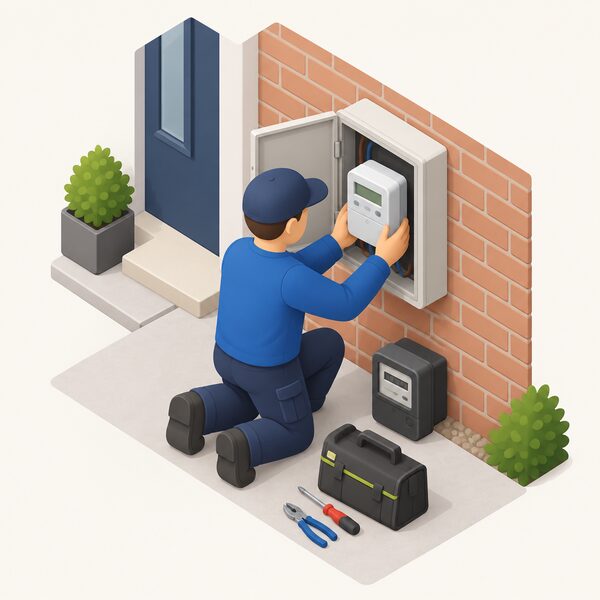
Energy suppliers are responsible for installing smart meters, so availability is a supplier question38. A smart meter is free, with no upfront charge, and is installed by the supplier at no extra cost8. Suppliers aim to provide every home and business in England, Scotland and Wales with free smart meters, with the rollout running over several years; Northern Ireland has its own separate rollout, described by the Consumer Council19.
Installation is not mandatory. It is not compulsory to have a smart meter, and a household can refuse one when offered27. Energy companies have been asked by government to take all reasonable steps to install smart meters in homes, and a supplier may be able to set up a meter to work in dumb mode, with all communications switched off7. A meter in that state cannot support a dynamic tariff, and declining one excludes the household from cheaper tariffs available only to smart meter customers39.
Homes with generation are generally catered for. Smart meters are designed to work with solar panels and a supplier should be able to offer one as part of the rollout40, though some suppliers are not yet ready to supply smart meters to customers with solar panels41. In most cases, having solar panels does not stop a household getting one18. See which tariffs your meter allows.
Two persistent worries are worth settling. A smart meter does not use home Wi-Fi, does not connect to a router and does not affect broadband speed; no home Wi-Fi, broadband, router or internet package is needed for it to send readings18, and it does not connect to the public internet at all42. On health, Public Health England carried out an extensive programme of research and found smart meters safe and posing no risk to public health, with radio wave exposure many times lower than from Wi-Fi and mobile phones and well within guideline levels41.
"there's no evidence that smart meters pose any risk to your health or the health of your family."
Energy suppliers are required to offer smart meters to all households and small businesses by the end of 2030, so households that decline one now will be offered again.
Sources43 cited
- Smart meters: your rights and expectations, GOV.UK, 2025-08-08
- Should I switch to a time-of-use tariff?, Energy Saving Trust, 2026-01-23
- Time-of-use tariffs explained, Which?, 2026-04-23
- Smart homes and a lower carbon footprint, Energy Saving Trust, 2026-01-21
- How can I read a smart meter, Smart Energy GB, 2026-09-17
- How do smart meters save energy, Smart DCC, 2026
- Do I have to accept a smart meter?, Which?, 2026-05-12
- Get help with your smart meter, Ofgem, 2026-09-17
- Do smart meters cost more?, Smart Energy GB, 2026-03-16
- How smart meters work with heat pumps, Smart Energy GB, 2026-04-24
- Energy flexibility, Smart Energy GB, 2026-08-17
- Flexibility for homes, Flex Assure, 2026-09-19
- Smart meter problems and solutions, Which?, 2026-08-24
- Feed-in Tariff information for generators, Ofgem, 2026-09-17
- 100Green energy company review, Which?, 2026-06-16
- What is a smart meter, Smart Energy GB, 2026-08-10
- Smart meter FAQs, Smart Energy GB, 2025-08-08
- How do smart meters work, Smart Energy GB, 2026-08-27
- How to get a smart meter, Smart DCC, 2026
- Behind the meter energy systems guidance, Welsh Government, 2026-06-29
- Five top tips from Which? to cut your energy bills, Climate Action Wales, 2026-03-18
- How to switch energy supplier, Which?, 2026-05-15
- How to use a smart meter to save money, Smart Energy GB, 2026-04-24
- Smart meters, Energy Ombudsman, 2026-09-20
- Smart meters, Climate Action Wales, 2026
- Smart meters advice and guidance, National Grid Electricity Distribution, 2026-09-17
- Guide to smart meters, Energy Saving Trust, 2026-07-15
- Upgrading Britain's first-generation smart meters, Smart DCC, 2026
- Smart electricity meters fact sheet, Consumer Council for Northern Ireland, 2026-04
- Complain about your energy supplier or network operator, Ofgem, 2026
- Switch your home energy supplier, Ofgem, 2026
- How your electricity or gas bill is calculated, Ofgem, 2026
- What happens if your energy supplier goes out of business, Ofgem, 2026
- Smart meters research briefing CBP-9865, House of Commons Library, 2023-09-26
- Problems getting to or topping up your prepayment meter, Citizens Advice, 2026-09-17
- Heat networks consumer protections draft guidance, Ofgem, 2025-09-05
- Energy price cap levels 1 October to 31 December 2025, Ofgem, 2025
- Energy saving tips, National Grid Electricity Distribution, 2026-09-17
- Do you have to have a smart meter by law, Smart DCC, 2026
- Can I get a smart meter?, Smart Energy GB, 2026-03-16
- Myth busting smart meter problems, Smart Energy GB, 2026-09-17
- Does a smart meter need Wi-Fi?, Smart DCC, 2026
- Smart meters and health, Smart Energy GB, 2026-03-16
 Meters and Time-of-Use TariffsDo you need a smart meter for a time-of-use tariff, and does it have to send readings every half an hour?
 Time-of-Use Tariffs ExplainedCan you pay less for electricity by using it at different times of day?
 Batteries and Smart TariffsA home battery can earn its keep if your electricity prices change through the day.
 Supplier-Controlled ChargingSmart charging tariffs let your energy supplier decide when your car charges, usually overnight when electricity is cheaper.
 Demand Flexibility and the GridGetting paid to shift your electricity use away from peak times is now a real option for households with a smart meter.
 The Full Tariffs GuideWhich energy tariff suits how you live, and will switching really save you money?