

In this guide
Northern Ireland runs its own electricity system operation, separate from the arrangements that cover England, Scotland and Wales. SONI manages the electricity grid, balancing demand and generation so power can flow from where it is generated to where it is used, and it is responsible for planning and upgrading the grid1. It is a system operator, not a regulator and not a network owner.
The part of SONI's role that reaches a household directly is the demand reduction ladder. When generation falls short, SONI can ask companies to generate more power, ask heavy industrial users to limit their use, and reduce household usage, including a small percentage voltage reduction that would be undetectable1. If those steps are not enough, it instructs NIE Networks to reduce demand, and NIE Networks is legally required to implement power cuts when instructed by SONI1.
That instruction produces what are called Planned Emergency Power Cuts: switching off the power supply to groups of customers in response to a severe shortage of electricity generation in Northern Ireland, affecting at least 5% of Northern Ireland households at once1. They can take place without warning if SONI instructs immediate demand reduction1.
What SONI is and what it does
SONI is the transmission system operator for Northern Ireland. Its stated role is to manage the electricity grid, balancing demand and generation to ensure electricity can flow from where it is generated to where it is needed, and it is responsible for planning and upgrading the grid1. It also holds the instruction power over NIE Networks, which is the network business that owns and operates the distribution system reaching homes and businesses.
The distinction between a system operator and a regulator matters, because the two are often confused. The GB and NI energy regulators cover only the on-grid pipes and wires market2. In Great Britain the equivalent system operator role sits with National Grid in England and Wales3, and the national system operator function has since been reorganised into NESO. Northern Ireland's arrangement is separate again: SONI operates the Northern Ireland system, and Northern Ireland sits in a single electricity market with the Republic of Ireland, so wholesale power is traded on an all-island basis even though the physical system operation described here is Northern Ireland's.
That separation has a practical consequence for households. Several UK-wide consumer arrangements stop at the Irish Sea. The supplier of last resort approach, for example, applies to both gas and electricity suppliers to residential users in the UK, excluding Northern Ireland4. A household in Northern Ireland therefore sits under a different set of protections and a different system operator from a household in England, Scotland or Wales. The wider picture of how Northern Ireland's market and gas network fit together is set out in energy supply in Northern Ireland, and the distribution business itself is covered in NIE Networks.
Balancing supply and demand on the Northern Ireland grid
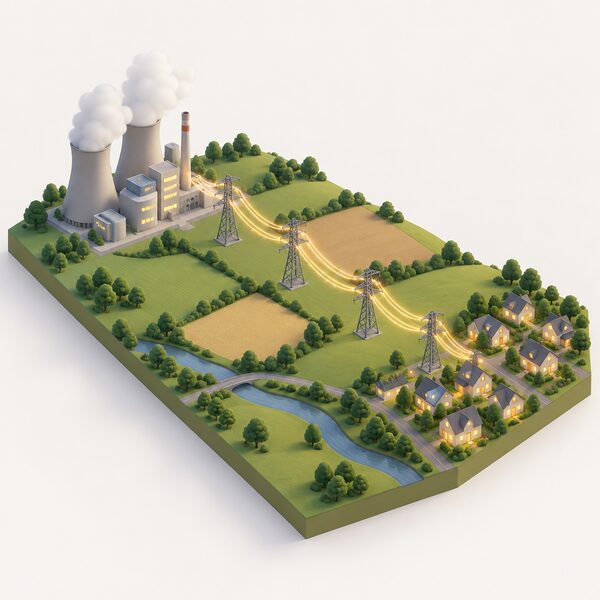
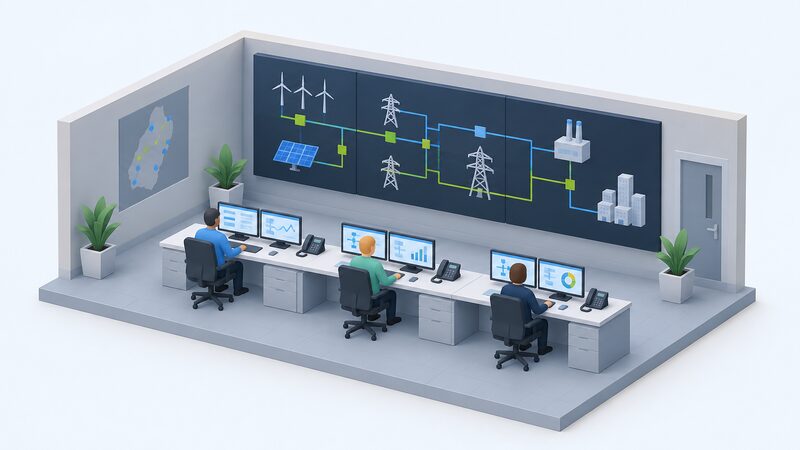
Balancing is the core of the job. Demand and generation have to match second by second, and SONI does this by managing the electricity grid so that power flows from where it is generated to where it is used1. On a small system with limited interconnection, that balancing act is tighter than on the Great Britain grid: there are fewer large generators to call on and less room for error.
Demand side response is one of the tools in the wider balancing picture. It covers a range of services that vary the demand of both domestic and commercial consumers to help balance the power grid5. That is the same principle SONI applies at the sharp end, but in normal operation it is a routine commercial service rather than an emergency measure. Household demand flexibility, and what it does for the grid, is covered in demand flexibility and the grid, and the technical side of keeping a system stable is covered in balancing services and frequency response.
For a household, the balancing role is invisible almost all of the time. Power flows, the lights stay on, and the only trace of the system operator is on the bill, through the network and balancing charges that fund the whole arrangement. The visible edge of the role appears only when the margin between available generation and demand closes, which is what the annual Winter Outlook exists to assess.
Planning and upgrading the network
Planning and upgrading the grid is the second half of SONI's remit1. That work determines what the Northern Ireland system can carry in future, and it is the part of the role that shapes whether new generation, new connections and new demand can be accommodated.
The network below the transmission system has its own planning and resilience arrangements. NIE Networks states that it has regularly reviewed plans in place to respond to severe weather6, and that it is in regular contact with the Met Office for weather information6. Each area of Northern Ireland has a local incident centre staffed by engineers and administrative staff during severe weather6, and the company's central control centre co-ordinates the restoration process and provides up to date information for customers6. Where possible it uses four wheel drive vehicles and co-ordinates repairs with Roads Service and local councils6.
Storm damage on the Northern Ireland network can include trees blown down across electricity lines, broken poles, damaged transformers and blown fuses6. That list is a reminder that the physical network, not the market, is what a household depends on in bad weather. The transmission side of that network, and who owns it, is covered in electricity transmission network, and the distribution side in electricity distribution networks.
The annual Winter Outlook

SONI undertakes a Winter Outlook every year to inform the industry and prepare for winter1. It is a forward assessment of the coming winter's conditions, published by the system operator for the benefit of the industry, and it is the document that sets out how the system expects to meet demand through the coldest months.
The Great Britain equivalent is published by NESO, and the two are separate documents covering separate systems. The GB version is explained in the NESO Winter and Summer Outlooks explained, and the general question of how margins are assessed and when shortfall notices follow is covered in electricity margins and supply shortfalls.
A Winter Outlook is not a household notice and does not tell an individual home what will happen to its supply. It is an industry planning document. Households wanting information during an actual incident are directed elsewhere: NIE Networks advises listening out for information on local radio, checking its website or social media platforms, and using a car radio to tune in for hourly news bulletins7.
What happens when generation falls short
A severe shortage of electricity generation in Northern Ireland is the trigger for the emergency arrangements. Planned Emergency Power Cuts are a form of emergency power cut used by energy companies in response to exactly that situation1. They mean switching power off to at least 5% of Northern Ireland households at once1.
The mechanism runs through the network business rather than the system operator. NIE Networks is legally required to implement power cuts when instructed by SONI1. Notice is not guaranteed: Planned Emergency Power Cuts can take place without warning if SONI instructs NIE Networks to reduce demand immediately, though the aim is to notify households through the media and social media beforehand1.
There is a separate safety route to disconnection that does not depend on a generation shortfall at all. Under Article 27 of the Electricity Safety, Quality and Continuity Regulations (Northern Ireland) 2012, a distributor may disconnect the supply to the consumer's installation or another distributor's network or street electrical fixture without giving the notice otherwise required, if the disconnection can be justified on grounds of safety8. That is a safety power, distinct from the demand reduction instruction, and it applies to the supply rather than to a group of households.
Demand reduction: the steps SONI can ask for

Demand reduction is a ladder, and the household step sits near the bottom of it. The sequence runs from asking companies to generate more power, to asking heavy industrial users to limit their use, to reducing household usage, including a small percentage voltage reduction which would be undetectable1. Only after those steps does the instruction to NIE Networks to reduce demand follow.
The order matters because it explains why industrial users are asked first. Large industrial loads can be curtailed in blocks, with a measurable effect on system demand and, usually, a commercial arrangement behind the curtailment. Household voltage reduction is the next step down: a small percentage reduction across the country that would be undetectable in the home, and which buys the system margin without switching anything off. The final step, switching off groups of customers, is the one that reaches the socket.
The wider case for reducing demand rather than only adding generation is made in official guidance: demand reduction can involve rolling out retrofit at scale and ensuring new houses and towns are built to appropriate net zero standards9. That is a long-term structural argument rather than an emergency measure, but it points the same way: a system with lower peak demand needs less generation to balance against it.
For a household, the practical reading of the ladder is that the first two steps are invisible and the third is designed to be. A voltage reduction that cannot be detected is not something a home can respond to or prepare for. The step that matters for preparation is the last one, and it is the one that arrives as a power cut.
What SONI's role means for households
The honest summary is that SONI's work is the reason a Northern Ireland household can usually take its electricity supply for granted, and also the reason that supply can be interrupted by a decision taken elsewhere. The grid is balanced continuously, planned and upgraded over years, and assessed each winter in advance. In a severe generation shortage, the same system operator can instruct the network business to switch off at least 5% of households at once, and the network business is legally required to comply1.
That is a dependence a household cannot remove by changing supplier or tariff. The physical supply, the balancing decision and the emergency instruction all sit above the retail market. What a household can influence is its own demand and its own resilience, and there is free, independent help available for that: the Consumer Council NI and Northern Ireland Energy Advice give free, independent and impartial energy advice to all domestic householders in Northern Ireland10. NI Energy Advice offers independent and impartial energy advice to domestic householders in Northern Ireland, plus referrals to energy grants and other sources of help11, and it is for all households across Northern Ireland12.
There is also a price comparison route. The Consumer Council offers an energy price comparison tool to compare electricity and gas tariffs for all suppliers in Northern Ireland13. For households struggling with bills, there is separate official advice13. The wider question of what a home can control, as against what sits with the system, is covered in energy security and household independence.
"Check on elderly or vulnerable neighbours, family and friends and make them aware of the Planned Emergency Power Cuts."
Sources13 cited
- Emergency power cuts, NIE Networks, 2026
- Energy regulation research briefing, House of Commons Library
- Energy Committee report on the system operator, Parliament, 2013
- Supplier of last resort information, Energy Ombudsman, 2026
- Demand side response research briefing, Parliamentary Office of Science and Technology, 2026
- Response to storms, NIE Networks, 2026
- Is there any action I should take when power is disrupted, NIE Networks, 2026
- The Electricity Safety, Quality and Continuity Regulations (Northern Ireland) 2012, section 27, legislation.gov.uk, 2012
- Demand reduction research briefing, Parliamentary Office of Science and Technology, 2025
- Low carbon heating, nidirect, 2026
- Energy saving grants in your area, nidirect, 2026
- Biomass, nidirect, 2026
- Advice if you're struggling to pay your energy bills, nidirect, 2026