
In this guide
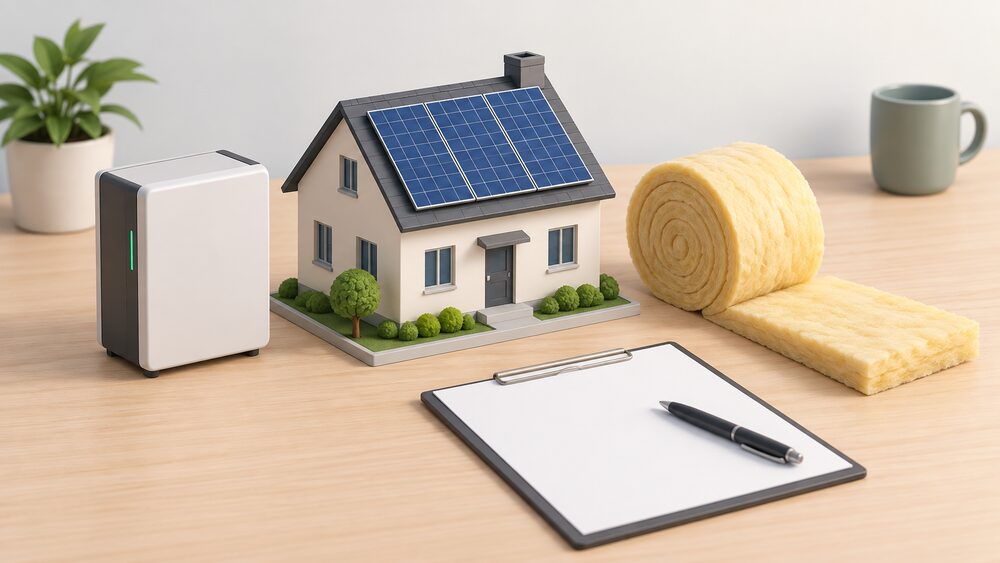
Energy security is a national question with a household answer, and the two are not the same size. The UK is a net energy importer with a high dependence on gas and oil, and the British Energy Security Strategy sets out how Great Britain will accelerate homegrown power for greater energy independence1. That is the frame. Inside it, a household controls three things: how much energy it needs, when it draws it, and how much it makes itself.
The figures that matter most are modest and specific. Average annual electricity consumption across all GB households is 3,955 kWh per year, on Ofgem's archetype data as of February 20242. The Demand Flexibility Service, which pays homes and businesses for shifting when they use electricity, incentivised 1.6 million households and businesses in winter 2022/23 and saved over 3.3GWh of electricity3. Storage batteries, both domestic and grid-scale, store electricity for up to eight hours3. Eight hours covers an evening peak. It does not cover a still, cold week in January.
What follows is an honest account of which national risks a home can insulate itself from and which it cannot. Fabric, heating choice, on-site generation, storage and flexibility all move the household's exposure. None of them removes the grid, the supplier, the gas network or the international market that sets the price of what remains.
A smaller exposure, not independence
A household cannot buy energy independence. It can buy a smaller exposure. The distinction matters because the two are routinely confused in marketing, and the evidence in the public record supports only the second.
The national position is set out plainly in government guidance from March 2022: the UK is a net energy importer with a high dependence on gas and oil1. The British Energy Security Strategy, published on 7 April 2022, applies to England, Scotland and Wales and sets out how Great Britain will accelerate homegrown power for greater energy independence1. The Committee on Climate Change welcomed the strategy but said it was still disappointing not to see more on energy efficiency and on supporting households to make changes that can cut energy bills now5. That criticism is the hinge of this page. Supply-side strategy and household-side action are different levers, and the second was, on the CCC's reading, underused.
What a household actually controls is narrower than the phrase "energy independence" suggests. It controls demand through fabric and behaviour. It controls the timing of some electricity use, and can be paid for that through the Demand Flexibility Service, which launched in winter 2022/23 to reward homes and businesses for shifting when they use electricity6. It can generate electricity on site. It can store electricity for up to eight hours3. It cannot control the wholesale price of gas, the availability of imports, or the network charges that sit on every bill.
The honest short answer, then: a home can cut what it needs, shift when it takes power, and make some of its own. It remains connected to a grid, supplied by a company, and priced by a market it does not influence. That is not a counsel of despair. It is the boundary within which household action is genuinely effective.
The figures: 3,955 kWh and a near-doubling in fuel stress
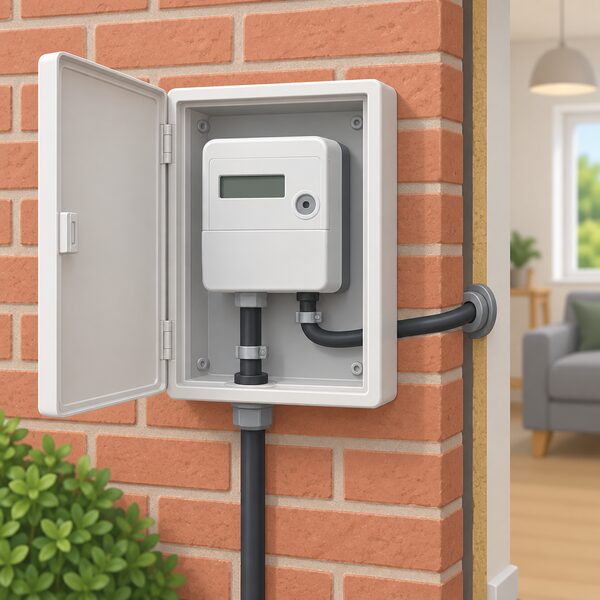
The numbers that describe household energy security come from official statistics, and they are worth reading carefully because they are often quoted loosely.
Energy Consumption in the UK 2025 is accredited official statistics7. Ofgem's archetype work puts average annual electricity consumption for all GB households at 3,955 kWh per year, as of February 20242. The same table gives an average annual figure of £44,938 across the modelled archetypes, which reflects the spread of household types in the model rather than a single typical home, and should be read that way.
On affordability, the Commons Library records that 36.4% of households in England, 8.91 million, were spending more than 10% of income on domestic energy after housing costs in 2023, up from 20.5% (4.93 million) in 20218. That is a near doubling in two years and it is the clearest single measure of how quickly household exposure can change.
Support has been large and temporary. The Energy Price Guarantee kept the annual energy bill for the typical household to around £2,500 from 1 October 2022, based on Ofgem Typical Domestic Consumption Values for a medium dual fuel household at 2.9MWh a year of electricity and 12MWh a year of gas4. The Energy Bills Support Scheme provided a £400 discount to help with the rising costs of energy, reaching 29 million households across Great Britain9. The British Energy Security Strategy promised upgrades to over half a million homes, delivering average bill savings of £30010.
| Figure | Value | Date | Source |
|---|---|---|---|
| Average GB household electricity use | 3,955 kWh per year | February 2024 | 2 |
| England households spending over 10% of income on energy | 36.4% (8.91m) | 2023 | 8 |
| Same measure, two years earlier | 20.5% (4.93m) | 2021 | 8 |
| Energy Price Guarantee typical bill | around £2,500 a year | from 1 October 2022 | 4 |
| Energy Bills Support Scheme discount | £400 per household | 2022 to 2023 | 9 |
| Households reached by that scheme | 29 million | 2022 | 9 |
What drives household exposure
Three forces drive household energy security, and only one of them is under the household's hand.
The first is the national supply position. Government guidance from March 2022 describes the UK as a net energy importer with a high dependence on gas and oil, and sets out measures across hydrocarbons, nuclear and renewables to support energy resilience and security while delivering affordable energy to consumers1. The Spending Review 2025 states that energy security is core to the government's national security plans, and commits to secure the energy system and improve people's lives in every part of the UK11. That is the top-down driver, and it moves slowly.
The second is the efficiency of the housing stock, which moves more slowly still. The Committee on Climate Change noted that energy use in homes, which accounts for 14% of total UK emissions, increased between 2016 and 201712. Its 2022 assessment was blunter: the average annual energy bill for UK households is around £40 higher than if insulation rates from pre-2012 had continued for the last decade13. That £40 is a per-year figure and it is the cost of a policy stall, not a technology failure.
The third is household behaviour and equipment, which can change in a season. The Demand Flexibility Service is the clearest example: it was designed to help manage potential winter pressures by reducing demand during evening peak periods and reducing reliance on more expensive electricity generation6. It launched in winter 2022/23 and became a year-round service on 27 November 2024, moving to operate as an in-merit margin tool6.
"Delivering on these goals will help to protect UK consumers from future price spikes and increase energy security by reducing energy needs and shifting demand from gas to electricity, which in future will be predominantly supplied from UK-based renewable generation."
England, Scotland, Wales and Northern Ireland
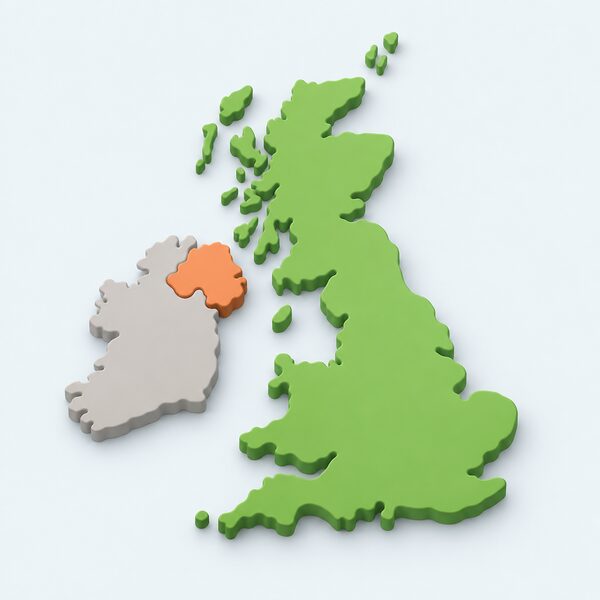
Energy policy is not uniform across the four nations, and the differences are material to what a household can access.
The Energy Company Obligation covers Great Britain, and domestic households in Great Britain are eligible15. ECO4 Flex proxies refer to homes in England16. The British Energy Security Strategy applies to England, Scotland and Wales1. The Energy Price Guarantee operated, for the most part, in the same way for households across the whole of the UK, with differences for Northern Ireland4.
Delivery has differed sharply. Scottish Government guidance records an average of 118 measures per 1,000 households under the Energy Company Obligation in Scotland, compared to 81 in Wales and 77 in England, as of December 202017. A parliamentary committee found a profound disparity between the public money invested in residential energy efficiency schemes per capita in England compared to the devolved nations18. The Minimum Energy Efficiency Standards are set by the UK Government, as energy is a reserved matter19.
Scotland's climate plan states that in 2025/26 alone, its schemes are supporting 20,000 households, saving them up to £500 a year on their energy bills20. The Energy Savings Opportunity Scheme was introduced across the UK in 2014 to meet requirements set out in the EU Energy Efficiency Directive21.
| Nation | Position in the evidence |
|---|---|
| England | ECO4 Flex proxies apply; 77 measures per 1,000 households, December 202017 |
| Scotland | 118 measures per 1,000 households, December 2020; 20,000 households supported in 2025/2620 |
| Wales | 81 measures per 1,000 households, December 202017 |
| Northern Ireland | Energy Price Guarantee differed; ECO covers Great Britain only4 |
The rules, and where they are changing
The rules that govern household energy security are a patchwork of obligations, schemes and standards, and they change.
The Energy Company Obligation is the main domestic efficiency obligation in Great Britain, and it has reached just over 9% of homes in Great Britain22. The Energy Saving Trust has developed a service allowing users to verify premises tenure for properties in England and Wales23. The Minimum Energy Efficiency Standards are set by the UK Government19.
Consumer confidence is a live constraint. The Chartered Trading Standards Institute estimates that as many as 5 million UK households are being deterred from installing energy-efficiency measures due to unfamiliarity or lack of reliable installer24. That is a rule-adjacent problem: the schemes exist, but the route through them is not trusted.
On flexibility, the rules are shifting in the household's favour. From 9 April 2026 the Demand Flexibility Service introduces a reduced eligibility threshold of 0.1MW, bi-directional flexibility, zonal procurement, Primacy and a Self-Nominated Baseline option6. From 7 October 2026 it will launch the capability to procure constraint management actions, and participants will be able to take part in both margin and system tagged actions6.
What independence a home can actually hold
The lens here is simple: say what the subject does for a household's independence, and say what dependence remains.
What it does. A household that cuts its demand reduces the volume it buys at whatever the market price is. The Committee on Climate Change found that improvements in energy efficiency had saved the typical household around £290 per year since 2008 as demand for electricity fell22. A household that installs storage can hold electricity for up to eight hours3. A household that joins the Demand Flexibility Service can be paid for shifting when it uses electricity, and the service delivered 3.9GWh of flexibility across 44 events from December 2024 to March 20253. In 2024 the scheme changed to an all year round service, and between December 2024 and April 2025, 11,900MWh of shiftable electricity demand was procured21.
What remains. The grid connection, the supplier relationship, the gas network where one exists, and the international market that prices the marginal unit. The UK is a net energy importer with a high dependence on gas and oil1. Household electricity prices in the UK were higher than in all but three EU states in the second half of 2025, and 18% above the EU average25. No amount of loft insulation changes that comparison.
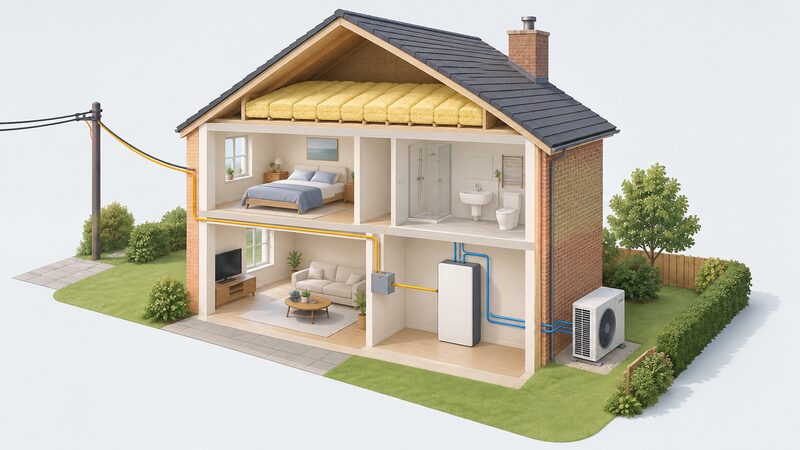
The realistic position is that household action reduces exposure at the margin and improves resilience during price spikes and peak events. It does not deliver independence from the system. The Heat and Buildings Strategy's own framing is that delivering on its goals will help to protect UK consumers from future price spikes and increase energy security by reducing energy needs and shifting demand from gas to electricity, which in future will be predominantly supplied from UK-based renewable generation14. That is a reduction in exposure, described accurately.
Sources25 cited
- British Energy Security Strategy, GOV.UK, 2022-04-07
- Ofgem archetypes update 2024, Ofgem, 2024-02
- Statutory Security of Supply Report 2025, GOV.UK, 2025-12-17
- Energy Price Guarantee up until 30 June 2023, GOV.UK
- CCC responds to UK Government's Energy Security Strategy, Climate Change Committee, 2022-04-07
- Demand Flexibility Service, NESO, 2026-09-17
- Energy Consumption in the UK 2025, GOV.UK, 2026-04-20
- Fuel poverty in England, House of Commons Library
- £400 energy bills discount, GOV.UK, 2023-02-22
- Major acceleration of homegrown power, GOV.UK, 2022-04-06
- Spending Review 2025, GOV.UK, 2025-06-30
- UK housing fit for the future, Climate Change Committee, 2016
- Current programmes will not deliver net zero, Climate Change Committee, 2022-06-29
- Independent assessment: the UK's Heat and Buildings Strategy, Climate Change Committee, 2022-03-16
- ECO4 and Great British Insulation Scheme mid-scheme changes, GOV.UK, 2024-11-14
- Birmingham City Council ECO4 Flex statement of intent, Birmingham City Council, 2024-11-01
- Tackling fuel poverty in Scotland, Scottish Government, 2020-12
- Energy efficiency inquiry, Business, Energy and Industrial Strategy Committee, 2019-07-12
- Decarbonising private housing, Senedd Research, 2026-09-20
- Scotland's Climate Change Plan 2026-2040, Scottish Government, 2025
- Smart Metering 2025 Costs and Benefits Report, UK Parliament, 2024
- UK climate action has reduced emissions without increases in household energy bills, Climate Change Committee, 2017-03-16
- ECO4 delivery guidance v3.2, Ofgem, 2025-12-08
- Energy efficiency pledges undermined by lack of consumer confidence, Chartered Trading Standards Institute, 2024-06-18
- Energy prices in the UK and EU, House of Commons Library, 2025
 Suppliers and IndependenceCan you really cut your energy bills by making your own power, and how much of your supplier do you still need?
 Heating and Energy IndependenceCan you heat your home without relying on gas or oil, and what would that take?
 The Full Energy Independence GuideCan you really run your home on your own power in the UK, and how far can that go before the grid still matters?
 Energy IndependenceA heat pump runs your heating on electricity instead of gas or oil, so how much does that really cut what you pay and how exposed you are when fuel prices jump?
 Self-Sufficiency RatioHow much of your own energy do you really make, and how much still comes in from outside?
 Energy Independence RulesExamines how the regulatory framework helps or hinders a household trying to generate, store and use its own energy, from connection rules to export arrangements and metering obligations.