
In this answer
Short answer
A solar home battery does not make a house independent. It changes the timing of when grid electricity is used, and how much of a household's own generation is used on site rather than exported. The published figures for what that achieves are consistent enough to plan around: adding a battery to a solar installation increases self-consumption from 30 to 40% to 70 to 80%1, and one independent guide puts the figure at 80% or more of generation used with a battery2.
Self-sufficiency, the share of total demand met without importing, is a different and usually lower number. A typical household with solar and battery storage can produce up to 80% of its annual demand3, and homeowners adding battery storage to solar PV are reported to meet 70 to 80% of annual electricity demand3. The Energy Saving Trust estimates 40% of a home's energy can come from solar cells, especially when used alongside a solar battery4.
The gap between those two numbers is the point of this page. Self-consumption measures the array; self-sufficiency measures the household. A battery improves both, but it cannot manufacture winter generation, and it cannot exceed what the roof produces.
What self-sufficiency means for a home with solar and a battery
Two measures get used interchangeably in sales conversations and they should not be. Self-consumption is the amount of solar electricity generated by a domestic solar PV system which is subsequently consumed within the property and not exported to the distribution network8. It is a ratio of generation. Self-sufficiency is the share of the household's demand that is met without drawing from the grid, and it is a ratio of consumption.
Self-consumption and self-sufficiency are different measures, and a battery moves them at different rates. Self-consumption is the share of solar electricity generated that is used in the property rather than exported1. Self-sufficiency is the share of the household's total annual demand that the system meets. Adding a battery can lift a household's self-consumption rate to over 70%2, and homeowners adding battery storage to solar PV can meet 70 to 80% of their annual electricity demand3. A typical household with solar and battery storage can produce up to 80% of their annual demand3. A household with high demand and a small array will show lower self-sufficiency than self-consumption.
The practical effect of storage is well documented. Adding a battery to a solar installation increases self-consumption from 30 to 40% to 70 to 80%1, and a UK domestic solar installation with batteries can boost a household's self-consumption rate to over 70%9. Independent data from a press release covering the June 2026 heatwave puts the self-consumption rate at 70% with a 10kWh battery10.
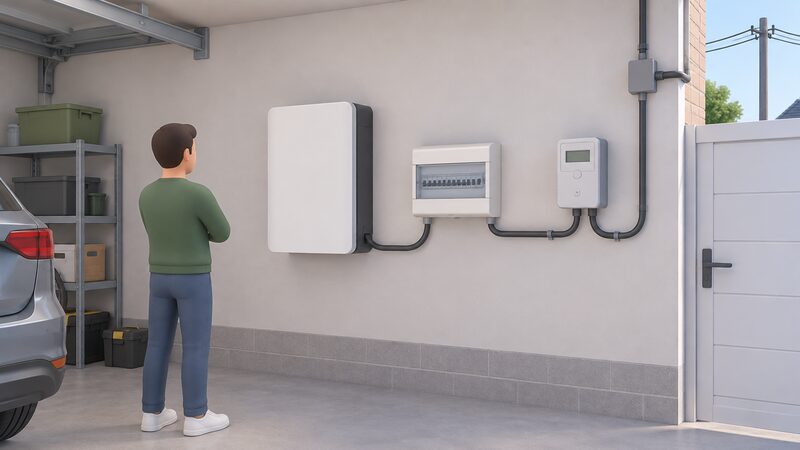
What a battery does for independence is narrower than the headline suggests. It stores free, renewable electricity to power a heat pump, making a household less reliant on grid electricity11, and it generates electricity instead of relying on the grid12. It does not remove the connection. The grid remains the supplier of last resort every winter evening, and the battery is a buffer against price and timing, not a substitute for the network.
Typical self-sufficiency levels: what households actually achieve
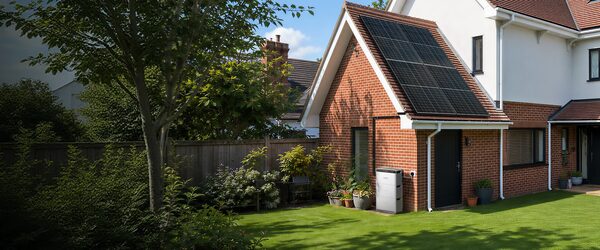
The range across sources is wide because the underlying homes are different. At the top end, one maker states a typical household with solar and battery storage can produce up to 80% of annual demand3, and the same source reports homeowners meeting 70 to 80% of annual electricity demand when adding battery storage to solar PV3. A maker's guidance for UK households puts the sweet spot at 50 to 70% self-sufficiency via solar and battery13, and another maker's figure for a correctly sized battery is 70% to 90% of generation14.
Independent and official figures sit in a similar band but measure different things. Solar Energy UK suggests that combining rooftop solar with a battery could enable 80% of a household's annual electricity1. The Energy Saving Trust estimates 40% of a home's energy with solar cells, especially alongside a battery4. Domestic battery systems can store as much electricity as a household typically uses in a day, enabling a PV system to provide up to 70% of a household's annual electricity demand5.
| Measure | Figure | Who reports it |
|---|---|---|
| Self-consumption, no battery | 30 to 40% | Official guidance1 |
| Self-consumption, with battery | 70 to 80% | Official guidance1 |
| Self-consumption, with battery | 80% or more | Independent guidance2 |
| Self-consumption, 10kWh battery | 70% | Independent press release10 |
| Annual demand met | up to 80% | Maker guidance3 |
| Annual demand met | 50 to 70% | Maker guidance13 |
| Annual demand met | up to 70% | Independent guidance5 |
The differences come from three things: how the household defines demand, whether the figure is annual or seasonal, and how the battery is sized against the array. A figure quoted as self-sufficiency by one source may be self-consumption by another's definition, which is why the table above separates them.
What limits self-sufficiency: roof size, season and household routine
The ceiling on self-sufficiency is set before the battery is chosen. The number of panels that can be installed may be limited by the roof shape, skylights, shading from nearby buildings or trees, local planning or conservation area requirements, local grid capacity and export limits15. A shaded or split roof produces less, and no amount of storage recovers generation that never happened.
Planning rules set hard limits on what can be added. On a flat roof the highest part of the solar PV equipment cannot be more than 600mm higher than the highest part of the roof, excluding a chimney16. Roof-mounted solar PV must not be higher than the highest part of the roof, excluding any chimney, and flat-roof PV must not be 0.6 metres higher than the highest part of the roof17. Stand-alone solar must not exceed 4 metres in height17, and where installed within 5 metres of a boundary it is limited to 2 metres in height18. A separate council guidance states stand-alone solar would exceed 4m in height and so falls outside permitted development19.
Season is the other limit, and it is not one a battery can solve. Winter generation is a fraction of summer generation, so a battery that fills easily in June may not fill at all in December. The annual figures quoted by sources average that out, which is why a household reading 80% annual self-sufficiency should not expect 80% in January.
Household routine matters as much as hardware. A battery sized to 50% to 80% of daily excess solar production is the maker's recommendation6, which assumes the household uses most of its electricity in the evening and can shift the rest. A household out all day with a heat pump running on a timer will see different results from one at home through the day.
Battery capacity and how it changes the share of self-used energy
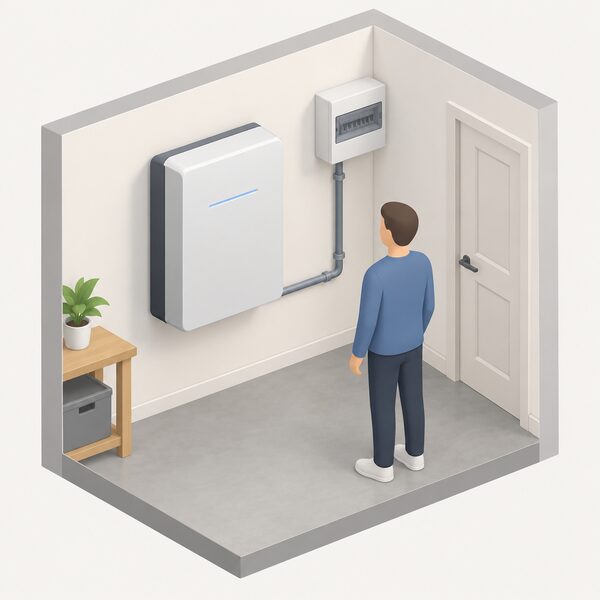
Capacity is the lever a household actually controls, and the relationship is not linear. Adding a battery to a solar installation increases self-consumption from 30 to 40% to 70 to 80%1, and a UK domestic solar installation with batteries can boost self-consumption to over 70%9. Independent data puts the self-consumption rate at 70% with a 10kWh battery10. A correctly sized battery takes a typical UK solar-equipped household to 70% to 90% of generation14.
The sizing rule from one maker is to size the battery to 50% to 80% of daily excess solar production6. That is a rule about matching storage to surplus, not maximising kWh. A battery larger than the daily surplus sits part-full for much of the year, and because batteries are not 100% efficient, not all of the energy put in comes back out7. Every extra kWh of capacity carries a round-trip loss on the energy that passes through it.
There is a second constraint that is easy to miss. A domestic battery system can store as much electricity as a household typically uses in a day5, which is the design point most systems are built around. Sizing beyond a day's demand only helps where the household can charge cheaply from the grid and discharge later, which is a cost strategy rather than a self-sufficiency one.
For households weighing capacity against other system choices, battery capacity and usable capacity explains the difference between nominal and usable kWh, and what size home battery you need covers the sizing process in more detail.
Export, tariffs and why full independence is rarely the goal
Full independence is rarely the goal because the economics point the other way. The price paid for exporting surplus solar electricity to the grid is almost always less than the price to buy electricity from the grid5, so there is a real gain in using generation on site. But the level of savings depends strongly on export tariffs, with the best Smart Export Guarantee rates significantly increasing returns20.
Adding a battery to a solar panel system can increase bill savings, but often not enough to recover the cost of the battery within its expected lifetime, particularly where households already have access to a good export tariff20. That is the central tension: a battery improves self-sufficiency, and a good export tariff can pay better than storing the same electricity. Having a storage battery may also render a household ineligible for some SEG tariffs, and exports, and therefore payments, reduce if a storage battery is fitted21.
Home batteries are most worthwhile if a household wants backup power, does not have full-retail export rates, or can access cheap overnight charging tariffs22. Battery storage can be charged with cheap electricity from a supplier, typically on certain tariffs at night or in the middle of the day23. That is grid electricity, so it improves cost control rather than independence, and it should be described as such.
For households thinking about how storage interacts with tariffs, stacking a home battery with smart and time-of-use tariffs and home batteries and household energy independence cover the trade-offs. The wider picture sits in the home battery storage guide.
How to measure your own self-sufficiency at home
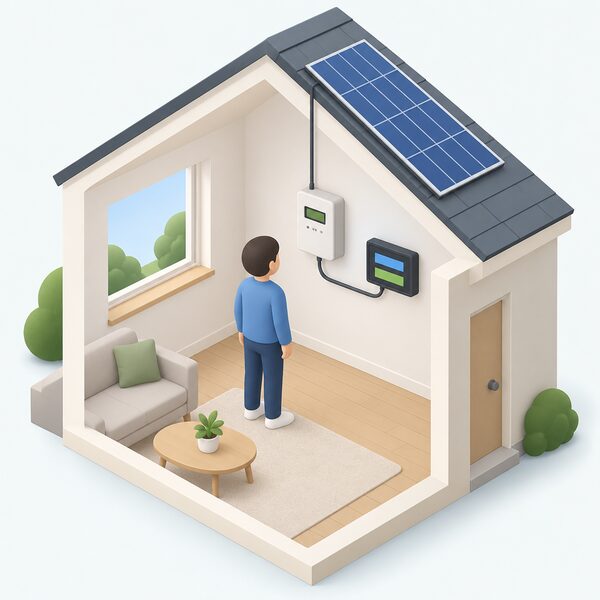
Self-sufficiency can be measured rather than estimated. MCS guidance sets out a method to estimate the electrical self-consumption of solar photovoltaic installations with domestic buildings in scope8, which is the same calculation an installer uses when reporting expected performance. The definition it works from is the amount of solar electricity generated by a domestic solar PV system which is subsequently consumed within the property and not exported to the distribution network8.
In practice a household needs three numbers: total generation, total export, and total import. Self-consumption is generation minus export, divided by generation. Self-sufficiency is total demand minus import, divided by total demand. A smart meter supplies the import and export figures without manual readings, since smart meter users do not need to submit meter readings themselves24.
Smart meters are designed to be able to work with solar panels, and a supplier should be able to offer one as part of the rollout25. Having solar panels does not stop a household getting one26. A smart meter does not automatically save energy or money, and practical changes are needed to save energy27, so the meter is a measurement tool rather than a saving in itself.
For households wanting the installer-side method, MGD 003: how installers must calculate self-consumption and battery benefit sets out the calculation. Monitoring apps and local data access are covered in monitoring a home battery.
Where a battery falls short of independence
Three limits are worth stating plainly. First, a battery does not keep the lights on by default. Solar panels will automatically switch off during a power cut, a safety feature that prevents electricity being exported to the network28, and typically solar panels cannot power a home during a power cut unless the home is off the grid or has additional equipment29. Not all battery systems are suitable for power cuts, and an installer should be asked whether a given battery will work in an outage, and for how long21. Solar panels stop working during a power cut for safety reasons and most restart automatically after power is restored30.
Second, plug-in solar cannot carry a whole house. UK-compliant plug-in solar devices are limited to a maximum output of around 800W, which is enough for everyday appliances but leaves higher-use appliances needing grid electricity31. That is a hard regulatory ceiling, not a sizing choice.
Third, near-total independence is possible but rare and specific. One independent case study records tenants who were 99% self-sufficient from the grid at certain points throughout the year using only solar PV and battery storage32. The phrase "at certain points throughout the year" is doing the work: that is a peak-summer figure for a specific housing portfolio, not an annual average a household should expect.
"Your solar panels will automatically switch off during a power cut. This is a safety feature that prevents electricity being exported to the network."
For households weighing backup against self-sufficiency, battery backup in a power cut and will a battery storage system work during a power cut cover the equipment needed. Off-grid designs are a different discipline, covered in off-grid battery systems.
Sources32 cited
- Great British Energy and solar self-consumption, UK Parliament POST, 2026
- Solar panels guide, Uswitch, 2026
- Solar energy pros and cons, Spirit Energy, 2026
- Making the most of your solar PV panels, Centre for Sustainable Energy, 2026
- What size solar battery do I need, SolaX Power, 2026
- Solar panel battery storage, Which?, 2026
- Is a home battery worth it, Independent Alliance of Advisers, 2026
- MCS 032: Solar PV self-consumption method, MCS Certified, 2025
- Solar power for your home, Jackery UK, 2026
- Britain's homes with solar panels reap £40 million during the heatwave, Uswitch, 2026
- Solar power modes explained, Astronergy, 2026
- How to ensure a heat pump runs efficiently, Energy Saving Trust, 2026
- How much electricity does solar power produce, Jackery UK, 2026
- Why solar PV battery storage is essential, Jackery UK, 2026
- Solar panel installation, Energy Saving Trust, 2026
- Planning permission for solar equipment on a house, Planning Portal, 2026
- Permitted development for retrofit and energy efficiency, Cotswold District Council, 2026
- Make your home more energy efficient, Confused.com, 2026
- Planning permission for stand-alone solar equipment, Planning Portal, 2026
- Battery storage and the grid, Electricity North West, 2026
- Supporting households with low carbon technology combinations, Energy Saving Trust, 2026
- Battery storage, Home Energy Scotland, 2026
- Can solar panels charge electric cars, The CPA, 2026
- Get help with your smart meter, Ofgem, 2026
- Smart meter FAQs, Smart Energy GB, 2026
- How carers could prepare for higher energy bills, Smart Energy GB, 2026
- Planned power cuts, Scottish and Southern Electricity Networks, 2026
- Solar power facts, Energy Saving Trust, 2026
- Advice and support FAQs, Electricity North West, 2026
- Plug-in solar panels, Energy Saving Trust, 2026
- FES support services: Stirling Council project, RECC, 2026
- Solar PV, Flexi-Orb, 2025
 Self-ConsumptionHow much of the electricity from your own solar panels do you actually use, and how much goes to the grid?
 Sizing a Self-Sufficient HomeHow many solar panels and how much battery storage does a home need to stop relying on the grid?
 Solar and Energy IndependenceHow far domestic solar cuts dependence on suppliers and the grid, what self-consumption really looks like across the year, what a battery, diverter or EV adds, and the grid-outage limit of ordinary inverters.
 Can a Home Be Self-Sufficient?Can a UK home really run on its own energy all year, or does the grid still do the heavy lifting in winter?
 What Size Battery?How much electricity does your home use in a day, and how much of that falls in the hours when power is cheap or your solar panels are generating?
 Payback and SavingsHow long until a home battery pays for itself, and why do quoted payback times vary so much?