In this guide
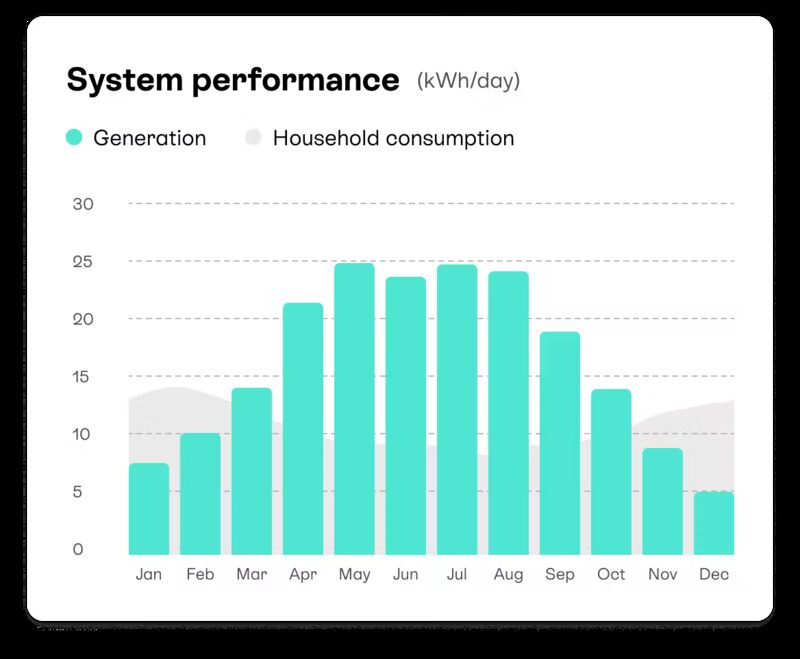
A UK household that generates its own electricity does not run short of energy across the year so much as run short of it in the wrong months. Roughly three-quarters of annual UK solar power is generated during the sunnier half-year from April to September1. Panels can be 25% to 50% less effective in winter than in summer, because of shorter days, more cloud and a sun that sits lower in the sky so its light does not strike the panels as directly2. One monitored household reported that in the colder months they made only about a third as much solar power as in the sunnier ones3.
Demand runs the other way. Electricity demand already peaks on winter mornings and evenings, when people are heating their homes4, and modelling of a more electrified system expects demand to keep peaking in winter evenings, with the potential introduction of a new winter morning peak created by heat pumps5. That is the winter gap: a summer surplus that is easy to generate and hard to use, and a winter deficit that is easy to feel and hard to fill. It is a seasonal problem, and almost none of the equipment sold to households is seasonal storage.
The practical consequence is that a domestic battery, the usual answer to a daily mismatch, does not solve this one. Great British Energy states that adding a battery to a solar installation increases self-consumption from 30 to 40% to 70 to 80%6, which is a large gain within a day and no gain at all across six months. Guidance is blunt about the residual: if you are hoping to cover winter energy use, you may need an additional solution such as battery storage7, and even then the grid remains the winter backstop for all but a handful of well-sited homes.
Why solar output falls in winter: the mismatch in numbers
Three effects stack in the same direction between November and February. Days are short, cloud cover is more frequent, and the sun sits lower in the sky so it may not hit the panels as directly as it does in the summer2. Together these commonly cut output by a quarter to a half against summer, on the same roof with the same panels2.
Measured household experience tends to sit at the harsher end of that band. A West Midlands household reported making only about a third as much solar power in the colder months as in the sunnier months3. National figures show the same shape at scale: roughly three-quarters of annual UK solar generation falls in the April to September half-year1, which means the remaining quarter has to cover the half of the year when heating, lighting and hot water demand is highest.
There is a second seasonal figure worth holding alongside the first, because the gap can be narrowed from the demand side as well as the supply side. Analysis of the winter of October 2022 to March 2023 found that, with weather accounted for, average household electricity consumption was 8.4% lower than the previous winter, with a price elasticity of -0.10 for electricity11. That drop came from households cutting back under price pressure rather than from any new equipment, and it illustrates how much of a winter shortfall is behavioural rather than physical. It is not a comfortable route to independence: consumer bodies have warned that energy support has failed to keep pace with rising energy costs and is insufficient for the scale of the financial challenge12.
The national roll-out is itself behind schedule. The Climate Change Committee's 2025 report to Parliament found that the roll-out of solar appears significantly off track and will need to improve to deliver its contribution to a decarbonised system13. Households planning around a growing pool of cheap daytime surplus should treat that trajectory as uncertain.
How solar PV works, and why it still runs under cloud
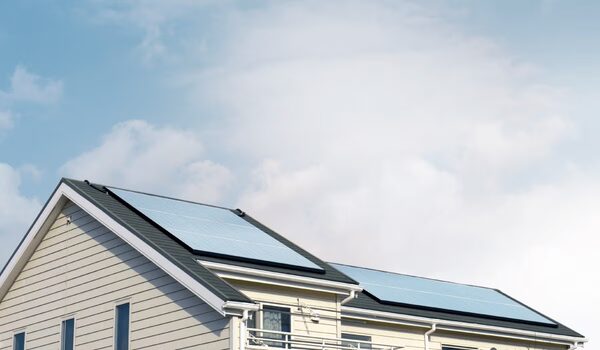
Photovoltaic panels convert sunlight into electricity which can be used in the home14. They work during daylight, even when it is cloudy or overcast, because they use light, not heat, to generate energy15. Cells can still generate some electricity on a cloudy day16, so output falls rather than stops under a grey sky, and over a British winter the system keeps contributing, at a reduced rate, to the household's own supply17.
That distinction matters for winter expectations. Cold is not the enemy: cool and windy conditions can be beneficial, since wind serves as a cooling mechanism for the modules, leading to increased efficiency15. Daylight hours and sun angle are the binding constraints2. The Energy Saving Trust puts it plainly: solar panels work in winter, but they will generate less electricity than in summer8. Systems work best under clear, sunny skies while still producing under cloud16.
The practical reading is that a December day is not a zero, but the diffuse light available in a short day cannot match a June afternoon. Independent testing bodies confirm that even on overcast days the UK has enough sunlight for solar panels to work18, which is a statement about viability across the year rather than about winter self-sufficiency in any single week.
System cost and what it saves
A typical domestic solar system costs around £6,100 to install, a figure carried by the Energy Saving Trust and repeated in installer-body guidance8. That is a typical figure, not a quotation: prices vary with roof size, access, scaffolding and whether storage is included, and the same market has been described with an average solar system cost of £10,270 while half of UK households have less than £5,000 in savings20. Where the two differ, they are measuring different baskets, a plain panel array against a larger or battery-inclusive installation, and the documents are not reconciled.
On savings, the government's UK Solar Roadmap modelled that a typical UK home could save around £500 a year from installing rooftop solar, based on the price cap current in June 20259. That saving is an annual average across a year whose generation is three-quarters concentrated in the summer half1, so the monthly benefit is heavily front-loaded into the months when bills are lowest anyway. A household judging the value of solar by its January bill will be disappointed; a household judging it by the year will not.
| Figure | Value | Source type |
|---|---|---|
| Typical installed cost | around £6,1008 | independent, Aug 2026 |
| Average system cost cited elsewhere | £10,27020 | independent, Sep 2026 |
| Modelled annual saving, typical home | around £5009 | official, Jun 2025 |
| Plug-in panel estimated annual saving | £70 to £11021 | government estimate via independent review, Sep 2026 |
Costs across the wider journey to independence are set out in what energy independence costs a UK household.
Payback: why the figures range from 5 to 16 years
Published payback periods for domestic PV differ widely, and the difference is almost entirely about when a household uses electricity rather than about the hardware. Official local-authority guidance gives 10 to 12 years22. The Energy Saving Trust's worked examples put a Stirling household at 11 to 12 years depending on export payments23. Home Energy Scotland cites a 5 to 10 year payback24, and Scottish research quotes 6 to 10 years where a system is optimised for self-generation25.
The outlier explains the rest. The Centre for Sustainable Energy notes that if you do not use much electricity during daylight hours, your payback period could be closer to 16 years26. Daytime occupancy, not latitude, is the dominant variable, which is why the same array pays back in half the time in one household and not the other.
Winter weakness does not move these numbers as much as instinct suggests, precisely because the winter contribution is small in the first place. A payback calculated over an 11 to 12 year horizon already embeds the fact that a quarter of output arrives in the darker half-year1. What does move it is self-consumption, which is why batteries and demand shifting change the arithmetic more than any seasonal adjustment. See how much a battery increases solar self-consumption for the mechanism.
Roof orientation, pitch and shading over short winter days
Orientation and pitch matter more in winter than in summer, because a low sun rewards a steeper, better-aimed surface. A mainly south-facing roof gives the best power output, with southwest or southeast-facing also good15, and an unshaded south-facing roof is described as ideal for maximum performance23.
On pitch the sources differ in emphasis rather than substance. Around 30 degrees is cited as best15; a hydro and renewables specialist gives around 40 degrees on a south-facing roof as the optimum to maximise energy generation and ensure consistency throughout the year27. The second figure is explicitly about year-round consistency, which is the winter-gap question: a steeper array gives up a little midsummer yield in exchange for catching a lower winter sun. Consumer testing describes the ideal UK case as a large, south-facing, 30 to 40 degree pitched roof in the south of England, free from shading28.
Shading is the one factor with no compensating benefit. Winter shadows are longest, so obstructions that are irrelevant in June, a chimney, a neighbouring roofline, a bare tree, can clip generation through the months when every hour counts.
Batteries and demand shifting: a daily fix for a daily problem
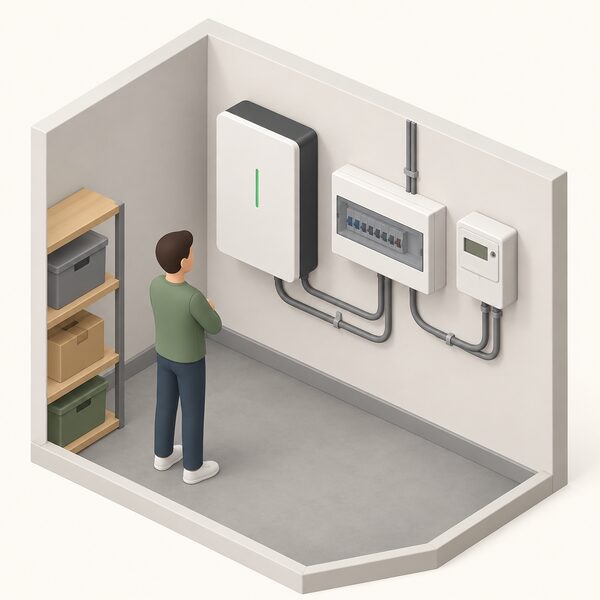
A home battery does one thing precisely: it moves generation from the hours it arrives to the hours it is needed. Great British Energy states that adding a battery to a solar installation increases self-consumption from 30 to 40% to 70 to 80%6. Uswitch data puts the self-consumption rate at 70% for households with solar and a 10 kWh battery29. Winter advice follows from that: store energy for when you need it most rather than sending it back to the grid2.
Monitored evidence is more nuanced than the headline. Homes with batteries in Living Lab trials consistently show lower total daily grid consumption across three seasons, with winter energy consumption instead seeing an increase, attributed to a suspected arbitrage pattern30. In other words, in winter some battery households import more, deliberately, charging cheaply at night to avoid expensive peak periods. That is a bill strategy, not a self-sufficiency strategy, and the distinction matters for anyone measuring independence rather than cost. The self-consumption and self-sufficiency ratio pages separate the two measures.
At system level the aggregate is significant. Solar Energy UK describes the combined potential of millions of homes with batteries to help balance supply and demand across the country by releasing stored power onto the grid when needed31. A household that signs up to that is trading a degree of control for revenue, and the dependence it creates, on a supplier, a tariff and often a manufacturer's cloud, is discussed in local control versus the manufacturer's cloud.
What a battery cannot do is carry July into January. Nothing in the domestic market stores energy across seasons at household scale, which is why guidance on winter coverage points to storage as a partial, not a complete, answer7.
Cutting winter demand instead: waste water heat recovery
If generation cannot be moved across seasons, demand can be reduced in the season that matters. Waste water heat recovery systems (WWHRS) recover heat from waste water from baths and showers and use it to preheat the incoming cold water to a combi boiler or hot water system32. Because the heat source is the household's own hot water use, the saving is not weather-dependent: the sector describes WWHRS as delivering consistent efficiency benefits year-round, independent of seasonal variation33, with typical bill reductions of £50 to £250 per household33. Tens of thousands have been installed in UK homes to date33.
Two families exist in the assessment methodology. An instantaneous system recovers heat only while water is flowing, and is assessed assuming warm water reaches the unit at 35 degrees C32. A storage WWHRS is a whole-house system that incorporates a dedicated storage volume for the recovered heat, does not require simultaneous waste and preheated water flow, and so is able to recover heat from bath water32. The storage volume is either combined, sitting within the dwelling's hot water vessel, or separate, in its own vessel, and is assumed to be inside the heated envelope32.
Rules that govern a storage system:
- Only one storage WWHRS is permitted in a dwelling32.
- A storage WWHRS cannot be applied in addition to an instantaneous WWHRS32.
- Performance data are valid only where the dedicated storage volume falls between the published Vlow and Vhigh for that product; outside that range the energy savings are reduced32.
- Assessment requires the total number of baths in the dwelling, the number whose waste water is routed through the system, and the dedicated storage volume32.
That last requirement is the practical constraint in a retrofit. A whole-house claim depends on how much of the household's bath and shower waste actually reaches the unit, so drainage routing, not the device, decides the outcome.
Solar thermal is the adjacent demand-side measure, and it carries the mismatch too: a well-designed system can yield the equivalent of up to 70% of a home's annual domestic hot water needs, with the cylinder thermostat usually set at 55 to 60 degrees C34. "Annual" is doing the work in that sentence, and the shortfall falls in winter.
Domestic hydropower: a generator whose season runs the other way
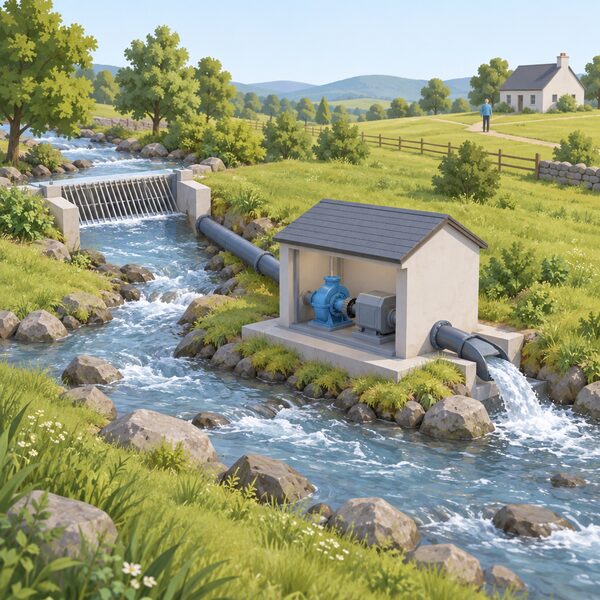
Hydro is the one household-scale renewable whose output may rise as solar falls, because winter rainfall raises river flow. Energy generated can be easy to predict, but will be highly seasonal35. For houses with no mains connection but with access to a micro hydro site, a good hydro system can generate a steadier, more reliable electricity supply than other renewable technologies at lower cost36, and micro-hydro is described as ideal for off-grid homes, offering long-term savings despite high initial costs37. It can be especially cost-effective for rural or off-grid homes, farms and businesses close to a suitable water source38.
The constraints are severe and site-specific. Suitability depends entirely on location and other factors35: not only location and access, but how steeply the river flows and how much water passes through35. Critically for the winter question in reverse, your river's lowest level determines how feasible your site is more than your river's highest level35, so a watercourse that dwindles in a dry spell sets the design limit even if it roars in February.
| Attribute | Domestic hydropower |
|---|---|
| Output pattern | Predictable but highly seasonal35 |
| System life expectancy | Up to 50 years35 |
| Maintenance | Almost maintenance free; very little upkeep once installed35 |
| Installation costs | High, depending almost entirely on size and location35 |
| System types | Three standard types35 |
| Assessment | By a certified hydropower installer35 |
Scale keeps this a minority answer. In Great Britain, hydropower made up just 2% of electricity generation in 202438. Hydropower is nonetheless an eligible technology under the Smart Export Guarantee, alongside solar PV, wind, micro-CHP and anaerobic digestion, for installations located in Great Britain39. A comparison of household generators is set out in solar panels vs small wind.
Community schemes, plug-in solar and what they add in the dark months
Adding capacity beyond one roof is the other route at the seasonal gap, and it comes in several forms.
Plug-in solar became legal across Great Britain during 202640, with the government stating that families would be able to buy a low-cost panel straight from a supermarket and set it up on a balcony or in a garden41, and that panels would be available in shops within months42. An interim product specification covers electrical design, British plug requirements, mounting systems and fire protection43. Government estimates quoted in consumer testing put savings at £70 to £110 a year21, with a payback period of five to ten years44. Plug-in batteries are already being developed for the UK market45. None of that changes the seasonal shape: a balcony panel follows the same April to September curve as a roof array1.
Collective purchase schemes work on price rather than season. Solar Together Norfolk allows households that already have solar panels to register to have battery storage added to maximise the benefits of their system46. Public programmes are expanding the installed base: the Social Housing Fund received a £100 million boost to support delivery of up to 57,000 solar installations for households in England47, and a further 100 schools and colleges were set to receive rooftop solar during 202642. More on shared ownership routes is in community energy in the UK.
The aggregate picture shows why the household gap is also a national one. Across the 1.9 million UK homes with rooftop solar, representing 6.3 GW of domestic-scale capacity, the equivalent of 10 million solar-powered air conditioning hours was available per heatwave day in June 202610. UK solar generation in 2025 ran 30% above 202410. That surplus exists in the months when heating demand is nil, and the winter morning and evening peaks are met from elsewhere4.
What remains dependent

A solar household with a battery and a well-drained WWHRS has reduced its imports substantially and changed its seasonal profile hardly at all. The remaining dependence is specific and worth naming: on the grid for winter mornings and evenings4; on a supplier for the import tariff and for any export payment under the Smart Export Guarantee39; on the manufacturer's firmware and, in many systems, its cloud service for battery scheduling; and on national policy, a roll-out the Climate Change Committee has judged significantly off track13.
No household-scale technology in current UK use stores energy from summer to winter. Hydropower is the only domestic generator whose season runs opposite to solar, and its suitability depends entirely on location35. Everything else in the toolkit, batteries, demand shifting, heat recovery, insulation, reduces the size of the winter draw rather than removing it. Households planning around this should read getting through a UK winter off-grid and can a UK home be completely energy self-sufficient, and the wider framing at /energy-independence/.
Sources47 cited
- UK solar beats coal over half year, Carbon Brief, 2016-10-04
- Do solar panels work in winter?, Uswitch, 2026-09-15
- Solar success in the West Midlands, MCS, 2023-09-23
- Why insulation matters for the grid, National Insulation Association, 2026-04-15
- Efficiency and flexibility: a UK perspective on heat pumps in the electricity system, Heat Pumping Technologies, 2024
- Household solar power, UK Parliament POST, 2026-06-25
- Solar panel installation guide: costs, planning and savings, IAA, 2026-09-20
- Solar power facts, Energy Saving Trust, 2026-08-13
- UK Solar Roadmap, DESNZ, 2025-06
- UK solar homes during the heatwave, Ember, 2026-06-24
- Winter demand falls as fuel bills rise, CREDS, 2022
- Statement on electricity bill tax cut, Age UK, 2026-07-21
- Progress in reducing emissions: 2025 report to Parliament, Climate Change Committee, 2025
- Solar PV advice, National Energy Action, 2026-04-23
- Solar panel myths debunked, Which?, 2026-06-09
- Solar power, Electricity North West, 2026-09-19
- Generating your own energy: solar electricity, Welsh Government
- How much of your electricity can solar panels produce?, Which?, 2024-06-27
- Solar panel installation, maintenance and repair, NICEIC, 2026-09-17
- How to decide if solar panels are right for your home, Ivie, 2026-09-20
- Plug-in solar panels, Which?, 2026-09-15
- Solar panels, Hammersmith and Fulham Council, 2026-09-17
- Solar panels advice, Energy Saving Trust, 2026-08-27
- Solar panels, Home Energy Scotland, 2026-09-20
- Balancing investment in clean heat and energy efficiency in Scottish housing retrofit, ClimateXChange, 2026-06-03
- A complete guide to solar PV, Centre for Sustainable Energy, 2025-11
- What makes a good solar PV roof, Renewables First, 2026-04-08
- Could solar panels save you £500 a year?, Which?, 2026-06-17
- Britain's homes with solar panels during the heatwave, Uswitch, 2026-06-28
- Grid impacts of heat pumps, EVs and solar revealed, Energy Systems Catapult, 2025-08-18
- Batteries in the home, Solar Energy UK, 2026-09-17
- SAP 10.3 full specification, BRE Group, 2026-01-13
- Future Homes Standard risks overlooking biggest household energy use, warns WWHR sector, CIPHE, 2026-05-19
- Home guide to solar water heating, OFTEC, 2026-09-20
- Hydropower for the home, Uswitch, 2026-01-06
- Hydro electricity, Planning Portal, 2026
- Sustainable home energy solutions, Planning Portal, 2024-09-02
- What is hydropower and how does it work?, Smart Energy GB, 2026-08-19
- The Smart Export Guarantee, House of Commons Library, 2026-05-13
- First regional solar breakdown as installations hit record highs, GOV.UK, 2026-08-27
- Heating oil support debate, Hansard, 2026-03-16
- Britain continues to break clean power records, GOV.UK, 2026-05-28
- Plug-in solar consultation, GOV.UK, 2026-06-16
- Plug-in solar, Centre for Sustainable Energy, 2026-09
- Plug-in solar explained, Low Carbon Hub, 2026-07-09
- Solar Together Norfolk, South Norfolk and Broadland Councils, 2026-09-17
- Thousands of homes will be eligible for £9,000 off a heat pump, GOV.UK, 2026-06-26
 Electricity Margin ShortagesWill the lights stay on this winter, and what would have to happen before homes lose power?
 The Full Statistics GuideHow many homes in the UK have solar panels, heat pumps or batteries?
 Can a Home Be Self-Sufficient?Can a UK home really run on its own energy all year, or does the grid still do the heavy lifting in winter?
 What Size Battery?How much electricity does your home use in a day, and how much of that falls in the hours when power is cheap or your solar panels are generating?
 Rising Electricity DemandElectric cars, heat pumps and data centres all need more electricity, so how much more will the UK actually use, and will the grid cope?
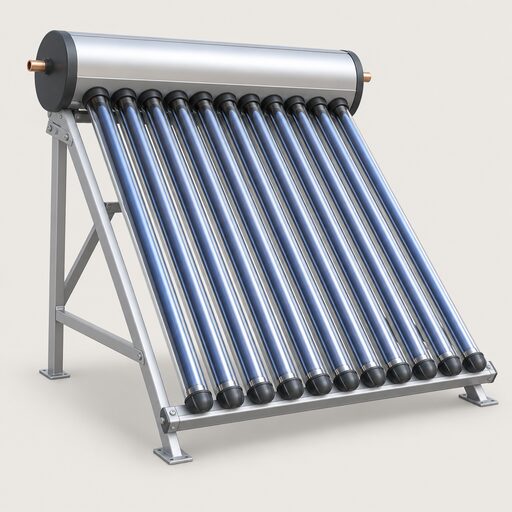 Solar Thermal Water HeatingSolar thermal panels heat your water using the sun, working alongside your boiler rather than replacing it.