

In this guide
Community energy in Great Britain is represented by three national membership bodies: Community Energy England, Community Energy Scotland and Community Energy Wales. They are sector organisations rather than suppliers, installers or grant administrators. They publish the annual State of the Sector report together, respond to government consultations jointly, and act as the referral point for groups that want to develop a local generation project. For a household, the practical value is indirect: these bodies shape the policy and funding landscape that community schemes operate in, and they are the route by which a group gets advice, representation and notice of funding windows.
The sector's scale is modest but measurable. The Community and Renewable Energy Scheme in Scotland has provided over £67 million in funding to communities throughout Scotland, supporting over 960 projects and the installation of 63 MW of renewable energy since inception1. The Energy Security and Net Zero Committee's community energy report, published on 17 June 2026, states a community energy target of 8 GW by 2030 and notes that GB Energy is reported to have committed to support at least 1000 local and community projects by 20302.
What follows is what the bodies are, what the sector delivers, how the annual report works, where the policy pressure sits, and what membership actually gives a group. The wider context for households sits in Community Energy in the UK: How Local Projects Work and in the pillar guide to household energy independence.
Who the membership bodies are, and who they cover
The three bodies divide along national lines. Community Energy England covers England, Community Energy Scotland covers Scotland, and Community Energy Wales covers Wales. Northern Ireland sits outside all three, which matters because the energy policy framework the bodies respond to is itself drawn on a Great Britain basis. The Energy Digitalisation Framework, for instance, applies to England, Scotland and Wales6, and the National Energy Efficiency Data-Framework carries the same territorial extent7. The Energy Price Guarantee applied to England, Scotland and Wales8, and the Energy Bills Support Scheme distributed funding to domestic customers in England, Wales and Scotland9.
That pattern is not incidental. The consumer satisfaction work that Ofgem commissions with Citizens Advice is a survey of domestic energy consumers in England, Scotland and Wales, described as Great Britain10, and the most recent supplier-level findings record overall satisfaction reaching the highest level recorded since the survey began in 2018 in the July to August 2025 period12. The January 2025 survey published two indicators of customer satisfaction for seven energy supply groups: overall satisfaction with their supplier, and satisfaction with the customer service received13.
For a household, the consequence is that the membership body relevant to a project depends on where the project is. A group in Powys or Ceredigion, for example, sits within the mid Wales region that has been working with the Energy Systems Catapult to develop local area energy plans14. A group in the Highlands sits within the Scottish support structure described below. The bodies themselves do not supply electricity, do not install equipment and do not award grants; they represent, advise and publish.
What the sector delivers: 57,000 solar installations and 1.7 million tonnes of CO2
The community and social energy sector's most concrete domestic output is installation, not generation. The Social Housing Fund will receive a £100 million boost to support the delivery of up to 57,000 solar installations for households in England1. Group buying schemes, backed by local councils and trusted partners, have already helped thousands of UK households save money and cut carbon2. On the demand side, 1.6 million households and businesses supported the Demand Flexibility Service by shifting demand, saving over 3,300MWh of electricity, enough to power around 10 million homes across Great Britain3.
The carbon arithmetic is where the sector's claims are largest and least household-specific. Ten million UK households resetting their boiler flow temperature to the recommended level or below is put at a saving of 1.7 million tonnes of CO24. The Domestic Renewable Heat Incentive is credited with enough renewable heat to heat almost 770,000 typical UK homes for a year5. The New Warm Homes Programme's 2.11 million tonnes of carbon savings are estimated, using HM Treasury guidance, to provide societal benefits worth £314m6. Heating with fossil fuels like gas and oil contributes 17% of the UK's total emissions7, which is the figure that gives all of the above their context.
Scotland's share runs through CARES, which has provided over £67 million in funding to communities throughout Scotland, supporting over 960 projects and the installation of 63 MW of renewable energy since inception8. The Social Housing Decarbonisation Fund Demonstrator saw up to 2,000 homes improved to at least EPC band C9. Household satisfaction with energy providers has reached 77%, the highest level since the 2021 energy crisis10.
The headline delivery figures for community energy are best read alongside the wider decarbonisation statistics, because the sector's contribution is real but small relative to national totals. Scotland's Community and Renewable Energy Scheme has provided over £67 million in funding to communities throughout Scotland, supporting over 960 projects and the installation of 63 MW of renewable energy since inception1. The same scheme has made an additional £3 million available to support decarbonisation of Scotland's most remote and rural off-grid communities5.
The comparison figures show the scale of the wider effort. The Domestic Renewable Heat Incentive produced savings equivalent to heating almost 770,000 typical UK homes for a year15. The Social Housing Fund will receive a £100 million boost to support the delivery of up to 57,000 solar installations for households in England this financial year16. The Social Housing Decarbonisation Fund Demonstrator saw up to 2,000 homes improved to at least EPC band C17. Heating with fossil fuels like gas and oil contributes 17% of the UK's total emissions18, and the UK electricity supply sector recorded a 1.7 TWh reduction in coal generation in 2024 compared with 202319.
Community energy's role in that picture is to keep generation and benefit local. The Climate Change Committee's 2026 progress report to Parliament and its commissioned work with the Energy Saving Trust and Green Alliance on international policy comparison both feed into the same policy space the membership bodies operate in19. The committee's March 2026 conclusion was that in all scenarios, achieving Net Zero was found to be a more cost-effective path for the UK economy than continued reliance on fossil fuels, bringing a net benefit to society21.
State of the Sector: the annual report the three bodies publish together

State of the Sector is the annual report the three national bodies publish jointly. It is the sector's own account of capacity, project numbers and households served across England, Scotland and Wales, and it is the document most often cited when the sector's contribution is discussed. It is published by the bodies themselves rather than by government, which distinguishes it from the official statistics that sit alongside it.
The official statistics that bear on the same questions come from several sources. UK energy in brief 2026 is a summary of some of the key annual statistics in the UK energy system22. The fuel poverty indicator for England draws its data from the Department for Energy Security and Net Zero23. The National Energy Efficiency Data-Framework covers England, Scotland and Wales7. The Carbon Budget Delivery Plan sets out the government's own delivery framework24.
The distinction matters for a household trying to judge a claim. A figure attributed to State of the Sector is the sector's own reporting; a figure attributed to the Department for Energy Security and Net Zero or to Ofgem is official statistics. Both are useful, and they answer slightly different questions. The sector report describes what community groups have built; the official statistics describe the national context those groups operate in.
Policy work: the Smart Export Guarantee and joint consultation responses
The Smart Export Guarantee is the policy area where the membership bodies have been most visible. It launched on 1 January 2020 and is a government-backed initiative3. It enables small-scale low-carbon electricity generators in Great Britain, known as SEG generators, to be paid for electricity they export25. The scheme supports small scale renewable electricity generation18.
The legislative history is documented. The Smart Export Guarantee Order 2019 was laid on 10 June 2019, published simultaneously with the government's response to the preceding consultations26. The Authority, meaning Ofgem, will publish guidance before implementation for generators and suppliers26. The original consultation, The Future for Small-Scale Low-Carbon Generation, carried a territorial extent of Great Britain27.
The sector's criticism of the SEG is structural rather than about any single rate. Because payments are set by individual suppliers rather than fixed by government, community generators face income uncertainty that the earlier Feed-in Tariff did not create. The bodies have pressed that case through consultation responses. On the Smart Secure Electricity Systems programme, the consultation responses broadly supported the government's proposals28, and the same finding is recorded on the implementation consultation29. That is a joint position rather than a community-energy-specific one, but it shows the route the bodies use: respond collectively, and push for the framework conditions that make small generators viable.
"The SEG launched on 1 January 2020 and is a government-backed initiative."
Funding routes for community groups

Funding for community energy is fragmented across nations and purposes, and the membership bodies act largely as the signposting layer. In Scotland, the Community and Renewable Energy Scheme provides advice and funding to communities across Scotland looking to develop renewable energy, heat decarbonisation and energy efficiency projects, including shared ownership projects30. It is delivered by Local Energy Scotland30 and has a network of development officers across Scotland to provide free, expert and impartial advice and support to community groups, charities and other eligible organisations seeking to explore their renewable energy options30.
In England, heating oil support is distributed by local authorities via the crisis and resilience fund31. In Wales, the Community EV Car Clubs scheme carries a £5 million scheme budget4. The Public Sector Decarbonisation Scheme made £1.425 billion of funding available in phase 324.
The pattern across the four nations differs in ways that matter to a group applying. Scotland has a single named scheme with an administrator and a development officer network. Wales routes some support through its own government. England's community energy funding is more dispersed, with local authority delivery for some crisis support and competitive funds for others. Northern Ireland is not covered by the three membership bodies at all. A group's first step is therefore to identify which nation's route applies before assembling an application.
The community energy inquiry and the committee's report
The Energy Security and Net Zero Committee launched its community energy inquiry in November 20242. It published its first report of Session 2026 to 27 on 17 June 2026, making recommendations to government on community energy2. The report is the most substantial parliamentary treatment of the sector to date.
Two forward-looking figures sit in it. The report states that the community energy target is 8 GW by 20302. It also reports that GB Energy has committed to support at least 1000 local and community projects by 20302. Both are reported commitments rather than delivered outcomes, and the distinction should be held clearly: a target and a commitment are statements of intent, and the sector's own delivery record, at 63 MW installed through CARES since inception1, shows the distance between the two.
The committee's wider economic finding, published in March 2026, was that in all scenarios, achieving Net Zero was found to be a more cost-effective path for the UK economy than continued reliance on fossil fuels, bringing a net benefit to society21. That conclusion frames the community energy recommendations: the argument for local generation is made on cost grounds as well as carbon grounds.
Community benefits and shared ownership
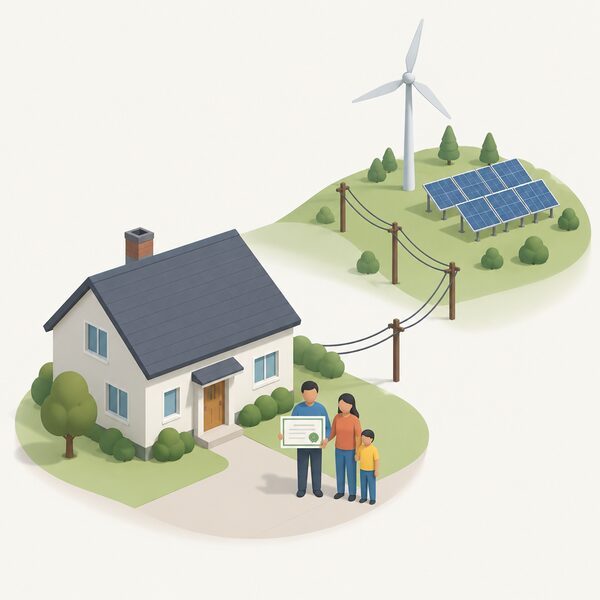
Shared ownership is the mechanism by which a household can hold a financial stake in a local generator without owning the equipment on its own roof. In Scotland, the Community and Renewable Energy Scheme encourages community ownership of renewable energy projects across Scotland, helping to maximise the benefits of renewable energy systems, and ensuring that the delivery of community energy comes with benefits for people in Scotland30. The scheme supports progress towards a target of two GW of community and locally owned energy in Scotland30.
The policy direction on benefits has been moving towards compulsion. A working paper published on 21 May 2025 sought views on introducing a mandatory community benefit fund scheme and facilitating shared ownership of renewable generation infrastructure32. Solar Energy UK published its Community Engagement Good Practice Guidance on 16 July 2025, covering engagement with people local to solar farm developments32. The Energy Saving Trust published research on community renewable shared ownership in Scotland on 24 September 202532.
For a household, shared ownership changes the nature of the dependence rather than removing it. A stake in a local generator gives a financial interest in local generation, but the household's own supply still comes through a licensed supplier and the grid. The distinction between holding a share and being self-supplied is set out in Community Energy Share Offers and Co-operative Ownership and in Local Energy Supply: Energy Local Clubs and Selling Power Locally.
What membership offers a community group
Membership of a national body is organisational rather than domestic. It brings representation in consultation responses, access to guidance, and notice of funding windows. The practical output is a method and a route: Smart Energy GB runs a Resource Centre for community and partner resources1, and UK Power Networks funding, administered by Community Energy South, provides fully funded bespoke training for new recruits to become 'energy champions'2. Younity's Community Power Club is a product that will allow community generators to earn more by supplying their members and communities through a Licence Exempt Supply arrangement3. That is the shape of what membership and its networks put within reach of a group: guidance, training and a supply route, rather than a grant in itself.
The representation function is about access rather than money. Eligibility for support schemes is drawn by nation and by organisation type, and a group's legal form decides which doors open. Awards for All England, Environment lists community benefit society among eligible applicants1. The Ynni Cymru capital grants scheme is open to community energy organisations, social enterprises, public sector bodies and SMEs2, and the Scottish Hydro Electric Community Trust considers applications for support with the cost of connecting to the electricity network for individual homeowners and community groups with charitable status3. The Energy Company Obligation, by contrast, is a household scheme: domestic households in Great Britain are eligible, and it supports energy efficiency measures in the home of those considered to be in fuel poverty4.
Membership does not supply electricity, does not install anything, and does not guarantee a grant. The dependence it creates is on a representative organisation rather than on a supplier or a manufacturer, which is a lighter form of dependence than most in this sector. What it does not change is the territorial patchwork underneath: the Energy Company Obligation is available in England, Scotland and Wales1, and supplier coverage varies, with Scottish and Southern Energy operating across southern England and northern Scotland2. A group's route to funding and support therefore still depends on where it is and what legal form it has taken.

Sources32 cited
- Tackling fuel poverty in Scotland, Scottish Government, 2025
- Community energy report, Energy Security and Net Zero Committee, 2026
- Smart Export Guarantee, Ofgem, 2026
- Community EV car clubs subsidy scheme, Welsh Government, 2024
- Heat in buildings strategy, Scottish Government, 2021
- Energy digitalisation framework, GOV.UK, 2026
- National Energy Efficiency Data-Framework, GOV.UK, 2025
- Energy Price Guarantee regional rates, GOV.UK, 2022
- Energy Bills Support Scheme payments, GOV.UK, 2022
- Customers' satisfaction with their supplier, July 2024, Ofgem, 2024
- Customers' satisfaction with their supplier, January 2025, Ofgem, 2025
- Customers' satisfaction with their supplier, July to August 2025, Ofgem, 2025
- Energy Consumer Satisfaction Survey, January 2025, Ofgem, 2025
- Renewable energy deep dive, Welsh Government, 2022
- Domestic Renewable Heat Incentive annual report, Ofgem, 2024
- Thousands of homes eligible for £9,000 off a heat pump, GOV.UK, 2026
- Social Housing Decarbonisation Fund, GOV.UK, 2024
- Your essential guide to heat pumps, Welsh Government, 2025
- Progress in reducing emissions, Climate Change Committee, 2026
- Climate policy that cuts costs, Climate Change Committee, 2026
- Cost of net zero by 2050, Climate Change Committee, 2026
- UK energy in brief 2026, GOV.UK, 2026
- Fuel poverty indicator, Office for National Statistics, 2026
- Carbon Budget Delivery Plan, GOV.UK, 2023
- Smart Export Guarantee annual report 2022-23, Ofgem, 2023
- Smart Export Guarantee Order 2019 explanatory memorandum, legislation.gov.uk, 2019
- The future for small-scale low-carbon generation, GOV.UK, 2019
- Smart Secure Electricity Systems programme, GOV.UK, 2025
- Delivering a smart and secure electricity system, GOV.UK, 2024
- Local and small-scale renewables, Scottish Government, 2026
- Heating oil support, Hansard, 2026
- UK Solar Roadmap, GOV.UK, 2025