

In this guide
Great British Energy is a publicly owned and operationally independent clean energy company, backed by £8.3 billion over the course of this Parliament1. It does not sell electricity to households. Its remit is to own, manage and operate renewable power generation projects, including wind and solar installations, across the UK, and to develop clean energy projects through its partnership with the Crown Estate1.
The money has started to move. Great British Energy has already invested £255m in rooftop solar, covering 250 schools and 260 NHS and military sites3. A Community Fund was launched with £5 million in grant funding for community energy groups4, and £10 million has been invested into supporting new clean power projects1. A further £700 million has been announced for clean energy supply chains1.
For a household, the practical position is simple. Great British Energy is not a supplier, not a tariff and not a route to a cheaper bill in itself. It is a funding and ownership vehicle for generation and supply chain capacity, and its stated aim of lower bills by an average of £300 a year is an aim, not an offer1. What it changes for a home is the wider system: more domestic generation, more supply chain capacity, and public money going into community-scale projects that households can sometimes access through local groups.
What Great British Energy is and who owns it
Great British Energy is owned by the UK government, on behalf of the British people1. It was announced by the government in July 2024 following the general election6, and the legislation that followed established it as a publicly owned and operationally independent energy company1. It has an independent board and is led by CEO Dan McGrail1.
The company's headquarters are in Aberdeen, Scotland, with plans to add sites in Glasgow and Edinburgh over time1. Aberdeen places it inside the existing North Sea industrial base, which matters for the supply chain work described below.
Its remit is generation ownership and operation rather than retail. Great British Energy will own, manage and operate renewable power generation projects, including wind and solar installations, across the UK1. Its stated purpose is to support the transition to a cleaner, more secure energy system1, and the government frames the wider programme as protecting bill payers through the deployment of clean, home-grown, low-carbon electricity generation5.
The company sits alongside other public bodies rather than replacing them. Great British Nuclear was launched separately to support new nuclear builds7, and Great British Energy's own funding line is recorded jointly with Great British Energy Nuclear in the £8.3bn total3. That distinction matters when reading announcements: not every pound described as Great British Energy money is spent by the company itself.
What it is for: clean energy projects, not household supply
The single most common misunderstanding about Great British Energy is that it will become a supplier. It will not. Great British Energy will not supply electricity directly to households1. There are approximately 53.7 million domestic customer accounts in Great Britain8, and none of them will be moved to Great British Energy, because the company has no supply licence and no retail operation.
What it does instead is invest in the assets and the industrial capacity behind generation. Its stated purpose is to support the transition to a cleaner, more secure energy system1, and the government's framing is that deployment of clean, home-grown, low-carbon electricity generation protects bill payers5. The mechanism is indirect: more domestic generation and more supply chain capacity are intended to change the conditions that set prices, not to set a price directly.
The name is also easily confused with two unrelated things. The Great British Insulation Scheme is a separate energy efficiency scheme in Great Britain, and it is not a grant scheme: it works by placing an obligation on medium and large energy companies to deliver measures that result in reduced energy usage, helping people get free or cheaper insulation to reduce their home's energy bills9. And Great British Nuclear is a separate body supporting new nuclear builds7. Neither is Great British Energy.
For a household's energy independence, the distinction is the whole point. Great British Energy does not reduce a home's dependence on a supplier, a meter or a grid connection. It works on the generation and supply chain side, where domestic capacity reduces exposure to imported energy and to the price set by international markets. That is a system-level change, and it arrives over years rather than at the next bill.
The £8.3 billion funding: how it is split
The headline figure is £8.3 billion over the course of this Parliament, recorded as funding for Great British Energy and Great British Energy Nuclear2. The same total appears in the independent description of the government's intention to invest £8.3 billion into the publicly owned green power company1.
Within that, the financial capacity is set out separately. Great British Energy has £4.0 billion of total capacity, all of it loans and equity, with £0.0 billion of guarantees capacity5. That £4.0 billion is described as additional capacity announced this Parliament5, and it forms part of the total capacity for the government's growth-focused public financial institutions5. The £8.3bn of funding includes this financial transaction capacity5.
The earlier tranches show how the money has been staged. Great British Energy's initial £100 million capital funding was confirmed in the 2024 Autumn Budget11, with a further £100 million of capital funding to spend in 2025 to 202611. £25 million was announced to establish the company11, and £125m of funding was announced for 2025 to 202611. Investments in clean energy projects were kickstarted in 202511.
On where the money comes from, some of Great British Energy's funding will come from a windfall tax on oil and gas producers1. One figure given is an increased windfall tax on oil and gas companies worth £1.2 billion over the course of the parliament1. That is a partial answer rather than a full breakdown: the £1.2 billion figure is smaller than the £8.3 billion total, and the material does not set out a complete funding composition.
| Funding element | Amount | Status |
|---|---|---|
| Total funding, this Parliament | £8.3 billion2 | Announced |
| Financial capacity, loans and equity | £4.0 billion5 | Announced this Parliament |
| Guarantees capacity | £0.0 billion5 | None |
| Initial capital funding | £100 million11 | Confirmed, Autumn Budget 2024 |
| Further capital funding, 2025 to 2026 | £100 million11 | Announced |
| Establishment funding | £25 million11 | Announced |
| Windfall tax contribution | £1.2 billion over the parliament1 | Reported |
Rooftop solar on schools and hospitals: £255m and 250 sites
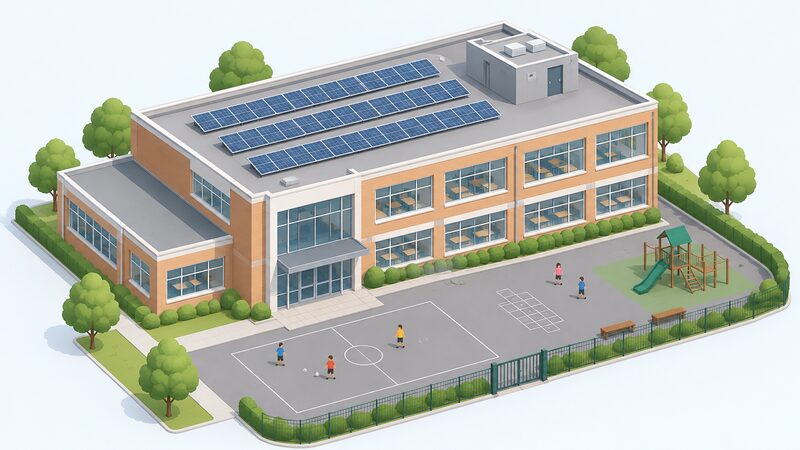
The most visible spending so far is on public sector rooftops. Great British Energy has already invested £255m in rooftop solar, covering rooftop solar for 250 schools, and 260 NHS and military sites3. The programme aims to enable around 200 schools and up to 200 hospitals in England to install rooftop solar4, and to increase NHS solar generation by 300%4.
The reported savings are the part householders tend to remember. Eleven schools in England installed solar panels, a step set to save those schools £175,000 a year1. The government's separate estimate for domestic solar is that installing solar panels could reduce energy bills by around £500 a year12. Those are different figures for different buildings and should not be read across: one is a school estate total, the other a household estimate.
The programme is expanding. A further 100 schools and colleges are set to receive rooftop solar this year13, and the government is backing the company to extend support for more rooftop solar installations on a further 100 schools and colleges this year alone14.
The wider solar context is that rooftop is where most new capacity is going. Around 255,000 rooftop solar installations were recorded in 2025, meaning at least 95% of all new solar was installed on homes, businesses and other buildings13. There are over 1.5 million domestic solar installations in the UK4. A 2023 assessment cited in official guidance put the potential at up to 117 GW of solar panel capacity on rooftops and other developed spaces across England15.
For a household, this is the clearest way Great British Energy touches homes indirectly. The company is not installing panels on houses, but it is normalising rooftop solar across public buildings, and the schools and hospitals programme is the reference point for what public sector procurement of rooftop solar now looks like. Deployment data for homes is covered in UK solar PV deployment statistics.
Community energy: loans, investment and support for local projects
Community energy is the part of Great British Energy's work a household can most plausibly reach, through a local group rather than through a supplier. Great British Energy's Community Fund was launched, providing £5 million in grant funding for community energy groups4. Separately, £10 million has been invested into supporting new clean power projects1.
Eligibility is broader than the phrase "community group" suggests. Projects can be delivered by community energy organisations, social enterprises, public sector bodies, and SMEs developing them10. That means a local authority, a housing body or a small company can sit alongside a volunteer-led group in the same funding stream.
There is a limit worth stating plainly. There is no firm commitment around what proportion of the £4.0 billion financial capacity will go to the Local Power Plan1. The community strand is real and funded, but its share of the total is not fixed, so the scale of what follows is not yet determined.
Community energy sits inside a wider statistical picture. Data on the number and type of community energy projects across the UK is collected separately, and the trends are set out in community energy statistics. For households in Wales, the Welsh Government has run its own support for communities transitioning to renewable energy, with £129 million of support announced16, which is a devolved strand rather than a Great British Energy one.
The independence question here is genuine but partial. A community energy project can give a local group an ownership stake in generation, and in some models a share of the revenue. It does not change the grid connection, the supplier relationship or the metering at an individual home. What it changes is who owns a piece of the local generation, and that is a different kind of independence from a household tariff.
Supply chains and larger projects: offshore wind and green hydrogen
The largest single allocation in the financial capacity is for offshore wind supply chains: £300 million of Great British Energy support over the Spending Review5. The stated purpose is boosting domestic jobs, mobilising additional private investment, and securing manufacturing facilities for critical clean energy supply chains such as floating offshore platforms5. A £1bn Clean Energy Supply Chain Fund has also been launched3, and a further £700 million of funding for clean energy supply chains has been announced1.
The scale of the pipeline behind that is large. The UK has the largest pipeline of floating wind projects worldwide based on confirmed seabed exclusivity, at over 25 GW11. The target is 50 GW of offshore wind by 203017, with a new ambition of up to 50GW by 203018. The Crown Estate has identified five areas of search for the intended deployment of 4 GW of floating offshore wind in the Celtic Sea by 2035, with the potential for up to an additional 20 GW by 204519.
On hydrogen, Great British Energy's emerging technology focus is hydrogen created from water by electrolysis, also called green hydrogen1. The wider strategy target is for hydrogen production capacity by 2030 with at least half coming from green hydrogen and utilising excess offshore wind power to bring down costs18. Great British Energy's mature technology focus is onshore wind1.
The independent assessment of deployment is broadly positive on wind. Based on the pipeline of contracted capacity, offshore and onshore wind roll-out both appear on track20. That is a statement about contracted capacity rather than about completed construction, and it is the kind of distinction that matters when reading progress claims.
For a household, supply chain investment is the least direct and potentially the most consequential strand. Manufacturing capacity for floating platforms and cables inside the UK reduces exposure to imported components and to the shipping and currency risk that comes with them. It does not change a home's meter, but it changes how much of the system a home depends on is built domestically.
The Crown Estate partnership and how projects are developed
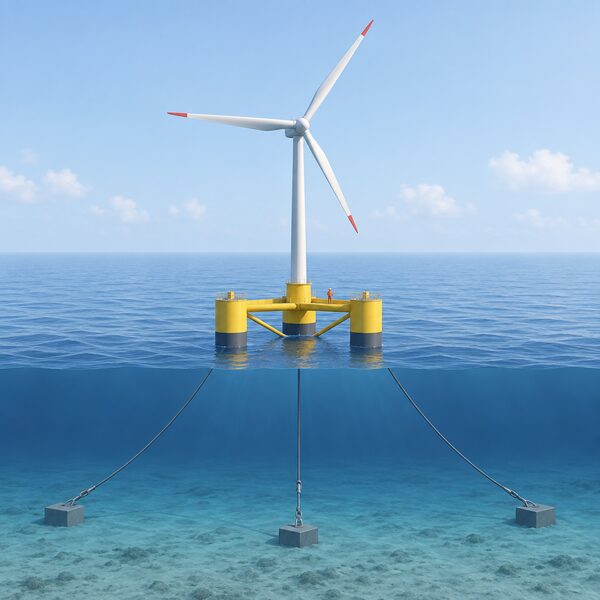
Developing clean energy projects through its partnership with the Crown Estate is one of Great British Energy's key functions1. The Crown Estate holds the seabed rights that offshore wind projects depend on, so the partnership is the route by which Great British Energy gets access to project sites rather than having to acquire them in a market.
The Celtic Sea programme shows how that development pipeline is structured. The Crown Estate's five areas of search are intended for 4 GW of floating offshore wind by 2035, with potential for up to an additional 20 GW by 204519. Those are development targets with long horizons, and the floating platforms they require are exactly the manufacturing capability the £300 million supply chain allocation is aimed at5.
Development also runs through named project structures. The SAPPHIRE Solo project lists subcontractors including Connect 3, Blairgowrie and Rattray Development Trust, Geospatial Insight Ltd, Strathclyde University's Energy Systems Research Unit, MCA Renewables, Zuos Ltd, and Scottish and South Energy Networks21. That mix, a development trust alongside a university research unit and network operators, is what a funded local energy project looks like in practice.
The timescales involved are long by household standards. Earlier modelling work on the GB energy sector examined scenarios and stress tests over the next 10 to 15 years22, which is a reasonable guide to how far out these projects are planned. A household reading a Great British Energy announcement should assume a horizon measured in years, not in billing periods.
The independence this creates is structural. Domestic ownership of generation and of the seabed development pipeline reduces reliance on imported energy and on foreign-owned generation capacity. It does not reduce a home's reliance on the grid, on a supplier, or on the gas network if the home is heated by gas. Those remain, and no Great British Energy funding stream changes them for an individual property.
Sources22 cited
- Which energy suppliers are British?, Uswitch, 2026
- Great British Energy research briefing, House of Commons Library, 2026
- DESNZ annual report and accounts 2025 to 2026: performance report, Department for Energy Security and Net Zero, 2026
- Great British Energy, Energy Saving Trust, 2026
- Spending Review 2025 document, HM Treasury, 2025
- Great British Energy announcement research briefing, House of Commons Library, 2025
- Spring Budget 2023, HM Treasury, 2023
- Debt Relief Scheme impact assessment, Ofgem, 2025
- Great British Insulation Scheme: homeowners and tenants, Ofgem, 2026
- £129 million support for Welsh communities to transition to renewable energy, Welsh Government, 2025
- Autumn Budget 2024, HM Treasury, 2024
- UK solar PV strategy part 2, Department of Energy and Climate Change, 2014
- Britain continues to break clean power records, Department for Energy Security and Net Zero, 2026
- Thousands of homes will be eligible for £9,000 off a heat pump, Department for Energy Security and Net Zero, 2026
- UK Solar Roadmap, Department for Energy Security and Net Zero, 2025
- Energy generation in Wales 2021, Welsh Government, 2022
- POST note on offshore wind, Parliamentary Office of Science and Technology, 2025
- Major acceleration of homegrown power in Britain's plan for greater energy independence, Department for Energy Security and Net Zero, 2025
- Accelerating to net zero: CCC progress report response, Department for Energy Security and Net Zero, 2024
- Progress in reducing emissions: 2025 report to Parliament, Climate Change Committee, 2025
- Heat Pump Ready Programme stream 1 phase 1 projects, Department for Energy Security and Net Zero, 2026
- Project Discovery consultation, Ofgem, 2010