

In this answer
Short answer
The Contracts for Difference scheme is the UK Government's main mechanism for supporting new low-carbon electricity generation projects in Great Britain. It guarantees a set price per MWh of electricity for 15 years, indexed to inflation, and settles the gap between that price and the wholesale market with electricity suppliers, who recover it from consumer bills1. The system has operated since 2014 and awards contracts through regular, competitive auctions rather than by application2.
The figures that matter to a household are these. CfDs account for less than 3% of average electricity bills, down from 5% before the energy crisis3. The CfD and Capacity Market schemes together add £1.8 billion and £1 billion respectively to domestic bills a year4. Around 90% of future CfD costs are associated with supporting future power plants, so the charge is largely about capacity not yet built5. The most recent auction produced strike prices of below £72/MWh for solar, £73/MWh for onshore wind and £78/MWh for offshore wind, in 2025 prices6.
The scheme is a two-way contract, not a one-way subsidy. When wholesale prices run above the strike price the generator pays the difference back, and that is what happened for the first time in September 20217. For a household, the CfD is a small, variable line in the bill that moves with wholesale prices, and it does nothing to reduce dependence on the grid, a supplier or the wholesale market itself.
What the scheme is and what it does
The CfD scheme is the government's principal route for bringing forward new low-carbon generation in Great Britain. Its purpose is supporting new low-carbon electricity generation projects, and amendments have made clear that encouraging low-carbon generation includes encouraging the continuation of, or an increase in, low-carbon electricity generation at existing generating stations1. That wording matters: the scheme is not only about new build, but about keeping existing low-carbon plant running.
The mechanism is a contract rather than a grant. CfDs are 15-year private law contracts, guaranteeing a set price per MWh of electricity for 15 years, indexed to inflation1. The generator sells into the wholesale market as normal and the contract settles the difference between the market price and the strike price. That gives the generator price certainty over the 15-year lifetime of a contract, which is what makes project finance possible for technologies with high upfront capital costs and no fuel cost2.
Contracts are awarded through regular, competitive auctions1. The auction is a reverse auction: generators bid the strike price they will accept, and the lowest bids win within each technology pot. The result is that the support level is set by competition rather than by administrative decision, and the strike prices that emerge are the prices the scheme pays.
For a household's energy independence, the CfD changes little directly. It does not give a home any control over generation, storage or supply, and it does not reduce the amount of electricity a home draws from the grid. What it does is shape the generation mix that the grid draws on, and therefore the wholesale prices that flow through to bills. The dependence that remains is on the grid, on a supplier and on the wholesale market, all of which the CfD operates within rather than replaces.
How the mechanism works: strike prices, top-ups and paybacks

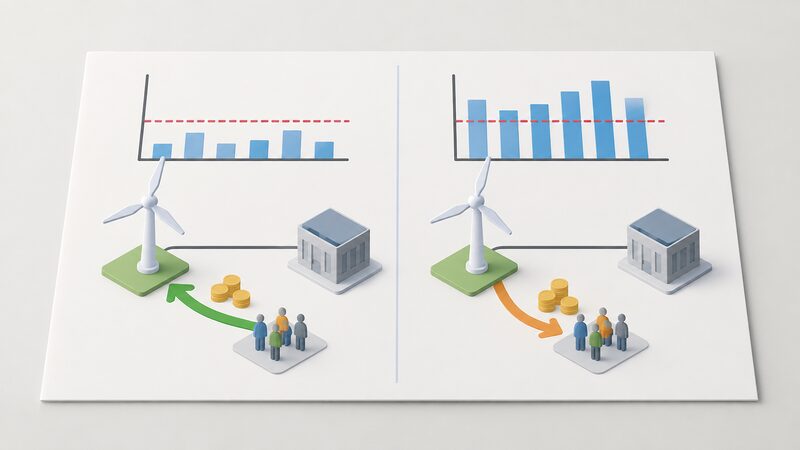
The CfD guarantees a minimum price that generation companies will be paid, topped up or repaid via suppliers and collected through consumers' electricity bills8. When the wholesale price is below the strike price, the generator receives a top-up. When the wholesale price is above the strike price, the generator pays the difference back. The direction of the flow depends entirely on market conditions, which is why the scheme has produced both costs and refunds.
The payback side is real and has happened. The UK's portfolio of CfD-backed projects paid back to billpayers for the first time ever in September 20217. Between November 2021 and January 2022, CfD projects paid back £114.4m to consumers9. That period coincided with very high wholesale prices, so the contracts that had been set at lower strike prices returned money rather than drawing it.
The cost side is what appears on bills in most periods. Around 90% of future CfD costs are associated with supporting future power plants5. That means the charge a household sees is not simply the cost of the wind and solar farms already generating, but the committed cost of projects that will generate later. The scheme is therefore forward-looking in its cost profile: money is collected now to underwrite capacity that comes online over the following years.
Ofgem has consulted on the CfD cost allowance within the price cap, seeking views on a potential simplification of the methodology to set the allowance and aiming to improve its accuracy10. The respondent groups included energy suppliers, energy industry bodies, consumer groups and charities10. That consultation closed awaiting decision as of 30 July 202610. The allowance is the mechanism by which the CfD cost reaches a capped tariff, so changes to its methodology change how the cost is spread across households.
"The government's "Contracts for Difference" scheme (CfDs) guarantees a minimum price that generation companies will be paid, topped up or repaid via suppliers and collected through consumers' electricity bills."
The auctions: established and less established technologies
CfDs are awarded through regular, competitive auctions1. Allocation rounds have historically grouped technologies into pots, separating established technologies such as solar and onshore wind from less established ones such as offshore wind and floating offshore wind. Reforms published for allocation round 7 included splitting offshore wind results from other technologies9. The separation matters because it prevents cheaper, mature technologies from crowding out those that need higher strike prices to proceed.
The seventh allocation round produced a record result. A record 8.4GW of offshore wind secured CfD contracts in AR7, announced on 14 January 2026, with five fixed-foundation projects totalling 8.25GW and two floating projects totalling 192.5MW securing contracts9. The four winning fixed-foundation offshore wind projects in England and Wales secured a strike price of £91.20/MWh in 2024 prices9. The two floating offshore-wind projects will see a strike price of £216.46/MWh9.
Allocation round 7 unlocked £27bn in private investment11. That figure is the scheme's clearest statement of what it is for: mobilising private capital into generation that the market would not otherwise finance at those prices. The government's own reporting treats the investment unlocked as the outcome, with the strike price as the instrument.
The scheme has also seen a cancellation. The developer Ørsted cancelled the 2.4GW Hornsea 4 offshore wind scheme, which had been awarded a CfD at the previous auction round, citing cost inflation9. A CfD award is not a guarantee that a project gets built, and cost inflation can make an awarded strike price unworkable. That is a limit on what the scheme can deliver, and it sits alongside the record round rather than contradicting it.
Strike prices by technology: solar below £72/MWh, onshore wind £73, offshore wind £78
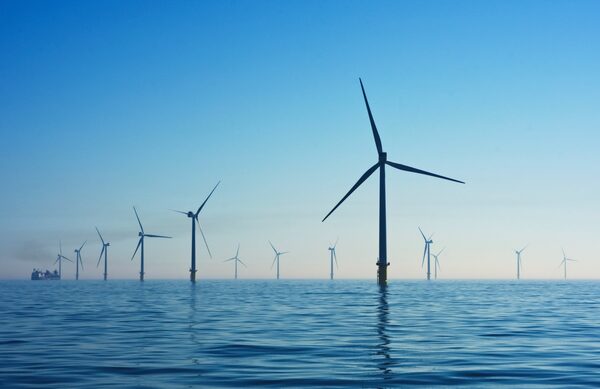
The strike prices that emerge from the auctions are the clearest measure of what each technology costs to bring forward. In the most recent CfD subsidy auction, solar came in at below £72/MWh, onshore wind at £73/MWh and offshore wind at £78/MWh, all in 2025 prices6. Those three figures sit close together, which reflects how far offshore wind costs have fallen relative to earlier rounds.
| Technology | Strike price | Basis | Source |
|---|---|---|---|
| Solar | Below £72/MWh | Most recent CfD subsidy auction, 2025 prices | 6 |
| Onshore wind | £73/MWh | Most recent CfD auction, 2025 prices | 6 |
| Offshore wind | £78/MWh | Most recent CfD auction, 2025 prices | 6 |
| Solar | £50 per MWh | Sixth allocation round | 12 |
| Solar | £47 | 2023 allocation round | 12 |
| Offshore wind, fixed foundation, England and Wales | £91.20/MWh | AR7, 2024 prices | 9 |
| Floating offshore wind | £216.46/MWh | AR7, 2024 prices | 9 |
The figures do not sit on a single consistent basis, and that is worth stating plainly. The solar, onshore wind and offshore wind figures are given in 2025 prices from the most recent auction6. The AR7 fixed-foundation and floating figures are given in 2024 prices9. The sixth allocation round solar figure of £50 per MWh and the 2023 figure of £47 are from a different round again12. Comparing across them without adjusting for the price base would misstate the trend.
The spread between technologies is wide. Floating offshore wind at £216.46/MWh is more than double the fixed-foundation figure of £91.20/MWh in the same round9. That gap is the reason the pots exist: floating projects cannot compete against fixed-foundation projects on price, so they are auctioned separately. Solar at below £72/MWh and onshore wind at £73/MWh are the cheapest of the technologies listed, and both are established technologies6.
For a household, the strike price is the input that determines the top-up or payback that eventually reaches the bill. A lower strike price means a smaller top-up when wholesale prices are low, and a larger payback when wholesale prices are high. The direction of the effect on bills therefore depends on the relationship between the strike price and the market, not on the strike price alone.
What it costs on bills: £1.8 billion a year and falling
The CfD and Capacity Market schemes add £1.8 billion and £1 billion respectively to domestic bills a year4. The CfD figure is the annual addition attributable to the Contracts for Difference scheme, and the Capacity Market figure is given alongside it for context. Both are additions to domestic bills, not to industrial or commercial bills.
The share of the average electricity bill is smaller than the headline figure might suggest. CfDs currently account for less than 3% of average electricity bills, down from 5% before the crisis3. The fall from 5% to less than 3% reflects both the rise in wholesale prices, which increased the denominator, and the payback flows during high-price periods. The scheme's share of the bill is therefore not fixed, and it moves with the market.
The cost is also concentrated on future plant. Around 90% of future CfD costs are associated with supporting future power plants5. That means the £1.8 billion annual addition is largely underwriting capacity that has not yet been built, rather than paying for output already delivered. A household reading its bill is therefore paying, in the main, for generation that will arrive later.
The price cap provides the frame within which the CfD cost reaches a household. For the period 1 July to 30 September 2026, the benchmark maximum charges vary by region: Eastern at £187.52 standing charge and £815.65 annual bill at 2,500 kWh single-rate, London at £181.21 and £843.39, Midlands at £207.57 and £810.72, and Southern at £172.77 and £801.7413. The CfD allowance sits within those capped figures rather than on top of them.
Contract length: 15 years, indexed to inflation

CfDs are 15-year private law contracts, guaranteeing a set price per MWh of electricity for 15 years, indexed to inflation1. The 15-year term is the current CfD term, and it is the period over which generators were given price certainty2. Indexation to inflation means the strike price is not fixed in nominal terms: it rises with the index over the contract's life.
The length of the contract is what makes the scheme work as a financing instrument. A generator committing capital to a wind farm needs a revenue horizon long enough to service debt, and 15 years of indexed price certainty provides that. The contract is a private law contract rather than a statutory entitlement, so its terms are enforceable between the parties rather than administered as a licence condition1.
The term also determines how long a household is exposed to a given strike price. A contract signed at a low strike price locks in that price for 15 years, which is favourable to billpayers when wholesale prices are high and less so when they are low. A contract signed at a high strike price does the reverse. The portfolio effect is that contracts signed across different rounds and price environments average out over time.
The 15-year term is not unique to Great Britain. In France, larger projects exceeding 25GWh/yr must compete under a Contracts for Difference scheme, with each CfD also running for 15 years5. That is a different jurisdiction with its own auction rules, so it sets no precedent for the Great Britain scheme, where CfDs are 15-year private law contracts guaranteeing a set price per MWh, indexed to inflation.
For a household's independence, the contract length is the reason the CfD cost is a long commitment rather than a short one. A 15-year indexed contract signed today sets a cost or a payback stream that runs well beyond any individual tariff fix or price cap period. The household cannot opt out of the CfD element of the bill, and it cannot shorten the contract. What it can do is understand that the charge is a portfolio average across contracts signed in different years, not a single price.
Where the scheme sits in the wider supply picture
The CfD is one of several mechanisms that shape what a household pays and where its electricity comes from. It sits alongside the Capacity Market, which pays for firm capacity, and the network charges that recover the cost of moving power. The CfD's role is specifically to bring forward low-carbon generation by removing price risk from the generator, and it does that by transferring that risk to billpayers through the settlement mechanism8.
The scheme's limits are as important as its reach. It does not build anything itself, and an awarded contract can be cancelled, as Hornsea 4 was9. It does not reduce a household's dependence on the grid, on a supplier or on the wholesale market. It does not give a home any generation or storage of its own. What it does is change the mix of generation that the grid draws on, and therefore the wholesale prices that flow through to bills over time.
The direction of the money can run either way. The first billpayer payback came in September 2021, and £114.4m was returned between November 2021 and January 20227. In most periods the flow is outward, with the CfD and Capacity Market schemes adding £1.8 billion and £1 billion respectively to domestic bills a year4. A household should expect the CfD line to be small, variable and capable of turning into a credit when wholesale prices are high.
The scheme's future cost is weighted towards plant not yet built. Around 90% of future CfD costs are associated with supporting future power plants5. That means the charge is best understood as a forward commitment: the household is paying now, in part, for generation that will be delivered later. The strike prices from the most recent auction, solar below £72/MWh, onshore wind £73/MWh and offshore wind £78/MWh in 2025 prices, are the prices that commitment is being made at6.
Sources13 cited
- UK Solar Roadmap, Department for Energy Security and Net Zero, 2025-06
- Electricity prices in Great Britain, House of Lords Library, 2026-06
- Factcheck: Why expensive gas, not net zero, is keeping UK electricity prices so high, Carbon Brief, 2025-05-20
- Household energy bills and green levies, Nesta, 2026-09-20
- How to pay for energy policy, Cadent, 2026
- A record year for British solar, Ember, 2025
- Analysis: Cutting the green crap has added £2.5bn to UK energy bills, Carbon Brief, 2021-09
- What's in an energy bill: wholesale costs, Nesta, 2024-11-22
- Q&A: What the UK's record auction for offshore wind means for bills and clean power by 2030, Carbon Brief, 2026-01-15
- Energy price cap: proposed changes to the Contracts for Difference cost allowance, Ofgem, 2026-07-30
- DESNZ annual report and accounts 2025 to 2026: performance report, GOV.UK, 2026-09-17
- RECC Autumn Newsletter 2024, Renewable Energy Consumer Code, 2024
- Energy price cap levels, 1 July to 30 September 2026, Ofgem, 2026
 The Full Tariffs GuideWhich energy tariff suits how you live, and will switching really save you money?
 Export Rates Per kWhHow much will your supplier pay you for the solar power you send to the grid, and why do rates vary so much from one company to another?
 Wind Power on the UK GridOffshore wind now supplies a big share of Britain's electricity, and it keeps growing.
 Electricity InterconnectorsWhere does Britain's electricity come from when the wind drops, and how much do we buy from abroad?
 UK Electricity Generation MixBreaks down the shares of gas, wind, nuclear, solar, biomass, hydro and imports in UK electricity generation, how those shares move by hour and season, where the published figures come from, and what the mix means for a household's energy independence.
 Prepayment and Pay As You GoHow prepayment and pay as you go energy tariffs work in the UK: meter types, top-ups, emergency credit, debt repayment through the meter, price cap treatment and how households move to a credit meter.