

In this answer
Short answer
The Warm Home Discount is a one-off £150 discount off household electricity bills, paid once a year to eligible households by participating suppliers1. It is not a benefit, not a grant application in most of the UK, and not paid in cash: it appears as a credit on the electricity account, usually between October and April.
For winter 2026 to 2027 the qualifying date is 23 August 2026, and the scheme opens in October 20262. That gap matters. Entitlement is fixed by circumstances on the qualifying date, so a household that becomes eligible in November does not qualify for that winter, and one that stops claiming a qualifying benefit in September may still be paid.
The route to payment differs by nation. In England and Wales the majority of eligible households receive the rebate automatically through data matching, with no application at all2. In Scotland the core group is paid automatically but the broader group must apply to its supplier4. Park home and caravan residents apply themselves each year, usually from September6.
What the Warm Home Discount is, and what it is worth
The scheme requires large domestic energy suppliers to provide an annual discount of £150 to eligible households9. The Department for Energy Security and Net Zero describes it as a one-off £150 discount off household electricity bills1, and the Met Office frames it as a one-off payment giving eligible older and low-income consumers £150 off their energy bill10.
The figure has moved. A parliamentary committee document records the discount as a one-off £140 payment applied to eligible customers' electricity bills between October and April11. The £140 and £150 figures are both in circulation for different scheme years; the current published figure is £1509.
The payment is a credit against electricity, not a cash sum, and it is one per household rather than one per person. It is not means-tested against savings in the way some benefits are, but it is tied to the benefits listed for each nation. The scheme is funded by suppliers and the costs are recouped from the energy bills of all their customers, which is why the discount is not free money from government: it is a levy redistributed to eligible households8.
For a household's energy independence the discount is a modest, reliable reduction in one bill, not a route off the grid. It does not reduce consumption, does not fund insulation or a heat pump, and does not change who supplies the electricity. It is best understood as a fixed annual credit that offsets part of the standing cost of being connected.
Who qualifies: the core group and the broader group
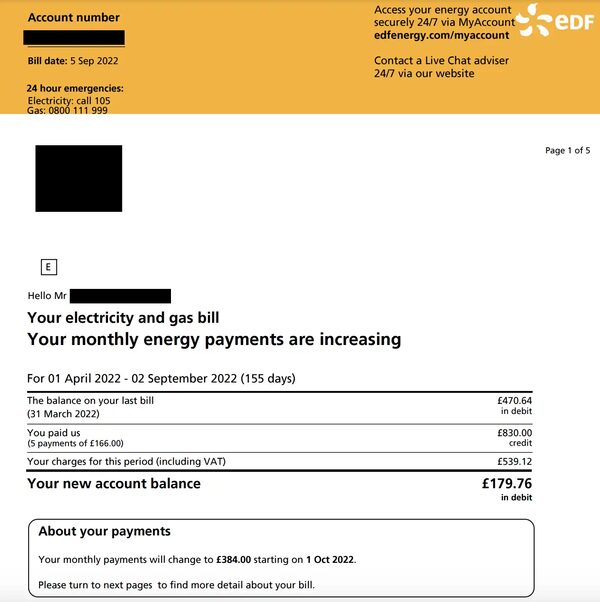
Eligibility splits into a core group, paid automatically, and a broader group, which in Scotland must apply. In England and Wales the core group has historically been split into Core Group 1, based on receipt of the Guarantee Credit element of Pension Credit on the qualifying date, and Core Group 2, based on a qualifying means-tested benefit8.
The government has consulted on merging the two into a single Core Group in England and Wales, retaining the expanded eligibility criteria from 2025/2613. Until that change takes effect, the two-group structure is what the published statements describe.
The core group in England and Wales covers households where the person named on the energy bill, or their partner or legal representative, received the relevant benefit on the qualifying date13. The qualifying means-tested benefits for Core Group 2 include Housing Benefit, income-related Employment and Support Allowance, income-based Jobseeker's Allowance, Income Support, the Savings Credit element of Pension Credit and Universal Credit8.
In Scotland the core group, industry initiatives and broader group all apply to the scheme14. The broader group requires a low-income test through specific qualifying benefits plus a vulnerability requirement: a child under five, an income-related qualifying component, a limited capacity for work element, a disabled child element or a disabled element8.
| Group | England and Wales | Scotland |
|---|---|---|
| Core group | Automatic payment, no application15 | Automatic payment, no application5 |
| Broader group | Not used in the same form; Core Group 2 covers means-tested benefits8 | Must apply to the supplier5 |
| Park homes | Apply each year, usually from September6 | Apply each year, usually from September6 |
England and Wales: automatic payment, with an application route if it does not arrive
There is no need to apply for the Warm Home Discount in England and Wales; the supplier applies it automatically16. The Department for Energy Security and Net Zero states that through data matching the majority of eligible households will receive their rebates automatically from their energy supplier2.
A letter is sent in autumn 2026 to households that are eligible or that need to provide more information15. If no letter arrives by early January 2027 and the household believes it qualifies, the helpline must be called by the end of February 202717. That deadline is the single most important date in the process, because a missed call can mean a missed payment for the year.
The helpline number is 0800 030 93227. Written enquiries go to Warm Home Discount Scheme, PO Box 970, Preston, PR2 0FX, used for eligibility queries where the supplier cannot help7.
The automatic route depends on data matching between suppliers and government records, which is why the qualifying date matters more than the application date. A household whose benefit claim was live on 23 August 2026 should appear in the matching; one whose claim started later will not, however strong the need in January.
"You don't need to apply for the scheme - payments are automatic."
Scotland: qualifying benefits and the application process for the broader group

Scotland keeps an application route that England and Wales have largely removed. The core group need not apply and receives a letter automatically, but the broader group must contact its energy company to apply5. Citizens Advice Scotland states plainly that the broader group needs to apply to its supplier4.
The broader group in Scotland tests low income through specific qualifying benefits and adds a vulnerability requirement8. The qualifying benefits include Adult Disability Payment, Housing Benefit and Pension Age Disability Payment4. The vulnerability criteria are a child under five, an income-related qualifying component, a limited capacity for work element, a disabled child element or a disabled element8.
This is the point at which the four nations diverge most. A household in Glasgow on the same benefit as a household in Manchester may need to make an application that the Manchester household never sees, and the Scottish application is made to the supplier rather than to a central body. The National Energy Action guidance notes that an application process still applies in Scotland for those in Core Group 2, known there as the broader group19.
For a Scottish household the practical consequence is that the discount is not passive. It requires knowing which group applies, checking the supplier's own broader group criteria, and applying within the supplier's window. Suppliers set their own broader group criteria within the national framework, so two households on the same benefit with different suppliers can get different outcomes.
Park homes and caravans: eligible, but you must apply yourself
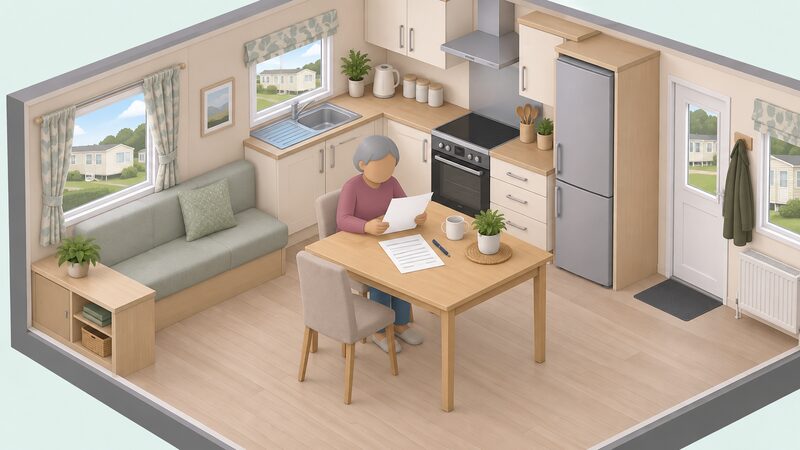
Park home residents can be eligible for the Warm Home Discount but must apply themselves rather than being paid automatically16. The Park Homes Warm Home Discount scheme requires applicants to be permanent residents of a park home, to pay the park site owner for electricity usage, and to be on a relevant qualifying benefit or to demonstrate household income or fuel poverty criteria2.
The scheme is for permanent residents of park homes who pay the site owner for their electricity, and applicants need to apply each year, with only one application per household considered8. Applications usually open in September6. The income test is a household income below £20,328 per year before tax or deductions, or receipt of at least one of the benefits listed on the application page15.
Caravan residents follow a different route again. They must contact the Warm Home Discount helpline and provide evidence that the caravan is their sole, legal residence and that the applicant is named on the electricity bill2.
The reason for the separate route is that park home residents usually buy electricity through the site owner rather than directly from a licensed supplier, so the data matching used in England and Wales cannot see them. That also means the discount depends on the site owner passing it through, which is a dependence the household cannot control.
Switching supplier, supplier failure and other rules that can cost you the discount
Switching away from a supplier that offers the Warm Home Discount to one that does not means losing it, even for the core group, so the new supplier's criteria should be checked before switching20. Not all suppliers offer it, and it is best to switch after receiving the discount so it is not lost for that year21.
There is a partial protection. If a household switches supplier after the date its eligibility is checked, it might still get the discount from the supplier it was with on that date4. That protects the qualifying-date principle but not a switch made before the check.
Suppliers with more than 1,000 domestic customers must pay the discount, and smaller suppliers can offer it voluntarily; larger suppliers must offer it to both the core and broader groups20. The scheme obligates participating suppliers to provide rebates to eligible low-income households2.
If a supplier stops trading, the new supplier taking on its customers should honour the Warm Home Discount22. That is the position for households already receiving it, and it reflects the fact that the obligation sits with the supplier rather than with the customer's choice.
Claiming the discount does not affect eligibility for any other discounts or payments16, and it does not affect the Cold Weather Payment, the Winter Fuel Payment or other cost of living and fuel support17. For a household managing several support payments at once, the Warm Home Discount can be claimed alongside them without reducing any of them.

Sources22 cited
- Warm Home Discount statistics 2025 to 2026, GOV.UK, 2026-09-17
- Warm Home Discount eligibility statement, England and Wales, 2026 to 2027, GOV.UK, 2026-09-17
- Can I get other help with fuel as a pensioner, Turn2us, 2026-10
- If you live in Scotland, GOV.UK, 2026-08-23
- Grants and benefits to help you pay your energy bills, Citizens Advice Scotland, 2026-09-17
- Park homes advice, Centre for Sustainable Energy, 2026-07
- Warm Home Discount contacts, guidance and resources, Ofgem, 2026-09-17
- Warm Home Discount research briefing, House of Commons Library, 2026-02-26
- Warm Home Discount statistics 2025 to 2026, GOV.UK, 2026-06-18
- Keeping your home warm in winter, Met Office, 2026-09-20
- Warm Home Discount inquiry, Public Accounts Committee, 2026-09-20
- DESNZ annual report and accounts 2025 to 2026, GOV.UK, 2026-09-17
- Continuing the Warm Home Discount Scheme: government response, GOV.UK, 2026-01-30
- Warm Home Discount, Ofgem, 2026-09-17
- Grants and benefits to help you pay your energy bills, Citizens Advice, 2026-09-17
- Warm Home Discount guide, Uswitch, 2026-08-12
- Warm Home Discount Scheme, England, Scotland and Wales, Turn2us, 2026
- Energy grants guide, Confused.com, 2026
- Your home energy checklist, National Energy Action, 2026-09-10
- Warm Home Discount, Which?, 2026-08-04
- Dealing with your energy supplier, Centre for Sustainable Energy, 2026-01
- Energy supplier out of business, Uswitch, 2026-05-29
 Older People and Home EnergyOlder people often pay more to keep warm and can miss out on help they are entitled to.
 The Full Grants and Schemes GuideWhich grants can you actually get right now, and how do you apply for them?
 Which Homes Suit a Heat PumpMost UK homes can have a heat pump fitted, so the real question is whether yours makes it easy or expensive.
 Warm Air Heating SystemsWarm air heating works by pushing heated air through vents in your floors or walls.
 Flexibility Payments for HomesCan you really get paid for using less electricity at peak times, and how much would a household actually earn?
 The Full Heat Pumps GuideWill a heat pump keep my house warm in winter, and what does one cost to buy and run?