

In this guide
The Warm Home Discount in Scotland is worth the same 150 pounds as in England and Wales, but it is not the same scheme. Since 2022 the discount has operated as two separate schemes, one covering England and Wales and the second covering Scotland, and the Scottish scheme keeps a structure the rest of Great Britain has left behind: a Core Group, a Broader Group and Industry Initiatives1. The practical consequence for a Scottish household is that a large share of recipients have to ask for the money rather than simply receive it.
The rebate itself is a discount on the electricity account, not a payment. Turn2us describes it plainly: "The Warm Home Discount is a one-off discount of £150 on your electricity bill. You don't get any money."2 The Core Group in Scotland does not involve an application and is identified through automatic data matching using Department for Work and Pensions data, while the Broader Group is delivered by each scheme supplier on an individual application basis, using criteria that supplier sets and the regulator approves3. Scottish Government reporting for 2024/25 described a 150 pound rebate going to around 93,000 households in the Core Group and up to 207,000 households in the Broader Group4.
A third route exists for people whose electricity is billed by a site owner rather than an energy company. Park home and static caravan residents in that position normally cannot be reached by a supplier at all, so a separate Park Homes Warm Home Discount scheme, administered by Charis Grants, handles them across England, Scotland and Wales5.
Two schemes, one discount: why Scotland is treated separately
Fuel poverty is devolved. Scottish Government ministers have determined eligibility for the Warm Home Discount in Scotland for the next scheme period within a funding limit, under devolution arrangements set out in amendments to the Energy Act 2010 made by the Scotland Act 2016, and could in future develop their own regulations within that limit3. That is why the scheme splits: the Warm Home Discount Regulations 2011 established the original scheme, and it is continued in Scotland by the Warm Home Discount (Scotland) Regulations 20226, which came into force on 20 October 2022 and created what is formally known as the Warm Home Discount (Scotland) Scheme [7 placeholder].
There is also a data reason. The English and Welsh scheme was rebuilt around property characteristics, and Consumer Scotland has pointed out that "The Valuations Office data (as used for Warm Home Discount) does not exist in Scotland" [8 placeholder], so alternative proxies would be needed before Scotland could copy that approach. In the absence of that data, the Scottish scheme has kept the older application-based Broader Group. The 2022 consultation on the Scottish scheme said it "will largely mirror the scheme previously in place across Great Britain from 2021 to 2022" [9 placeholder], covering the period from 2022 to winter 2025-2026.
For a household thinking in terms of energy independence, this is a reminder of how little of the picture sits in one place. The rebate is funded through a levy on all domestic energy bills1, which means bill payers collectively fund it; eligibility is decided in Edinburgh; the regulations are made at Westminster; and delivery depends entirely on whichever electricity supplier holds the account. There is no route to the discount that does not run through a supplier relationship.
Scotland's separate treatment is part of a wider pattern of divergence set out in why home energy grants differ across the nations and in which energy powers are devolved and which are reserved.
The discount: £150 off the electricity bill, not cash
The Warm Home Discount provides 150 pound energy bill rebates, funded through a levy on domestic bills1. Official statistics describe it as "A one-off £150 discount off household electricity bills"8, and the scheme requires large domestic energy suppliers to provide that annual discount to eligible households9. The Department for Energy Security and Net Zero has reported that around 6 million households now benefit from a 150 pound rebate off their winter energy bill10.
The mechanics matter. Under the Scottish regulations the rebate is applied by crediting the customer's electricity account so that the amount charged, including VAT, is reduced; it may be applied to a gas account on request, or given as credit for prepayment customers6. Independent guidance describes the same thing as an automatic credit to the account or a voucher for a prepayment meter top-up11. A household on a prepayment meter therefore sees the benefit at the top-up point rather than on a bill.
The value rose from 140 pounds. Proposals published in 2022 said the scheme would "boost cash paid out to help meet energy costs from £140 to £150" in Scotland [11 placeholder]. Older guidance still describing a 140 pound one-off payment applied between October and April reflects the earlier position rather than the current one.
Two limits are worth stating. First, the discount is tied to the electricity account, so it reduces a bill rather than putting money in a household's hands. Second, it is a single annual rebate, not a tariff change, and it does nothing to reduce the underlying consumption that drives the bill. Measures under the Home Energy Scotland grant and loan or HEEPS area based schemes address that side; the Warm Home Discount does not.
Who qualifies in Scotland: the Core Group and the Broader Group
From 2026/27 the structure of the scheme in Scotland is the Core Group, the Broader Group and Industry Initiatives3. Ofgem confirms that in Scotland all three elements apply, whereas in England and Wales the core group and industry initiatives apply1.
The Core Group does not involve an application and is instead subject to automatic data matching using Department for Work and Pensions data3. Turn2us puts it simply: "If you are in the Core group, there is no need to apply."2 Households identified this way receive a letter.
The Broader Group is delivered by each scheme supplier in Scotland on an individual application basis1. The regulations describe it as the prescribed rebate being provided to Scotland domestic customers selected by the supplier who appear to meet supplier eligibility criteria approved by the Authority6. Because each supplier sets and runs its own criteria, the qualifying tests are not identical across the market. Citizens Advice Scotland states that supplier criteria must include people who get Adult Disability Payment, Housing Benefit and Pension Age Disability Payment12.
Commons Library briefing material sets out that the Scottish Broader Group requires applicants to meet a low-income requirement tested through specific qualifying benefits and a vulnerability requirement, the vulnerability criteria being a child under 5, an income related qualifying component, a limited capacity for work element, a disabled child element or a disabled element13.
| Feature | Core Group (Scotland) | Broader Group (Scotland) |
|---|---|---|
| Application needed | No, automatic data matching with DWP data3 | Yes, directly to the supplier each year3 |
| Who decides eligibility | Scottish Ministers, within a funding limit3 | Supplier criteria approved by the Authority6 |
| Households, 2024/25 | Around 93,0004 | Up to 207,0004 |
| Rebate | £1504 | £1504 |
Which? reports that a household in Scotland should get the discount automatically if named on the electricity bill before 23 August 2026 and receiving a qualifying benefit, listing Pension Credit, an extra amount of Universal Credit for a disability or health condition, a disability or pensioner premium of income-related Employment and Support Allowance, or a disability or pensioner premium alongside a Support for Mortgage Interest loan7.
How the discount is paid and which suppliers take part
Participation is an obligation on larger suppliers, not a choice for most of the market. Energy suppliers with more than 1,000 domestic customers, plus other suppliers who elect to take part, offer the discount and recoup the costs from the energy bills of all their customers13. The 2022 Scottish consultation said supplier participation thresholds would be lowered so that more energy suppliers participate, particularly from 2023 to 2024 onwards [9 placeholder].
Compliance is monitored. In scheme year 12, of the 18 suppliers reporting end of year compliance, 16 met their respective spending obligations for the Scotland scheme [14 placeholder].

Switching supplier has a different effect in each group. Independent guidance sets out that for Core Group 1 and Core Group 2 in England and Wales the company that supplied electricity on the qualifying date is responsible for payment, whereas Broader Group customers in Scotland need to reapply with the new supplier11. That is a real trap: a household that changes tariff for a better price mid-application can lose the rebate unless it applies again.
The expansion and what changed for Scotland
The 2025 expansion was framed around England and Wales, with Scotland handled by increasing the money rather than changing the mechanism. The government proposed, in Scotland, to proportionally increase the size of the scheme so more households on means-tested benefits could receive support through their energy supplier's scheme [15 placeholder]. Regulations were laid to extend the scheme in England and Wales and to increase the Scottish Broader Group budget proportionately for winter 2025 to 2026 [15 placeholder]. Parliamentary material records that the instrument amends the Warm Home Discount (Scotland) Regulations 2022 to increase suppliers' non-core spending obligation by an amount commensurate to the expected increase in England and Wales [16 placeholder].
Government figures put the number of households receiving the discount before the expansion at an estimated 3.4 million, around 3.1 million in England and around 300,000 in Scotland [16 placeholder]. The 2025 announcement recorded 240,000 first-time recipients in Scotland and described the Scottish change as increasing the level of spend available for suppliers to allocate through the Broader Group [17 placeholder]. Which? reports that around six million households should get the discount this winter, including 250,000 households in Scotland getting it automatically for the first time7.
Looking forward, eligibility for the Core Group in Scotland is to be expanded to align with the same qualifying benefits list as for the Scottish Winter Heating Payment3. That is the most consequential change for households: it moves more people from the apply-and-hope Broader Group into the automatic Core Group.
Earlier expansion of the Scottish scheme followed the same shape. Proposals in 2022 were for support in Scotland to grow by around 13 million pounds, to 49 million pounds per year, expanding the scheme to cover an additional 50,000 Scottish households per year on top of the 230,000 that already received payments, taking the total to over 280,000 households [18 placeholder]. Separately, Scottish Government engagement material notes that Scotland secures 9.4 per cent of Great Britain spending [19 placeholder].
Applying through your supplier: who must apply and who gets it automatically
This is where Scotland diverges most sharply in daily practice. The government response is explicit that "all applicants to the Broader Group in Scotland must apply each year for the rebate directly to their energy supplier"3. Citizens Advice Scotland states the position for the Broader Group as "you need to apply to your supplier"12. Consumer Scotland has noted that the Warm Home Discount in Scotland still retains an applications process for its Broader Group [20 placeholder].
The Fuel Bank Foundation reports that a household in Scotland receiving Pension Credit Guarantee Credit and named on the electricity bill will likely receive the discount automatically, while Scottish households on other means-tested benefits will need to apply by calling their energy supplier [21 placeholder]. In England and Wales there is no need to apply, because the supplier applies the discount automatically11.
A further condition applies wherever the household lives: an applicant must be a customer of an electricity supplier and be an account holder or named on an electricity bill5. Where the name on the bill belongs to someone else, the rebate cannot follow.
Timing also matters. Commons briefing material states that eligible energy customers should receive the discount by 31 March 202613. The qualifying date for the current round, as set out for England and Wales, sits in August: the conditions had to be met on 23 August 2026 [23 placeholder].
Park homes and static caravans: the separate Charis route
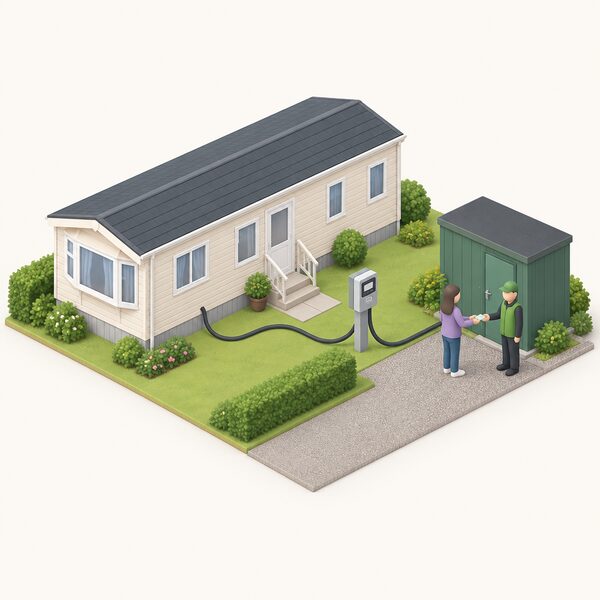
Households on park home and caravan sites are usually invisible to the supplier route because they buy electricity from the site owner. A dedicated Park Homes Warm Home Discount scheme fills that gap. Eligibility is decided by the scheme administrator, currently Charis Grants, and the scheme is funded by energy suppliers who may choose to contribute to it or to fund other measures under the Industry Initiatives element of the Warm Home Discount5.
Charis describes the scheme as an Ofgem regulated, multi-supplier initiative, funded in 2024/25 by E.ON Next, Utilita, OVO and Rebel Energy [24 placeholder]. Charis was approached by Ofgem in 2015 to create a scheme specifically to help park home residents [24 placeholder].
Eligibility, as set out in official guidance, is for permanent residents of park homes who pay the site owner for their electricity, pay council tax and receive certain benefits or are on a low income; residents need to apply each year and only one application per household is considered13. For 2026/27 the stated test is that an applicant must be a permanent resident of a park home, pay the park site owner for electricity usage, and be on a relevant qualifying benefit or demonstrate household income or fuel poverty criteria5. The payment is 150 pounds13.
For Scotland specifically, Charis has described the scheme as open to permanent residents of park homes or static caravans who pay for gas and electricity directly to site owners and are not in direct contact with their energy supplier, with individual payments of 150 pounds [25 placeholder]. In that Scottish round, 261,750 pounds was set aside specifically for Scottish residents in that position, with a finite fund that closes once distributed, and the scheme was set up in partnership with E.ON and is Ofgem approved and regulated [25 placeholder][26 placeholder].
"This grant is not for those using holiday park homes, log cabins or similar temporary forms of accommodation."
Scale and uptake:
| Measure | Figure |
|---|---|
| Park home and static caravan addresses across England, Scotland and Wales | An estimated 110,000 [27 placeholder] |
| Households paid by the Charis scheme last winter | More than 7,200 [27 placeholder] |
| Park home households paid through Charis in winter 2024/25 | More than 7,200 [28 placeholder] |
| Distributed when the scheme was rolled out in 2020/21 | Over £3.3 million to nearly 24,000 park homes [26 placeholder] |
Applications are made online or by phone through the Charis park homes service [27 placeholder], and Which? notes that applications for the Park Homes Warm Home Discount can be made via Charis from September 20267. Turn2us confirms the scheme is open for applications2.
There is one exception on the supplier side. Official scheme rules acknowledge that there may be a small number of caravans classed as permanent residences that do have a direct relationship with a supplier5, and those households would go through the normal route rather than Charis.
How Scotland's scheme differs from England and Wales in practice
The scheme covers England, Scotland and Wales and will run until 31 March 20311. The rebate value is identical. What differs is how a household gets it, and how reliably.
| Point of difference | Scotland | England and Wales |
|---|---|---|
| Elements in operation | Core Group, Industry Initiatives and Broader Group1 | Core group and industry initiatives1 |
| Application | Broader Group must apply to the supplier each year3 | No application needed; supplier applies it automatically11 |
| Effect of switching | Broader Group customers reapply with the new supplier11 | The supplier on the qualifying date is responsible11 |
| Allocation | First-come first-served within each supplier's cap [22 placeholder] | Data matched |
| Who sets eligibility | Scottish Ministers, within a funding limit3 | UK government regulations [23 placeholder] |
The application requirement is not a neutral administrative detail. It creates a gap between those who are eligible and those who are paid, and it falls hardest on households least likely to chase a supplier. Energy UK has argued that the lack of data matching in the Scottish scheme increases suppliers' workload and creates additional fixed costs, and that aligning the Scottish scheme to England and Wales would support the objective of reaching more households [29 placeholder]. The British Gas Energy Trust response took a different view of the immediate step, agreeing that the most effective option was to maintain the broader group in Scotland for now [30 placeholder].
For household energy independence the honest reading is narrow. The Warm Home Discount reduces one winter's electricity bill by a fixed amount. It does not reduce demand, does not change the tariff, and cannot be accessed without a supplier or, for park homes, without an annual application to a grant administrator. Every part of it depends on continuing decisions by the Scottish Government on eligibility, by Westminster on the regulations, and by suppliers on when to open and close their windows. Structural reductions in exposure come from the fabric and heating measures covered elsewhere on home energy across the UK nations and in fuel poverty in Scotland, not from the rebate.
Sources13 cited
- Warm Home Discount (WHD), Ofgem, 2026
- Warm Home Discount Scheme: England, Scotland and Wales, Turn2us, 2026-09-08
- Continuing the Warm Home Discount scheme: government response, GOV.UK, 2026-01-30
- Tackling Fuel Poverty in Scotland: Periodic Report 2021-2024, Scottish Government, 2025
- Warm Home Discount eligibility statement, England and Wales 2026 to 2027, GOV.UK, 2026-09-17
- The Warm Home Discount (Scotland) Regulations 2026, legislation.gov.uk, 2026-04-30
- Warm Home Discount, Which?, 2026-08-04
- Warm Home Discount statistics 2025 to 2026, GOV.UK, 2026
- Warm Home Discount statistics 2025 to 2026, GOV.UK, 2026-06-18
- DESNZ annual report and accounts 2025 to 2026: performance report, GOV.UK, 2026
- Warm Home Discount guide, Uswitch, 2026-08-12
- Grants and benefits to help you pay your energy bills, Citizens Advice Scotland, 2026-09-17
- Warm Home Discount scheme briefing, House of Commons Library, 2026-02-26
 Tariffs in ScotlandWhy do Scottish electricity bills differ from the rest of Great Britain, and why do standing charges cost more in the north?
 Older People and Home EnergyOlder people often pay more to keep warm and can miss out on help they are entitled to.
 Why Energy Grants DifferWhere you live in the UK changes which home energy grants you can get.
 Home Energy Planning ScotlandDo you need planning permission for solar panels or a heat pump in Scotland?
 Housing Stock Data for ScotlandScotland's housing is measured differently from England's, so the numbers you see may not compare directly.
 The Full Heat Pumps GuideWill a heat pump keep my house warm in winter, and what does one cost to buy and run?