
On this page
The Winter Heating Payment is a single, annual payment from Social Security Scotland to help people on low incomes with their heating bills over winter. Some people in Scotland get one payment each winter, and the current rate is £62.001. It replaced the Cold Weather Payment in Scotland from winter 2022 to 2023, and the crucial difference is predictability: the Cold Weather Payment paid £25 for each week of very cold weather, so households never knew in advance what they would get, while the Winter Heating Payment is the same fixed sum every winter, paid regardless of the weather in your area2.
Most people do not apply. Social Security Scotland uses data it already holds, mainly about the benefits you receive, to decide whether you qualify, and payments are made automatically between December and February1. You receive a letter or an email beforehand telling you the payment is coming1. For winter 2025/26 the payment was £59.75, and the Scottish Government estimated it would provide £28.3 million through the scheme that winter2.
What it is worth, and how the figure has moved
The headline number is £62.00, which is what Social Security Scotland pays to each eligible household at the current rate1. That figure has not stood still. When the Scottish Government consulted on the scheme, then called Low Income Winter Heating Assistance, it proposed a single annual payment of £50 to all eligible households receiving income-related benefits7. The payment launched at that level: the Scottish Government described replacing the Cold Weather Payment with a new annual payment of £50 for all low-income households who were currently eligible, covering around 400,000 people in Scotland5. By winter 2025/26 the rate had risen to £59.752, and it now stands at £62.001.
The size of the payment was a live question from the start. The equality impact assessment for the scheme noted that raising the payment to a suggested £75 to £100 would increase forecast annual expenditure from £20 million to between £30 million and £40 million8. The Scottish Government has not gone that far: its estimated spend for winter 2025/26 was £28.3 million4. That gap between what was suggested and what was funded tells you what the payment is for. It is a contribution towards winter heating costs, not a full answer to them, and the Scottish Government's own framing of the scheme as support for households "currently eligible for the Cold Weather Payment" shows it was designed to hold the line on existing support rather than extend it5.
For a household budgeting for winter, the practical point is that the amount is known in advance. Unlike the old weather-triggered payment, the £62.00 arrives whether the winter is mild or severe3, which makes it a plannable line in a winter budget rather than a lottery.
Eligibility through benefits
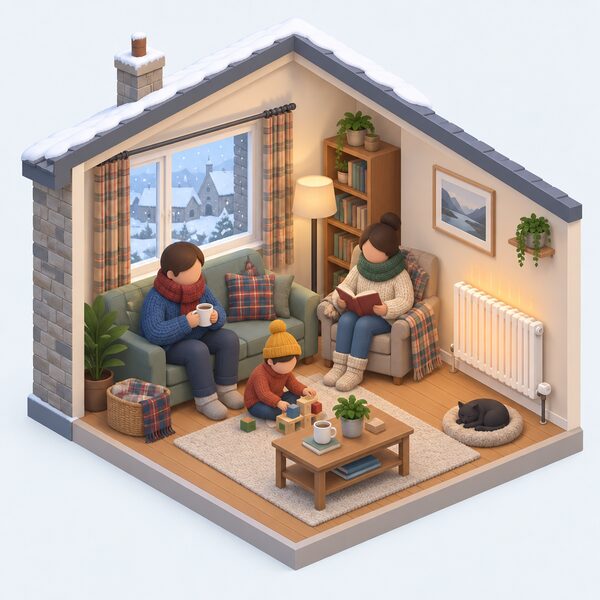
Eligibility is built entirely on the benefits you already receive. Social Security Scotland uses your data to decide if you get the payment, so the qualifying test is whether you are getting the right benefits on the qualifying date, not whether your home is cold or your income has fallen1.
The scheme targets particular groups that might need additional help with heating costs. The equality impact assessment sets these out: people on a low income who are of pension age, a disabled adult, or a family with responsibility for a child under 5 or a disabled child, in each case in receipt of qualifying low-income benefits8. That is a wider net than the old Cold Weather Payment in one sense, because it names disabled adults and families with young children explicitly, but the underlying condition is the same: no qualifying benefit, no payment.
Two related facts give a sense of the scale on the pension side. The changes around pension age heating support potentially affect over 800,000 households of older people in Scotland6. Of these pensioners, almost 250,000 are on very low incomes, and many of those should be, but are not, in receipt of Pension Credit6. That last point matters for households reading this page: if you are a pensioner on a very low income and you are not claiming Pension Credit, you may be missing the benefit that opens the door to this and other support. The payment system can only see people who are already in the benefits system.
Because the payment is automatic, the practical risk is not a failed application but an invisible one: a benefits award that started too late, a record that is out of date, or an entitlement that was never claimed in the first place. None of those generate a rejection letter, they simply generate silence.
Changes introduced after the Cold Weather Payment ended
The Winter Heating Payment replaced the Cold Weather Payment scheme in Scotland from winter 20227. The old scheme paid £25 for each week of cold weather, so a mild winter meant little or nothing, and a harsh one meant more6. The new scheme pays one fixed sum, regardless of weather conditions in your area3.
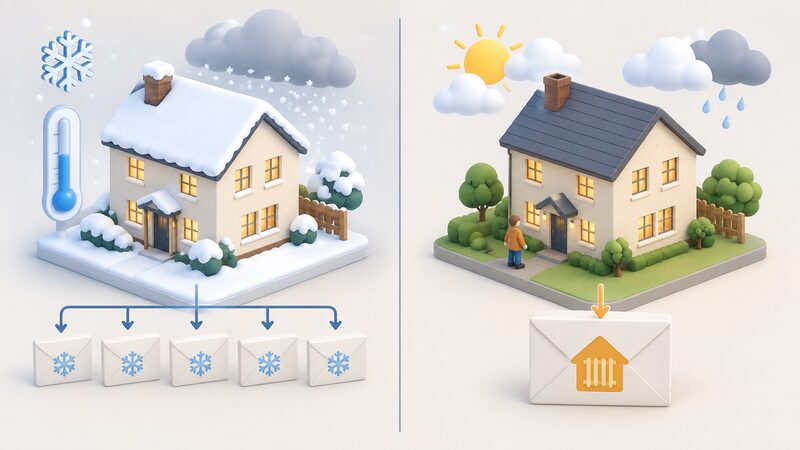
The design trade-off is worth stating plainly. Under the old scheme, a household in a cold part of Scotland that endured several triggered cold spells could receive more in total than the new fixed payment delivers; a household in a milder area, or in a mild winter anywhere, could receive nothing at all. The fixed payment removes that variance in both directions. The Scottish Government's rationale was that a predictable payment gives households certainty, and the equality impact assessment noted that because the Winter Heating Payment is an automatic payment that usually requires no application form, this avoids additional challenges for the groups it targets8.
One boundary line is often confused. Cold Weather Payments are different to Winter Fuel Payments3. The Winter Fuel Payment was the pension age scheme, and in Scotland it has been replaced by the Pension Age Winter Heating Payment, covered below. The Winter Heating Payment is the low-income scheme, and it continues alongside the pension age one; a household does not choose between them, eligibility for each is assessed separately.
Payment timing and the advance notification letter
Winter Heating Payment is paid from December and through winter each year1. Payments should be made automatically, between December and February2, and most Winter Heating Payments for the winter 2025/26 season were made automatically from December 202511.
Before the money arrives, you get a letter or an email from Social Security Scotland telling you it is coming1. That notification is the practical signal that Social Security Scotland's records show you as eligible, so it is worth reading rather than filing: it confirms the decision has been made in your favour before the payment itself lands.
The timing has been the subject of some official reflection. The equality impact assessment records that the Scottish Government committed to exploring the feasibility of moving the February payment date forward following delivery of the Winter Heating Payment8. In other words, the government itself recognised that a payment arriving as late as February, after the coldest months have passed, is less useful to a household than one arriving earlier, and it has looked at whether the timetable can be pulled forward. Households planning their winter budget should work on the basis that the money may arrive anywhere in the December to February window, and that the letter or email comes first1.
Missing payment: what to do
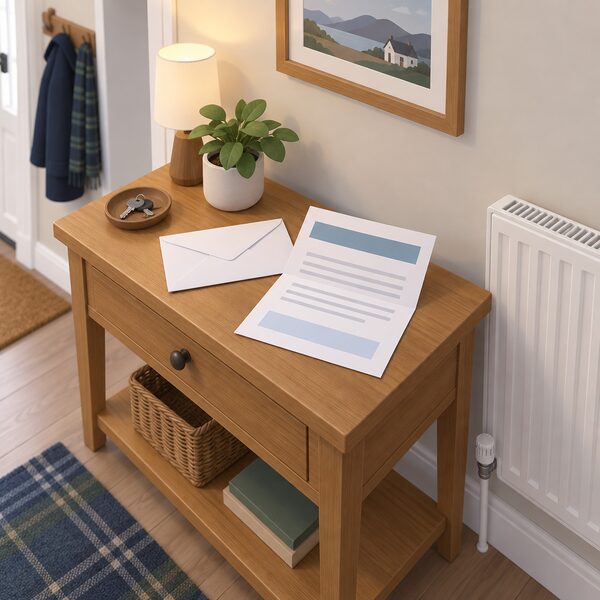
Because there is no application, there is also no application rejection, and the failure mode is simply a payment that never comes. The official route for a missed payment is direct: Social Security Scotland accepts a request from anyone who believes a Winter Heating Payment is due to them and has not arrived, and will then check whether a payment is due1.
The situations where this most often matters are the ones the automatic process can miss:
- A qualifying benefit was awarded after the qualifying date, or a backdated award covers it
- Your circumstances changed during the winter, such as moving into a qualifying benefit
- Your address or bank details held by the benefits system are out of date
- You believe you qualified but received no letter or email beforehand
The letter or email that normally precedes the payment is a useful diagnostic here1. If winter is advancing and no notification has arrived, that is the moment to contact Social Security Scotland rather than waiting until February, since the payment window runs to the end of that month2.
For households of pension age, the parallel scheme has its own deadlines. Claims for the winter 2026/27 Pension Age Winter Heating Payment must be sent and arrive by 31 March 202712, and the scheme opened for claims in October 202613. Most of those payments are made automatically from November 202614, with letters confirming the payment being sent from November 202615.
Pension Age Winter Heating Payment: amounts, qualifying week and cut off dates
The Pension Age Winter Heating Payment replaced the Winter Fuel Payment for people in Scotland15. It helps people of State Pension age pay their heating bills15. If you live in Scotland, you cannot get a Winter Fuel Payment, and you might instead be eligible for the Pension Age Winter Heating Payment16.
The qualifying week is the anchor for the whole scheme. For the winter 2026/27 payment, eligibility depends on living in Scotland on the last day of the qualifying week, which ran from 21 to 27 September 202617. The payment amounts for that qualifying week were published following a review of the guidance in August 202618.
The process and deadlines for winter 2026/27:
- Qualifying week: 21 to 27 September 2026, with eligibility depending on living in Scotland on the last day of that week17
- Opt-out deadline: households can opt out by completing an online form by 19 October 202617
- Claims open: October 2026, for the minority who need to claim rather than being paid automatically13
- Automatic payments and confirmation letters: from November 202614
- Claim deadline: claims must be sent and arrive by 31 March 202712
Payment goes to the same account as your State Pension, or any Social Security Scotland benefits you get15. You could also get other help with heating costs alongside it15.
Two rules deserve particular attention. First, the recovery rule: where a pensioner has a taxable income above £35,000, HMRC will take the Pension Age Winter Heating Payment back4. The Scottish Government's £157 million budget for the scheme is stated after that payment recovery4. Second, the opt-out: because HMRC claws the payment back from higher-income pensioners anyway, opting out by the October deadline simply avoids the money passing through your account first17.
If you disagree with a decision about your Pension Age Winter Heating Payment, you can challenge it, and guidance on how to do so was last reviewed in August 202619. A challenge will not overturn the recovery rule itself, since that is a fixed feature of the scheme rather than an individual judgement19.
The scale is large. The changes around this payment potentially affect over 800,000 households of older people in Scotland6, and almost 250,000 of these pensioners are on very low incomes, many of them entitled to but not receiving Pension Credit6. A fuller treatment of the pension age scheme is on our Pension Age Winter Heating Payment page.
Child Winter Heating Payment: support for families
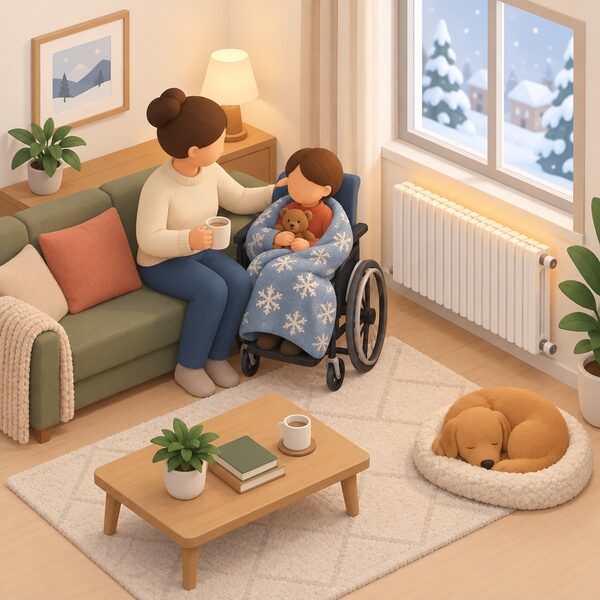
The Child Winter Heating Payment is a benefit from the Scottish Government, and it is separate from the Winter Heating Payment described above20. It is a payment to help disabled children and young people and their families with increased heating costs over winter20.
The amounts are materially higher than the low-income scheme. The payment is £255.80, rising to £265.50 for winter 2026/2721. The Scottish Government estimated it would provide £11.4 million through the Child Winter Heating Payment in the winter 2025/26 season4.
The delivery timetable is set in regulation: the scheme was designed to ensure that this financial support is delivered by 31 December each year23. That is earlier than the Winter Heating Payment's December to February window, which reflects the recognition that families with disabled children face heating costs that cannot wait until the end of winter.
Like the main scheme, it is administered from existing benefit records, so families receiving the relevant disability benefits for a child or young person are the route in. Our Child Winter Heating Payment page covers the detail.
How these payments affect, and do not affect, energy independence
The Winter Heating Payment and its pension age and child counterparts are devolved payments: they exist because Scotland has its own social security powers, and they differ from what households in England and Wales receive. That is part of a wider picture of devolved and reserved energy powers and of why energy grants differ across the four nations.
What they do is straightforward: they put a known, fixed sum towards winter heating costs, automatically, without an application in most cases2. For a household on a low income, £62.00 is a real contribution, and its predictability is worth something in itself after years of weather-dependent payments3.
What they do not do is equally important to state. They do not reduce a household's dependence on its heating fuel, its supplier, or the grid. The money arrives as cash, not as insulation, a better boiler or a heat pump, so the underlying exposure to energy prices is untouched. A household that struggles to heat an inefficient home in December will still be struggling in March, with the payment spent. The structural help lives elsewhere: in the Home Energy Scotland grant and loan, in HEEPS area based schemes, in the Warm Home Discount in Scotland, and in the wider effort to cut fuel poverty in Scotland.
There is also a dependence worth naming inside the schemes themselves. Because payment is automatic and record-driven, a household's access depends entirely on the accuracy of what the benefits system holds about it, and on being in the system at all. The almost 250,000 pensioners on very low incomes, many of them not receiving the Pension Credit that would qualify them, show the cost of that dependence in human terms6. Energy independence for a household starts with knowing which of these payments it is entitled to, and making sure the records that trigger them are right.
Sources23 sources
- Winter Heating Payment, mygov.scot, 2026-09-17
- Winter Fuel Payment and Winter Heating Payment briefing, UK Parliament, 2026-02-26
- Cold Weather Payment, GOV.UK, 2026-09-17
- Helping households to manage their energy bills, Scottish Government, 2025-11-03
- Tackling Fuel Poverty in Scotland: Periodic Report 2021 to 2024, Scottish Government, 2025-04
- Tackling Fuel Poverty in Scotland: engagement responses, Scottish Government, 2025-04-22
- Consultation on Low Income Winter Heating Assistance, Scottish Government, 2021-12-01
- Winter Heating Payment Low Income Scotland: Equality Impact Assessment, Scottish Government, 2022-11-18
- Scottish Government response to the LIWHA consultation, Scottish Government, 2022-06-07
- LIWHA consultation: analysis of responses, Scottish Government, 2022-06-07
- What is a Winter Heating Payment, Turn2us, 2025-12
- About the new Pension Age Winter Heating Payment, Home Energy Scotland, 2026-03-31
- How do I claim a Pension Age Winter Heating Payment, Turn2us, 2026-10-01
- Pension Age Winter Heating Payment, Turn2us, 2026-11
- Pension Age Winter Heating Payment, mygov.scot, 2026-09-17
- Winter Fuel Payment, GOV.UK, 2026-09-17
- Can I get a Pension Age Winter Heating Payment, Turn2us, 2026-09
- How much Pension Age Winter Heating Payment will I get, Turn2us, 2026-08-10
- How do I challenge a Pension Age Winter Heating Payment decision, Turn2us, 2026-08-10
- Child Winter Heating Payment, mygov.scot, 2026-09-17
- Child Winter Heating Payment Scotland, Turn2us, 2026-10
- How much Child Winter Heating Payment will I get, Turn2us, 2026-10
- Winter Heating Assistance for Children and Young People: draft EQIA, Scottish Government, 2021-09-24
 Grants for PensionersWhat cash help can pensioner households get towards energy bills?