
In this guide
Wales is legally committed to reaching net zero greenhouse gas emissions by 2050. The target sits in the Environment (Wales) Act 2016, which originally required a reduction of at least 80% by 2050 before it was raised to net zero, and the regulations that made the change were made in the Senedd on 9 February 20211. The Welsh Government has said it is pushing to "get there sooner"3.
The mechanism is a series of five-year carbon budgets. The Third Carbon Budget, covering 2026 to 2030, is set at a 58% reduction on 1990 levels as an average annual figure over the period1. For the Fourth Carbon Budget, covering 2031 to 2035, the Climate Change Committee recommends a 73% average annual reduction on 1990 levels, including Wales' contribution to international aviation and shipping1. The Welsh Government was required to set that budget by the end of 20251.
The Committee's assessment is blunt: Wales is not yet on track to meet its targets for the second half of this decade and beyond4. Its advice on the Fourth Carbon Budget came with 16 priority recommendations for immediate action, focused on surface transport, buildings, and agriculture and land use, sectors where significant policy powers are devolved to the Welsh Government1.
What are the figures?
The Welsh framework is built from a long-term target and a sequence of five-year budgets. The long-term figure is a 100% reduction on 1990 levels by 2050, which is what net zero means in practice1. The UK-wide equivalent is expressed as at least a 100% reduction by 2050, with an interim milestone of an 89% reduction by 20407.
The budgets step up in ambition. The Second Carbon Budget, covering 2021 to 2025, was set at a 37% reduction on 1990 levels as an average annual figure over the five-year period. The Third, covering 2026 to 2030, is 58%. The Fourth, covering 2031 to 2035, is recommended at 73%1. The step between the Third and Fourth budgets is 15 percentage points, which the Committee notes is the same size as the step between the Second and Third1. Emissions over the Fourth Carbon Budget period are projected to be an annual average of 73% lower than 1990 levels and 58% lower than levels in 20221.
The Committee's advice also sets out what the reduction is made of. Electrification delivers 67% of the total emissions reduction required by 2033 in the Balanced Pathway. Demand-side measures contribute 21%. Low-carbon fuels and carbon capture and storage together contribute 10%. Bioenergy with carbon capture and storage contributes 2%, and land-based actions contribute only 1%1.
| Budget period | Target (average annual reduction on 1990 levels) |
|---|---|
| Second Carbon Budget, 2021 to 2025 | 37%1 |
| Third Carbon Budget, 2026 to 2030 | 58%1 |
| Fourth Carbon Budget, 2031 to 2035 | 73% recommended1 |
The sectoral picture matters as much as the headline. Surface transport, agriculture and land use, and buildings together comprise more than 60% of the emissions reduction required over the Fourth Carbon Budget period1. Those are the areas where Welsh Government policy, rather than UK Government policy, does most of the work.
What drives the reduction
The Committee's pathway for Wales is not a single measure but a set of shifts, and electrification is the largest of them. Electricity accounts for a 55% share of emissions reduction by 2033 in Wales, against 29% for demand measures, 10% for low-carbon fuels and CCS, 4% for engineered removals and 2% for nature in the UK comparison1. The Welsh profile leans harder on electricity than the UK average.
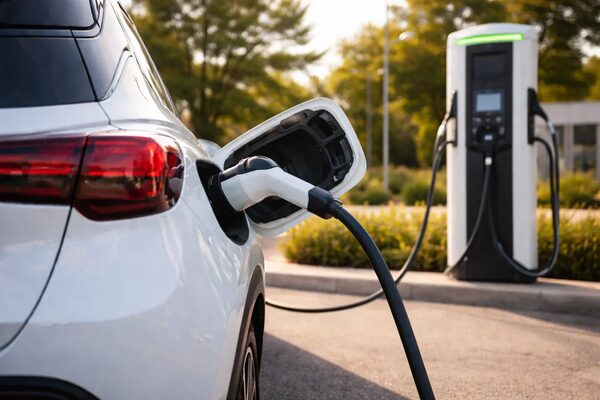
Transport is a major component. The Welsh Government's ambition is to provide one public chargepoint for every 7 to 11 electric vehicles by 20254. Electrification delivers 67% of the total emissions reduction required by 2033 in the Balanced Pathway, with low carbon farming fuels and carbon capture and storage contributing a further 10% and demand measures 21%8. The UK is on track with chargepoint roll-out but not on track on electric vehicle sales rates, according to the Committee's 2024 progress report8.
Land use and nature carry specific targets. The Welsh Government aims to extend hedgerows by 20% by 2035, achieve annual tree-planting rates of at least 4,500 hectares per year by 2030 rising to 7,500 per year by 2035, and plant trees on 2% of farmland by 2025 rising to 5% by 2035 while maintaining its primary use4. Peatland restoration is targeted at 1,800 hectares per year by 2030, with 58% of peatland under restoration management by 2035 and 79% by 2050, and all upland peat under restoration management by 20454.
Waste and consumption appear too: the framework includes improving on the 70% recycling target for 2025 and reducing per-person car demand by 10% by 20304. The public sector has its own milestone, a 2030 public sector decarbonisation goal4.
"net zero emissions, previously thought unachievable and unaffordable by experts, was now possible with ambitious policy and a 'Team Wales' effort"
How Wales compares with the other UK nations
England, Wales and Northern Ireland have committed to reaching net zero by 20502. Wales, like the UK, has committed to reaching net zero carbon emissions by 20509. The Welsh target is statutory, made under the Environment (Wales) Act 2016, and the Act has an ambitious target to reach net zero greenhouse gas emissions by 2050, with any residual emissions balanced1.
Scotland operates a different framework. The Climate Change Committee provides regular advice there, including an annual Scottish progress report on reducing emissions, advice on emissions reduction targets and regular independent assessments of Scotland's adaptation programmes10. The Committee said it would assess the merits of whether the Scottish Government's plan delivers its targets in its progress report early the following year, and noted that when it last assessed Scotland's performance it said the Government needed to set out clear detail of how policies would work together to deliver the required levels of emissions reduction11.
Northern Ireland receives separate advice. The Committee's report provides advice to Northern Ireland on its 2030 and 2040 interim targets and its first three carbon budgets12. That is a different structure from Wales' five-year budgets running from 2021.
Wales' contribution to the UK total is modest in absolute terms but not trivial. Emissions reductions in Wales deliver around 7% of the overall abatement required to meet the UK's recommended Seventh Carbon Budget and Net Zero target6. The Committee's UK-wide modelling puts the required reduction at 87% compared to 1990 levels by 2040, with electrification making up 60% of emissions reductions by 204013.
| Nation | Framework |
|---|---|
| Wales | Net zero by 2050 under the Environment (Wales) Act 2016, with five-year carbon budgets1 |
| England | Net zero by 20502 |
| Northern Ireland | Net zero by 2050, with advice on 2030 and 2040 interim targets and first three carbon budgets2 |
| Scotland | Separate framework with annual progress reporting and its own targets10 |
What are the rules?
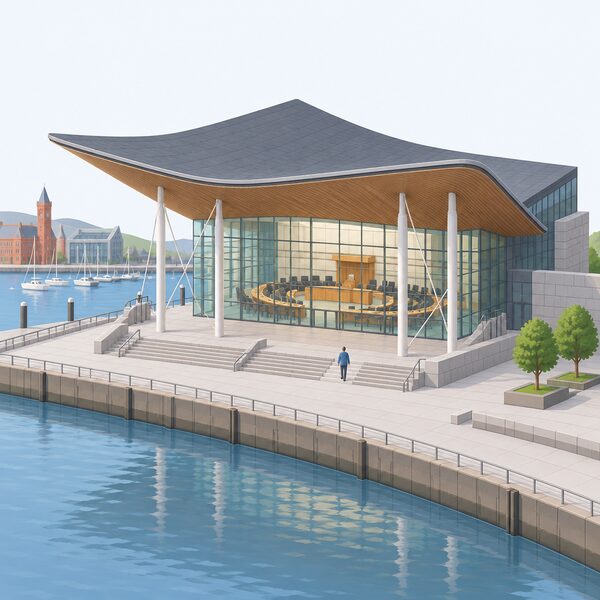
The legal architecture is set by the Environment (Wales) Act 2016. Regulations made in the Senedd on 9 February 2021 introduced a statutory target to achieve net zero by 20505. Before that, Wales was committed to a 95% reduction in carbon emissions by 2050, with regulations laid in the Senedd to move to a net-zero target5. The Welsh Government declared its ambition to bring forward a target for Wales to achieve net zero emissions no later than 2050 in June 201914, and set ambitious energy targets for homes to achieve net zero carbon by 2050 the following month15.
The carbon budgets are the delivery mechanism. The Committee's advice on the Fourth Carbon Budget was that the Welsh Government should not plan to use international credits, referred to as carbon units in the Act, to achieve it1. In other words, the reduction is expected to happen domestically rather than being bought in.
Building rules are part of the framework. Policy 45 of Net Zero Wales commits Wales to set higher energy efficiency standards for new builds through reviewing Building Regulations Part L, Conservation of Fuel and Power16. The Net Zero Wales plan identifies 123 policies and proposals to meet the carbon emissions targets16. The Welsh Government has also committed to ensuring that standards mean no new buildings are connected to the gas grid from 20254.
Homes have their own target. The plan set out that Welsh homes need to be net zero by 2050, with publicly owned buildings and social housing leading the way17. The Welsh Government has said that meeting its Net Zero Wales targets requires determined progress on reducing carbon emissions from homes18. There is also a proposal to evaluate the cost effectiveness of retrofitting social housing to reach an EPC 'A' rating, with the proposed target to be reviewed4.
What it means for household energy independence
The Welsh target reaches into the home through three routes: how homes are heated, how they are powered, and what they are allowed to connect to.
The first is the gas grid. The commitment that no new buildings are connected to the gas grid from 2025 changes the default for new homes in Wales4. A household in a new build is on a different trajectory from one in older stock, and the practical consequence is that heating and hot water must come from something other than a gas boiler.
The second is electrification of heat. The Committee's pathway has electrification delivering 67% of the emissions reduction required by 20331. For a household, that translates into a heat pump, a battery, solar, or some combination, and into a much closer relationship with the electricity grid than with a gas supplier. The Committee's top recommendation is to make electricity cheaper by taking policy costs off electricity bills, which it describes as vital for ensuring the required scale-up of heat pump installations19. It said it hoped to see this addressed in the upcoming Warm Homes Plan19.
The third is the power system itself. The Welsh target includes delivering a decarbonised and resilient power system by 20354. The National Energy Plan for Wales is intended to set out the energy system changes required to achieve Net Zero by 2050 while delivering a secure and affordable energy system in Wales20.
What dependence remains is substantial. A household that electrifies its heat still depends on the grid, on a supplier, and on the pace at which the power system is decarbonised. The Committee's own assessment is that a significant increase in roll-out rates is needed in many areas in the next few years, even though there have been some encouraging signs of progress in the delivery indicators19. Wales is not yet on track for the second half of this decade and beyond4. The target is a legal commitment; the delivery is not yet there.
The 2035 question

The statutory target date is 2050, but there is an active strand of Welsh policy looking at 2035. The Wales Net Zero 2035 Challenge Group was established to examine potential pathways to net zero by 203521. Its final reports were published by the Welsh Government22. The group's remit was exploratory: the current target date is 205022.
The distinction matters for households because a 2035 date would compress the timetable for retrofitting homes, changing heating systems and upgrading the electricity network into a much shorter window. The Committee's advice on the Fourth Carbon Budget already describes the start of that budget period as only six years away6. A 2035 target would sit inside the Fourth Carbon Budget period rather than after it.
The Welsh Government's response to the Committee's net zero report and its response to the recommendations in the renewable energy 2050 work set out how it intends to take the advice forward23. The Committee, for its part, has said it will continue to hold the Government to account for how it delivers against its targets25.
For a household, the practical reading is that the direction of travel is set: away from gas connections in new buildings, towards electrified heat, and towards a power system that is expected to be decarbonised by 2035. The pace is the open question, and the Committee's progress reports are where that is measured.
Sources25 cited
- Wales' Fourth Carbon Budget, Climate Change Committee, 2025
- The UK's climate change targets and carbon budgets, House of Commons Library, 2026
- Wales commits to net zero by 2050 and sets out ambitions to get there sooner, Welsh Government, 2021
- 2023 Progress Report: Reducing emissions in Wales, Climate Change Committee, 2023
- Tackling fuel poverty 2020 to 2035: outcome summary, Welsh Government, 2021
- Modern electric technologies offer Wales a bright future, Climate Change Committee, 2025
- Why net zero, UK Government, 2021
- Electric vehicle charging market study: final report, UK Government, 2021
- Home energy efficiency: key terms explained, Development Bank of Wales, 2024
- Climate change, Scottish Government, 2026
- Response to the Scottish Government's climate change plan, Climate Change Committee, 2025
- Advice report: The path to a net zero Northern Ireland, Climate Change Committee, 2026
- End the fossil fuel age for a secure and prosperous future, Climate Change Committee, 2025
- Written statement: response to the Committee on Climate Change's net zero report, Welsh Government, 2019
- Reducing carbon emissions from our homes: new report calls for action and ambition, Welsh Government, 2019
- Part L Wales impact assessment: domestic existing and new build, Welsh Government, 2022
- New Warm Homes Programme policy statement, Welsh Government, 2023
- Time to raise the bar on Wales' housing standards, Welsh Government, 2022
- Response to the Government's carbon budget and growth delivery plan, Climate Change Committee, 2025
- Preparing Wales for a renewable energy 2050, Welsh Government, 2024
- Written statement: publication of the Wales Net Zero Challenge Group report, Welsh Government, 2024
- Written statement: publication of final reports of the Wales Net Zero 2035 Challenge Group, Welsh Government, 2024
- Annex: Welsh Government response to each recommendation in the Preparing Wales for Renewable Energy 2050 report, Welsh Government, 2024
- New Warm Homes Programme: integrated impact assessment, Welsh Government, 2024
- Response to the Government's Seventh Carbon Budget target, Climate Change Committee, 2026
 Wales Renewable Energy TargetsWales aims for renewable sources to meet the equivalent of 70% of its electricity consumption by 2030 and 100% by 2035, with at least 1.5 GW locally owned by 2035.
 Carbon Budgets and Net ZeroThe UK has promised to cut its emissions to almost nothing by the middle of the century.
 Climate TargetsNorthern Ireland has committed to cutting its greenhouse gas emissions to almost nothing by 2050, with a big reduction due by 2030.
 Energy Supply in WalesWales makes more electricity than it uses, but how much of it comes from renewables, and will that reach all of it by 2035?
 Community Energy in WalesWales wants more of its energy owned by local people, not big companies.
 Fuel PovertyHow the Welsh Government defines and measures fuel poverty, the latest modelled estimate of 340,000 households (25%) as at October 2024, who is most affected, and how the Tackling Fuel Poverty Plan and the Warm Homes Nest scheme are meant to bring the figure down.