

In this answer
Short answer
The headline answer is EPC C. The UK Government has set out a commitment requiring all social housing in the UK to meet an EPC rating of at least C or equivalent by 20301. In Wales that sits inside a separate Welsh framework, the Welsh Housing Quality Standard, which all existing social homes must meet2.
The Welsh Government has consulted on going further. Its draft heat strategy proposed that all new social housing must have an energy pathway in place to achieve EPC A by 2033, or by a date after 2033 that the Welsh Government authorises3. The Climate Change Committee's Welsh progress report recommended evaluating the cost effectiveness of retrofitting social housing to EPC A and reviewing the proposed target, which signals that the A rating is a proposal under examination rather than settled policy4.
What that means in practice depends on where a home starts. In 2024, 71.15% of social rent homes in Wales were rated Band C or above, the highest proportion of any tenure in Wales5. Roughly three in ten social rent homes were below that line, and those are the properties the 2030 deadline bites on.
Who the 2030 EPC C requirement applies to
The Welsh Housing Quality Standard applies to Registered Social Landlords and local authorities with social rented housing stock7. That covers housing associations and council landlords, not private owners or private tenants. The standard's stated purpose is to improve the quality of social homes in Wales, and it underpins the Welsh Government commitment to decarbonise housing in Wales to meet legally binding climate targets in 20502.
The 2030 EPC C commitment is framed at UK level as applying to all social housing1. For Welsh social landlords, the practical effect is that the Welsh quality standard and the UK-wide efficiency commitment point in the same direction, with the Welsh standard carrying the legal weight for existing stock.
Private rented housing is a different regime entirely. The UK Government has consulted on requiring private rented properties in England and Wales to reach EPC C by 20308. The Welsh Government's own research describes decarbonising private housing as the unresolved part of the picture, distinct from the social sector9. A tenant in a housing association home and a tenant in a private let are therefore covered by different rules with different enforcement routes.
There is also a scale commitment alongside the standards. The Welsh Government set out a commitment to build 20,000 high quality, low carbon homes for rent over the five years from 202110. New build social housing has been expected to reach EPC A since at least 2021, when a consultation noted the expectation of an EPC A rating for new-build social housing11.
What the Welsh Housing Quality Standard requires
The Welsh Housing Quality Standard 2023 is the instrument that carries the requirement for existing social homes. Its purpose is to improve the quality of social homes in Wales2. The summative evaluation of the standard describes it as applying to Registered Social Landlords and local authorities with social rented housing stock7.
The standard has moved over time. An earlier Welsh Government consultation recorded a long-standing commitment through the Welsh Housing Quality Standard requiring social homes to reach not less than EPC D, with the new standard due the following year looking at a target of an A rating12. That trajectory, from D as a floor to A as an aspiration, is the clearest signal of how Welsh policy has shifted.
The 2023 standard also connects housing to the wider Welsh climate framework. It underpins the commitment to decarbonise housing in Wales to meet legally binding climate targets in 20502. Wales has committed to reaching net zero by 2050, with publicly owned buildings and social housing leading the way13. The Climate Change Committee's fourth carbon budget advice for Wales sets the interim path: a 63% reduction on 1990 levels by 2030, 89% by 2040 and 100% by 205014.
For a social landlord, that means the EPC target is not an isolated compliance exercise. It sits inside a decarbonisation programme that also touches heating systems, fabric and, in time, the fuel a home uses.
Conditions, exceptions and where the figures disagree

The 2030 commitment is stated as a requirement for all social housing in the UK to meet EPC C or equivalent1. The phrase "or equivalent" matters, because it allows for the reformed metrics used in the English social housing standard, where homes must reach EPC C or above against any one of three reformed metrics by 1 April 2030, and against a second metric by 1 April 2039, unless an exemption applies15. That is the English regime, not the Welsh one, but it shows how the equivalent route is being defined elsewhere in the UK.
The Welsh A rating proposal carries its own condition. The draft heat strategy wording is that all new social housing must have an energy pathway in place to achieve EPC A by 2033 or by a date after 2033 that the Welsh Government has authorised3. The authorisation clause is the exception mechanism: the deadline can move.
"Evaluate the cost effectiveness of retrofitting social housing to reach an EPC 'A' rating, and review the proposed target"
On the current stock position, the figures come from different sources and measure slightly different things. The independent statistics put social rent homes in Wales at 71.15% Band C or above in 2024, against 62.68% for social rent homes in England5. The Office for National Statistics records homes in Wales with a median EPC score of 68 (Band D) as of March 2025, across all tenures, with 67% of Welsh dwellings having at least one EPC registration since records began in 20076. The two are not in conflict: one covers the social rented sector, the other all Welsh homes.
| Measure | Figure | Scope | Date |
|---|---|---|---|
| Social housing EPC target | C or equivalent | UK social housing | 20301 |
| Proposed Welsh social housing target | EPC A | New social housing | 2033 or later3 |
| Social rent homes at Band C or above, Wales | 71.15% | Social rent | 20245 |
| Social rent homes at Band C or above, England | 62.68% | Social rent | 20245 |
| Median EPC score, all Welsh homes | 68 (Band D) | All tenures | March 20256 |
| Welsh dwellings with an EPC registration | 67% | All tenures | March 20256 |
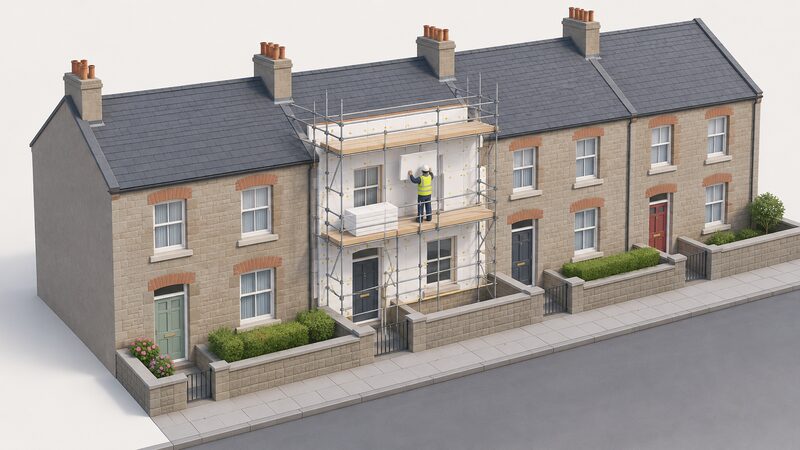
The age of the stock is the main reason the gap exists. Wales has the oldest housing stock in the UK, with 26% of it pre-1919, and the private rented sector has the oldest stock and highest proportion of poor quality housing, with 43% pre-191916. Social housing is not the worst-positioned tenure, but older social stock shares the same fabric problem.
How Welsh social landlords reach the target
The main route for the social sector is the Optimised Retrofit Programme, which is aimed at the social housing sector in Wales9. It is the Welsh Government's dedicated retrofit vehicle for social landlords, as distinct from the schemes aimed at private households.
The Warm Homes Nest scheme is the other Welsh programme, and it is not a social housing fund. Nest eligibility requires a household to own or privately rent their home, receive a means-tested benefit or live in a low-income household, and live in a home with an EPC rating of 54 (E) or less, or 68 (D) or less where a household member has an eligible health condition17. An earlier consultation described Nest funding as going to properties with an overall EPC rating of E or below18. Social tenants do not access Nest for their landlord's obligations.
For private homeowners in Wales there is a separate route: the Green Homes Wales scheme is for homeowners in Wales, subject to affordability and credit checks19. That is relevant to the wider Welsh housing stock but not to social housing compliance.
The practical sequence for a social landlord working toward EPC C is broadly:
- Establish the current EPC position across the stock, using the 67% registration coverage in Wales as a starting point for what is known6.
- Identify the properties below Band C, which on 2024 figures is roughly three in ten social rent homes5.
- Prioritise fabric measures, since the pre-1919 share of Welsh stock is where the efficiency gap concentrates16.
- Address heating, given the Welsh pathway expects nearly a quarter of existing homes in Wales to be heated by low-carbon electrified heating, predominantly heat pumps, by 2033, with annual installation rates reaching nearly 25,000 in 203014.
- Record the outcome through a fresh EPC, since the target is defined by the certificate.
What this means for a household's energy independence
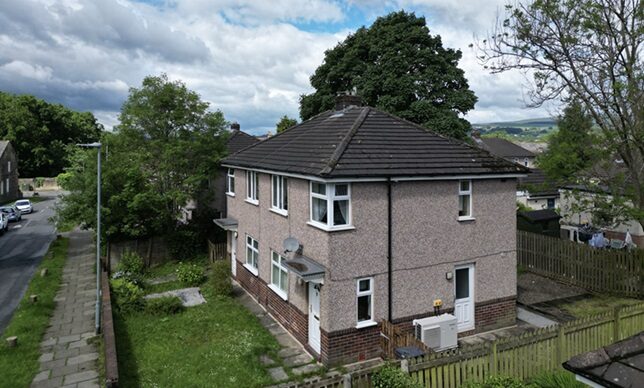
A social home brought up to EPC C needs less energy to reach the same warmth. That reduces exposure to whatever the unit price of gas and electricity happens to be, and it is the main independence gain available to a tenant. The Welsh pathway expects low-carbon electrified heating, predominantly heat pumps, to cover nearly a quarter of existing Welsh homes by 203314.
What it does not do is remove dependence. A retrofitted social home still draws electricity from the grid and still buys it from a supplier. A heat pump shifts a household from gas onto electricity, which changes which network it depends on rather than ending the dependence. The EPC target is a fabric and systems standard, not a self-sufficiency standard.
There is a planning dimension for anyone extending the work. Guidance on insulation notes that the planning regime described relates to England and that policy in Wales may differ20. Welsh social landlords working on external fabric and heating will be operating under Welsh planning rules, not the English ones.
The wider Welsh context is that the housing stock is old and the tenure mix is weighted toward owner occupation. Owner occupiers account for 69% of tenure in Wales and the private rented sector 13%16. Social housing is the sector where the standards are clearest and the deadlines firmest, which is why it is described as leading the way in the Welsh net zero framework13.
Sources20 cited
- Accelerating to net zero: responding to the CCC progress report, GOV.UK, 2024-12-17
- Welsh Housing Quality Standard 2023, Welsh Government, 2024-08-02
- Draft heat strategy for Wales, Welsh Government, 2023-08
- 2023 progress report: reducing emissions in Wales, Climate Change Committee, 2023-06-06
- Energy saving statistics, Uswitch, 2024
- Energy efficiency of housing in England and Wales, Office for National Statistics, 2025-03
- Summative evaluation: Welsh Housing Quality Standard, Welsh Government, 2021-06-30
- Landlords: how to make your property more energy efficient, Energy Saving Trust, 2026-08-04
- Decarbonising private housing: the net zero elephant in the energy inefficient room, Senedd Research, 2026-09-20
- No more fossil fuels to heat new homes, Welsh Government, 2021-08-17
- Building regulations discussion document, Northern Ireland Department of Finance, 2021-10
- Outcome summary: tackling fuel poverty 2020 to 2035, Welsh Government, 2021-03-02
- New Warm Homes programme integrated impact assessment, Welsh Government, 2024-03-08
- Wales' fourth carbon budget, Climate Change Committee, 2026
- The Warm Homes Plan, Elmhurst Energy, 2030-04-01
- Private sector housing renewal and adaptations, Swansea Council, 2026-09-20
- Nest scheme eligibility, House of Commons Library, 2026-05-13
- Summary of responses: tackling fuel poverty, Welsh Government, 2015-10
- Financial support for home energy, Energy Saving Trust, 2026-09-14
- Insulation planning permission, Planning Portal, 2026-09-17
 Housing Stock and EPCsWelsh homes are among the oldest and least energy efficient in the UK, so what does that mean for yours?
 Welsh Housing Quality StandardWhat does the Welsh Housing Quality Standard mean for your home if you rent from a council or housing association in Wales?
 Housing Stock Data for WalesHow energy efficient are Welsh homes, and how many have a rating?
 Wales Renewable Energy TargetsWales aims for renewable sources to meet the equivalent of 70% of its electricity consumption by 2030 and 100% by 2035, with at least 1.5 GW locally owned by 2035.
 MEES for Rented HomesCovers the minimum EPC standards that apply to private rented homes, the cost caps and exemptions, and how exemptions are registered.
 Energy Performance CertificatesAn Energy Performance Certificate rates how energy efficient your home is, from A down to G.