

In this answer
Short answer
An Energy Performance Certificate records how energy efficient a building is and how it could be improved, and it is a statutory requirement whenever a property is bought, sold or rented1. It has been part of the conveyancing and letting process since 20071. A copy is lodged on a national register, and that register is where a householder, a buyer or a tenant finds the certificate for a given address2.
The search itself is free and takes a minute. For a property in England, Wales or Northern Ireland, the certificate sits on the government's EPC Register, searched by postcode or by the report reference number3. For a property in Scotland, the search is on the Scottish EPC Register4. A certificate is valid for ten years, or until another one is commissioned for the same building, whichever comes sooner5.
What the search returns is a rating from band A, very efficient, to band G, inefficient, together with the estimated carbon emissions, the estimated energy cost and a report of cost effective measures that would raise the rating6. The rating is a modelled, standardised estimate rather than a measurement of the building, and government research published in May 2026 examined weaknesses in the assumptions and processes behind it7.
What an EPC is and when one is needed
An EPC explains how energy efficient a building is and how it could be improved13. It gives information about the energy efficiency of a property, its heating source, its estimated carbon emissions and its estimated energy cost14. Provision is a statutory requirement whenever a property is bought, sold or rented, a duty introduced in 20071.
The trigger points are specific. Certificates are needed whenever a property is built, or marketed for sale or rent2. They are required when a dwelling is constructed, converted, sold or let, and not at any other time15. An EPC is required when selling or letting an existing building16. In Scotland, when a building is advertised for sale the EPC rating must be included in the property advertisement17.
That last point matters more than it looks. The rating is not a private document between seller and buyer: it is a public-facing piece of information about the property, and it follows the building rather than the occupant. A household that improves its home and commissions a new assessment changes what any future buyer, tenant or grant administrator sees.
For a household's energy independence, the EPC is the entry ticket rather than the destination. It is the document that grant schemes, lenders and landlords check before anything is funded or let, and it is the baseline against which any improvement is measured. It does not itself reduce a bill or generate a unit of heat.
Where to look: the register for your nation
There is no single UK register. The certificate is lodged on a national register and accessed through the EPC search facility on the EPC Register2, but which register depends on where the property is.
| Property location | Where to search | Notes |
|---|---|---|
| England, Wales, Northern Ireland | GOV.UK find energy certificate service | Search by postcode or report reference number3 |
| Scotland | Scottish EPC Register | Run by the Energy Saving Trust4 |
| Any nation, Green Deal property | Report reference number only | A certificate tied to a Green Deal plan cannot be retrieved by postcode9 |
Any single valid EPC is available through a public search using the postcode or the report reference number, while EPCs for a building with a Green Deal plan can only be retrieved using the reference number9. Current and expired certificates can both be found on the register for England, Wales and Northern Ireland7.
The register also serves a second purpose. Qualified assessors can be found on the EPC register16, and the Department for Communities and Local Government EPC register lists the certification body a domestic energy assessor belongs to, shown as scheme details below the assessor's contact details18. That is the route to checking whether the person who produced a certificate is accredited and which scheme oversees them.

What the certificate shows: bands, ratings and the improvement report
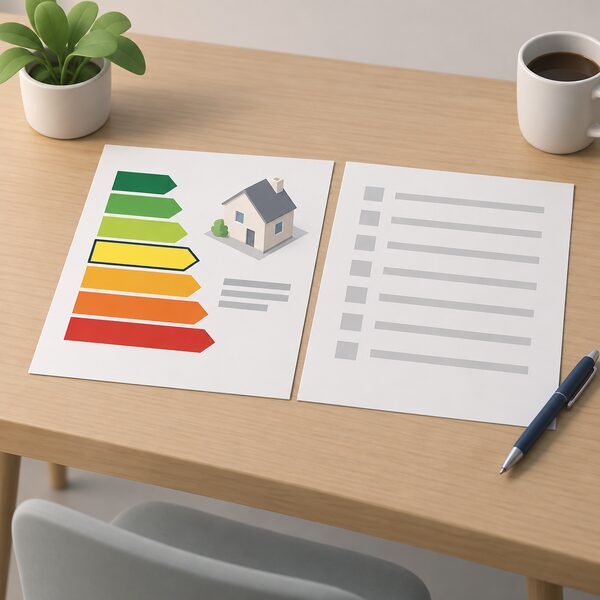
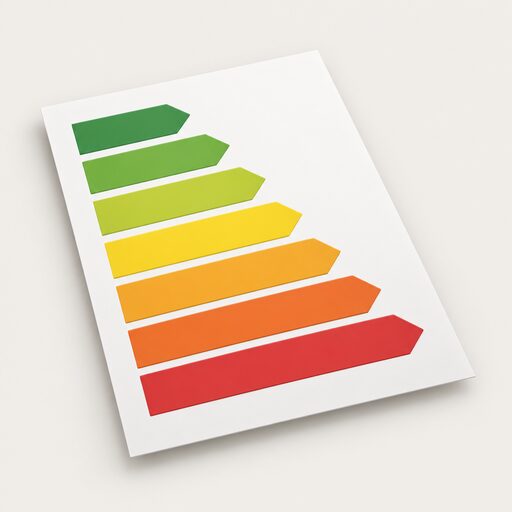
The rating runs from band A, the most efficient, to band G, the least efficient19. The certificate rates how energy efficient a building is on that scale8. Alongside the band sits an estimated, standardised rating based on a model of the building rather than a measurement taken in it20.
With each EPC comes a report setting out the cost effective measures that a homeowner or business can take to improve the energy efficiency and the energy rating, such as low energy bulbs or upgrading insulation2. That report is the practical half of the document: it names measures and gives an indication of what each would do to the band.
The scale of what improvement can achieve is visible in grant delivery. Under Home Upgrade Grant Phase 2, the average EPC improved by one band, with 60% of homes upgraded to band C or higher21. That is a programme with funded fabric measures behind it, not a certificate alone.
The gap between bands is real in consumption terms. Homes rated F or G used 68% more energy overall and 88% more gas than homes rated A or B, and homes rated D spent 27% more on their energy bill overall and 53% more on their gas bill than homes rated A or B22. Those figures describe existing stock rather than the effect of any single measure, but they show why the band is treated as a proxy for running cost.
"An EPC (Energy Performance Certificate) is an estimated, standardised rating (A-G) of a building's energy efficiency based on a model"
Validity: ten years, and when an expired EPC still matters
An EPC is valid for a maximum of ten years, or until another EPC is commissioned for the same building, whichever is sooner5. Ratings are valid for ten years23. The ten-year period is the figure used across official statistics, official guidance and independent guidance alike15.
Reform has not changed it. The 2026 consultation response on reforming the energy performance of buildings regime confirmed that the intention is to maintain the current ten-year validity period for reformed EPCs, while existing EPCs retain their ten-year validity until they expire25. A Scottish Government consultation response had raised the possibility of reducing the validity period from ten years to five26, but the confirmed position keeps ten.
An expired certificate still has uses. It remains on the register and can be found, and it records the property's condition at the date of assessment, which is useful when planning work or checking what a previous owner did. What it cannot do is satisfy a requirement for a current certificate: a sale, a new tenancy or a grant application will call for an assessment that is no more than ten years old27.
There is one place where expiry has a sharper consequence. Where a landlord has registered a high cost exemption, the exemption itself expires after its period, and the landlord must then try again to improve the property's EPC rating to meet the minimum level of energy efficiency; if that still cannot be achieved, a further exemption may be registered28. Expiry is therefore not a permanent escape from the standard.
What an EPC costs and who can carry out the assessment
There is no set fee for an EPC assessment. Guidance for the Boiler Upgrade Scheme removed an earlier recommendation that an assessment might cost £60 upwards and replaced it with the statement that there is no set fee30. Published figures vary by source and by property: independent guidance puts the cost at £60 to £120 to get a property on the register9, while Welsh Government consumer guidance gives a usual range of £50 to £15010. A Scottish Government consultation on the Heat in Buildings Bill noted that in the domestic sector an assessment can be over £10031. Prices are quoted by the assessor, and the range reflects the size and complexity of the property as much as anything else.
An EPC can only be produced by an accredited energy assessor who visits the property to carry out an assessment2. The assessment provides an assessment of the home's energy efficiency32. Qualified assessors can be found on the EPC register16, and the register also identifies the certification body that oversees a domestic assessor18.
For a household, the practical points are these. The assessment is a visit, not a desk exercise, so access to the whole property is needed. The certificate is lodged on the register by the assessor, so the household does not hold the only copy. And because the register is public, the rating is visible to anyone who searches the address.

How the rating is worked out, and where it falls short

The rating is modelled. It is an estimated, standardised rating of a building's energy efficiency based on a model20, which means it reflects the assumptions built into the method as much as the physical building. Government research published in May 2026 set out to identify weaknesses in current EPC assumptions and processes, including defaults and assessor practices, and to develop insights to improve modelling algorithms and enable dynamic updates to EPCs when building changes occur7. That work is a recognition that the current certificate can misdescribe a property, particularly where a default value has been used in place of a measured one.
One consequence of the method is well known to householders. A property using mains gas will score higher on the energy efficiency rating than a property which uses electricity, because mains gas is cheaper per kilowatt hour than electricity3. The rating is therefore partly a running cost measure under a standard tariff assumption, not a measure of carbon alone or of how a home feels to live in. A well insulated electrically heated home can sit in a lower band than a poorly insulated gas heated one for that reason.
The band also drives obligations. In England and Wales, a property let with a rating of F or G must be improved to a minimum rating of E, or an exemption registered where applicable11. The UK Government has proposed raising the minimum EPC standard for domestic private rented properties to band C by 2030, but that remains a proposal rather than a rule in force12. Scotland is developing its own standards, with draft regulations for the private rented sector and a separate timetable33.
For energy independence, the EPC is a benchmark rather than a lever. It tells a household where the building sits on a standardised scale and what measures would move it, and it determines access to some funded work and to the lettings market. It does not measure self-consumption, on-site generation or how much of a household's heat and power comes from its own roof or its own land, and a home with solar panels and a heat pump can still be scored on the cost assumptions of the model rather than on the energy it actually buys.
Sources33 cited
- Energy Performance Certificate accuracy research, GOV.UK, 2026-05-26
- Energy Performance Certificates, nidirect, 2026-02-26
- EPCs explained, Elmhurst Energy, 2026-09-20
- Retrofit explained, Energy Saving Trust, 2026-02-06
- Energy Performance Certificates, Isle of Anglesey County Council, 2025-09
- How energy efficiency data can help reduce our carbon footprint, Office for National Statistics, 2020-09-23
- How to make your home more energy efficient, Which?, 2026-05-05
- Energy efficiency of housing in England and Wales, Office for National Statistics, 2025-10-28
- Energy performance certificates guide, Scottish Government, 2026-08-24
- Five top tips to cut your energy bills, Welsh Government, 2026-03-18
- Minimum energy efficiency standards, Carmarthenshire County Council, 2026-09-20
- Trading standards guidance, Isle of Anglesey County Council, 2026-05
- Energy performance certificates guide: buildings for sale, Scottish Government, 2026-08-24
- Energy Performance Certificates: an introduction, Scottish Government, 2015-12
- When is an Energy Performance Certificate required?, Planning Portal, 2026
- Energy Performance Certificates, Uswitch, 2026-07-27
- Energy Performance Certificates, House of Commons Environmental Audit Committee, 2026-09-20
- Who to contact, Ofgem, 2026-09-17
- Energy Company Obligation ECO4 scheme, Derbyshire County Council, 2026-09-17
- Measuring the invisible: HTC and the future of retrofit, Stroma, 2026-09-20
- Green Homes Grant Local Authority Delivery and Home Upgrade Grant statistics, GOV.UK, 2025-11
- Watt a Save 2026, Home Builders Federation, 2026-02-02
- Edinburgh Local Heat and Energy Efficiency Strategy, City of Edinburgh Council, 2023-12
- Support for landlords, Centre for Sustainable Energy, 2026-06
- Reforms to the energy performance of buildings regime: partial government response, GOV.UK, 2026-03-09
- EPC reform consultation: government response, Scottish Government, 2025-01-21
- Boiler Upgrade Scheme guidance for installers, Ofgem, 2026-07-02
- Guidance on PRS exemptions and exemptions register evidence requirements, GOV.UK, 2026-05-05
- EPCs are changing, Scottish Government, 2026-08-24
- Summary of updates to Boiler Upgrade Scheme guidance for property owners, Ofgem, 2023-12
- Delivering net zero for Scotland's buildings, Scottish Government, 2023-11
- Solar photovoltaic panels, London Borough of Bromley, 2026-09-17
- Draft Energy Efficiency (Domestic Private Rented Property) (Scotland) Regulations 2026, Scottish Government, 2025-06
 Get an EPC for Your HomeSelling or renting out a home means you need an Energy Performance Certificate.
 Read an EPCA walk through each part of an EPC: the A to G rating and potential rating, the estimated costs, the fabric and heating assumptions and the recommendation table, plus what the assessor did and did not inspect and how the rules differ across the UK.
 EPC Regulations and ReformSelling or renting out a home means you need an Energy Performance Certificate.
 New Build Energy PerformanceHow energy efficient are new build homes compared with older ones?
 Energy Performance CertificatesAn Energy Performance Certificate rates how energy efficient your home is, from A down to G.
 Housing Stock and EPCsNorthern Ireland's homes score best in the UK for energy efficiency, yet most run on heating oil.