
In this answer
Short answer
The Green Deal was a UK Government energy efficiency loan scheme that ran from 2013 to 2015, and it is closed to new applicants1. What makes it unusual, and what still matters to householders today, is that the money borrowed was never attached to the person who borrowed it. The loan is attached to the property, so if a homeowner sells, the loan passes to the new owner3. The charge is collected through the electricity bill, and the next occupant picks up the payments4.
That single design choice explains almost every question people still ask about the scheme. It is why a buyer can inherit a debt they never signed for, why a landlord is legally required to disclose it, why switching supplier is possible but conditional, and why paying the loan off early is not always straightforward. The scheme itself has gone; the charges have not.
The Green Deal: what it was and when it closed
The Green Deal was launched by the previous Coalition Government to incentivise and help fund energy efficiency and renewable energy technologies for homes8. It went live at the beginning of 20139, and the official description of the scheme was that households could use cheap loans to spend on energy-saving improvements, such as insulation and new boilers, with no upfront cost10. Home owners, landlords and tenants could get loans for improvements such as adding insulation or solar panels2.
The scheme's central promise was the golden rule: a household's energy bill would not go up overall as a result of taking out a loan, and installers were expected, in theory, to ensure the savings from the measures would equal or surpass the amount spent on them11. That promise is worth reading carefully now, because it was a design intention rather than a guarantee that survives in any enforceable form.
The UK Government stopped funding the Green Deal scheme in July 20153. The scheme is described officially as running from 2013 to 2015 and is now closed to new applicants1. It was not the last scheme to close: the Green Homes Grant closed in March 202212, and the National Insulation Association's summary of the period records that both had closed, meaning householders could not then apply for support via any consumer-focused national funding scheme12. For a household trying to place the Green Deal in context, the closed insulation schemes page sets it alongside the other retired programmes.
What the Green Deal did for energy independence was partial and conditional. It moved the upfront cost of fabric measures off the householder and onto a finance arrangement, which let some homes insulate without capital. It did not remove dependence on the grid or on a supplier: the repayment route ran through the electricity bill, so the household remained tied to a billing relationship for the life of the loan.
How the loan worked: borrowing against the electricity bill
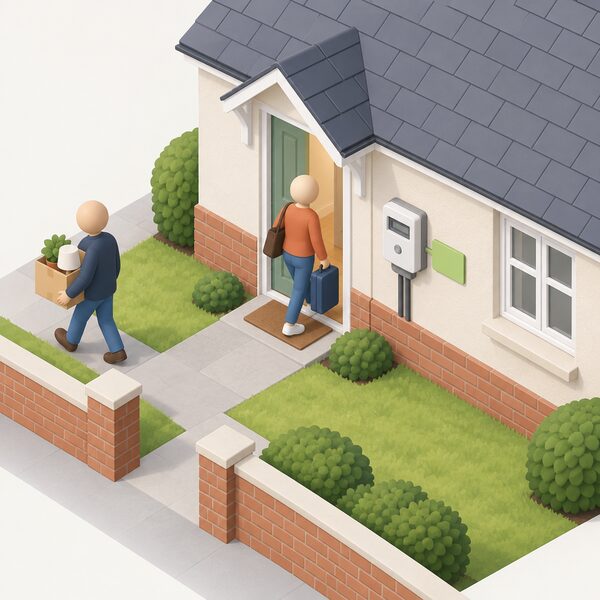
The mechanism was simple to describe and awkward to unwind. Repayments were spread out over time and paid back through the electricity bill13, and the loan was repaid over a period of up to 25 years by being added to the property's energy bill5. The charge was added to the electricity bill specifically, not the gas bill2.
That choice of collection route is the source of most of the scheme's later complications. A debt collected through an electricity account is only collectable while the account exists, so the scheme needed the charge to survive a change of occupant, a change of supplier and a change of tenancy. The design answer was to attach the obligation to the meter and the property rather than the account holder: the charge stays on the energy meter, so if the person moves, the charge stays with the house, and the next occupant picks up the payments14.
The scheme's own literature described the arrangement as one where the financial obligation is attached to the property, so there are no costs to the consumer once they stop receiving the benefits in energy reduction5. That is a maker-side framing of the same fact, and it is worth separating the two halves: the obligation does attach to the property, and the householder's liability does end when the benefit stream ends. What it does not mean is that a new owner escapes a charge that is still running.
"The charge stays on the energy meter, so if the person moves, the charge stays with the house, and the next occupant picks up the payments"
For energy independence, the loan was a mixed instrument. It financed fabric improvement, which reduces the energy a home needs and therefore reduces exposure to price. It also created a standing charge on the electricity account that a household cannot shop away, only service or repay.
The charge stays with the property, not the person
This is the defining feature of the scheme and the one that catches people out. The loan is attached to a property, rather than an individual, so if a homeowner sells their home, the loan will pass to the new owner3. The same point is put independently: the loan is tied to the property rather than the individual5. Contemporary reporting at launch described the scheme as attached to the home, not the individuals who take it out10.
The practical consequence is that a Green Deal charge behaves more like a property defect or an easement than like a personal debt. It does not follow the borrower to a new address, and it does not disappear when the borrower dies or moves. It sits with the building until it is repaid or the term ends.
| Question | Answer |
|---|---|
| Who owes the money after a sale? | The new owner; the loan passes with the property3 |
| Does the original borrower stay liable? | No, the obligation attaches to the property, not the individual5 |
| How is it collected? | Through a charge added to the electricity bill2 |
| What ends the householder's cost? | The end of the benefit stream in energy reduction5 |
For a household's energy independence, this cuts both ways. A property with a charge has a known, fixed repayment profile built into its running costs, which is a form of cost certainty. It also has a cost that cannot be removed by changing behaviour, changing supplier or improving the building further, and that a buyer will price into an offer.
Buying or renting a home with an outstanding charge
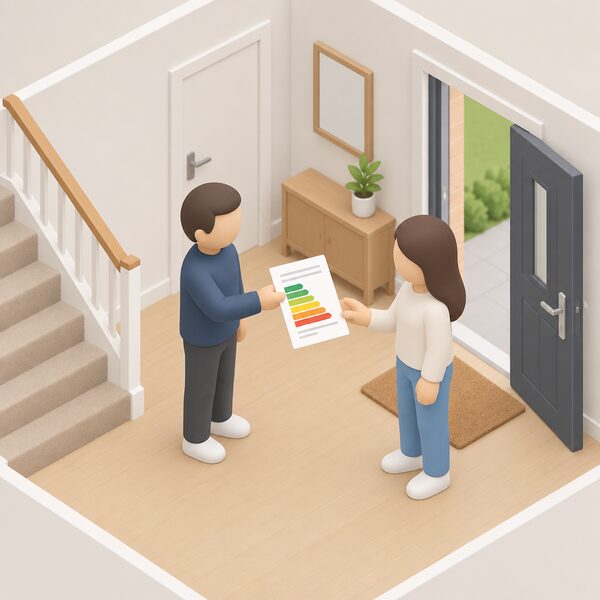
Disclosure is a legal duty, not a courtesy. The seller or landlord is legally required to tell the buyer or tenant about the Green Deal loan, and to tell them that they are responsible for it2. They must also show the buyer or tenant the Energy Performance Certificate for the property, and must do this before the buyer or tenant moves into the property2. A tenant should have been told the property was part of a Green Deal before moving in15.
The Energy Performance Certificate is therefore the practical place to look, and the Energy Performance Certificates page explains what an EPC records and how the Green Deal charge appears on it. The scheme's quality mark, a green house with a tick on the roof, is a visual identifier of Green Deal work rather than proof of an outstanding loan2.
Where disclosure did not happen, there is a route. The Energy Ombudsman can review disputes with Green Deal providers if they are unable or unwilling to help when something goes wrong with a Green Deal plan, and it can also take complaints where a buyer moved into a property and the seller or landlord did not tell them about the loan4.
Renting adds a second layer. A landlord might charge more for energy if they borrowed money to make energy efficiency improvements such as wall insulation or double glazing15. That is a permitted recovery of cost, and it sits alongside the tenant's own right to switch supplier where the tenant pays the bills16. The insulation in rented and social housing page covers the wider split of responsibilities between landlord and tenant.
Paying the loan off early, and when charges apply
Early repayment is allowed, but it is not free of consequence. You can pay the loan off early but there may be extra costs2. The specific condition reported by the scheme's administrators is that early repayment charges may apply if the repayment period is more than 15 years6. That threshold matters: a loan taken over a long term, which the scheme permitted up to 25 years5, is the case most likely to carry a charge.
The process starts with the managing company rather than the supplier. A letter is issued telling the householder how to repay early and about any charges from the company that manages the loan2. The first step is to contact the energy company or Green Deal provider to check what any charges are17. Any early repayment charges must have been disclosed up front or made clear in the Green Deal agreement17.
The Green Deal plan itself should record the mechanics. The agreement documentation covers what happens if the householder wants to pay the agreement off early19, and the payment period information includes the date on which the payment period starts and the date on which it finishes20. Those two dates, read together with the 15-year threshold, tell a householder whether a charge is likely to bite.
That is the crux of the early repayment question. A householder who intends to stay for the full term and wants the charge off the bill has one calculation; a householder who intends to sell in two years has a different one, because the buyer inherits the charge either way and the early repayment penalty is money spent to remove a cost the seller will not bear.
Switching electricity supplier with a charge in place
Switching is possible, with one condition. You can change electricity supplier as long as the new supplier is taking part in the Green Deal scheme2. The condition exists because the charge is collected through the electricity bill, so the receiving supplier has to be able to administer it.
The underlying right to switch is general. If you pay a supplier directly for the electricity or gas you use at home, you can choose to switch to a different supplier or tariff at any time16. Switching is described as easy where the household is on a variable rate tariff or where a fixed rate contract is ending shortly21, and it is free of charge22. Where a household is in credit with the current supplier, the money should be claimed back when switching23.
| Point | Position with a Green Deal charge |
|---|---|
| Can the household switch? | Yes, if the new supplier takes part in the scheme2 |
| What if the new supplier does not participate? | The charge cannot be transferred to that supplier, so the switch is not available2 |
| Cost of switching | Free of charge22 |
| Credit balance | Claim it back from the old supplier23 |
For a household's independence, this is the sharpest limit the scheme imposes. A Green Deal charge narrows the supplier market to participating suppliers, which reduces the household's ability to chase the cheapest tariff. It does not prevent switching altogether, and it does not affect the gas account, but it is a standing constraint on the electricity side for as long as the charge runs.
Where a household is struggling with bills, suppliers can agree a payment plan, payment break or reduction24, and the insulation grants in Wales page covers the current Welsh alternative, Green Homes Wales, which offers interest-free loans ranging from £1,000 to £25,000 with repayment terms up to 10 years7. That scheme is a separate programme with its own terms, not a revival of the Green Deal.
Complaints, and where the Ombudsman fits
The complaint route has a clear order. Contact the Green Deal provider if you have a complaint2. If the complaint is not resolved within eight weeks of contacting the provider, it can go to either the Financial Ombudsman Service or the Energy Ombudsman, depending on what the complaint is about2.
The split is by subject matter. The Financial Ombudsman Service handles cases where someone thinks they were mis-sold the Green Deal, for example if the provider did not make them aware of the facts, and other financial issues2. The Energy Ombudsman reviews disputes with Green Deal providers if they are unable or unwilling to help when something goes wrong with a Green Deal plan4, and it also covers dissatisfaction with the work the installer did, and cases where a buyer moved into a property and the seller or landlord did not tell them about the loan2.
The eight-week deadline is the practical trigger. The same eight-week period before referral to the Energy Ombudsman is described in the context of Green Deal complaints3. For a householder, the sequence is: check the charge with the provider, complain in writing, and escalate after eight weeks if the matter is unresolved6.
Sources25 cited
- The Green Deal and other energy efficiency schemes, House of Commons Library, 2026
- Green Deal energy saving measures, GOV.UK, 2026
- Green Deal scheme: research briefing, House of Commons Library, 2026
- How we can help, Energy Ombudsman, 2026
- What is the Green Deal?, CIGA, 2026
- Green Deal: I want to repay early, Resolver, 2026
- Green Homes Wales, Development Bank of Wales, 2026
- Green Deal research briefing, House of Commons Library, 2018
- Refrigerants in heat pumps final report, DECC, 2014
- Carbon Brief's essential Green Deal news roundup, Carbon Brief, 2013
- Can the Green Deal make energy efficiency the next big thing?, Carbon Brief, 2013
- UK energy efficiency, National Insulation Association, 2021
- Energy saving measures boost house prices, GOV.UK, 2013
- Minor consequential improvements, Part L Building Regulations, Parliament, 2012
- What your landlord can charge for energy, Citizens Advice, 2026
- Switch your home energy supplier, Ofgem, 2026
- Green Deal: I want to repay the loan early, Resolver, 2026
- Solar panels: I want to pay off the loan, Resolver, 2026
- Green Deal: cancel my agreement, Resolver, 2026
- Green Deal plan regulations, Legislation.gov.uk, 2025
- How to read your energy bill, Confused.com, 2025
- Change my electricity supplier, Fuse Energy, 2026
- Getting the best energy deal, Age UK, 2026
- Getting help if you can't afford your energy bills, Ofgem, 2026
- Financial support for home energy, Energy Saving Trust, 2026
 Closed Energy PoliciesIf a scheme you used has closed, do you still get paid?
 Green Energy TariffsDoes a green tariff really mean greener electricity comes into your home, or just that your supplier buys renewable certificates to match what you use?
 Free Solar Panels vs Rent-a-RoofOffers of free panels usually mean a company owns the system and keeps the generation income or charges a monthly fee.
 Final Bills and Credit RefundsHow final bills and credit refunds work when you leave an energy supplier: the six-week deadline for the final bill, the ten-working-day deadline for refunding credit, the twelve-month back billing limit, and the automatic compensation that applies when suppliers miss these standards.
 The Full Tariffs GuideWhich energy tariff suits how you live, and will switching really save you money?
 Check Which Energy Grants ApplyWhich energy grants can you actually get right now, and which have closed?