

In this answer
Short answer
The Renewables Obligation is a support scheme for large-scale renewable electricity generation, and it is closed. It was designed to encourage the generation of electricity from eligible renewable sources in the UK, and it closed to new projects in 20171. Energy bills still fund the projects that were part of the scheme, which is why a householder searching the term today finds it on a bill rather than in a list of open grants2.
The mechanism is a supplier obligation. It requires electricity suppliers to present a certain number of Renewables Obligation Certificates (ROCs) for each megawatt hour used by customers3. Suppliers buy some of the electricity they supply from renewable sources under instruction from the UK Government, and the cost of doing so is recovered through domestic electricity bills4. The scheme began in 2002 in Great Britain and three years later in Northern Ireland, and its final entrants will continue to participate until the scheme's definitive closure in 20373.
For a household, the practical question is what it costs and what is changing. Independent analysis puts the levy at 3.2p per unit, raising £3 billion from household bills a year, and adding £86 to the annual bill of a typical dual-fuel household5. The November Budget moved the cost of the Renewables Obligation from bills to general taxation, and from April the government covers three quarters of the costs for domestic bills, continuing for three years at £2.3bn per year3.
What the Renewables Obligation does, and what it does not
The scheme supports large-scale renewable electricity generation1. It is not a household grant, an insulation scheme or a boiler replacement programme. It does not pay a homeowner for installing anything, and it does not reduce a bill by generating electricity on a roof. What it does is underwrite the revenue of accredited renewable generators, and the cost of that underwriting is spread across electricity consumption.
The distinction matters because the Renewables Obligation is frequently confused with the Energy Company Obligation, which is a different scheme with a different purpose. The Energy Company Obligation is an obligation on energy suppliers to deliver measures such as insulation, heating, and solar panels, and it is designed to tackle fuel poverty and help reduce carbon emissions7. It funds the installation of insulation, district heating connections, renewables, heating installations and repairs8. The Renewables Obligation funds generation, not homes.
Both are levies, and both appear in the same part of a bill, which is the source of much of the confusion. The Energy Company Obligation is delivered by energy companies and funded by a levy on energy bills9. The Renewables Obligation is set by the UK Government and Ofgem and works through certificates rather than installed measures4.
A separate certificate, the Renewable Energy Guarantee of Origin (REGO), is issued one per megawatt hour of renewable electricity generated10. REGO certificates are used for disclosure of a tariff's renewable content, not for obligation compliance, and the two should not be conflated when reading a supplier's green tariff claims.
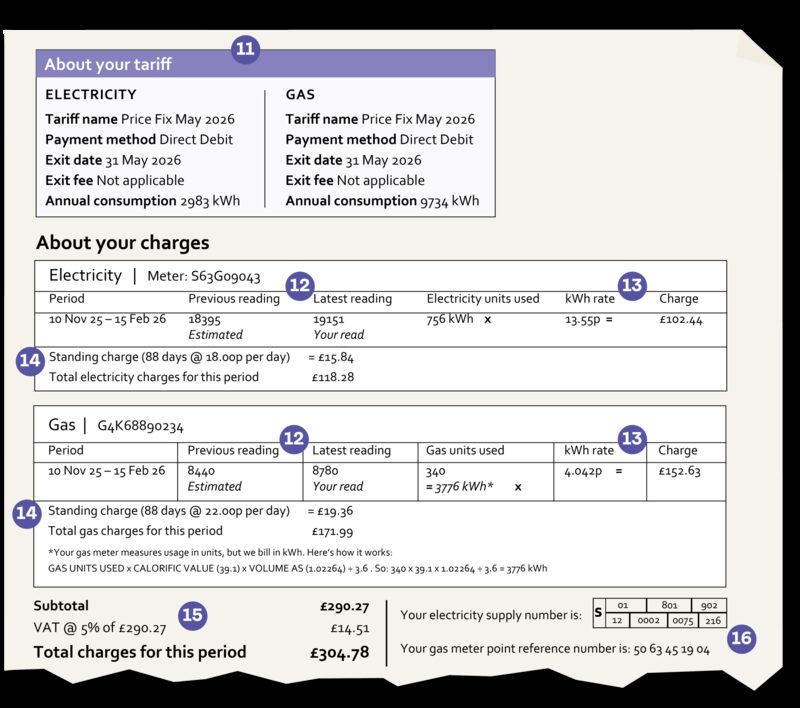
Who pays, and who the scheme applies to

The obligation falls on electricity suppliers, and it reaches households through the unit rate. The Renewables Obligation reduction applies to all domestic customers, including those on fixed tariffs1. That is the key point for a household trying to work out whether it benefits from the funding switch: the reduction is not confined to variable tariffs or to customers of a particular supplier.
Suppliers must submit estimated electricity supply figures for the preceding obligation period by 1 June, and final supply figures by 1 July11. Those deadlines drive the reconciliation of what each supplier owes, and they explain why obligation costs can be adjusted after the event rather than being fixed at the start of a year.
Compliance is not always clean. On the RO scheme there were 27 incidents recorded between July and December 2023, and 23 of the 27 were for suppliers missing mutualisation payment deadlines11. Mutualisation is the mechanism by which other suppliers absorb a shortfall when one fails to pay, so those incidents are a measure of how often the industry has had to cover for a participant.
The scheme's geography is uneven in origin but not in effect. It came into effect in 2002 in Great Britain and three years later in Northern Ireland3. Northern Ireland therefore has a shorter history of accredited projects under the same obligation, though the cost recovery mechanism through bills operates across the UK.
The cost on a bill, and why the figures differ
The headline figures for the Renewables Obligation's cost to households do not agree, and the disagreement is worth understanding rather than resolving. Independent analysis states that it raises £3 billion from household bills a year at a rate of 3.2p per unit, and that it is the largest policy cost on electricity bills, adding £86 to the annual bill of a typical dual-fuel household5. A separate independent estimate gives the Renewables Obligation as £17, or 1%, per household12.
The two figures measure different things. The £86 figure is described as an addition to the annual bill of a typical dual-fuel household, while the £17 figure is given as a per-household cost alongside other levies. A further independent source gives the levy rate as 3.18p/kWh on domestic electricity bills and revenue of £3,000 million in 2024 to provide revenue support for legacy renewable generation projects13. The rate figures are close; the household totals are not, and the two figures for the household cost do not agree.
What is not in dispute is the direction of travel. The cost of the RO is projected to fall to zero over the next 15 years as RO-supported power plants stop receiving support after 20 years, and the scheme will taper down as these contracts gradually expire from 2027 onwards14. That projection rests on the assumption stated with it, and it is a projection rather than a commitment.
| Measure | Figure | Source type |
|---|---|---|
| Levy rate | 3.2p per unit | Independent analysis5 |
| Levy rate | 3.18p/kWh | Independent guidance13 |
| Annual revenue | £3 billion from household bills | Independent analysis5 |
| Annual revenue | £3,000 million in 2024 | Independent guidance13 |
| Typical dual-fuel household cost | £86 a year | Independent analysis5 |
| Per-household cost | £17 (1%) | Independent guidance12 |
The funding switch and the Energy Independence Bill

The most significant recent change is where the money comes from. The November Budget decision moved the cost of the Renewables Obligation from bills to general taxation15. From April, the government will cover three quarters of the costs of the Renewables Obligation for domestic bills, continuing for three years at a cost of £2.3bn per year3. A separate independent source puts the government share at 75% of RO costs funded from general taxation6, and another gives the same 75% figure for the period 2026 to 20296.
The switch is being given a longer life than the three-year funding window. The Energy Independence Bill puts the Renewables Obligation funding switch onto a permanent statutory footing16. The introduction of the Renewables Obligation to Exchequer Scheme is set out in official guidance for energy suppliers on domestic tariff reductions17.
There is also a proposal to change the timing of payments rather than the amount. Citizens Advice has raised the possibility of legislative changes to require the bills for the Renewables Obligation to be paid more frequently18. That is a cash-flow measure aimed at suppliers, not a change to the levy's size.
Reform has specifically identified schemes including the Renewables Obligation, Feed-in Tariffs and Warm Home Discount for removal from household energy bills19. That is a stated intention rather than an enacted change, and it sits alongside the funding switch rather than replacing it.
"the November Budget decision to move the cost of the Renewables Obligation from bills to general taxation"
How the obligation is administered
The Renewables Obligation is set by the UK Government and Ofgem4. Ofgem administers the certificate system, receives supply data, and reports on compliance. The UK Government instructs energy suppliers to buy some of the electricity they supply to their customers from renewable sources, and the certificate mechanism is how that instruction is evidenced20.
The certificate itself is the unit of compliance. Suppliers must present a certain number of Renewables Obligation Certificates for each megawatt hour used by customers3. A supplier that cannot present enough certificates makes a payment instead, and that payment is recycled among suppliers that did comply, which is why the obligation behaves like a levy with a redistribution step rather than a straightforward tax.
The scheme has been replaced for new generation by a different mechanism. It has been closed to new projects since 2017 and has been replaced by Contracts for Difference13. Households looking at how new low-carbon generation is funded should look to the Contracts for Difference arrangements rather than to the Renewables Obligation.
The Renewables Obligation sits within a wider set of costs recovered through electricity bills. Network charges, balancing costs and other obligations all appear alongside it, and the transmission and balancing charges explain the rest of the policy and network cost stack. For the generation the scheme supported, the UK electricity generation mix shows what is now on the system.
What it means for a household's energy independence
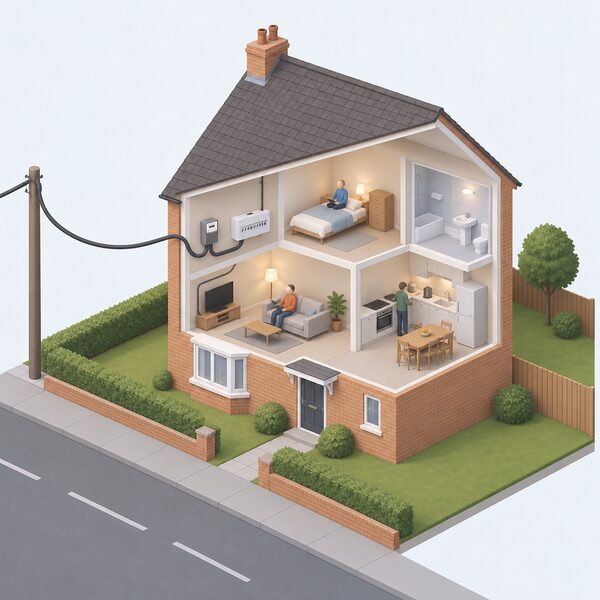
The Renewables Obligation does nothing for a household's energy independence. It is a charge on consumption that supports large-scale generation elsewhere. A home that pays it remains dependent on the grid for every unit it uses, and on a supplier to pass the electricity through. The scheme changes the carbon intensity of the power delivered, not the household's exposure to the grid.
The dependence it leaves in place is specific. A household cannot opt out of the obligation by changing supplier, because it is a supplier obligation recovered through the unit rate and applies to all domestic customers including those on fixed tariffs1. It cannot be discharged by generating electricity on site, because the obligation is assessed on supplier volumes rather than household behaviour. And it cannot be avoided by choosing a green tariff, because the obligation applies regardless of the tariff's fuel mix.
What a household can control is separate from the obligation. On-site generation, storage and demand flexibility change what a home draws from the grid, and the demand flexibility and the grid arrangements describe how that participation works. The wider question of what a home can genuinely control is set out in energy security and household independence.
The scheme's own trajectory is towards disappearance from bills. Contracts taper from 2027 onwards and the cost is projected to fall to zero over the next 15 years14. The funding switch moves three quarters of the domestic cost to general taxation for three years from April3. Both changes reduce what appears on a bill; neither changes what a household can generate for itself.
Sources20 cited
- Autumn Budget energy bill changes explained, Good Energy, 2026-04-20
- What changes are coming for energy bills in 2026, Which?, 2025-12-30
- Solar industry welcomes legacy subsidy reform, Solar Energy UK, 2025-11-26
- Flexi 2026 charges, ScottishPower, 2026-09-17
- Household energy bills and green levies, Nesta, 2026-09-20
- Budget announcement response, Energy Saving Trust, 2025-12-09
- Energy Company Obligation (ECO), Ofgem, 2026-09-17
- Funding for heat pumps, Energy Saving Trust, 2026-07-10
- Building trust: improving the reliability of installers, Which?, 2024-05-29
- Green electricity tariffs, Centre for Sustainable Energy, 2026-07
- Supplier Performance Report July to December 2023, Ofgem, 2023-12-31
- Green costs on energy bills 101, Carbon Brief, 2026-09-20
- Cheaper electricity, fairer bills, Nesta, 2024-12-04
- How to pay for energy policy, Cadent, 2026
- Civil society urges government to go further and faster, End Fuel Poverty Coalition, 2026-05-12
- King's Speech outlines three energy bills, End Fuel Poverty Coalition, 2026-05-13
- Domestic energy tariff reductions 2026: guidance for energy suppliers, GOV.UK, 2026-03-18
- Response to Ofgem's supplier licensing review, Citizens Advice, 2021-05-20
- Four key takeaways from Reforms Conference, Solar Energy UK, 2026-09-08
- Flexi 2023 charges, ScottishPower, 2026-09-17
 Closed Energy PoliciesIf a scheme you used has closed, do you still get paid?
 Meter Readings and EstimatesWhy is my energy bill estimated, and how often should my meter be read?
 Reading an Energy BillA line-by-line walk through a domestic gas and electricity bill: unit rate, standing charge, kWh consumption, meter readings, tariff name and balance, plus the 12-month back billing limit and the guaranteed standards payments that apply when a supplier or network operator gets it wrong.
 Electricity Network ChargesWhy are network charges on my bill so high, and who decides how much they are?
 TNUoS, BSUoS and Network ChargesWondering why your electricity bill mentions network costs, or whether where you live changes what you pay?
 Standing ChargesWhy is there a daily charge on a gas or electricity bill even when nothing is used, and what does it actually pay for?