
In this guide
Network charges are the part of an electricity bill that pays for the wires, cables, pylons and substations that carry power from where it is generated to the property that uses it. Ofgem defines them simply as the costs "to build, fix and repair pipes and wires to move energy"1. They are not a retail product and no household can shop around for them: they follow the property, not the contract.
The scale is larger than most billpayers assume. Network costs are the next most important component of the price cap after wholesale energy, making up almost 30% of the total2. The network cost allowance inside the cap rose by £24, or 6%, from £372 to £396 per year for a typical consumer3. Since 2021, rising network charges have added some £63 to bills4.
What follows explains what those charges buy, how they sit inside the full stack of bill components, who sets them, why they differ by region and by fuel, and what all of it means for a household trying to reduce its dependence on the grid.
What network charges actually pay for
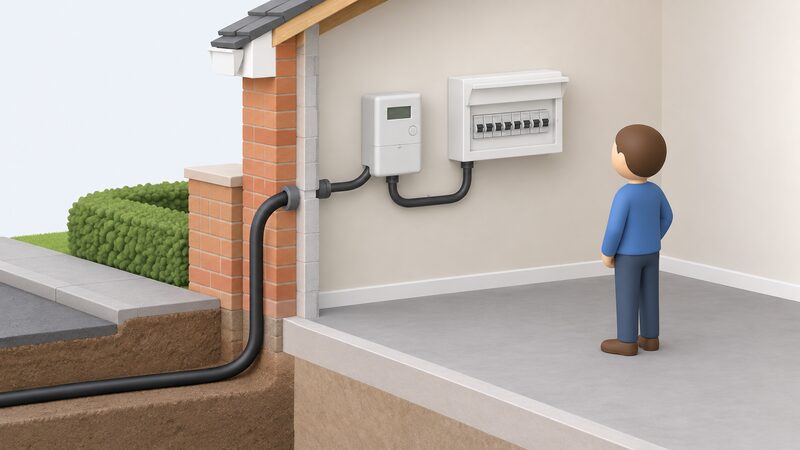
The money recovered through network charges funds the physical system that moves energy. Ofgem's definition covers building, fixing and repairing pipes and wires1. The standing charge on a bill is the mechanism that recovers much of this: Parliament's research service describes it as recovering "the costs required to provide energy company services, including providing and maintaining the wires, pipes and cables that deliver power to a customer's door, through to the staff and buildings required for the energy business to function"7.
Responsibility for that infrastructure sits with the network operator, not the supplier. Ofgem states that "a network operator is responsible for the pipes and wires that move energy", and that the operator should be contacted about power cuts or connection issues in the area8. That division matters when something goes wrong: a supply interruption is a network event, while a billing dispute is a supplier matter.
A second category of cost also lands on the network. Gas transporters are unable to charge for health and safety disconnections, and according to industry those costs are ultimately passed onto other customers through network charges, leading to higher household bills for those remaining on the network9. The same logic applies to bad debt more broadly: where a cost cannot be recovered from the customer who caused it, it is spread across the remaining customer base.
There is also a residual category. Ofgem's 2019 decision records residual network charges as "currently accounting for around £4bn/year across electricity transmission and distribution networks"5. These are the costs of the network that are not attributable to any one user, and they are recovered from the whole connected base.
For a household, the practical point is that none of this is avoidable through choice of supplier. The wires exist, they must be maintained, and the cost is socialised across everyone connected to them.
Network costs within the full breakdown of a bill
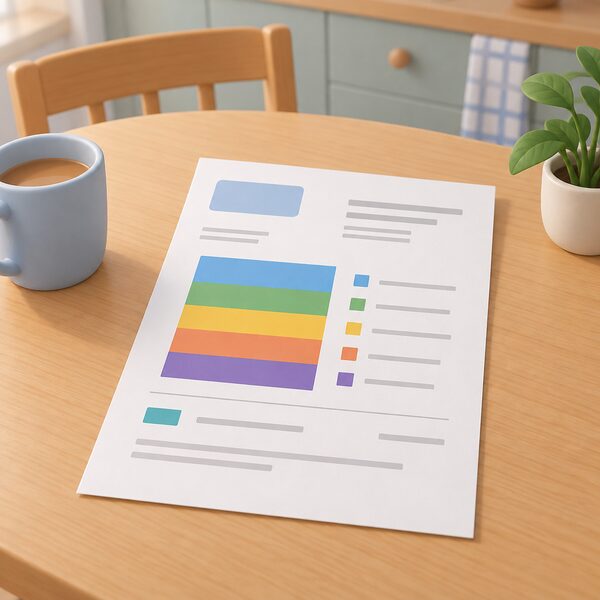
A domestic energy bill is not one charge but a stack of them. Ofgem lists the components as wholesale costs, network costs, operating, debt and industry costs, EBIT, policy costs and VAT, with the final figure also shaped by the type of energy used, the type of meter installed and how the bill is paid10. Wholesale costs are defined as "the cost a supplier pays to buy energy"1. Operating, debt and industry costs are "the costs a supplier pays to run their business"1.
VAT sits at 5% on domestic energy1. That rate is subject to a temporary change: a zero rate applies to qualifying supplies of domestic electricity in Great Britain from 1 October 2026 to 31 March 20276. The government has stated that all suppliers are expected to pass the VAT reduction on to all customers, including those on fixed tariffs11.
The relative weight of each component has shifted over time. Analysis of the rise in bills since pre-crisis levels attributes 54% to higher wholesale prices, with network charges and green levies accounting for 20% and 6% respectively4. In other words, the network is the second largest driver of the increase, well ahead of environmental levies.
| Component | What it covers | Source |
|---|---|---|
| Wholesale costs | The cost a supplier pays to buy energy | 1 |
| Network costs | Building, fixing and repairing pipes and wires | 1 |
| Operating, debt and industry costs | The costs a supplier pays to run their business | 1 |
| Policy costs | Environmental and social schemes | 10 |
| VAT | 5% on domestic energy, temporarily zero for qualifying electricity from 1 October 2026 | 1 |
The table shows why a household cannot isolate network charges: they are embedded in the unit rate and the standing charge rather than presented as a discrete line. The standing charge is treated as part of the charge for a supply of gas or electricity for VAT purposes, even though it is shown separately on bills6.
The charges inside an electricity bill that are not the unit rate
Beyond the headline components, several factors move the final figure. Ofgem identifies the type of energy used, the type of meter installed and how the bill is paid, for example by Direct Debit, as variables in the calculation10. Heating type matters too: a bill can vary based on how a home is heated, including whether it uses heating oil or sits on a heat network1.
Smart metering adds a data dimension. The DCC smart energy network states that the only data transmitted over its network is how much gas and electricity a household uses and its chosen tariff12. That is a narrow data flow, but it is the mechanism by which half-hourly consumption becomes visible to the network and to suppliers.
For households on heat networks, the billing rules are different again. Bills and billing information must be accurate and based on actual consumption13. Where individual metering comes into effect for networks covered by the Landlord and Tenant Act that charge through service charges or rent, suppliers would be expected to charge for heat separately and unbundle the heat charge from service charges or rent14. The Heat Network (Metering and Billing) Regulations 2014 require that, where cost effective and technically feasible, heat network suppliers must provide individual meters and bills based on meter readings15.
Who sets and regulates the charges: Ofgem's role
Ofgem is Great Britain's independent energy regulator. Its principal objective is to protect the interests of existing and future gas and electricity consumers, including their interests in the Government's compliance with the net zero target for 2050 and five-year carbon budgets, and it has a duty to promote growth9. That combination of consumer protection and decarbonisation is unusual and shapes how network charges are set: the regulator must weigh the cost to billpayers against the investment needed to decarbonise the grid.
As scheme administrator for environmental and social schemes, Ofgem is responsible for setting energy suppliers' obligations16. Its work includes calculating suppliers' obligations and tracking performance against them, processing notifications, auditing suppliers, counter fraud work, and reporting to the Secretary of State at DESNZ17. Those obligations are recovered through policy costs on bills, which sit alongside network costs in the same stack.
The regulatory reach has a clear boundary. Households that get their heat delivered through a heat network are not covered by Ofgem; gas supply to a network is regulated as a commercial supply but heat supply to homes is not18. That gap is significant for the roughly one in fifty households on such networks, and it is the subject of separate reform work covered in heat network regulation.
Ofgem has also examined regional variation directly. A 2015 report set out the background of gas and electricity network charges, comparisons between the charges in each region, an assessment of how UK-wide charges would impact on consumers, and an overview of the approach to network charges in other countries19. The regulator has separately reviewed regional electricity distribution connection costs and the information provided to prospective connection customers20.
For households, the practical consequence is that network charges are set through a regulatory process, not a market one. The Ofgem page covers the regulator's wider remit, and the energy price cap page explains how the network allowance is folded into the cap.
How network charges differ between electricity and gas
Electricity and gas networks are regulated separately and their costs land on bills differently. The clearest illustration is in how a policy cost would be recovered: under a network charges funding route, costs would fall on the unit rate for gas and the standing charge for electricity20. That asymmetry reflects the different structures of the two networks and the different ways households use them.
The gas network carries its own socialised costs. Because gas transporters cannot charge for health and safety disconnections, those costs are passed onto other customers through network charges, raising bills for those who remain connected9. This is a direct transfer from households that leave the gas network to those that stay, and it becomes more pronounced as more homes electrify heating.
Electricity network costs have risen faster in recent years. Network charges account for 20% of the rise in bills since pre-crisis levels4. The network cost allowance within the price cap rose from £372 to £396 per year for a typical consumer, an increase of £24 or 6%3. An earlier cap period saw networks costs rise marginally from £388 to £394, an increase of £6, driven by changes in the cost of balancing the electricity system21.
| Electricity | Gas | |
|---|---|---|
| Recovery route for a policy cost | Standing charge | Unit rate20 |
| Disconnection cost treatment | Not applicable in the same way | Passed to remaining customers through network charges9 |
| Share of bill rise since pre-crisis | 20% (network charges overall) | Included in the same 20% figure4 |
The two fuels also differ in how a household can respond. A household that disconnects from gas entirely removes its exposure to gas network charges but increases its electricity consumption, and therefore its contribution to electricity network costs. That trade-off is central to any decision about electrifying heat.
Why network charges vary by region
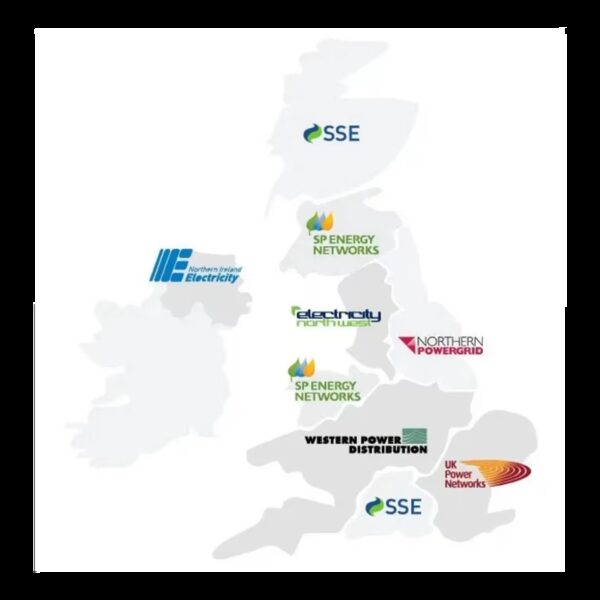
Network charges are not uniform across Great Britain. The price cap itself varies by region because the costs of transporting energy from the generation source to the customer vary by region22. That is the mechanism by which regional network costs reach household bills: the cap is set at different levels in different areas, and the network component is one reason why.
The variation has been a long-standing concern. Ofgem's review of regional electricity distribution connection costs noted that there were concerns that connection customers were being charged different amounts to complete similar connections work, depending on where they lived19. That is a connection cost rather than a consumption charge, but it illustrates the same underlying issue: the cost of moving energy depends on geography.
Government has taken a position against levelling the charges nationally. Its reasoning is that national pricing risks an overall increase in network costs by weakening each network company's local accountability to its customers, as well as making charges less transparent21. In other words, uniform charges might look fairer but could cost more in total and reduce the pressure on individual network companies to control their own costs.
For a household, the practical effect is that two identical homes with identical consumption in different parts of Great Britain can face different network costs embedded in their bills. The difference is not something a supplier can remove, and it does not change when a household switches. It is a function of where the property sits on the network.
How network charges interact with tariffs and price changes
Network charges sit underneath the retail market rather than inside it. A household that pays a supplier directly can choose to switch supplier or tariff at any time23. A tenant who pays the energy bills can do the same23. But switching changes the retail margin and the wholesale purchasing strategy, not the network component, which follows the property.
There are costs to switching. A customer on a fixed rate tariff who leaves before it ends may have to pay an exit fee23. When switching, the old supplier refunds any credit on the final bill, and compensation may be due if it does not24. To compare tariffs, a household needs its postcode, the name of its current supplier and tariff, the unit price in kilowatt hours, and its annual energy use23.
The price cap is the main mechanism through which network costs reach households. The cap includes a network cost allowance, and that allowance has risen from £372 to £396 per year for a typical consumer3. The cap also includes a Network Charging Compensation Scheme allowance, which funds compensation on electricity network charges to energy intensive industries using Great Britain's electricity grid25. That is a cost added to domestic bills to support industrial competitiveness.
For households that generate their own electricity, the interaction is more complex. Network charges are levied on consumption, so self-generation reduces the network cost a household pays indirectly through its unit rate. But the residual network costs, around £4bn per year across transmission and distribution5, still have to be recovered from the remaining connected base. That is the tension at the heart of charging reform, and it is covered in more detail in regulation and energy independence.
What network charges mean for household energy independence
Network charges are the price of connection. A household that stays connected to the electricity network pays for the wires that keep the lights on, and it pays whether or not it uses them at any given moment. That is the trade-off: connection brings reliability and the ability to import and export, but it also brings a cost that cannot be avoided by changing supplier or tariff.
The dependence is real and worth stating plainly. A grid-connected home depends on the network operator for the physical connection, on a supplier for billing and metering, and on the regulatory process for the level of the charges. Ofgem's principal objective includes protecting consumers' interests in the Government's compliance with the net zero target for 2050 and five-year carbon budgets9, which means network charges will continue to fund the investment needed to decarbonise the grid.
For households on heat networks, the dependence is deeper. Heat networks are natural monopolies, where one entity is the supplier for all homes and businesses on the network, and most consumers cannot switch suppliers or move to a different tariff14. Households on heat networks are not covered by Ofgem, and heat supply to homes is not regulated in the same way as gas or electricity supply18. That is a materially different position from a grid-connected home, and it is the subject of the heat network regulation page.
What a household can influence is how much energy it draws through the network. Demand side response could make household energy bills cheaper26, and suppliers offer advice on more efficient use of energy that could help cut bills27. Neither changes the network charge itself, but both change the volume of units over which it is spread.
The wider policy direction points to continued upward pressure. The government has taken £150 of costs off energy bills through the Budget28, and a temporary zero rate of VAT applies to qualifying domestic electricity from 1 October 2026 to 31 March 20276. Those measures reduce the total bill, but they do not change the network component, which remains a charge for connection rather than for consumption.
Sources28 cited
- Understand your electricity and gas bills, Ofgem, 2026
- Energy price cap and network costs, House of Commons Library, 2026
- Summary of changes to energy price cap 1 October to 31 December 2025, Ofgem, 2025
- Electricity prices in Great Britain, House of Lords Library, 2026
- Full decision document, Ofgem, 2019
- VAT on fuel and power notice 701/19, HM Revenue and Customs, 2026
- Standing charges and energy company services, House of Commons Library, 2026
- Complain about your energy supplier or network operator, Ofgem, 2026
- Call for input on disconnections, Ofgem, 2025
- How your electricity or gas bill is calculated, Ofgem, 2026
- New PM cuts tax on household electricity bills, HM Government, 2026
- Does a smart meter need Wi-Fi?, Smart DCC, 2026
- Heat networks consumer protections draft guidance, Ofgem, 2025
- Heat network metering and billing requirements, House of Commons Library, 2026
- Heat networks regulation consumer protection guidance decision, Ofgem, 2026
- Great British Insulation Scheme: energy suppliers, Ofgem, 2026
- Energy Company Obligation (ECO), Ofgem, 2026
- Heat networks and Ofgem regulation, House of Commons Library, 2026
- Review of regional electricity distribution connection costs, Ofgem, 2015
- Resetting the energy debt landscape, Ofgem, 2024
- Default Tariff Cap Letter for 1 July 2023, Ofgem, 2023
- Default tariff cap policy consultation overview, Ofgem, 2018
- Switch your home energy supplier, Ofgem, 2026
- How your electricity or gas bill is calculated, Ofgem, 2026
- Energy price cap will rise 6.4% in April, Ofgem, 2025
- Demand side response and household bills, Parliamentary Office of Science and Technology, 2026
- Heat networks consumer protections draft guidance, Ofgem, 2026
- Households can save as plug-in solar panels come to market, HM Government, 2026
 TNUoS, BSUoS and Network ChargesWondering why your electricity bill mentions network costs, or whether where you live changes what you pay?
 The Full Energy Bills and the Price Cap GuideWondering why your bill went up even when you used less power?
 Tariffs and Energy IndependenceA tariff decides what you pay for power from the grid and what you get paid for sending solar back.
 Export Rates Per kWhHow much will your supplier pay you for the solar power you send to the grid, and why do rates vary so much from one company to another?
 Suppliers and IndependenceCan you really cut your energy bills by making your own power, and how much of your supplier do you still need?
 Export Limitation and G100Your solar panels can be set to stop sending power to the grid once they reach a certain level.