
In this guide
A competent person scheme is a route by which a registered installer certifies their own work as compliant with the building regulations, instead of the householder applying to a building control body. Official guidance is direct about the trade: "This is instead of getting building regulations approval."1 The installer is approved to carry out the work to comply with building regulations without involving local authority building control2.
The practical effect for a household is that no separate application, no inspection visit and no fee to a building control body is needed for the covered work. Customers do not have to get a local council or a private approved building inspector to check the work3. What arrives instead is a certificate: for windows and doors, a certificate showing the work was done by a registered installer2; for electrical work, a completed Electrical Installation Certificate showing the work was tested for safety4.
The scheme route is not universal and not automatic. Schemes have different application processes and different fees, and an installer chooses a scheme that supports their trade or types of work1. Where no registered installer is used, the work reverts to the ordinary building control route, with an application, an inspection and a completion certificate. The sections below set out what the regulations cover, which trades can self-certify, what the paperwork means, and where the rules diverge across the four nations.
What building regulations are and when they apply to your home
Building regulations are the standards that apply to building work, and the definition of building work is broader than most householders expect. It covers the erection or extension of a building, the installation or extension of a service or fitting controlled under the regulations, an alteration project that will temporarily or permanently affect the building's ongoing compliance on structure, fire, or access and use, the insertion of insulation into a cavity wall, the underpinning of foundations, and work affecting the thermal elements, energy status or energy performance of a building7.
The regulations will probably apply if a household wants to put up a new building, extend or alter an existing one, or provide services and fittings such as washing and sanitary facilities, hot water cylinders, foul water and rainwater drainage, replacement windows, and fuel burning appliances of any type7. They may also apply to certain changes of use of an existing building, because the change of use may mean the building as a whole no longer complies with the requirements that apply to its new type of use7.
Two conditions shape how this lands on a household. First, the works must not make other fabric, services and fittings less compliant than they were before, or dangerous7. The provision of replacement double-glazing, for example, must not make compliance worse in relation to means of escape, air supply for combustion appliances and their flues, and ventilation for health7. Second, some kinds of building project are exempt from the regulations altogether7.
Responsibility is worth stating plainly, because it does not sit where many households assume. If you are the owner of the building, it is ultimately you who may be served with an enforcement notice if the work does not comply with the regulations. If you are employing a builder, the responsibility will usually be theirs, but that should be confirmed at the very beginning8. Building regulations are separate from planning permission: even if planning permission is not needed, building regulations consent may still be required9.
For the household's energy independence, this matters because almost every measure that reduces reliance on imported gas or grid electricity, solar panels, heat pumps, battery storage, a new boiler, replacement glazing, is building work or a controlled service installation. The regulations are the gate through which that work passes, and the competent person scheme is the fastest gate available.
Competent person schemes: self-certification instead of building control approval
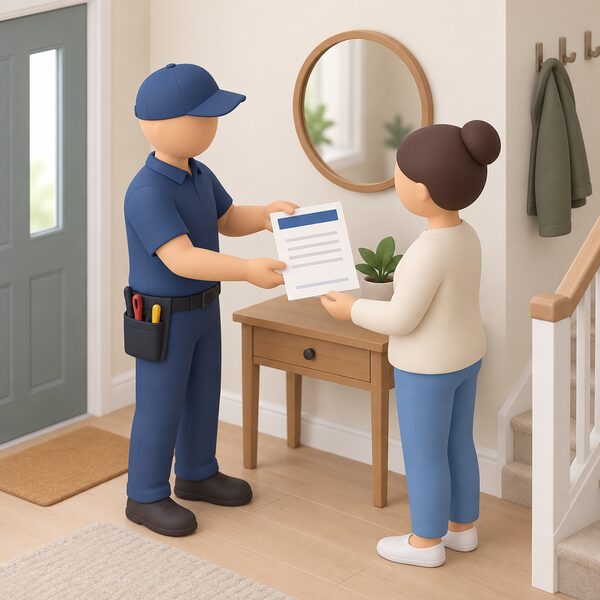
An installer who is registered with a scheme can self-certify that their work complies with building standards3. Members are allowed to certify their own work and will tell the council that the work has been properly installed and tested10. Work carried out under a competent person scheme does not need notification to building control10.
The alternative route remains open. Installers who do not join a scheme, or who choose not to use it for a particular job, can still use local council or private inspectors1. For work that is not higher risk, a household can choose either the local authority's building control department or a private registered building control approver11. Building control bodies may also accept certification under independent schemes of certification and accreditation as evidence of compliance with a relevant standard, which is how third-party certification feeds into the system12.
Where a household prefers a different technical approach from the one described in an approved document, other ways to comply may be used, subject to seeking agreement with the relevant building control body at an early stage13. That is the general escape valve in the system, and it applies whether or not a scheme is used.
The trade-off is straightforward. The scheme route removes an application, an inspection and a fee, and replaces them with a certificate from the installer's scheme. In exchange, the household is relying on the scheme's own registration and monitoring of that installer rather than on a building control body's independent inspection of the specific job. That is why checking the registration matters, and why the certificate is the document that proves the work was done inside the system.
Which trades can self-certify: boilers, electrics, glazing, renewables and more
The list of covered work is wider than the phrase "competent person scheme" suggests, and it has grown over time. The Building Regulations &c. (Amendment) Regulations 2012 added bodies to the list of bodies authorised under the self-certification scheme provided for by regulations 12 and 20 and Schedule 3 of the Building Regulations14.
- Gas, oil and solid fuel boilers. For oil fired boilers and solid fuel fired boilers, an installer should be registered with the Competent Person Schemes5.
- Electrical installation work. Electricians become registered with an approved self certification organisation15. Electrical work in new dwellings and extensions to existing dwellings is notifiable unless the installer is a member of a competent persons self-certification scheme15.
- Windows and doors. A registered installer is approved to carry out the work to comply with building regulations without involving local authority building control2.
- Solar photovoltaics. Installers who are members of a relevant competent person scheme can self certify certain types of building work, including the installation of solar PV, avoiding the need to seek separate building regulations approval16.
- Wind turbines. An installer registered with the relevant competent person scheme may be authorised to self-certify the work without involving local authority building control for turbines attached to the house, and for the electrical work on turbines not attached to the house where the work is of the type listed in Row 12 of Schedule 3 and the installer is a member of a scheme listed against that row18.
- Heat pumps and mechanical ventilation. A competent person scheme should be used when undertaking a heat pump or mechanical ventilation installation19. For installing mechanical ventilation and air condition systems in dwellings there are currently four registered competent person schemes: BESCA, Blue Flame Certification, Certsure and Napit19.
The direction of travel is towards more, not less, use of schemes. The government has made significant amendments to the Approved Documents to state that a competent person scheme should be used when undertaking a heat pump or mechanical ventilation installation19. For a household weighing up a heat pump, that means the installer's registration is not a nice-to-have but the expected compliance route.
The schemes by trade: FENSA, CERTASS, OFTEC, NICEIC, MCS and BESCA
Scheme operators are trade-specific, and the same installer may hold more than one registration. The names that appear in official guidance and local authority documents include NAPIT, ELECSA and NICEIC for electrical work20, and MCS, NICEIC, CIGA and Stroma for funded energy efficiency work, where an installer who is part of a competent person scheme such as those can self-certify their work and will not need to get building regulations approval from the council21.
| Trade or work type | Scheme names appearing in official guidance | Source |
|---|---|---|
| Electrical installation work | NAPIT, ELECSA, NICEIC | 20 |
| Funded energy efficiency measures | MCS, NICEIC, CIGA, Stroma | 21 |
| Mechanical ventilation and air conditioning in dwellings | BESCA, Blue Flame Certification, Certsure, Napit | 19 |
| Boilers, oil and solid fuel | Competent Person Schemes (installer should be registered) | 5 |
| Windows and doors | Registered installer route under the scheme system | 2 |
The older scheme landscape is visible in a 2004 local authority document, which records that three organisations, ELECSA, NAPIT and NICEIC, plus CORGI and OFTEC, also ran a scheme under which approved competent persons could self-certify limited electrical works in kitchen, bathroom or boiler installation at the time of publication22. CORGI has since been replaced as the gas registration body, and the list has been amended by legislation since14.
For a household, the practical point is that the scheme must match the work. Official guidance to installers is to choose a scheme that supports your trade or types of work1, and the advice to households is to check the installer is a member of a scheme covering the work they will be undertaking16. A window registration does not cover a boiler, and an electrical registration does not cover glazing.
TrustMark: the government-endorsed quality scheme behind the installers
TrustMark is a government endorsed quality scheme23, and it functions as a competent person register for finding an installer who will assess your circumstances and property to identify suitable measures24. It sits above the trade schemes rather than replacing them: an installer can hold both a trade scheme registration and TrustMark registration.
TrustMark registration is a condition of certain funded work rather than a general requirement for domestic jobs. Installers under UK Government schemes must be TrustMark registered and/or Microgeneration Certification Scheme (MCS) certified25. Under the Green Homes Wales loan terms, the installer must be registered with TrustMark and the relevant body for the relevant type of eligible measure, must comply with relevant PAS certification, and must not be the borrower, a member of the borrower's household or immediate family26. Under the Warm Home Discount (England and Wales) Regulations 2026, a boiler or central heating system must be installed by, or under the responsibility of, a person who is registered with TrustMark, with a certificate of lodgement issued by the operator of TrustMark; repairs follow the same rule27.
TrustMark's warranty expectations are set out in official guidance: a minimum two-year warranty for work, and a minimum 25-year guarantee for certain measures installed under the ECO25. TrustMark accredited private installers carry out the installation work under the ECO4 Flex route21.
TrustMark has also been used as the data and support layer for government schemes. The Department for Energy Security and Net Zero confirmed that it nominated TrustMark to directly support customers of the closed Energy Company Obligation scheme, reachable on 0333 555 1234 or through an online form6. There were around 14,700 WH:LG measures lodged in the TrustMark data warehouse up to the end of July 2026, covering around 6,700 households28.
What a competent person certificate means for you as the owner
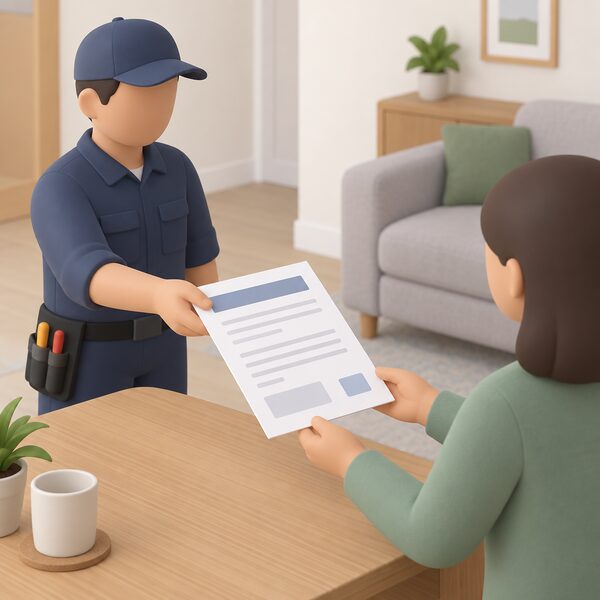
The certificate is the record that the work was done inside the compliance system, and it can be used as evidence of compliance3. Its form depends on the trade.
For windows and doors, when work is complete you will receive a certificate showing the work was done by a registered installer2. For electrical installation work, the competent person should also provide you with a completed Electrical Installation Certificate which shows that the work was tested for safety4. For boiler work, the installer should produce a commissioning certificate such as a Benchmark certificate and notify the local authority building control department either directly, or, if a member of a Competent Person Scheme, via the scheme operator5.
Where a building control body is involved instead of a scheme, the paperwork differs. Once it has decided that the work meets all the Building Regulations requirements, it will issue a Building Regulations completion certificate if it is a building control authority, or a final certificate if it is a registered building control approver13. The same distinction appears in the heat pump guidance: the installer should give notice to the building control authority that commissioning has been carried out13.
For a household, the certificate has three uses. It evidences compliance if a building control body or a buyer asks. It supports a warranty or insurance-backed claim through the scheme if the work fails. And it is the document that would be missing if the work had been done outside the system, which is where the next section begins.
When you still need building control approval instead
The scheme route is an exemption from applying, not from complying. You do not need to get approval yourself if you use someone registered with a competent person scheme11. Where that condition is not met, the ordinary route applies.
- Electrical work by an unregistered electrician or by the householder. A Building Regulations application should be made to Building Control if the electrician employed to carry out the work is not registered as a competent person, or if the work is done by the householder4. A Building Regulations application will have to be submitted to the local authority if electrical adaptations are being carried out by an individual or firm who is not qualified to self-certify22.
- Boiler work by a non-registered installer. The installer will not be able to self-certify that their work is compliant, and the firm or the householder must give notice to the local authority of the intention to carry out the boiler work in advance and pay a notification fee5.
- Heat pumps by a non-registered installer. Before work begins the installer must notify an appropriate building control body13.
- Higher-risk buildings. You do not need Building Safety Regulator approval if the building work is exempt from building regulations, is done under a competent person scheme, or is an emergency repair11.
Safety checking can be done in either of two ways: by using an electrician registered with a competent person scheme, or by notifying the building control section of the local authority4. Contact a building control body to check the building regulations or apply for approval31.
The cost of getting it wrong: enforcement notices and fines
The consequences fall in three places: the work, the paperwork and the person.
On the work itself, you may have to correct the work or pay a fine if building regulations are not followed3. The person doing the work could be prosecuted and fined if they do not comply with building regulations11. And the owner of the building may ultimately be served with an enforcement notice if the work does not comply7.
On the paperwork, without approval you will not have the certificates of compliance you may need when you want to sell your home11. That is the consequence most households meet first, at the point of sale, often years after the work was done.
On fees, the position is asymmetric. Schemes have different fees1, and where a non-registered installer does boiler work, the firm or householder pays a notification fee to the local authority5. No published figure for either is given here; scheme fees and notification fees are set by the scheme or the local authority respectively.
Energy performance certificates carry their own penalties, which are separate from building regulations enforcement. The penalty for not complying is £200 for dwellings and from £500 to £5,000 for any other property, and a person can be fined more than once32. A penalty charge notice of £200 applies for not providing an on-construction EPC to the owner of a newly built or renovated or modified property32. These figures come from 2013 guidance for Northern Ireland and are given here as the published penalty levels in that document.
England, Wales, Scotland and Northern Ireland: where the rules differ
Building regulations are devolved, and the differences are material. There are different rules in Scotland and Northern Ireland31. The competent person scheme system described above is the England and Wales system; Scotland operates building standards through the building warrant route, and Northern Ireland through its own technical booklets and building control service.
Within England and Wales there are further distinctions. The Building Regulations only set standards for electrical installation work in relation to dwellings, including houses and flats33. If you are carrying out electrical work in your home or garden in England and Wales, you will have to follow the rules in force there33. In England only, an electrician registered with a third-party certification scheme, a registered third-party certifier, provides an additional inspection route20.
The notification exemptions are the same across England and Wales for electrical work: repairs, replacements and maintenance work, and extra power points or lighting points or other alterations to existing circuits, do not need to be reported, except in a kitchen or bathroom, or outdoors33. The Building Regulations do not set standards for the safety of electrical appliances, but they do require that fixed connections of appliances are safe33.
For households in Scotland and Northern Ireland, the practical consequence is that the scheme names and the certificate names in this article may not apply. The equivalent protections exist under different legislation and different registers, and the building control or building standards body for the nation is the correct point of contact. The pages on Scottish building standards and building regulations in Northern Ireland set out those routes.
What this means for a household's energy independence

A competent person scheme does not generate energy, and it does not reduce a household's dependence on the grid or on a supplier. What it does is remove a procedural barrier that sits between a household and the measures that do reduce that dependence: solar photovoltaics, heat pumps, mechanical ventilation, a new boiler, replacement glazing, battery and electrical work.
The dependence that remains is on the scheme and on the installer's registration. The household is trusting that the registration is current, that the scheme covers the trade, and that the scheme's monitoring and insurance-backed warranty will hold if the work fails. That is a different kind of reliance from relying on a building control body's inspection of the specific job, and it is why the register check matters more than the certificate alone.
There is also a dependence on the manufacturer or the installer company continuing to exist. A warranty is only as good as the entity behind it, and the Public Accounts Committee's finding that 22 installers were reinstated after remediation shows that registration status can change over the life of an installation29. For a household, the durable protections are the certificate, the scheme's complaints route, and the building control completion certificate where that route was used instead.
Sources33 cited
- Building regulations: competent person schemes, GOV.UK, 2026-09-17
- Building regulations: doors and windows, Welsh Government, 2026-09-17
- Use a competent person scheme, GOV.UK, 2026-09-17
- Building regulations: general information for electrics, Planning Portal, 2026
- Building regulations: boilers and heating, Welsh Government, 2026-09-17
- Written statement on support for householders affected by the closure of the Energy Company Obligation scheme, Welsh Government, 2026-03-13
- Building regulations, Planning Portal, 2026
- When you need approval, Planning Portal, 2026
- Planning frequently asked questions, London Borough of Hammersmith & Fulham, 2026-09-17
- Building control application guidance notes, London Borough of Bromley, 2026-09-17
- Building regulations approval, GOV.UK, 2026-09-17
- Building regulations consultation, Welsh Government, 2013-01-23
- Approved Document L Volume 1: Dwellings, MHCLG, 2026-09-17
- The Building Regulations &c. (Amendment) Regulations 2012, legislation.gov.uk, 2012-12-17
- Electrical safety, Cumberland Council, 2026-09-17
- Solar photovoltaics and planning in conservation areas, West Suffolk Council, 2026-09-17
- Solar panels, Wirral Council, 2026-09-17
- Building regulations for wind turbines, Planning Portal, 2026
- Future Homes and Buildings Standards consultation response, MHCLG, 2026-03
- Installing solar panels at your home, Brighton & Hove City Council, 2026-09-17
- ECO4 Flex, South Cambridgeshire District Council, 2026-09-17
- Part P electrical safety, Wigan Council, 2004-12
- Get a grant or loan to improve your home energy efficiency, Bristol City Council, 2026
- Energy Company Obligation scheme, Leeds City Council, 2026-09-20
- Research briefing CBP-9585, House of Commons Library, 2026-05-13
- Green Homes Wales loan standard terms and conditions, Development Bank of Wales, 2026-09-17
- The Warm Home Discount (England and Wales) Regulations 2026, legislation.gov.uk, 2026-03-27
- Warm Homes Local Grant statistics, August 2026, GOV.UK, 2026
- Public Accounts Committee report, House of Commons Public Accounts Committee, 2026-01-23
- Building regulations for boilers and heating, Planning Portal, 2026
- How to apply for building regulations approval, GOV.UK, 2026-09-17
- Energy performance of buildings guidance, Building Control Northern Ireland, 2013-09
- Building regulations: electrics, Welsh Government, 2026-09-17
 Certificates You Should ReceiveAfter work like solar panels or a new boiler, what paperwork should you actually be handed, and by when?
 Using an Installer in EnglandHow do you check an installer is registered to sign off their own work, and what happens if they are not?
 Checking an InstallerBefore you sign anything, how do you know your installer is genuine?
 Replacement Window RulesWho signs off replacement windows so they meet building rules?
 Electrical Safety RegulationElectrical work at home raises real questions about who can do it, what needs signing off, and what paperwork you should keep.
 Small Wind Turbine StandardsA small wind turbine needs the right certificate before it can go up, and that affects whether you need planning permission and whether you can get paid for the electricity you send to the grid.