

In this guide
A completed installation should leave a household with a small bundle of documents, and the bundle is what proves the work was done lawfully. The core items are a Building Regulations compliance certificate or a completion certificate, an Electrical Installation Certificate where electrical work was involved, a commissioning record such as a Benchmark certificate for heating, and the scheme certificate that a registered installer issues on completion. Official guidance states that when works have been completed the installer should produce a commissioning certificate such as a Benchmark and notify the local authority building control department directly, or through the scheme operator if they are a member of a Competent Person Scheme1.
The certificate that matters most for a future sale is the compliance certificate. Where a registered competent person does the work, they must give a copy of the Building Regulations compliance certificate to the occupier and give the certificate, or a copy of the information on it, to the building control authority3. The deadline is 30 days from completion4. Where a building control body handles the job instead, it issues a Building Regulations completion certificate if it is a building control authority, or a final certificate if it is a registered building control approver5.
The paperwork is not a formality. Without approval you will not have the certificates of compliance you may need when you want to sell your home, and you may have to correct the work or pay a fine if building regulations are not followed6. This page sets out what each document is, who issues it, when it should arrive, and what to do when something is missing.
What paperwork proves an installation was done legally
The legal proof is a certificate issued either by a building control body or by an installer who is registered to self-certify. Where a competent person does electrical work, they should provide a completed Electrical Installation Certificate showing that the work was tested for safety7. Where the plans or building notice route is used instead, an Electrical Installation Certificate signed by a competent person must be provided when work is finished8. On the registered installer route, a registered installer is approved to carry out the work to comply with building regulations without involving local authority building control, and a certificate is issued on completion9.
For heating, the pattern is the same but the document names differ. When works have been completed the installer should produce a commissioning certificate such as a Benchmark, and notify the local authority building control department either directly or, if a member of a Competent Person Scheme, via the scheme operator2. In due course the local authority should supply a Building Regulations Completion Certificate that indicates compliance2. Altered or replaced heating systems should also generate a certificate showing that the necessary checks have been carried out2.
For renewable installations, the commissioning paperwork does double duty. Ofgem's guidance on Feed-in Tariff commissioning states that evidence should take the form of a commissioning certificate or letter signed by the installer or engineer who carried out the tests and procedures for commissioning, confirming the location of the installation and the date the installation was commissioned10. The supplier guidance lists installer paperwork such as a commissioning certificate as suitable evidence for technology type, declared net capacity, installation type and total installed capacity11.
"This should take the form of a commissioning certificate or letter signed by the installer or engineer who carried out the tests and procedures for commissioning"
The practical test is simple: if the work was notifiable and no certificate exists, the household has no independent record that the installation meets the standards. That gap follows the property, not the installer.
Building Regulations: what they cover and why certificates matter

Building regulations set standards for the design and construction of buildings to ensure the safety and health for people in or around those buildings12. They are separate from planning permission, which controls whether a project is acceptable in principle12. The regulations apply to a defined list of projects: putting up a new building, extending or altering an existing one, and providing services or fittings such as washing and sanitary facilities, hot water cylinders, foul water and rainwater drainage, replacement windows, and fuel burning appliances of any type4.
The definition of building work is broader than most householders expect. It covers the erection or extension of a building, the installation or extension of a controlled service or fitting, an alteration project that will temporarily or permanently affect the ongoing compliance of the building with requirements relating to structure, fire, or access to and use of buildings, the insertion of insulation into a cavity wall, the underpinning of foundations, and work affecting the thermal elements, energy status or energy performance of a building4. They may also apply to certain changes of use of an existing building4.
Two conditions run through all of it. The works must not make other fabric, services and fittings less compliant than they were before, or dangerous5. The provision of replacement double-glazing, for example, must not make compliance worse in relation to means of escape, air supply for combustion appliances and their flues, and ventilation for health4.
Responsibility is worth stating plainly. If you are the owner of the building, it is ultimately you who may be served with an enforcement notice if the work does not comply with the regulations4. If you are employing a builder, the responsibility will usually be theirs, but that should be confirmed at the very beginning4. Some kinds of building project are exempt, and construction work may also trigger a separate duty to notify the Health and Safety Executive4.
For a household, the certificate is the point at which all of this becomes visible. It is the only routine document that records a third party's judgement that the work met the standards.
The compliance certificate: what it is and who issues it
The Building Regulations compliance certificate is the document a registered competent person issues for their own work. The procedure is set out in Approved Document L: the installer must give a copy of the Building Regulations compliance certificate to the occupier, give the certificate or a copy of the information on it to the building control authority, and give notice to the building control authority that commissioning has been carried out in accordance with the approved document3. The certificate must reach the occupier within 30 days of the work being completed4.
Where a building control body is involved instead, the certificate has a different name. Once it has decided that the work meets all the Building Regulations requirements, it will issue a Building Regulations completion certificate if it is a building control authority, or a final certificate if it is a registered building control approver5. For heat pump work, the two certification routes are self-certification by a registered competent person or certification by a building control body3.
Building control bodies may also accept certification under independent schemes of certification and accreditation as evidence of compliance with a relevant standard, which is how scheme certificates carry weight beyond the installer's own assurance5.
| Document | Issued by | Given to | Timing |
|---|---|---|---|
| Building Regulations compliance certificate | Registered competent person | Occupier, plus the building control authority | Within 30 days of completion4 |
| Building Regulations completion certificate | Local authority building control | Owner | Once the body decides the work complies5 |
| Final certificate | Registered building control approver | Owner | Once the body decides the work complies5 |
| Electrical Installation Certificate | Competent person | Occupier and, on the notice route, the council | When work is finished8 |
| Commissioning certificate (Benchmark) | Installer | Occupier | On completion of the works1 |
Competent person schemes: the self-certification route
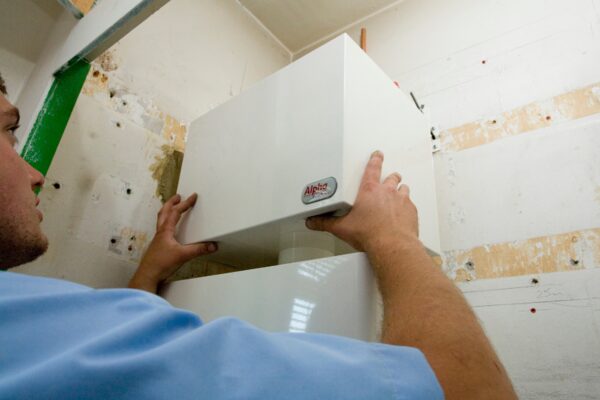
A competent person scheme is a government approved route that lets registered installers certify their own work13. An installer, for example of windows or boilers, who is registered with a scheme can self-certify that their work complies with building standards, and the resulting certificate can be used as evidence of compliance14. Members can certify their own work and tell the council that the work has been properly installed and tested15. A registered installer will be approved to carry out the work to comply with building regulations without involving local authority building control16.
The advantage for a household is procedural. Instead of a separate building control application, notification and inspection, the scheme handles the notification and the certificate arrives through the installer. The certificate is not a lesser document: it is the compliance record, and it is what a buyer's solicitor will ask for.
The limits matter too. Self-certification only covers the types of work the scheme is registered for. Where the work is not covered, or the installer is not registered, approval can be sought from the relevant Building Control Body, either at your local authority or a registered building control approver, who will check compliance and issue a certificate of compliance if satisfied9. Where a heat pump installer is not a registered competent person, the installer must notify an appropriate building control body before work begins3. Before work begins the installer must either notify the local authority or arrange for a registered building control approver to oversee the work5.
For a household weighing up independence, the scheme route keeps the compliance record inside a recognised framework rather than depending on the installer's own paperwork alone. It does not remove the dependence on the installer to notify correctly, which is why the certificate itself is the thing to hold.
Notifiable and non-notifiable work: where your job sits
Not everything needs a certificate. Work is exempt from notification where it is carried out under a self-certification scheme listed in Schedule 3, and where work is listed in Schedule 4 to the Building Regulations as being not notifiable17. For Schedule 4 work there is no requirement for a certificate confirming that the work complies with Building Regulation requirements to be given to the occupier or the building control body17.
For electrical work, the dividing line is location and type. Most repairs, replacements and maintenance jobs, and alterations or additions to existing circuits outside special locations, are non-notifiable11. Adding lighting points, including light fittings and switches, to an existing circuit is permitted where the work is not in a kitchen or special location and does not involve a special installation18. The installation of a new consumer unit or fuse box is notifiable11. Notifiable work must be reported to the local building control body unless completed by someone registered on the competent person scheme who can provide a compliance certificate19.
The Building Regulations allow certain works, known as non-notifiable or minor work, to be carried out without having to tell building control7. Repairs, replacements and maintenance work, and extra power points or lighting points or other alterations to existing circuits, do not need to be reported, except in a kitchen or bathroom, or outdoors7.
| Work | Notifiable? | Certificate expected |
|---|---|---|
| New consumer unit or fuse box | Yes11 | Electrical Installation Certificate8 |
| Work in a kitchen, bathroom or other special location | Yes, unless a scheme member does it12 | Compliance certificate via the scheme19 |
| Extra socket on an existing circuit, outside special locations | No7 | None required17 |
| Adding a light fitting to an existing circuit, outside a kitchen | No18 | None required17 |
| Replacement windows and doors | Yes, unless self-certified4 | Compliance certificate or FENSA-style certificate20 |
Part P: electrical work in dwellings
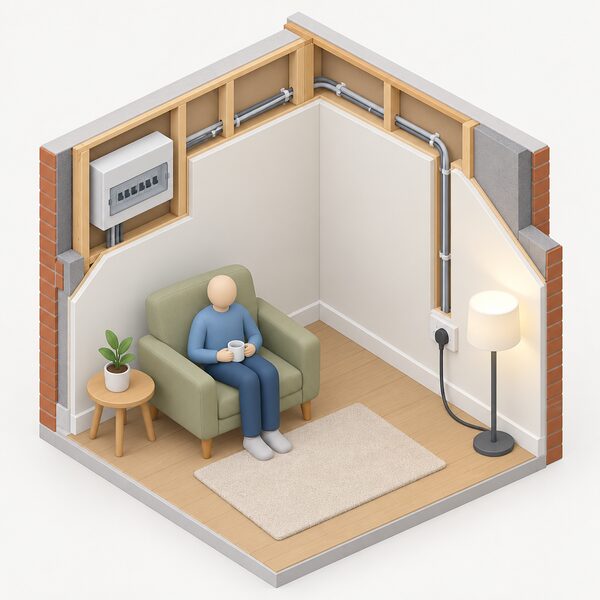
Part P of the Building Regulations governs electrical safety in dwellings, including a house, a flat or a small commercial premises linked to domestic accommodation18. All new electrical work in a dwelling must be designed and installed to account for it18. Approved Document P provides further practical guidance for undertaking this type of work7. The Building Regulations only set standards for electrical installation work in relation to dwellings, and they do not set standards for the safety of electrical appliances, though they do require that fixed connections of appliances are safe7.
The certificate that follows is specific. A copy of the Installer's Electrical Installation Test Certificate compliant with BS7671 must be obtained and supplied to the local authority15. Until this certificate is received a Completion Certificate for the whole of the works cannot be issued15. Where the plans or building notice route is used, an Electrical Installation Certificate signed by a competent person must be provided when work is finished8.
Special locations carry their own notification rule. Any electrical work in special locations or installations is notifiable unless the installer is a member of a Competent Persons Self Certification Scheme, and the list includes kitchens, bathrooms, shower rooms, swimming pools, paddling pools, hot air saunas, electric floor or ceiling heating systems, garden lighting or power installations, solar photovoltaic power supply systems, small scale generators such as micro combined heat and power units, and extra low voltage lighting installations, unless they are pre-assembled, CE-marked lighting sets12.
The Building Regulations do not cover appliance safety, so a certificate for the fixed wiring is not a statement about the appliance plugged into it. That distinction matters when a warranty claim turns on whether the installation or the product failed.
Certificates for specific installations: windows, heating and solar
Different installations generate different documents, and the names are not interchangeable.
Windows and doors. Replacing windows and doors is covered by the Building Regulations6. A registered installer will be approved to carry out the work to comply with building regulations without involving local authority building control, and a certificate is issued on completion16. FENSA self-certifies window and door installations under Building Regulations and provides a FENSA certificate, often requested during property sales20. Certass provides a certificate of compliance for your records and future home sales20. Where the work is not self-certified, approval can be sought from the relevant Building Control Body, which will check compliance and issue a certificate of compliance if satisfied9.
Heating and boilers. When works have been completed the installer should produce a commissioning certificate such as a Benchmark and notify the local authority building control department directly or via the scheme operator1. The local authority should then supply a Building Regulations Completion Certificate indicating compliance2. Where the installer cannot self-certify, the firm or the householder must give notice to the local authority of the intention to carry out the boiler work in advance and pay a notification fee1.
Solar PV and wind. Installers who are members of a relevant competent person scheme can self-certify certain types of building work, including solar PV installation, avoiding separate building regulations approval18. For wind turbines, the route depends on the mounting: an installer registered with the relevant competent person scheme may be authorised to self-certify work on turbines attached to the house under Row 17 of Schedule 3, and for turbines not attached to the house the equivalent route sits in Row 1216. Where the electrical work is of the type listed in Row 12 and the installer is a member of a competent person scheme listed against that row, the installer may be authorised to self-certify the work without involving local authority building control16.
Oil. A registered technician will give you a commissioning certificate which meets building control's regulations21.
Electric vehicle chargepoints. Notifiable work must be reported to the local building control body unless completed by someone registered on the competent person scheme who can provide a compliance certificate19.
Listed buildings. Where a building is listed, special planning controls apply and listed building consent is needed for works that affect it22. If you need to change your windows you will probably need either Listed Building Consent or a Certificate of Lawfulness, and the same applies where new material is introduced or original fabric removed, including painting, re-rendering, cladding, re-roofing and changing windows and doors23.
Benchmark: the commissioning checklist for heating systems
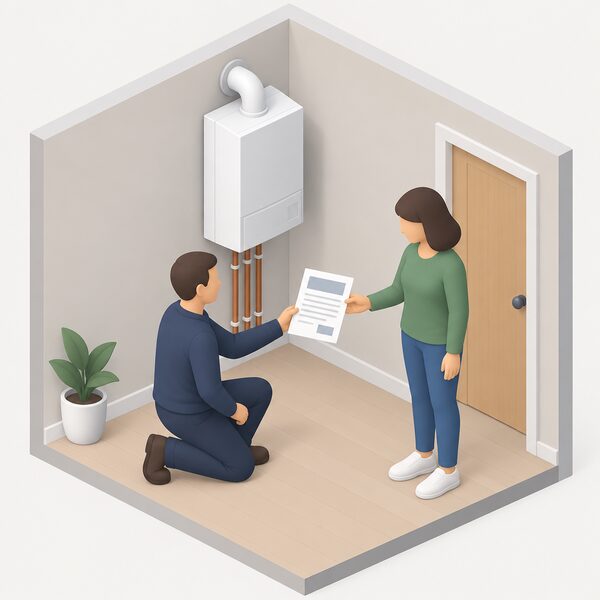
The Benchmark certificate is the commissioning record for a heating system. Official guidance states that when works have been completed the installer should then produce for you a commissioning certificate such as a Benchmark, and notify the local authority building control department either directly, or, if a member of a Competent Person Scheme, via the scheme operator2. The same wording appears in the boiler and heating guidance: the installer should produce a commissioning certificate such as a Benchmark, and the local authority should in due course supply a Building Regulations Completion Certificate that indicates compliance1.
The document records that the system was commissioned, not merely installed. That distinction is what makes it useful later: a warranty claim or a service visit turns on whether the appliance was set up to the manufacturer's specification at the point of installation, and the commissioning record is the evidence.
Related checklists exist elsewhere in the framework. Accredited Construction Details contain checklists which should be used by the Designer, Constructor and Building Control Body to demonstrate compliance24. For renewable installations supported by the Feed-in Tariff, the commissioning certificate or letter had to confirm the location of the installation and the date the installation was commissioned, signed by the installer or engineer who carried out the tests and procedures10.
For a household, the commissioning record is the document that makes the system's performance auditable. It is also the document most often missing from a second-hand installation, which is why a buyer's surveyor asks for it.
What happens if the paperwork is missing
The first consequence is legal. You may have to correct the work or pay a fine if building regulations are not followed14. If you are the owner of the building, it is ultimately you who may be served with an enforcement notice if the work does not comply4.
The second is transactional. Without approval you will not have the certificates of compliance you may need when you want to sell your home6. A FENSA certificate is often requested during property sales, and a Certass certificate of compliance is issued for your records and future home sales20.
The third is practical. A missing certificate usually means a missing notification, and a missed notification is harder to fix than a lost document. Where the installer is still trading and still registered, the scheme operator can often reissue. Where the installer has gone, the building control body that holds the record is the route.
The dates matter when chasing. The compliance certificate should arrive within 30 days of the work being completed4. If it has not arrived by then, the installer or the scheme is the first point of contact, and the building control authority is the second.
Keeping certificates safe: selling your home and replacing lost documents

Certificates should be kept with the property's other papers, not with the appliance manuals. The reason is that they are requested at the point of sale, and a conveyancer will ask for the compliance record for any notifiable work.
Replacing a lost certificate is possible because the record is duplicated. Regulation 18 of the Building Regulations 2010 requires that, where the building control authority is a designated local authority, it must send a copy of each certificate it gives under this regulation in relation to a building to the local authority for the area in which the building is situated25. The England version applies the same duty where the relevant authority is the regulator25. In practice this means a copy sits with the council, and a duplicate can be traced through the authority that holds it.
In Scotland the completion stage works differently. On completion, the owner or client must certify that the works have been constructed in accordance with the building warrant and the building regulations26. An approved certifier of construction who has been assessed to have the professional skills and relevant experience can certify compliance with the electrical safety requirements27. An approved Certifier of Construction can also certify compliance of plumbing, heating or drainage installations28.
For renewable installations, the commissioning paperwork has a second life. Ofgem's supplier guidance lists installer paperwork such as a commissioning certificate as suitable evidence for technology type, declared net capacity, installation type and total installed capacity11. The Feed-in Tariff commissioning guide sets out the same requirement in the form of a signed certificate or letter10.
The wider point for a household's energy independence is that the paperwork is what converts a private installation into a documented one. A solar array, a heat pump or a battery reduces reliance on a supplier, but the certificate is what allows the installation to be sold, mortgaged, insured or repaired without argument. The dependence that remains is on the scheme, the building control body and the manufacturer's records, and those are the places to look when a document goes missing.
Sources28 cited
- Boilers and heating: Building Regulations, Planning Portal, 2026
- Building Regulations: boilers and heating, Welsh Government, 2026
- Approved Document L Volume 1: Dwellings, GOV.UK, 2026
- When you need approval, Planning Portal, 2026
- Building Regulations, Planning Portal, 2026
- Building Regulations approval, GOV.UK, 2026
- Building Regulations: electrical work in homes and gardens, Welsh Government, 2026
- Electrical safety: building control, Cumberland Council, 2026
- Doors and windows: Building Regulations, Planning Portal, 2026
- Feed-in Tariffs guide: commissioning, Ofgem, 2023
- Feed-in Tariff guidance for licensed electricity suppliers, Ofgem, 2024
- What is the difference between planning permission and Building Regulations approval, Planning Portal, 2026
- Building Regulations: competent person schemes, GOV.UK, 2026
- Use a competent person scheme, GOV.UK, 2026
- Building control application guidance notes, London Borough of Bromley, 2026
- Building Regulations: doors and windows, Welsh Government, 2026
- Building Regulations: Part J heat producing appliances, Welsh Government, 2025
- Building Regulations: electrics general information, Planning Portal, 2026
- Building Regulations: electric vehicle charging, Planning Portal, 2026
- Window installations: guide to regulations, The CPA, 2025
- Domestic oil installation and boiler servicing, nidirect, 2024
- Planning and listed building consent requirements, West Northamptonshire Council, 2023
- Making alterations to a listed building, Bristol City Council, 2026
- Accredited Construction Details, Planning Portal, 2026
- The Building Regulations 2010, Regulation 18, legislation.gov.uk, 2026
- Building Standards Technical Handbook: Domestic (April 2026), Scottish Government, 2026
- Building Standards Technical Handbook 2020: electrical safety, Scottish Government, 2020
- Building Standards Technical Handbook 2022: water efficiency, Scottish Government, 2022
 Solar Panel InstallationHow long will the panels actually take to fit, and what happens on the day?
 Selling a Home With Energy KitCovers the paperwork a sale requires when a home has solar panels, a heat pump, insulation or a leased roof, and how warranties, export payments and guarantees transfer.
 Building Regulations EnglandAdding a heat pump, solar panels or an extension usually needs building regulations approval, and it is separate from planning permission.
 Paperwork to KeepThe certificates, guarantees and records that follow each type of energy work, why they matter at sale, for grants and for export payments, and where replacements can be obtained.
 Competent Person SchemesIf a tradesperson says they can sign off their own work, how do you know they are genuinely registered?
 Manufacturer WarrantiesHow long does a boiler, heat pump or solar panel warranty actually last, and what do you have to do to keep it valid?