

In this guide
For the Boiler Upgrade Scheme, the answer is yes: the installation must be carried out by an installer certified by the Microgeneration Certification Scheme (MCS). The scheme is installer-led, which means the property owner does not apply to Ofgem directly. The chosen MCS certified installer applies for the grant voucher on the owner's behalf, discounts the grant from the invoice, and redeems the voucher after the installation is commissioned1.
The money involved is substantial. The standard grant is £7,500 for eligible properties that do not qualify for the uplifted amount, and £9,000 for eligible off-gas grid properties with an air-to-water or ground source heat pump, a rate available from 21 July 2026 and in place until 31 March 20273. The full grant value must be deducted from the quote before any payment is made by the property owner, so the household never pays the gross price and waits for reimbursement3.
The certification requirement is not a formality. Without an MCS certified installer you will not be eligible for financial incentives, and all installations under the scheme must be MCS certified, meaning delivered by an MCS installer using MCS certified products4. The rest of this page sets out how the installer-led process runs, what the other funded schemes require, and what happens when certification lapses mid-job.
Yes: a Boiler Upgrade Scheme installation must be done by an MCS certified installer
The requirement is stated in the same terms across the official documents. To be eligible for the Boiler Upgrade Scheme, installers must be MCS certified and meet the MCS standards, and installers must be MCS certified to participate in the scheme at all1. The certification applies to the company and to the products: all installations under the scheme must be MCS certified, which means delivered by an MCS installer using MCS certified products5.
MCS itself is a certification scheme for microgeneration installation companies and products. It certifies, quality assures and provides consumer protection for microgeneration installations and installers, covering small-scale renewable electricity technologies such as solar photovoltaic panels, biomass, wind, heat pumps and heat products8. That breadth matters for households planning more than one measure, because the same certification body covers the heat pump and, separately, the solar array.
The standards are not left to the installer's judgement. All heating systems installed under the Boiler Upgrade Scheme must meet the relevant MCS standards approved and published by the Secretary of State3. The scheme also sets technical thresholds that the installer must design to: air-to-water and ground source heat pumps must achieve an in situ seasonal coefficient of performance (SCOP) of at least 2.8, and the heat pump system must provide 100% of the space heating needs of the eligible property3. Heat pump compressors must be electric-driven9.
"All installations under the BUS must be MCS certified, that means delivered by an MCS installer, using MCS certified products"
For a household, the practical effect is that the certification is the gate to the money, not a quality badge bolted on afterwards. It also means the installer carries the compliance burden: the design, the product selection and the commissioning evidence all have to satisfy MCS standards before Ofgem will pay. The MCS certified installers page covers what the certification covers in more detail, and the MCS installation standards page sets out the individual standards.
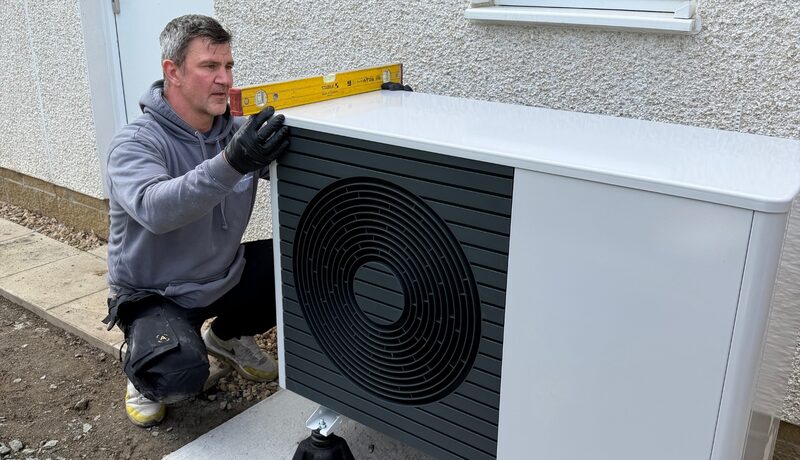
How the installer-led voucher process works, from application to redemption

The scheme is installer-led. Installers who are MCS certified can apply for and redeem Boiler Upgrade Scheme vouchers on behalf of property owners, and the application is installer-led, with the installer applying for the grant on the property owner's behalf10. Ofgem administers the scheme on behalf of the Gas and Electricity Markets Authority9.
The grant application has two stages: a Voucher Application and a Voucher Redemption Application3. The installer submits the voucher application, Ofgem issues the voucher, the installer submits the redemption application after commissioning, and the installer receives the grant payment11. A voucher application is only considered properly made once Ofgem has all the necessary information to assess eligibility, and the property owner has provided consent and identity verification9.
The sequence a household experiences runs as follows.
- The installer surveys the property and confirms the technology and eligibility.
- The installer applies to Ofgem for a voucher, with the owner's consent and identity verification.
- Ofgem assesses the application and issues the voucher.
- The installation is completed and commissioned to MCS standards.
- The installer submits the redemption application, and the grant is paid to the installer.
The application must be properly made within 120 days of the commissioning date, and Ofgem may grant an extension to that rule where the length of time taken to reach certain administrative decisions results, or is likely to result, in the 120-day period being exceeded for a re-application3. Voucher validity periods cannot be extended under any circumstances9. Only one voucher can be redeemed per property, and a property is not eligible if a previous BUS grant has already been received for installing a heat pump or biomass boiler at the same address3.
Payments to installers run on a weekly schedule, usually within five working days of approval, by BACS transfer into UK bank accounts which accept pound sterling9. If payment has not been received ten working days after notification of a successful voucher redemption application, the installer can raise it with Ofgem9. For the household, the important point is that the grant is settled between Ofgem and the installer: the owner's protection lies in the deduction from the quote, not in a payment they make and reclaim.
Other schemes and their installer requirements
The Boiler Upgrade Scheme is not the only funded route, and the installer requirements differ by scheme and by nation. The table below sets out what each requires.
| Scheme | Who administers it | Installer requirement | Grant or funding |
|---|---|---|---|
| Boiler Upgrade Scheme | Ofgem, for the Gas and Electricity Markets Authority9 | MCS certified installer and MCS certified products1 | £7,500 standard, £9,000 off-gas grid uplift3 |
| ECO4 | Energy suppliers, under Ofgem's delivery guidance12 | Competent person register such as TrustMark for finding an installer13 | Supplier-funded measures; BUS and ECO funding cannot be blended for the same measure12 |
| Warm Homes: Local Grant | Local authorities14 | Delivered through local authority arrangements14 | Up to £30,000 of measures per property15 |
| Warmer Homes Scotland | Scottish Government16 | MCS certified installer for heat pump installations funded by the Home Energy Scotland Grant17 | Heating and insulation measures, including ground source heat pumps16 |
ECO4 is the supplier obligation route. Funding from BUS and ECO cannot be blended for the same measure or be included within an ECO4 project, so a household cannot stack the two on one installation12. For finding an installer under ECO, official guidance points to searching a competent person register such as TrustMark, the government endorsed scheme for work done around the home, where an installer will assess circumstances and the property to identify suitable measures13. The TrustMark registered businesses page explains what that registration covers.
Warm Homes: Local Grant is administered by local authorities and provides grants to low-income households living in privately owned properties, funding insulation, energy-efficient heating systems and renewable energy installations14. Up to £30,000 of measures is available per property, and gas and oil boilers are not eligible improvements under the scheme15. The scheme is to be delivered from April 2025 to March 202818. Eligibility is described in two different ways across the documents: one source sets the threshold at households with a combined income of less than £36,000, while another adds that the home must be in England, privately owned, rated EPC D to G, with household savings less than £25,000 and income usually £36,000 a year or less, subject to postcode or benefits exceptions15.
Warmer Homes Scotland helps households in, or at risk of, fuel poverty improve their heating and energy efficiency, and was launched in September 2015, then relaunched in 2023 with increased funding for clean heating systems16. It has a strong focus on heating and insulation measures, and renewable and micro-generation measures have been made available, including ground source heat pumps, micro-wind, micro-hydro and micro-CHP systems20. Heat pump installations funded by the Home Energy Scotland Grant need to be carried out by an MCS certified installer17. The installers in Scotland page covers the wider Scottish picture.
Finding and checking an MCS certified installer
The starting point is the MCS directory of certified installers and products, which is the register the scheme rules point to. The Boiler Upgrade Scheme guidance for property owners states that the chosen installer will need to be certified by the Microgeneration Certification Scheme, a nationally recognised certification body2. Checking the certificate number and the scope of certification, rather than the logo on a van, is what confirms the installer can actually redeem a voucher.
MCS runs its own layer of checking on top of the scheme's audit programme. MCS undertakes its own checks on installations completed by MCS certified installers, separate from Ofgem's audit programme, and may contact owners directly or arrange a visit4. Property owners contacted for those checks should aim to respond within seven days9. Ofgem's own audit power is broad: it can conduct site or desk audits at any point after a BUS application, including after grant payment, and these can be either site or desk audits21. A formal request for access will be issued as a notice to the property at least two days before the proposed inspection9.
Installers are required to keep all documentation relied upon in voucher applications and voucher redemption applications for six years from the date the application was properly made3. That retention period is what allows an audit to be answered long after the work is finished, and it is a reason for a household to keep its own copy of the handover documents. The MCS certificate and handover documents page sets out what should be in that pack.
If something goes wrong, the contact depends on the nature of the problem. MCS is the contact for issues with the installation process, the installer, or the MCS certificate or product22. For scheme administration, including voucher and payment questions, Ofgem's BUS Enquiries team can be reached at BUS.Enquiry@ofgem.gov.uk or by phone on 0330 053 20063. Where a complaint escalates, the complaining about an installer page covers the route.

What happens if the installer's certification lapses mid-job

Certification is a live status, not a one-off qualification, and the scheme rules treat it that way. Ofgem's installer guidance added an explicit rule that installers cannot use a temporary MCS certification number to create an account or apply for a voucher, and that retrospective applications are allowed only after full certification, at the installer's risk6. The practical consequence is that a company part-way through certification cannot start the voucher process on the strength of an application in progress.
The voucher timetable compounds the risk. Voucher validity periods cannot be extended under any circumstances, and the application must be properly made within 120 days of the commissioning date9. If certification lapses during that window, the deadline does not move to accommodate it. Every new voucher application receives a new unique voucher ID, and any supporting evidence from a previous application cannot be transferred and will need uploading again; the date Ofgem receives consent and new supporting valid evidence is when the new voucher application is considered properly made9.
There is also a budget dimension. Ofgem cannot issue any new vouchers once the budget threshold has been met, and queue position is based on when the voucher application is deemed properly made9. Unspent budget is not carried over to the next scheme year11. A re-application therefore loses its place in the queue as well as its evidence, which is a material risk where a quarterly cap is in force.
For the household, the protection is in the sequence of payments rather than in the certification itself. Because the full grant value must be deducted from the quote before any payment is made by the property owner, the owner is not advancing the grant money and waiting to be reimbursed3. The exposure is to delay and to the loss of the grant if the installer cannot complete the redemption, which is why the certification status of the company is worth checking at the point of signing rather than at the point of commissioning. The checking an installer before you sign page covers the wider checks, and the when an installer goes bust page deals with the failure case.
What the grant covers, and what it does not
The grant values are set by technology and by property. The standard grant is £7,500 for eligible properties that do not qualify for the uplifted amount, and the uplifted grant value of £9,000 applies to eligible off-gas grid properties with an air-to-water heat pump or ground source heat pump3. The uplifted rate is available from 21 July 2026 and will be in place until 31 March 20273. The documents give different figures in places: one official source states £7,500 for a ground source heat pump and £5,000 for a biomass boiler, while another gives £2,500 for air-to-air heat pumps and £5,000 off a biomass boiler2. The grant categories are currently based on replacement technology type, and the Secretary of State may review grant values at any time, with a grant change notice published at least 28 days before a change takes effect9.
| Technology | Grant position |
|---|---|
| Air-to-water heat pump | Eligible; £7,500 standard, £9,000 off-gas grid uplift3 |
| Ground source heat pump (including water source and shared ground loops) | Eligible; £7,500 standard, £9,000 off-gas grid uplift3 |
| Air-to-air heat pump | Eligible for residential properties only; £2,50023 |
| Biomass boiler | Eligible in rural areas only; £5,0002 |
| Hybrid heat pump system | No grant available24 |
| Fossil fuel hybrids | Not eligible9 |
The technical conditions are detailed. The previous heating system being replaced must have been either a fossil fuel-based system or an electric heating system that does not include a heat pump, and the BUS-funded system must fully replace the property's existing fossil fuel or electric heating system, except where supplementary heating appliances are permitted3. From 28 April 2026, BUS heat pumps can be installed alongside supplementary heating appliances, provided these appliances are not fossil fuel based3. Biomass boilers cannot be installed alongside supplementary heating appliances, must not be installed in properties connected to the gas grid, and may only be installed in properties in rural areas9.
Capacity limits apply to the installation. The maximum permitted capacity is 45 kWth for an individual heat pump system, 70 kWth for a multi heat pump system, and 300 kWth total for shared ground loop systems, with each connected heat pump not exceeding 45 kWth3. The maximum permitted capacity for an individual biomass boiler system is 45 kWth9. Biomass boilers must also meet emissions limits: particulate matter must not exceed 30g/GJ net heat input and NOx must not exceed 150 g/GJ net heat input3.
Some properties are excluded outright. Properties classed as social housing are not eligible for BUS funding, including shared ownership properties, and new builds by developers are not eligible8. Self-build properties are only eligible for BUS funding for heat pumps, and the property must have been built mainly using the labour or resources of the first owner3. From 28 April 2026, properties are no longer required to have a valid EPC to apply for BUS, although earlier guidance required a valid energy performance certificate and a certificate number no more than 10 years old3. The scheme has been extended to 2030, and the guidance applies to applications properly made on or after 28 April 20263.
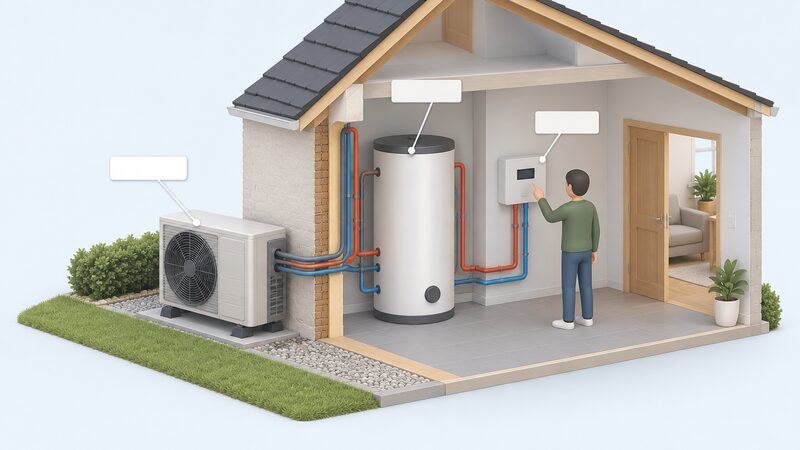
Where the installer requirement leaves a household's independence
The certification requirement does two things at once for a household's energy independence. It ties the grant to a verified supply chain, which raises the floor on design and commissioning quality, and it concentrates the administrative process in the installer's hands, which means the household's access to public money depends on a company's registration status remaining valid through the voucher window.
The dependence that remains is worth stating plainly. The grant is paid to the installer, not to the owner, and the owner's protection is the deduction from the quote3. The voucher belongs to the property and the installer's application, not to the household, and only one voucher can be redeemed per property9. The scheme itself is time-limited: it has been extended to 2030, and the uplifted off-gas grid rate runs only until 31 March 20273. The Secretary of State may review grant values at any time, with at least 28 days' notice of a change9.
There is also a fuel dependence question underneath the grant. A heat pump replaces a fossil fuel or electric heating system, and the household remains connected to the electricity grid for its operation, with the running cost set by the tariff rather than by the scheme3. The grant reduces the capital cost of the change; it does not change the fact that the heat pump runs on imported or grid-generated electricity. What it does change is the household's exposure to gas or oil supply for heating, which is the dependence the scheme is designed to reduce.
For households in Scotland, Wales and Northern Ireland, the position differs. The Boiler Upgrade Scheme covers England and Wales only9. Scotland routes support through Warmer Homes Scotland and the Home Energy Scotland Grant, where heat pump installations funded by the grant also need to be carried out by an MCS certified installer17. The installers in Wales and installers in Northern Ireland pages cover the arrangements in those nations, and the installers and energy independence page sets out the wider picture.
Sources24 cited
- Boiler Upgrade Scheme, Ofgem, 2026-09-17
- Boiler Upgrade Scheme, GOV.UK Find Government Grants, 2026-09-18
- Boiler Upgrade Scheme guidance for installers v5.1, Ofgem, 2026-07-02
- Boiler Upgrade Scheme guidance for property owners v5.1, Ofgem, 2026-07
- MCS outreach reveals high satisfaction rates for Boiler Upgrade Scheme installations, MCS, 2026-02-02
- Summary of updates to BUS guidance for installers V5, Ofgem, 2026-04
- BUS Annual Report 2024 to 2025, Ofgem, 2025-07
- Boiler Upgrade Scheme guidance for property owners V5, Ofgem, 2026-04-28
- Boiler Upgrade Scheme guidance for installers V5, Ofgem, 2026-04-28
- Boiler Upgrade Scheme, Ofgem, 2026-09-17
- BUS Quarterly Report Issue 14, Ofgem, 2025-11-26
- ECO4 delivery guidance v3.2, Ofgem, 2025-12-08
- Energy Company Obligation (ECO) scheme, Leeds City Council, 2026-09-20
- Warm Homes: Local Grant, Greater Manchester Combined Authority, 2026-09-17
- Home and business grants, schemes and advice, East Hertfordshire District Council, 2026-09-17
- Warmer Homes Scotland scheme headline data, Scottish Government, 2025-10-29
- What the Warm Homes Plan and Future Homes Standard mean for installers, NICEIC, 2026-04-23
- Warm Homes: Local Grant statistics August 2026, GOV.UK, 2026-08
- Warmer Homes, Greater London Authority, 2026-09-17
- Energy saving home improvements, Scottish Government, 2026-09-17
- Boiler Upgrade Scheme installers, Ofgem, 2026-09-17
- Who to contact, Ofgem, 2026-09-17
- Carbon Budget and Growth Delivery Plan: heat and buildings factsheet, GOV.UK, 2026-06-23
- What you can get, GOV.UK, 2026-09-17
 Buying Direct or Via InstallerCan you buy a heat pump yourself and still get the grant, or does it have to go through an installer?
 Installer QualificationsWhat training and qualifications should a heat pump installer actually have?
 The Full Heat Pumps GuideWill a heat pump keep my house warm in winter, and what does one cost to buy and run?
 Grants and Energy IndependenceCan you get a grant for solar panels or a battery?
 Apply for a Home Energy GrantThe application sequence common to funded schemes: the checker, the survey or assessment, the installer, the paperwork and the sign-off.
 Ground Source Heat PumpsA ground source heat pump takes warmth from the ground to heat your home and water.