

In this answer
Short answer
Yes. To get a Boiler Upgrade Scheme grant, the installer must be MCS certified and certified to install heat pumps or biomass boilers, and the heat pump itself must carry MCS certification1. The scheme is installer-led: an MCS-certified installer applies to Ofgem for the voucher on the property owner's behalf, discounts the grant from the invoice, and redeems the voucher once the installation has been commissioned3. A householder cannot apply directly.
The money is substantial. Ofgem's installer guidance gives an air-to-water heat pump a grant value of £7,500 from 21 July 2026, and eligible off-gas grid properties an uplifted grant of £9,0001. Air-to-air heat pumps carry a £2,500 value from the same date, but only once they can be certified by MCS1. The scheme covers England and Wales, and is scheduled to close to new applications at 11:59pm on 30 December 20295.
Certification is therefore not paperwork at the margins of the grant. It is the gate: no MCS installer, no voucher, and no MCS certificate on the heat pump, no redemption. What follows sets out the rule, the amounts, who qualifies, how the installer-led process runs, the timing windows, and where the scheme does not reach.
The certification rule: installer and heat pump both
The requirement runs in two parts. Ofgem's installer guidance states that installers must be MCS certified and be certified to install heat pumps and/or biomass boilers1. The property owner guidance repeats the same condition from the household side, and independent certification bodies put it plainly: the installer must be MCS-certified and the heat pump must be MCS-certified2. Both halves have to be satisfied for a voucher to be issued and redeemed.
That second half is easy to overlook. A competent installer working with an uncertified unit does not produce an eligible installation, because the MCS certificate is what evidences the work and carries the commissioning date that the voucher application depends on. The Energy Saving Trust's moving-house checklist tells buyers to check if the heat pump has an MCS certificate, which is the same check a grant application turns on7. Where metering is required, Ofgem guidance adds that the metering information must be added to the MCS certificate1.
For a household, the practical consequence is that certification is a property of the whole job, not just the tradesperson. The certificate number, the commissioning date and the model installed all travel together into the application. A Domestic Renewable Heat Incentive participant taking over payments needs the original MCS certificate number for the heat pump and the installer commissioning certificate, which shows how central those documents are across the heat schemes8.
Checking status is straightforward. MCS publishes a Find an Installer tool and a Customer Support Helpdesk for confirming whether a business is certified9. The same tool will list certified installers for air-to-air heat pumps once they are ready under the scheme10. The Energy Saving Trust recommends getting quotes from at least three different MCS-certified installers, which is a price check rather than a grant rule11.

What the Boiler Upgrade Scheme pays

The headline figure is £7,500 towards the cost of installing a heat pump, available to property owners including landlords, and paid as a one-off voucher to the registered installer who then deducts it from the householder's bill12. Ofgem's installer guidance sets the air-to-water heat pump grant value at £7,500 from 21 July 20261.
Off the gas grid, the figure rises. From 21 July 2026, eligible off-gas grid properties can apply for an uplifted grant of £9,000, for air-to-water or ground source heat pumps1. Citizens Advice describes the same structure from the household side: £7,500 to help pay for an air-to-water heat pump, or £9,000 if the home is not on the gas grid and uses oil or liquefied petroleum gas14. The uplift is aimed at homes carrying the higher running costs and disruption of oil or LPG heating.
Air-to-air heat pumps sit at a lower value. Ofgem's guidance gives them a grant value of £2,500 from 21 July 2026, against £7,500 for air-to-water1. They are not eligible until they can be certified by MCS, which the Warm Homes: Local Grant policy guidance expected in 20264. MCS states that once air-to-air units are ready under the scheme, its Find an Installer tool will be usable to find a certified installer10.
| System | Grant value from 21 July 2026 | Notes |
|---|---|---|
| Air-to-water heat pump | £7,500 | Standard rate1 |
| Air-to-water or ground source, eligible off-gas grid property | £9,000 | Uplifted rate1 |
| Air-to-air heat pump | £2,500 | Once MCS certification is available1 |
The higher grant rate applies to new applications submitted from 21 July 202615. The scheme is scheduled to close at 11:59pm on 30 December 20295.
Who qualifies: England, Wales and the heating being replaced
The Boiler Upgrade Scheme provides grants for heat pump installations across England and Wales16. Its purpose, as set out when it launched, is to encourage property owners in England and Wales to install low carbon heating systems such as heat pumps, and in limited circumstances biomass systems, replacing high carbon fossil fuel heating17. The scheme therefore turns on what is being replaced as much as what is being installed.
Independent guidance on the air-to-air grant describes eligibility as generally including homeowners in England and Wales replacing fossil fuel heating systems, subject to property and installer criteria18. The same shape applies across the scheme: a fossil fuel or electric system comes out, a certified low carbon system goes in, and an MCS-certified installer carries the application.
Scotland and Northern Ireland sit outside the Boiler Upgrade Scheme. Scotland runs its own route: the Home Energy Scotland Scheme offers grants to homeowners to install heat pumps19, and only MCS certified heat pump installations qualify for that scheme2. The Scottish Government's 2025 progress report records changes to eligible measures, including removing hybrid heat pumps, solar PV and battery, and changes to the eligibility of self-builders20. Home Energy Scotland's grant and loan terms state that hybrid heat pumps are not eligible for funding21, and grant funding is not available for replacement heat pumps, wind or hydro turbines, warm air units, solar water heating systems, glazing or insulated doors22.
For a Welsh household, the same England and Wales scheme applies, and the Welsh Government has separately promoted support for households investing in greener homes23. The practical point for a householder in any of the four nations is to establish which scheme covers the property before choosing an installer, because the certification requirement is common to all of them but the grant amounts and eligible measures are not.
How the installer-led application works
The application is installer-led, with the installer applying for the grant on the property owner's behalf3. In practice the installer discounts the grant from the invoice, applies to Ofgem for a grant voucher, and redeems the voucher after installation and commissioning3. Ofgem's own description is the same: the scheme is installer-led, and installers who are MCS certified can apply for and redeem Boiler Upgrade Scheme vouchers24.
The process runs in stages. The installer submits the voucher application, and following successful commissioning of the installation submits a voucher redemption application; once that succeeds, a grant payment is made to the installer25. The householder's role is to choose a certified installer, agree the work, and confirm the property and heating details that the application rests on.
- Choose an MCS-certified installer, checking status through the MCS Find an Installer tool or helpdesk9.
- The installer applies to Ofgem for a grant voucher on the property owner's behalf3.
- The installation is completed and commissioned, producing the MCS certificate and commissioning date1.
- The installer submits the voucher redemption application after successful commissioning25.
- Ofgem pays the grant to the installer, who has already discounted it from the householder's invoice3.
Government guidance for householders points to the same route: the installer applies for the grant on the householder's behalf through Ofgem, and a quote can be sought through the MCS find a heat pump installer tool or by contacting an energy supplier16. The Energy Saving Trust's recommendation of quotes from at least three certified installers fits naturally at step one11.
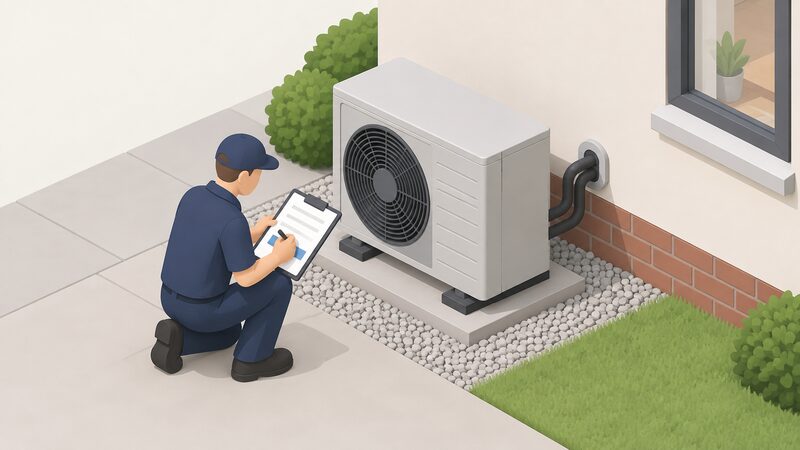
Timing: the 120-day window and voucher validity

Two clocks matter. The first governs the voucher application. Installers must ensure the voucher application is properly made within 120 days of the commissioning date on the MCS certificate1. Ofgem's installer page states the same rule from the eligibility side: the system must be commissioned no more than 120 days prior to the voucher application being properly made24. The window exists to stop retrospective claims on long-finished installations.
The second clock governs the installation itself. Once a voucher is issued, the work must be completed within its validity period, which the property owner guidance gives as 3 months for air-to-water heat pumps, air-to-air heat pumps and biomass boilers26. A voucher that lapses before commissioning cannot be redeemed, so the two windows have to be planned together: the installation has to happen inside the voucher's life, and the voucher application has to be made inside 120 days of the commissioning date.
| Rule | Period | Source |
|---|---|---|
| Voucher application after commissioning | Within 120 days of the MCS certificate commissioning date | 1 |
| Commissioning before voucher application | No more than 120 days prior | 24 |
| Installation after voucher issue | Within 3 months | 26 |
For a household, this is where an installer's administrative reliability matters as much as their technical work. A correctly certified installation that misses the 120-day window produces no grant, and the householder has no direct route to apply. The dates on the MCS certificate are the ones that count, which is another reason the certificate itself is worth checking at handover7.
Where the scheme falls short
The Boiler Upgrade Scheme does not reach every home or every technology, and the gaps are worth knowing before an installer is appointed.
Hybrid heat pumps are not funded through the routes covered here. Home Energy Scotland's terms state that hybrid heat pumps are not eligible for funding21, and the Scottish Government's progress report lists the removal of hybrid heat pumps, solar PV and battery as eligible measures20. A household wanting a heat pump paired with a retained fossil fuel boiler should not assume grant support.
New-build properties are excluded from the deployment statistics, which do not include installations in new-build properties or retrofit installations that are not MCS certified27. That exclusion reflects the scheme's purpose: it funds retrofit of existing heating, not new construction.
Social housing has its own route. MCS-certified heat pumps with shared ground loops will remain eligible for funding through the Warm Homes: Social Housing Fund4, which sits alongside rather than inside the Boiler Upgrade Scheme. The Warm Homes: Energy Upgrade Grant similarly requires that all measures should be carried out by MCS certified installers, or relevant qualifications in cases of heat network connections28.
Scotland's scheme carries its own exclusions, including replacement heat pumps and several other measures22. Northern Ireland is not covered by the Boiler Upgrade Scheme at all.

What certification means for a household's energy independence
A grant-funded heat pump changes where a home's heat comes from, and that is the independence question. Replacing oil or LPG with a heat pump removes a delivered fuel and its delivery tanker, and moves the household onto electricity, which it can increasingly generate itself. The £9,000 uplift for eligible off-gas grid properties recognises that shift directly1.
What remains is dependence of a different kind. The heat pump runs on electricity, so the household still relies on the grid and a supplier unless it has its own generation. The installation itself depends on a certified supply chain: an MCS-certified installer, an MCS-certified unit, and an Ofgem-administered voucher process that the householder cannot enter directly24. The grant is a one-off capital contribution, not a continuing subsidy, and the scheme closes to new applications at 11:59pm on 30 December 20295.
Certification also carries consumer protection weight. MCS maintains scam-awareness guidance for consumers, and its Find an Installer tool and helpdesk exist precisely so that householders can verify who they are dealing with before money changes hands9. For a household weighing up a heat pump, the certification check is the first step in the process and the one that determines whether any grant is available at all.
Sources29 cited
- Boiler Upgrade Scheme guidance for installers v5.1, Ofgem, 2026-07-02
- Free money: the link between certification and incentives, Eurovent Certification, 2026-05-21
- Boiler Upgrade Scheme, Ofgem, 2026-09-18
- Warm Homes: Local Grant policy guidance, Department for Energy Security and Net Zero, 2026-07
- Boiler Upgrade Scheme, Find Government Grants, 2026-09-18
- Boiler Upgrade Scheme guidance for installers V5, Ofgem, 2026-04-28
- Moving house energy checklist, Energy Saving Trust, 2026-05-01
- Heat pump inheritance, Energy Saving Trust, 2025-07-04
- Be scam aware, MCS, 2026-06-09
- Air-to-air heat pumps, MCS, 2026-07-24
- Installing a ground source heat pump, Which?, 2025-09-22
- What is the Boiler Upgrade Scheme?, Which?, 2025-10-22
- Energy Performance Certificates, Uswitch, 2026-07-27
- Deciding if a heat pump is right for you, Citizens Advice, 2025-12-08
- Air source heat pumps vs ground source heat pumps, Energy Saving Trust, 2026-07-16
- Heat pump, Clean Energy Campaign, 2026-09-10
- Domestic Renewable Heat Incentive closes: what's next for clean heat, Ofgem, 2022-04-07
- Oil heating heat pump grant, Low Carbon Hub, 2026-08-11
- Home Energy Scotland grant and loan terms and conditions, Home Energy Scotland, 2026-09-17
- Heat in buildings progress report 2025, Scottish Government, 2025-10-02
- The Heat in Buildings Programme, Scottish Government, 2026-09-17
- Home Energy Scotland funding portal, Energy Saving Trust, 2026-09-20
- £5 million to help Welsh households invest in greener homes, Welsh Government, 2026-03-05
- Boiler Upgrade Scheme: installers, Ofgem, 2026-09-17
- Insights from Ofgem's Boiler Upgrade Scheme quarterly report, HIES, 2024-01-18
- Boiler Upgrade Scheme guidance for property owners V5, Ofgem, 2026-04-28
- Heat pump deployment quarterly statistics, United Kingdom, 2026 Q1, Department for Energy Security and Net Zero, 2026-06-11
- Clean heat: supporting low-income households, Energy UK, 2026-06-11
- ECO4 delivery guidance v3.2, Ofgem, 2025-12-08
 Installer QualificationsWhat training and qualifications should a heat pump installer actually have?
 MCS ExplainedMCS is the quality mark for solar panels, heat pumps and other home renewables.
 Buying Direct or Via InstallerCan you buy a heat pump yourself and still get the grant, or does it have to go through an installer?
 Appliance Standards and MarkingWhich marks should a boiler, heat pump or cylinder have before you buy, and what do they actually prove?
 Replacing a Gas or Oil BoilerSwapping a gas, oil or LPG boiler for a heat pump changes how your home is heated and how much it costs.
 The Full Heat Pumps GuideWill a heat pump keep my house warm in winter, and what does one cost to buy and run?