
In this guide
The marks on a heating appliance are not decoration. They are the record of who checked the product, against which standard, and under whose authority. For a household, they are the difference between a boiler, heat pump or cylinder that can legally be sold in Great Britain and one that cannot, and between a grant-funded installation that qualifies and one that does not.
Three separate systems sit behind the marks. UKCA marking is the Great Britain conformity mark, and for heating products sold on the GB market there is a mandate to display it1. CE marking ceased to be recognised in Great Britain from 1 January 2023, though energy-related products with the CE mark can currently be sold in Great Britain if they comply with GB ecodesign standards, without also affixing a UKCA mark2. MCS certification is a different thing again: a certification scheme for microgeneration installation companies and products, covering the installer and the installation as well as the product4.
UKCA marking: what it is and when it applies
UKCA marking is the conformity mark for products placed on the Great Britain market. It is not a quality rating and it is not a performance grade. It records that the product has been assessed against the applicable GB rules and that the manufacturer has taken responsibility for that conformity.
The marking regime has a specific requirement for representatives. For any products imported from within the EU, any authorised representative appointed to deal with the marketing and sale of UK products must be based and have a business address situated within the UK2. That is a change of substance for manufacturers who previously relied on an EU-based representative, because the representative's location is now part of the compliance chain rather than an administrative detail.
Documentation runs alongside the mark. Declarations of Performance must reference the new UKCA legislation document, superseding (EU) 305/2011, and must reference UK designated standards rather than the existing EU standards referenced in the Official Journal2. Those declarations must continue to be made available to market surveillance authorities2.
Conformity assessment itself has a location requirement. Any product placed on the market after the implementation date needs its conformity assessment undertaken by a UK recognised notified institute listed on the UK notified laboratory database2. That is the practical bottleneck for manufacturers: the test house has to be recognised in the UK, not merely competent.
For a household, the mark answers a narrow question: can this product lawfully be sold here. It does not answer whether the product suits the house, whether the installer is competent, or whether the installation complies with building regulations. Those are separate checks, and the sections below set out where each one lives.
UKCA marking is mandatory for refrigeration, air conditioning and heat pump products
The mandate is explicit for heating products sold on the GB market: they are required to display the UKCA mark1. That covers the refrigeration, air conditioning and heat pump categories, which share a technical lineage and, in practice, a testing regime.
The standards behind the mark matter more than the mark itself. The Boiler Upgrade Scheme (England and Wales) Regulations 2022 list BS EN 14825:2018, covering air conditioners, liquid chilling packages and heat pumps with electrically driven compressors for space heating and cooling, testing and rating at part load conditions and calculation of seasonal performance, as an approved standard under regulation 4(1)(c)10. A second approved standard, BS EN 14511-2:2018, covers test conditions for the same equipment families10. The two documents address different things, one part-load rating and seasonal performance, the other test conditions, and the regulations list both.
Commissioning is a separate requirement from marking. Heat pumps and any dedicated ancillary products, such as integrated hot water cylinders, should be commissioned in accordance with both the manufacturer's instructions and the appropriate system design parameters11. A product can carry every mark required and still be commissioned badly.
Metering has been part of the accreditation picture for some years. All heat pumps accredited to the Domestic RHI from 22 May 2018 must be fitted with metering for performance before applying, confirmed on the MCS certificate12. That requirement tied the physical installation to the certification document, and the same pattern now runs through the Boiler Upgrade Scheme.
The transition from CE to UKCA marking in Great Britain

The transition has not been a clean switch. CE marking ceased to be recognised in the UK from 1 January 2023, and manufacturers and retailers were expected to move to the UK mark2. But the position for energy-related products has been held open.
Energy Related Products which have the CE Mark can currently be sold in Great Britain if they are compliant with GB's ecodesign standards, without the need to also affix a UK Conformity Assessment marking3. The same position is stated in later consultation material: CE marked products can be sold in Great Britain if they comply with GB ecodesign standards, without also affixing a UKCA marking14. Both statements are current, and both are framed as the existing position rather than a permanent settlement.
That leaves a two-track market. A heat pump or boiler can lawfully be sold in Great Britain carrying CE marking alone, provided it meets GB ecodesign standards, or it can carry UKCA marking. The mandate for heating products to display the UKCA mark sits alongside that recognition rather than replacing it outright1.
Meters show how product-specific the rules are. The Measuring Instruments Regulations 2016 were amended from 1 January 2021 so that new electricity meter designs can have UKCA Marking to be placed on the market, and both CE and UKCA marked meters can continue to be placed on the market in GB15. That is a narrower and more settled position than the general energy-related products picture.
"Currently CE marked products can be sold in Great Britain if they are compliant with GB ecodesign standards, without the"
For a household, the practical consequence is that the presence of a CE mark alone on a heating product is not evidence of non-compliance. The mark to look for is the one the product category requires, and for heating products on the GB market that is the UKCA mark1.
Northern Ireland: the UK(NI) regime
Northern Ireland does not follow the Great Britain marking position. It sits under a separate arrangement, and the practical effect is that products and schemes in Northern Ireland are governed by different instruments from those in England, Scotland and Wales.
The divergence shows up most clearly in grant funding. Government-supported heat pump installation statistics note that the schemes cover installations in the UK, however, some devolved administration schemes in Scotland and Northern Ireland are currently not included5. That is a coverage limitation in the official statistics themselves, not a statement about eligibility for any particular household.
Northern Ireland has its own advice and support infrastructure. NI Energy Advice offers independent and impartial energy advice to domestic householders in Northern Ireland, plus referrals to energy grants and other sources of help16. The Consumer Council offers an energy price comparison tool to compare electricity and gas tariffs for all suppliers in Northern Ireland18. The Northern Ireland Affordable Warmth Scheme is delivered by the government of Northern Ireland19.
Statistical work in Northern Ireland runs to its own framework. Work on the Energy Rating of Housing in Northern Ireland must adhere to the Code of Practice for Official Statistics as enforced by the UK Statistics Authority19. Domestic electricity consumption data for Northern Ireland classifies electricity meters as domestic meters based on their tariff type20. The Energy Price Guarantee for Domestic Electricity Consumers in Northern Ireland Direction No.2 was made under section 22 of the Energy Prices Act 202221.
For a household in Northern Ireland, the marking question is therefore not simply a GB question with a different address. The applicable regime, the grant schemes and the advice bodies are all distinct, and a product or installer approved under one set of arrangements is not automatically approved under the other.
What UKCA conformity assessment requires
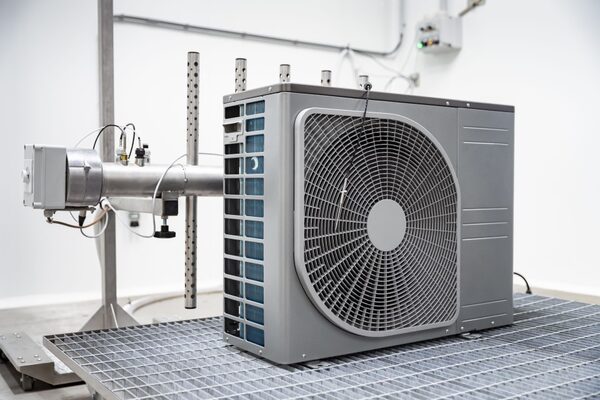
Conformity assessment is the work behind the mark. It is not a self-declaration in every case, and the location of the assessment body is now part of the requirement.
The core requirement is that conformity assessment for products placed on the market after the implementation date is undertaken by a UK recognised notified institute listed on the UK notified laboratory database2. That database is the reference point: a test report from a laboratory outside it does not satisfy the requirement, however thorough the testing.
Declarations of Performance carry the documentary burden. They must reference the new UKCA legislation document, superseding (EU) 305/2011, and must reference UK designated standards rather than the EU standards referenced in the Official Journal2. They must also continue to be made available to market surveillance authorities2. The shift from EU to UK designated standards is the substantive change, because it changes which version of a standard a manufacturer is declaring against.
Testing capacity in the UK has been a live question. BSRIA holds accreditation by the UK Accreditation Service to test heat pumps up to about 30 kW capacity according to EN14511, and has sought accreditation for part load testing to EN1482522. That is a specific, dated statement of UK test capability, and it maps onto the standards the Boiler Upgrade Scheme regulations list10.
| Requirement | What it covers | Source |
|---|---|---|
| UK recognised notified institute | Conformity assessment for products placed on the market after the implementation date | 2 |
| UK notified laboratory database | The list of recognised assessment bodies | 2 |
| Declaration of Performance | Reference to the UKCA legislation document, superseding (EU) 305/2011 | 2 |
| UK designated standards | Replacing EU standards referenced in the Official Journal | 2 |
| Market surveillance availability | Declarations must remain available to authorities | 2 |
For a household, none of this is visible on the appliance. What it means is that the mark on a product sold in Great Britain rests on an assessment carried out under GB rules, by a body recognised in the UK, against a UK designated standard. That chain is what gives the mark its meaning.
MCS: the UK quality mark for renewable heating products
MCS is the UK's quality mark for small-scale renewables like heat pumps23. It is an independent certification scheme for microgeneration installation companies and products24, and it aims to ensure consistent standards and provide confidence to consumers7.
Its scope is wider than a product mark. MCS sets and maintains technical standards for installations and products, certifies installers and products against those standards, issues MCS certificates for completed eligible installations, and assists certification bodies to review and address cases and consumer issues relating to installers or products24. That combination, product plus installer plus certificate, is what distinguishes it from a conformity mark.
The scheme's limits are worth stating plainly, because they are not always understood. MCS requires installers to provide a design-stage prediction of system efficiency, not verify actual performance25. It does not require remediation of systems that are underperforming relative to their design25. Weather compensation is not mandatory under current requirements of the Microgeneration Certification Scheme25, and third party non-modulating controls are not prohibited25. MCS specifies handover documentation but not the quality of verbal explanation, household understanding, structured follow-up or ongoing support25.
"MCS requires installers to provide a design-stage prediction of system efficiency, not verify actual performance."
That is the honest boundary of the scheme. It certifies that a product and an installer meet defined standards and that a certificate was issued. It does not guarantee that the installed system performs as designed, and it does not require the installer to fix a system that falls short of its design prediction.

What MCS certification covers and its size limits
MCS certification does not cover every heat pump installation. The installations that would not be covered by MCS are heat pumps installed with a thermal output larger than 45kW and the majority of installations in new-build properties5. Both figures appear in official statistics, and both are stated as scope limitations rather than exclusions by choice.
The 45kW threshold is a thermal output limit, not an electrical one, and it sits well above the capacity of a typical single dwelling. The new-build limitation is broader in effect: most installations in new-build properties fall outside MCS, which means the certification route that applies to a retrofit does not automatically apply to a new home.
Certified installers use MCS certified ground and water source heat pumps, tested for quality, reliability and performance23. That is the product side of the scheme: the equipment itself has been assessed, not just the company fitting it.
Batteries sit inside the same framework. Domestic batteries on the UK market with UKCA/CE marking, which is required in the MCS Battery Installation Standard, are covered by that standard26. The marking requirement is written into the installation standard, so a battery without the mark does not meet it.
Government schemes lean on MCS certification directly. Warm Homes: Local Grant requires MCS certification for low carbon heating measures, with the exception of high heat retention storage heaters covered by PAS 203027. The Boiler Upgrade Scheme requires installers and the low-carbon heating products supported under the scheme to be Microgeneration Certification Scheme certified, and installers to be members of an approved consumer code4. Installers must be MCS certified and certified to install heat pumps and/or biomass boilers28.
| Scheme | MCS requirement | Source |
|---|---|---|
| Boiler Upgrade Scheme | Installers and supported low-carbon heating products MCS certified; installers in an approved consumer code | 4 |
| Warm Homes: Local Grant | MCS certification for low carbon heating measures, except high heat retention storage heaters under PAS 2030 | 27 |
| Warm Homes: Social Housing Fund | MCS certification required for low carbon heating measures | 26 |
BSI Kitemark and combined MCS certification
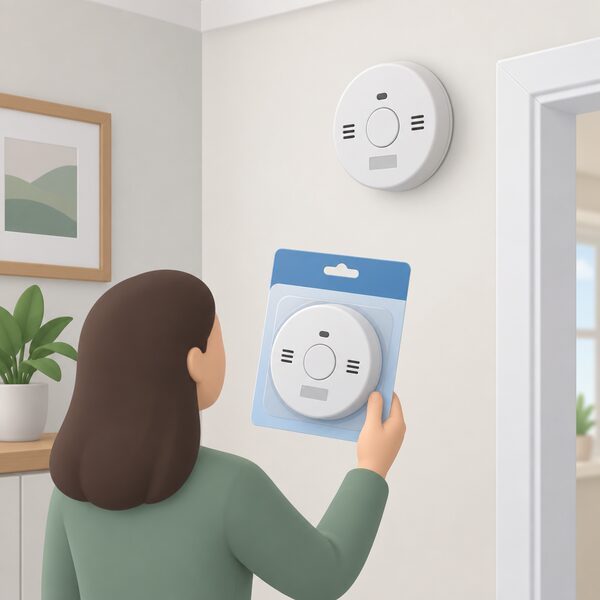
The Kitemark is a British Standards approval mark, and it appears in safety contexts where a specific standard governs the product. Carbon monoxide alarms provide the clearest example: they must comply with British Standard EN 50291 and carry a British or European approval mark, such as a Kitemark, before purchase29.
That is a different kind of mark from UKCA. The Kitemark indicates conformity with a named British Standard, and in the case of CO alarms the standard is EN 5029129. The requirement is stated as a condition of purchase, which makes it a consumer-facing check rather than a market-access formality.
For renewable heating, the certification route is MCS rather than Kitemark, and the two can sit together on a product or an installer's credentials. The distinction to hold onto is what each one certifies: a Kitemark certifies a product against a standard, while MCS certification covers installers, products and completed installations, and issues a certificate for the installation itself24.
Water supply regulations and gas appliance rules that sit alongside marking
Marking sits on top of a layer of installation rules that have nothing to do with conformity assessment. These are the rules that govern what can be fitted, where, and by whom.
In Wales, building regulations apply to providing services and/or fittings in a building such as washing and sanitary facilities, hot water cylinders, foul water and rainwater drainage, replacement windows, and fuel burning appliances of any type30. That list is broad, and it captures hot water cylinders and fuel burning appliances directly, which means a cylinder or boiler replacement can fall within the regulations regardless of the mark on the product.
In England, regulation 12(6A) of the Building Regulations 2010 identifies notifiable work as comprising the installation of a new or replacement consumer unit, the installation of a complete new circuit connected to the consumer unit, or alteration work in and around a bath or shower31. That definition dates from April 2013 and governs when electrical work must be notified31.
Gas appliance rules run alongside. Most heating in the UK is supplied by gas9, and gas work is subject to its own safety regime rather than to the product marking regime. The two are complementary: a boiler can carry the required conformity mark and still be installed in a way that breaches building regulations or gas safety requirements.
Solid fuel adds a further layer. All Cleaner Choice appliances are on the exempt appliance list, and are tested to emit at least 50% less emissions than required in smoke control areas32. That is a local emission rule operating in parallel with product marking, and it is unaffected by the marking changes2.

How marking and certification relate to government clean heat schemes
Government clean heat schemes use certification as a gate. The Boiler Upgrade Scheme is the clearest case: installers and the low-carbon heating products supported under the scheme must be Microgeneration Certification Scheme certified, and installers must be members of an approved consumer code4. The scheme is administered by Ofgem11.
The certification requirement is technology-specific. Installers must be MCS certified and be certified to install heat pumps and/or biomass boilers28. A general MCS membership is not enough for a heat pump grant; the certification has to cover the technology being installed.
MCS also runs its own verification alongside the grant body's audit. MCS undertakes its own checks on installations completed by MCS certified installers, separate from Ofgem's audit programme, and may contact the property owner directly33. Property owners contacted for MCS checks should aim to respond within seven days8. MCS can be contacted at mcscertified.com or by calling 0333 103 8130, and may contact a household for a short, routine verification on behalf of Ofgem either by email or phone on 0333 103 81988.
Complaint routes follow the certificate. For MCS certified installations, a complaint must be raised no more than two years after the date that the system was commissioned7. MCS is the contact for issues with the installation process, the installer, or the MCS certificate or product7.
Metering requirements tie the installation back to the certificate. All heat pumps accredited to the Domestic RHI from 22 May 2018 must be fitted with metering for performance before applying, confirmed on the MCS certificate12. A replacement MCS certified product must be MCS certified, use the same source of energy as the product it replaces, and have a Seasonal Performance Factor of at least 2.5 for heat pumps12. Metering information must be added to the MCS certificate34.
For a household, the chain runs: product mark for market access, MCS certification for installer and installation, certificate for the record, and scheme rules for the grant. Each link is separate, and a failure at any one of them affects a different thing.
Sources34 cited
- Raising minimum standards for heat pumps: options assessment, UK Government, 2024-11-27
- All you need to know about UKCA marking, HETAS, 2025-11-17
- Extended CE marking recognition for ecodesign regulations, UK Government, 2025-12-09
- Boiler Upgrade Scheme annual report 2024 to 2025, Ofgem, 2025-07
- Heat pump deployment quarterly statistics, United Kingdom 2026 Q1, UK Government, 2026-06-11
- Heat pump deployment tables Q2 2026, UK Government, 2026-09-10
- Domestic RHI: who to contact, Ofgem, 2026-09-17
- Boiler Upgrade Scheme guidance for installers v5.1, Ofgem, 2026-07-02
- Most heating in the UK is supplied by gas, House of Commons Library, 2022-01
- Boiler Upgrade Scheme regulations: approved standards, grant categories and grant levels, UK Government, 2026-07-21
- Approved Document L Volume 1 consultation version, Welsh Government, 2026-09-17
- Domestic RHI essential guide, Ofgem, 2022-03
- Domestic RHI essential guide, Ofgem, 2024-06
- Extended CE marking recognition for ecodesign regulations: consultation document, UK Government, 2026-07-06
- MIR approved gas and electricity meters, UK Government, 2025-11-06
- Ventilation systems, nidirect, 2026-09-17
- Hydropower, nidirect, 2026-09-17
- Advice if you're struggling to pay your energy bills, nidirect, 2026-09-17
- Northern Ireland energy efficiency of housing, Northern Ireland Executive, 2024-07
- Domestic electricity consumption indicator, Office for National Statistics, 2026-09-20
- Energy Price Guarantee for Domestic Electricity Consumers in Northern Ireland Direction No.2, UK Government, 2023-06-23
- Domestic hybrid heat pumps, UK Government, 2016-11
- Ground and water source heat pumps, MCS Certified, 2026-06-09
- Boiler Upgrade Scheme, Ofgem, 2026-09-17
- Carbon footprint report: heat pump transition, UK Government, 2026-05
- Warm Homes: Social Housing Fund wave 3 scheme guidance addendum, UK Government, 2026-06
- Warm Homes: Local Grant policy guidance, UK Government, 2026-07
- Boiler Upgrade Scheme guidance for installers V5, Ofgem, 2026-04-28
- Gas safety: frequently asked questions for owner occupiers, Health and Safety Executive, 2026
- When you need approval, Planning Portal, 2026
- Building regulations: minor works, Planning Portal, 2013
- Log burner rules, HETAS, 2026
- Boiler Upgrade Scheme guidance for property owners, Ofgem, 2026-03-25
- Domestic RHI: eligible heating systems, Ofgem, 2026-09-17
 Standards and CertificationHow do you know a heat pump will really perform as promised?
 Installer QualificationsWhat training and qualifications should a heat pump installer actually have?
 Hydrogen Appliance TestingHow domestic hydrogen boilers, hobs and fires are tested and certified in the UK, the hydrogen content covered, the bodies involved, and the standards work still outstanding before general sale.
 The Full Brands GuideWhich boiler, heat pump or solar brand can you trust, and who actually owns it?
 MCS ExplainedMCS is the quality mark for solar panels, heat pumps and other home renewables.
 Certification and ApprovalsWhich certificates actually matter when you are choosing solar panels or a heat pump?