In this guide
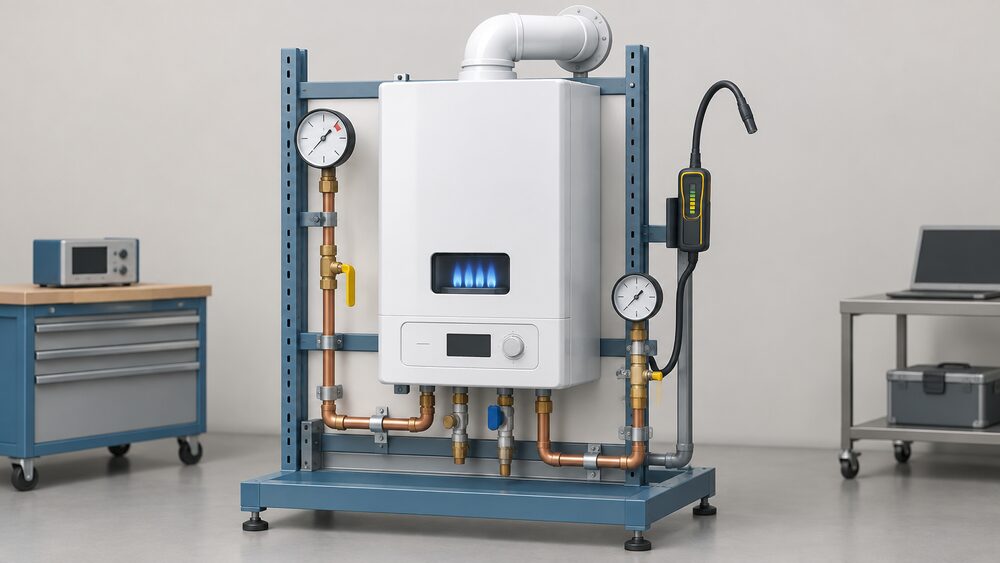
Hydrogen appliance certification is the process by which a boiler, hob or fire is tested against a published standard and then approved for sale and installation. For 100% hydrogen domestic appliances in the UK, that process has not produced a certifiable product. Official statistics state that hydrogen boilers are not currently available in the UK, and that hydrogen-ready boilers are not yet available either1. The Hy4Heat programme has successfully proven that hydrogen boilers can operate safely within a test environment, which is a laboratory result rather than a certificate2.
What exists instead is a blend mark. All existing gas appliances are certified to run on a 23% hydrogen-blend3, and Kiwa operates a 20% Hydrogen Mark based on Test Requirements for natural gas appliances burning up to 20% hydrogen admixture, using EN15502 as the reference standard4. That is the certification frontier today: appliances proven against a minority hydrogen admixture, not against pure hydrogen.
The practical consequence for a household is that no hydrogen boiler, hob or fire can be bought, installed or certified in the UK at present, and the standards work that would change this is still in progress. What follows sets out what certification means, why the 100% case is stuck, how the appliance differs from a gas one, and where the testing and demonstration activity actually sits.
What certification means for a hydrogen appliance
Certification is not a single test. In the UK it is a chain: a product standard that sets the technical requirements, a testing body accredited to test against it, a certification body accredited to issue the certificate, and an installation route that recognises the certificate. The Microgeneration Certification Scheme illustrates the shape. It includes certification for products and installer companies, and a code of practice based on The Office of Fair Trading Consumer Code6. The scheme certifies, quality assures and provides consumer protection for microgeneration installations and installers, covering small-scale renewable electricity technologies such as solar photovoltaic panels, biomass, wind, heat pumps and heat products7.
For gas appliances, the installation end of the chain is already well established. Work to install a new boiler, or a cooker that also supplies central heating, needs Building Regulations approval because of safety issues and the need for energy efficiency8. Where a registered installer with the relevant competencies carries out work on gas appliances, they should be able to self-certify the work without the need for close involvement of building control9. A hydrogen appliance would need to slot into that same structure, with a product certificate behind the installer's self-certification.
The accreditation layer matters as much as the product test. The Boiler Upgrade Scheme regulations name BS EN ISO/IEC 17065:2012, Conformity assessment, Requirements for bodies certifying products, processes and services, as an approved standard10. That is the standard a certification body must itself meet before its certificates are accepted. Certification bodies in adjacent fields work to the same pattern: an F-Gas handler must hold a certificate issued by a certification body, demonstrating that they have passed a theoretical and practical examination organised by an evaluation body, covering the minimum skills and knowledge set out in Annex I of the Regulation, for the category concerned11.
"The scheme includes certification for products and installer companies."
Why no 100% hydrogen boiler can be certified yet
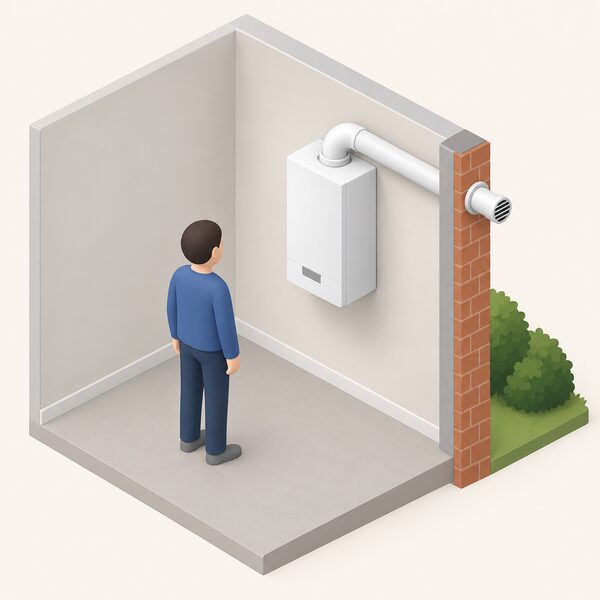
The blocker is not a single missing test. It is that no approved 100% hydrogen model exists to certify, and the surrounding policy has moved away from the appliance rather than towards it. The proposed Future Homes Standard states that gas boilers, including hybrid and hydrogen-ready boilers, will not meet the proposed standards, and that fossil fuel heating will not meet this standard, including hydrogen-ready and hybrid boilers12. An appliance class that the forward building standard excludes has a weak route to mass certification.
The same pattern appears in grant scheme rules, where technologies wait for a formal place in the assessment framework. Phase Change Material heat batteries cannot currently be installed through the Warm Homes scheme until there is a formally approved convention or they are a formally recognized technology category in SAP13. Heat batteries will not be eligible for the scheme until they can be MCS certified, which requires both an installation and a product standard13. Integrated and compact hybrids are not eligible measures, because they contain a new gas boiler which cannot be funded13. Certification and eligibility move together: a product without a standard has no certificate, and a product without a certificate has no funded route into a home.
There is a manufacturer view on how to bridge the gap. Baxi Heating UK Ltd has argued for a mandate that all boiler installations from 2025 are hydrogen ready, on the basis that this would mean a significant proportion of the existing stock could later be converted2. That is a proposal from a maker, not an adopted rule, and it concerns hydrogen-ready appliances rather than 100% hydrogen ones.
How a hydrogen appliance differs from a gas one
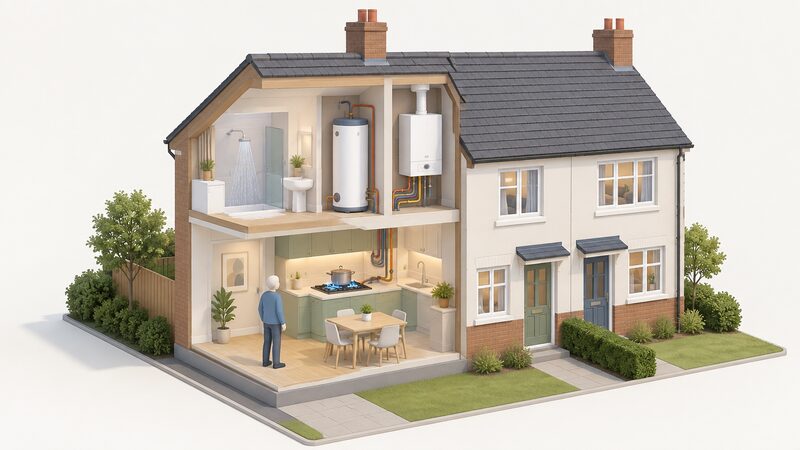
Three design areas change when the fuel changes: the burner, flame detection and leak behaviour. Hydrogen burns with a flame that the sensing used on natural gas appliances does not detect in the same way, so flame detection is a distinct engineering problem rather than a tuning exercise. Burner design follows, because the flame speed and combustion characteristics differ. Leak risk follows too, because hydrogen is a smaller molecule and behaves differently in pipework and joints.
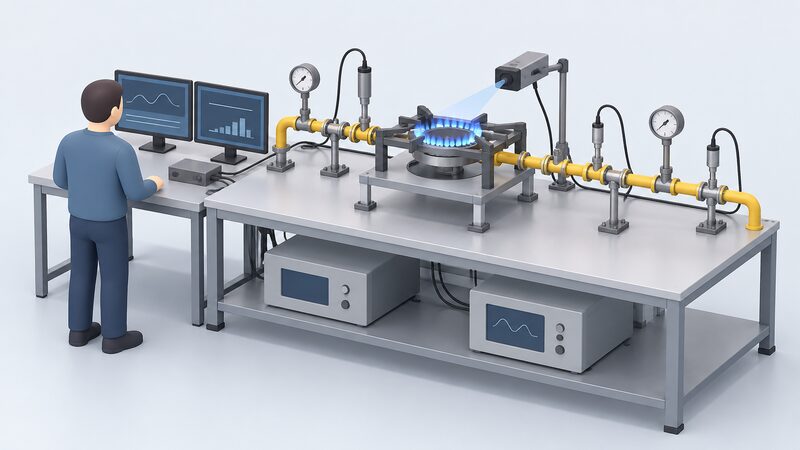
The testing regime that covers these areas is built on the existing gas appliance standards rather than a new hydrogen standard. Kiwa is accredited for testing in accordance with EN155024, and its 20% Hydrogen Mark rests on Test Requirements for natural gas appliances burning up to 20% hydrogen admixture, using EN15502 as the reference standard4. The mark is intended for boiler manufacturers wanting to future-proof their natural gas appliances, for gas network operators planning blending pilot projects and householders4. Kiwa states that it will publish Test Requirements for appliances tested in accordance with EN89, gas-fired storage heaters, and EN613, independent gas-fired convection heaters, soon4. Those two product families cover the storage heater and the independent convection heater, which is the category a hydrogen fire would sit in.
The eligibility conditions for the mark show how tightly testing and factory surveillance are bound together. A manufacturer qualifies if Kiwa has issued a GAR certificate and a product surveillance contract for a product and the manufacturer has completed the tests specified in the Test Requirements4. Certification here is not a one-off laboratory pass: it is a certificate plus an ongoing surveillance contract, which is what keeps a mark valid over a production run.
Emissions, efficiency and the 100% ceiling
Hydrogen combustion produces water vapour, and the efficiency ceiling is fixed by physics rather than by engineering effort. A hydrogen boiler that works via combustion would not exceed 100% efficiency3. That is the same ceiling that applies to any combustion appliance, and it is the reason hydrogen heating is discussed as a like-for-like replacement for a gas boiler rather than as a step change in running efficiency.
Nitrogen oxides are the emission that standards address with a number. The comparable official limit in the boiler guidance is for biomass: NOx did not exceed 150 g/GJ net heat input14. That figure belongs to biomass boilers, not to hydrogen appliances, and no NOx limit specific to a certified 100% hydrogen domestic boiler appears in the published material. Where a hydrogen appliance standard is eventually written, a NOx limit of that kind is the form it would take.
Efficiency and emissions also interact with the tax and grant framework, which treats appliance classes differently. Energy efficient boilers do not qualify for the reduced rate and carry 20% VAT15. The qualifying energy products list that attracts the reduced rate covers central heating and hot water controls, draught stripping, insulation on walls, floors, ceilings and lofts, solar panels, ground-source heat pumps, air-source heat pumps, micro combined heat and power units, wood-fuelled boilers, and wind and water turbines in Great Britain only16. Hydrogen appliances are not on that list, because there is no certified product to place there.
For a household, the emissions picture is therefore simple to state and hard to act on: a hydrogen boiler would emit water vapour and a controlled level of NOx, would not exceed 100% efficiency, and cannot yet be bought. The independence it would offer is independence from natural gas, not independence from a supplier or a network, because hydrogen would arrive through a pipe or a delivery arrangement like any other fuel.
BSI and the standards route
BSI is the UK national standards body, and it publishes European standards in the UK as BS EN5. That single fact explains why hydrogen appliance certification is not a purely British project. Domestic appliance standards in this field are European standards, and the UK adopts them rather than writing a parallel set.
The adoption mechanism has a consequence that matters for timing. The British Standards Institution's agreement with the European Committee for Standardisation obliges it to withdraw UK national standards after a harmonised European Standard with the same scope and field of application has been produced17. A UK-only hydrogen appliance standard would therefore be displaced if a European equivalent appeared, which is an argument for the work running through the EN route from the start. It also means the pace of UK certification is tied to the pace of European standards work.
The practical effect for a household is that no amount of UK demonstration activity can substitute for a published standard. Testing bodies can build capability, manufacturers can build prototypes, and trials can run, but the certificate needs a standard behind it. That is the gap the 100% hydrogen appliance sits in: proven in a test environment, without a published product standard to be certified against.

MCS, Kitemark and what each certificate covers
Two certification routes are often confused, and they cover different things. MCS is an independent certification scheme for microgeneration installation companies and products18. The Microgeneration Certification Scheme certifies, quality assures and provides consumer protection for microgeneration installations and installers including solar photovoltaic panels, biomass, wind, heat pumps and heat products19, and it is the leading quality assurance organisation for microgeneration, meaning small scale renewable 50kW or smaller, technologies13. It covers the installer as well as the product.
The BSI Kitemark is a product mark. BSI offers a combined MCS and BSI Kitemark Certification for microgeneration products used to produce electricity and heat from renewable sources20, and describes the benefit as improving product and manufacturing procedures via the testing, audit, and certification process, and gaining global market access through certification20. The combined route means one assessment can carry both marks.
| Route | What it certifies | Scope | Source |
|---|---|---|---|
| MCS | Products and installer companies | Microgeneration, 50kW or smaller | 19 |
| BSI Kitemark | Products | Microgeneration products producing electricity and heat from renewable sources | 20 |
| Combined MCS and Kitemark | Product and installer | Microgeneration products | 20 |
| Kiwa 20% Hydrogen Mark | Natural gas appliances burning up to 20% hydrogen | Boilers, storage heaters, convection heaters | 4 |
Public schemes lean on these routes as a condition of funding. Installers and the low-carbon heating products supported under the Boiler Upgrade Scheme must be Microgeneration Certification Scheme certified, and members of an approved consumer code21. Installers must be MCS certified and be certified to install heat pumps and/or biomass boilers22. Warm Homes: Local Grant requires MCS certification for low carbon heating measures, with the exception of high heat retention storage heaters covered by PAS 203023. ECO4 requires low carbon heat installations and microgeneration installations to be certified by the Microgeneration Certification Scheme or under an equivalent scheme operated by a person accredited to ISO/IEC 17065:201224. A hydrogen appliance would need an equivalent route, and none is published.
Testing, audit and the path to market
The route from prototype to market runs through testing, audit and certification in sequence, and each stage has its own evidence requirement. Kiwa's hydrogen testing capability sits in laboratories in The Netherlands, UK, Italy, Turkey and China4, which is where the blend testing described in its Test Requirements is carried out. The mark itself is issued only where a GAR certificate and a product surveillance contract are in place and the specified tests are complete4.
Surveillance is the part households rarely see and the part that keeps a certificate honest. A product surveillance contract means the certified appliance is checked after the initial test, so the certificate covers production rather than a single sample. That is the same logic that sits behind installer certification in the gas world, where a registered installer with the relevant competencies can self-certify work on gas appliances without close involvement of building control9.
Market access is the stated commercial purpose of the certification route. BSI frames certification as a way to gain global market access20, which reflects that appliance certificates are recognised across markets rather than being purely national documents. For a hydrogen appliance, that matters because the UK market alone would be small for a new appliance platform, and the standards route is European.
Where hydrogen appliances can be seen today
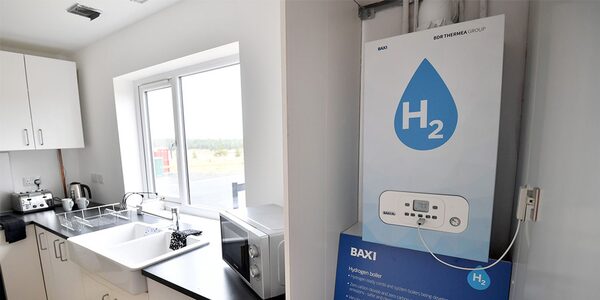
Demonstration is where the visible activity sits, and it is separate from certification. The Hy4Heat programme was set up with heating appliance manufacturers developing domestic hydrogen appliances to demonstrate the safe use of hydrogen as a fuel in providing domestic heating, hot water and cooking requirements25. Its finding is that hydrogen boilers can operate safely within a test environment2.
The show homes put those appliances in front of the public. The Hy4Heat appliances, which have been developed in the UK, are available on rotation so that different manufacturers can share their innovations with the public26, and the semi-detached houses demonstrate the use of hydrogen fuelled appliances in a real-world setting26. The Heat and Buildings Strategy set out a village scale trial by 202527, and the Government is considering Redcar, Teeside as a potential location for the hydrogen heating trial28. The trial as legislated involves only 1,000 to 2,000 properties29.
For a household, the distinction between a demonstration and a certificate is the whole point. A working appliance in a show home proves the engineering can be done. It does not create a product standard, an accredited certificate, or an installation route that a householder could use. The hydrogen home heating trials and the demonstration and test homes pages cover that activity in more detail, and the Cartrefi hydrogen demonstration home is a worked example of a retrofit.
Cost and availability for UK households
There is no published UK price for a 100% hydrogen boiler, because no certified model is on sale. The only price commitment in the material is a manufacturer one: a number of leading boiler manufacturers have made a joint price-promise commitment that a hydrogen ready boiler will cost no more than a gas boiler does today3. That commitment covers hydrogen-ready appliances, which burn natural gas, and it is a maker's statement rather than a published price.
Availability is stated plainly in the official statistics. Hydrogen boilers are not currently available in the UK, and hydrogen-ready boilers are not yet available1. The proposed Future Homes Standard would not be met by gas boilers, including hybrid and hydrogen-ready boilers12, which puts the appliance class outside the direction of travel for new build.
Where a household does encounter a certification cost, it is in adjacent processes rather than in hydrogen. An appliance exemption costs £470 excluding VAT for each additional appliance in a range30. Domestic EPC lodgement fees are set at £6.00 for domestic certificates and £15.50 for non-domestic certificates31. Neither figure relates to hydrogen appliance certification, and neither should be read as a proxy for it.
The independence question is worth stating plainly. A certified hydrogen boiler would reduce a household's dependence on natural gas, and would not reduce its dependence on a piped fuel supply, a network operator or a billing relationship. Certification is what would make the appliance legal to install and safe to run; it is not what would make the household self-sustaining. For the wider picture, the standards and certification for emerging energy products page sets out how certification routes work across technologies, and hydrogen safety in the home covers the safety side in detail.
Sources31 cited
- DESNZ public attitudes tracker: heat and energy use in the home, winter 2025, GOV.UK, 2026-03-12
- Written evidence to the House of Commons committee, UK Parliament, 2026
- Hydrogen boilers: what you need to know, Which?, 2026-09-17
- Kiwa 20% Hydrogen Blend Mark, Kiwa, 2026-09-17
- Technical booklet B: materials and workmanship, Building Control Northern Ireland, 2013-07
- The Microgeneration Certification Scheme, Planning Portal, 2026-09-17
- ECO4 Flex and GBIS Flex information document, Ceredigion County Council, 2025-11
- Boilers and heating: building regulations, Planning Portal, 2026
- Boilers and heating, Planning Portal, 2026
- Boiler Upgrade Scheme regulations: approved standards, grant categories and grant levels, GOV.UK, 2026-07-21
- F-Gas handler for stationary refrigeration, air-conditioning and heat pump equipment, GOV.UK, 2026-09-17
- The Future Homes and Buildings Standards 2023 consultation, GOV.UK, 2026-09-17
- Warm Homes: Social Housing Fund wave 3 scheme guidance, May 2026 addendum, GOV.UK, 2026-06
- Boiler Upgrade Scheme guidance for installers, version 5, Ofgem, 2026-04-28
- Tax on shopping: energy saving products, GOV.UK, 2026-09-17
- VAT: energy saving products for consumers, HM Revenue and Customs, 2026-09-20
- Building Standards Technical Handbook, Domestic, April 2026, Scottish Government, 2026-03
- Boiler Upgrade Scheme, Ofgem, 2026-09-17
- Energy efficiency schemes: ECO flexibility funding, Ceredigion County Council, 2026-09-17
- MCS Microgeneration Certification: where innovation meets sustainability, BSI, 2026-09-17
- Boiler Upgrade Scheme annual report 2024 to 2025, Ofgem, 2025-07
- Boiler Upgrade Scheme guidance for installers, version 5.1, Ofgem, 2026-07-02
- Warm Homes: Local Grant policy guidance, July 2026, GOV.UK, 2026-07
- Energy Company Obligation 4 and the Great British Insulation Scheme: mid-scheme changes, GOV.UK, 2024-11-14
- Written evidence on the Hy4Heat programme, UK Parliament, 2020-10
- Case study: UK hydrogen heated homes of the future, Ofgem, 2021-07-29
- Heat and Buildings Strategy, GOV.UK, 2025
- Research briefing: hydrogen heating trials, House of Commons Library, 2026-09-20
- Hydrogen heating village trial publication, UK Parliament, 2022-07
- Get an exemption for an appliance to burn unauthorised fuel, GOV.UK, 2026-09-20
- Energy Performance of Buildings Scotland regulations 2025 update: EPC reform consultation response, Scottish Government, 2025-10
 Hydrogen Home Heating TrialsHydrogen home heating is still being tested, not sold.
 Hydrogen-Ready BoilersWhat manufacturers mean by hydrogen-ready and hydrogen-blend-capable, what conversion would require, and the state of UK hydrogen heating trials and decisions.
 Appliance Standards and MarkingWhich marks should a boiler, heat pump or cylinder have before you buy, and what do they actually prove?
 Hydrogen Safety in the HomeCan hydrogen actually be used to heat UK homes, and is it safe?
 Demonstration and Test HomesBefore new heating systems reach your home, they get tested in real houses with real people living in them.
 The Full Brands GuideWhich boiler, heat pump or solar brand can you trust, and who actually owns it?