In this guide
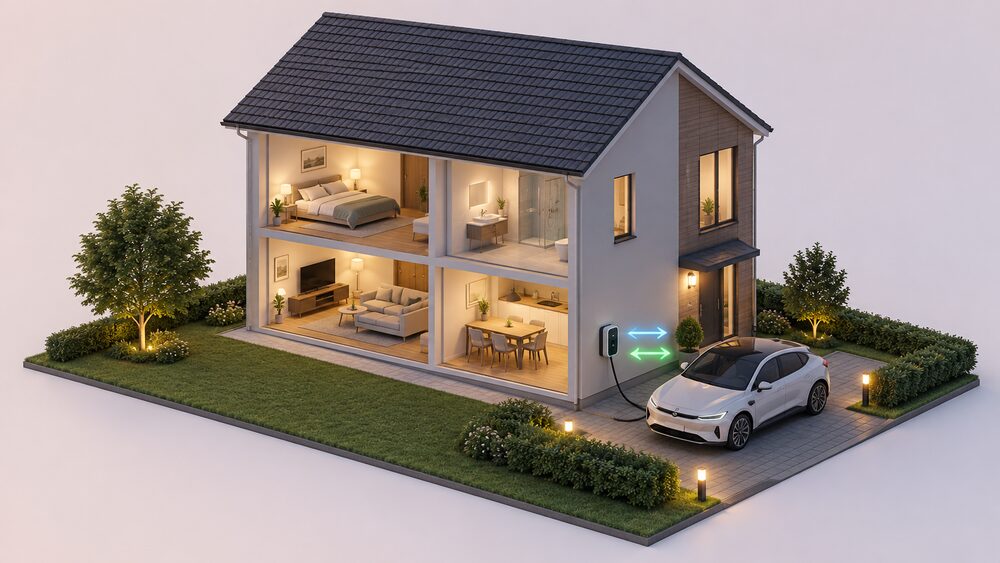
Bidirectional charging is charging that runs both ways: it lets an electric vehicle either draw power or supply power to a home or to the grid1. An ordinary chargepoint is a one-way tap. A bidirectional chargepoint provides two-way flows of energy and data between a plug-in vehicle and the grid, so the car's battery can charge, store and then discharge electricity when prompted2. The Climate Change Committee describes the family of these functions, V2X, as allowing electric vehicles to operate bidirectionally, charging from the electricity grid but also discharging to the grid, building or home as needed3.
The attraction for a household is obvious. A typical electric car carries far more energy than a domestic battery: an example used for home charging cost comparisons has a 50kWh battery, and a full charge of that car at home costs approximately £174. If even part of that could run the house through an evening peak, or be sold when prices are high, the car stops being only a cost and starts being a piece of household energy infrastructure. Cenex estimates average UK revenue generation from V2G at £150 to £200 per year5.
The honest position in 2026 is that bidirectional charging remains a minority technology in British homes. The Energy Saving Trust states that generally you cannot use an electric vehicle as a home battery, because the capability is currently being trialled in some places but is not widely available1. It is legal, it is encouraged, and the modelling is favourable, but the set of cars, chargers and tariffs that actually work together is narrow.
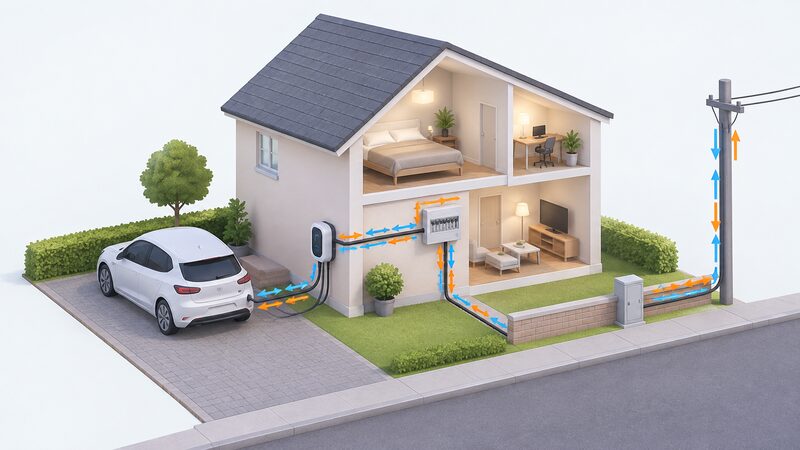
The four directions energy can flow: V2G, V2H, V2B and V2L
The umbrella term is V2X. Underneath it sit distinct uses that need different hardware, different permissions and different money.
| Mode | What it does | What it needs |
|---|---|---|
| V2G, vehicle to grid | Energy stored in the vehicle battery is exported to the grid during periods of high demand9 | Bidirectional chargepoint with two-way energy and data flow2, a supplier arrangement |
| V2H, vehicle to home | Supplies the house, and can provide backup power during power outages and support off-grid setups7 | Compatible EV model and compatible charger; limited to certain models7 |
| V2B, vehicle to building | Discharging to a building as needed, the commercial counterpart of V2H3 | Building-side control and metering |
| V2L, vehicle to load | Powering equipment directly from the car rather than through the house | Vehicle-side output; not all models offer it |
V2G is the version that touches the network and the market, and it is the one the UK research programmes have concentrated on. V2H is the one most households actually ask about, because it is about self-consumption and resilience rather than trading. The difference matters for independence: exporting to the grid deepens a relationship with a supplier, whereas powering the home from the car reduces imported units. The distinction is drawn out further on vehicle-to-home and vehicle-to-load and in the comparison of V2G and V2H.
How it works: the chargepoint, the car and the protocol
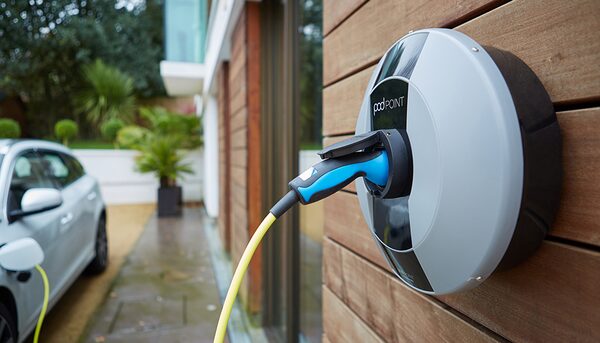
Three conditions must be met for bidirectional charging: an electric car, suitable charging infrastructure in the form of public chargers and wallboxes that support bidirectional charging, and a uniform software language8. Miss any one and nothing flows backwards.
The hardware side is the easiest to picture. A bidirectional chargepoint contains an inverter capable of converting the car's DC store into AC that the house wiring and the network can accept, and it exchanges data as well as energy so the grid or the supplier can prompt a discharge2. Smart V2G chargers including the Wallbox Quasar 1 and Indra V2G units enable bidirectional energy flow, allowing the vehicle to both charge and discharge to the grid7. The equipment side is covered in more detail on bidirectional chargers, and the individual makers on the Wallbox Quasar and Indra pages.
The software side is where the fragmentation sits. Chargepoint-to-network communication in Britain has long used the industry-standard Open Charge Point Protocol10. Vehicle-to-chargepoint communication is a separate matter, and it is the layer that decides whether a given car and a given box can negotiate a discharge at all. The protocol landscape, including CHAdeMO, CCS, ISO 15118 and OCPP, is set out on bidirectional charging standards.
Regulation already reaches domestic chargepoints. The Electric Vehicles (Smart Charge Points) Regulations 2021 apply to charge points intended for charging cars, vans or both, other than non-smart cables, public charge points and rapid charge points11. A domestic bidirectional wallbox therefore sits inside that smart charging regime rather than outside it, and the grid-side conditions are dealt with on grid connection rules for bidirectional charging.
Connectors: CHAdeMO leads, CCS is catching up
Most V2G systems use a specific type of connector called CHAdeMO, though some models can also use CCS7. The reason is not preference but protocol: only for the CHAdeMO connection is there currently a valid protocol for V2G charging to feed electricity into the public grid8.
This is awkward, because CHAdeMO is not where the mainstream market went. Almost all electric cars are supplied by the manufacturer with a cable carrying a Type 2 connector on the charger side, Type 2 being by far the most common public charge point standard12. Type 2 cables serve ordinary AC charging, including at Tesla home and public AC chargers, where a Type 2 to Type 2 cable is required, while Tesla Superchargers use tethered cables so no additional cable is needed13. None of that Type 2 hardware makes a car bidirectional.
Which cars can do it
The pioneer is Nissan: the Nissan Leaf has been able to charge bidirectionally for several years8. A published list of models able to charge bidirectionally was compiled as of May 20258, and the field has widened since the Leaf stood alone. Toyota Motor Europe has said it plans to introduce more advanced solutions including V2G integration, which will allow EVs not only to draw energy from the grid but also to return it when needed, as it expands its energy collaborations to additional countries15.
Model-by-model detail sits on which cars support bidirectional charging in the UK, with maker-specific notes on the Nissan LEAF and vehicle-to-grid and Renault bidirectional charging vehicles.
What it could earn and save a UK household

Two separate savings need to be kept apart: the saving from charging an EV cleverly, which most households can already access, and the extra from exporting, which few can.
On the first, an average-consumption household with an EV could already save around £330 annually by smart charging on a time-of-use tariff compared with a static one16. The SMMT states that drivers who can charge at home could save up to £750 a year compared with a petrol car17. Home charging is also simply cheaper than the alternatives: a full charge of around 220 miles costs £17 at home against £37 on public fast charging, £53 on public rapid charging and £45 for a full tank of petrol18.
On the second, the V2G Britain feasibility study modelled a 7kW V2G charger achieving annual revenues of around £436 above smart charging for a high plug-in rate archetype, where the car is plugged in 75% of the time6. Cenex's broader estimate of average UK revenue generation is the more conservative £150 to £200 per year5. Both figures are modelled outputs from research programmes, not offers, and both depend heavily on the household plugging in whenever the car is at home.
| Measure | Figure | Basis |
|---|---|---|
| Smart charging on a time-of-use tariff | around £330 a year16 | Average-consumption household with an EV |
| Home charging vs petrol | up to £750 a year17 | Drivers able to charge at home |
| V2G, average UK revenue | £150 to £200 a year5 | Cenex estimate |
| V2G, high plug-in archetype | around £436 a year above smart charging6 | 7kW charger, 75% plug-in rate |
| Reduced depreciation via battery management | £230 a year5 | Modelled, from reduced capacity fade |
Cenex also puts a value on the vehicle itself: capacity fade can be reduced by 9.1% over a year through battery management, which could extend useable battery life by 10% and give an annual depreciation saving of £2305. That is a saving on the asset rather than cash in a bank account, and it assumes the management regime actually delivers.
The scale of the potential audience is large. Around 19 million UK households could enjoy the benefits of home charging if they had a chargepoint19, and cross-pavement channel schemes aim to let more families tap into domestic electricity rates at as little as 2 pence per mile20. Tariff design is examined on V2G earnings and the tariffs behind them.
The grid case: storage, renewables and deferred network investment
A vehicle-to-grid system could offer a two-way movement of energy, with power stored in the car battery used in the home or sold back to the grid at times of peak demand21. Aggregate that across millions of cars and it becomes national infrastructure. Ofgem's modelling notes that if 50% of 2030's vehicles were V2G enabled, this would open up 22 TWh of flexible EV discharging capacity per year22.
The network savings follow. Smart charging alone could generate GB whole energy system net savings of £180m annually in 20306, with V2G saving an additional £40 to £90 million annually in GB by 203023 and helping to save £200m of cumulative distribution network investment by 203024. Cenex frames the deferral more starkly: V2G could defer network upgrades of £5bn, or £180 per household5. Reduced renewable curtailment could amount to a saving of 6 MtCO2e per year5.
Storage of this kind also fits the direction distribution networks are already travelling. A smart grid can facilitate new energy markets for renewable energy generators, battery operators and electric vehicles25, and energy storage is already deployed to provide frequency response to the grid26. In Northern Ireland, the Big Network Rebuild is intended in the longer term to deliver a more robust and resilient network able to accommodate rapid EV chargers, heat pumps, solar panels, community wind farms and technologies still to be developed for homes, farms and businesses27. Connection charging there is changing too, with a Go Live date for fairer connection costs expected later this year28.
For the household, the grid case cuts both ways. Exporting is genuinely useful to the system, but a car acting as a grid asset is a car enrolled in someone else's dispatch decisions, mediated by a supplier's app and platform. That dependence is worth naming alongside the revenue. The broader question is taken up in emerging technology and household energy independence.
Pairing it with solar

Battery storage helps a household make the most of renewable electricity from solar panels, wind turbines and hydro turbines29, and solar output can be used to charge an on-site battery storage system30. Bidirectional charging simply makes the car that store. Bidirectional charging allows EVs to power the home or export energy to the grid, and provides backup power during outages31.
The modelled carbon effect is meaningful: storing generation from a 4 kWp domestic solar PV system with an EV battery over a weekend with six hours of sun per day could save over 600 kgCO2e per year5. Battery storage can also be charged with cheap electricity from a supplier, typically on certain tariffs at night or in the middle of the day32, which means the car can be filled from solar in summer and from off-peak imports in winter.
Two caveats apply. Charging and discharging a DC battery system is less efficient, which could affect a feed-in tariff where one is held33. And every round trip through the car loses energy, so self-consumption gains are never one for one. The alternative of a fixed home battery is weighed on vehicle-to-grid or a home battery.
Does it harm the battery? What the evidence says
This is the question that decides most households against it, and the evidence is genuinely mixed.
The concern is real: frequent charging and discharging could shorten EV battery life, although the impact should be relatively minimal within recommended guidelines7. Charging a lithium-ion car battery to 100% can overheat it and cause cell degradation, meaning cells lose their ability to charge at their original rate34. Electrical Safety First's Battery Breakdown work identifies poor quality and substandard components, flawed design, physical abuse and improper charging or discharging as causes of thermal instability35.
Against that, managed cycling can help. EV-elocity found that V2G could extend the life of an EV battery by about 10%, around one extra year of use36, and Cenex's figure that capacity fade can be reduced by 9.1% over a year through battery management points the same way5. The mechanism is that a V2G system can hold the battery away from a full state of charge for long idle periods rather than leaving it there.
EV batteries are expected to last 10 to 20 years4. What no UK source in general circulation settles is how a manufacturer treats warranty cover when a battery is cycled by a third party's platform. That, rather than the physics, is the live risk, and it is examined on V2G, battery degradation and vehicle warranties.
Availability in the UK: trials, pilots and what you need
The Energy Saving Trust's position is blunt: bidirectional charging is currently being trialled in some places but is not widely available1. Getting access has generally meant joining a programme rather than buying off the shelf. Trials often require specific EV models and compatible chargers and may involve a selection process, with application typically involving online registration, eligibility verification and coordination with installers and energy suppliers7.
What a household needs, in practice:
- A vehicle on the bidirectional-capable list, in most cases with a CHAdeMO connection8
- A bidirectional chargepoint rather than a standard smart charger8
- Both vehicle and charger confirmed as bidirectional charging compatible14
- A supplier or platform willing to buy the exported energy, and the tariff to go with it
- Off-street parking or a cross-pavement arrangement, since bidirectional export from public chargers is not a domestic proposition
Britain has run substantial programmes in this space, including the Vehicle-to-Grid competition of which the V2G Britain feasibility study was part6. Individual programmes are covered on Project Sciurus and Powerloop, and what participation involves on taking part in a home energy technology trial.
For context on how quickly adjacent charging technologies move from pilot to product, the UK's first wireless charging trial launched in Nottingham in 2021 and concluded in 2023, using inductive charging technology similar to a wireless phone charger9. Pilots conclude; products do not always follow.
Costs today and where they are heading

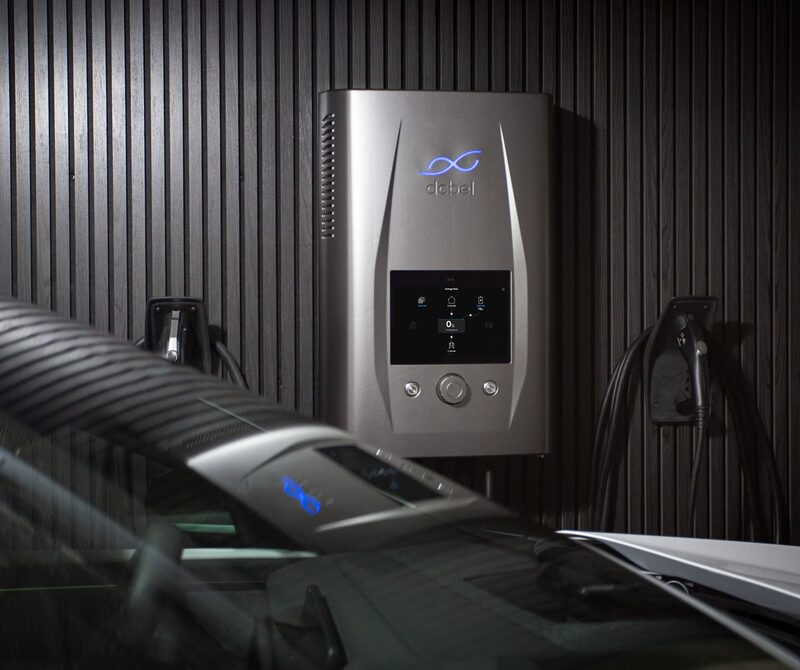
There is no settled published retail price for a domestic bidirectional charger in the UK, and prices are installer-quoted. What exists is projection. Cenex predicted V2G hardware prices to fall below the £3,000 to £5,000 level by 2025, and predicts V2G charger cost to fall to £1000 by 20305. The V2G Britain report suggests the premium over an equivalent smart charger is expected to reduce to between £656 and £1,164 by 203036.
| Cost projection | Figure | Date |
|---|---|---|
| V2G hardware price, Cenex prediction | below £3,000 to £5,000 | by 20255 |
| V2G charger cost, Cenex prediction | £1000 | by 20305 |
| Premium over an equivalent smart charger, V2G Britain | £656 to £1,164 | by 203036 |
Those projections should be read as projections. A household comparing a quoted bidirectional charger against £150 to £200 a year of modelled revenue5 will see the payback arithmetic for itself, and the honest conclusion today is that the economics work best where the charger cost is subsidised by a trial or bundled with a tariff. The wider pattern of paying early for immature equipment is set out on what emerging energy technology costs early adopters.
Is bidirectional charging legal in the UK?
Yes. Bidirectional charging is allowed in the UK, and it is a technology the government is keen to encourage8. The constraint is technical and commercial, not legal.
Chargepoint regulation is already in place and already directional about smartness. The Electric Vehicles (Smart Charge Points) Regulations 2021 apply to charge points intended for charging cars, vans or both, other than non-smart cables, public charge points and rapid charge points11. On the public network, the government has mandated that contactless payment be available on all new rapid chargers installed, and within the next couple of years this will also apply to existing rapid chargers without contactless capability37.
Anything that exports to the network sits behind a connection agreement with the distribution network operator, and that is where the practical permission is granted or refused. Parliamentary scrutiny has pressed for chargepoints that are interoperable and compatible with a smart energy system, which is exactly the standard bidirectional hardware has to meet.
What it means for household energy independence
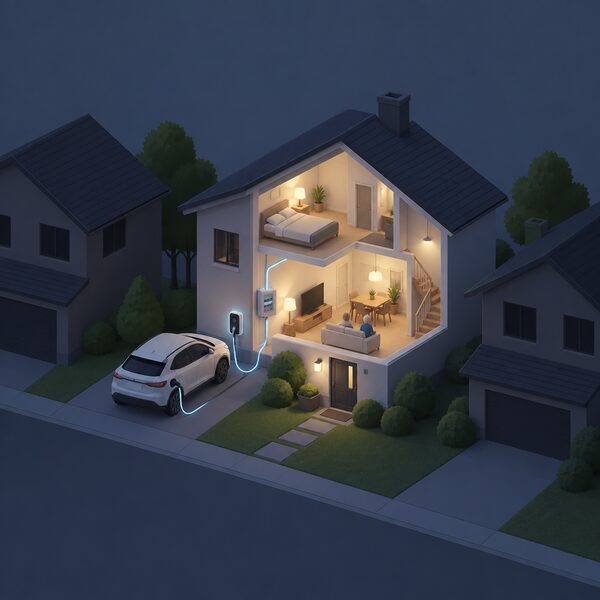
Bidirectional charging is one of the few technologies that could let a household meet an evening peak from stored energy it already owns, without buying a second battery. A 50kWh car battery4 dwarfs most domestic storage, and V2H can provide backup power during power outages and support off-grid setups7.
The dependencies are equally real. The car must be one of a small set of compatible models8. The charger must be bought new and is currently priced against projections rather than a market5. The revenue depends on a supplier's tariff and a platform's dispatch decisions, which means an app, a cloud service and a company that has to still exist in five years. Export requires a network connection agreement. And the capability is, on the Energy Saving Trust's assessment, still not widely available1.
A household that wants to reduce imported units today gets there faster through home charging on a time-of-use tariff, worth around £330 a year against a static tariff16. Bidirectional charging is the layer above that, and how it compares is set out on bidirectional charging vs smart charging. The wider field is mapped on the emerging home energy technology pillar.
Sources37 cited
- Battery storage advice, Energy Saving Trust, 2026-08-19
- Changing perceptions: the importance of V2G, Cenex, 2021-06-29
- Monitoring framework: a well-adapted energy system, Climate Change Committee, 2026-09-19
- Electric vehicles: debunking the myths, Energy Saving Trust, 2025-09-22
- More than money: finding the true power of V2G, Cenex, 2026-09-17
- V2GB: Vehicle to Grid Britain, Cenex, 2026-09-17
- Vehicle-to-grid charging guide, Uswitch, 2025-07-02
- What is bidirectional charging?, Carwow, 2025-05-30
- Five electric vehicle innovations to watch, Energy Saving Trust, 2026-09-20
- Pay-as-you-go EV recharging network, SMMT, 2012-06-21
- The Electric Vehicles (Smart Charge Points) Regulations 2021, legislation.gov.uk, 2021-12-15
- Tethered vs untethered charging, Zapmap, 2026-02-23
- EV connector types, Zapmap, 2026-05-20
- Battery storage advice, Centre for Sustainable Energy, 2025-10
- Toyota to expand EV charging ecosystem across the UK, SMMT, 2025-12-04
- Electricity distribution networks study: government response, UK Government, 2025-07-07
- EVs: the facts, SMMT, 2025-09-22
- Charging electric vehicles, Energy Saving Trust, 2026-04-23
- Home and community charging statistics, Zapmap, 2026
- Electric vehicle pavement channels grant, Energy Saving Trust, 2025-11-03
- Smart homes and a lower carbon footprint, Energy Saving Trust, 2026-01-21
- Case study: UK hydrogen heated homes of the future, Ofgem, 2030
- Vehicle to Grid Britain, Energy Systems Catapult, 2030
- V2G Britain case study, Cenex, 2030
- What is a smart grid?, UK Power Networks, 2026-09-17
- Trading sunlight, Solar Energy UK, 2026-09-17
- The Big Network Rebuild: how will it impact me, NIE Networks, 2026-09-19
- Connection charging announcement FAQs, NIE Networks, 2026-09-20
- Storing energy, Energy Saving Trust, 2026-07-15
- Solar panels planning guidance, East Herts Council, 2026-09-17
- Integrating solar panels with EV charging, Uswitch, 2025-07-02
- Battery storage, Home Energy Scotland, 2026-09-20
- Solar panel battery storage, Which?, 2026-05-14
- Tips for electric cars in hot weather, Zapmap, 2025-07-08
- Battery safety campaign, Electrical Safety First, 2026-09-17
- An introduction to vehicle-to-grid charging for electric vehicles, Cenex, 2022-08
- Guide to EV charging, Zapmap, 2026-09-04
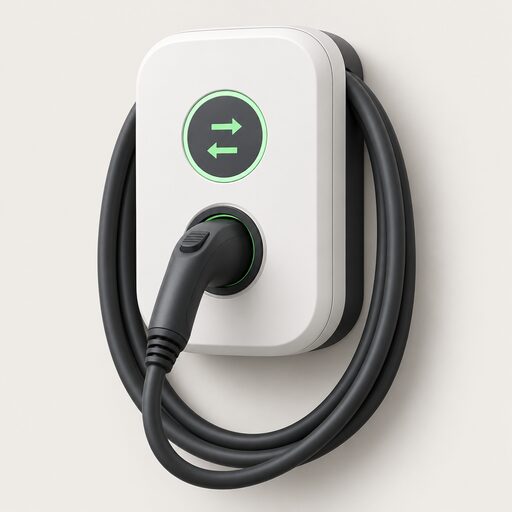 Bidirectional Chargers and CostsA bidirectional charger lets your electric car send power back to your home or the grid, not just take it in.
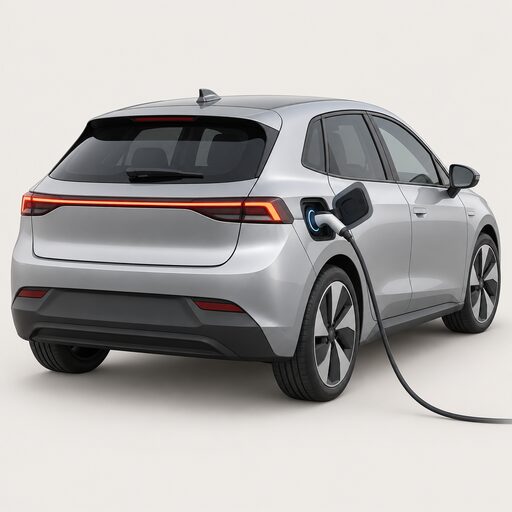 V2G and V2H ChargingCan your electric car earn money by sending power back to your home or the grid?
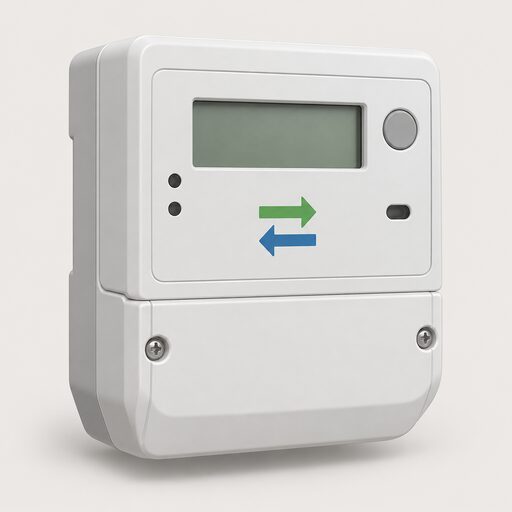 Grid Connection Rules for V2GCan your charger send power back to the grid?
 Charging and Energy IndependenceCharging an electric car at home can cut your fuel costs, but how much does it really free you from the grid?
 Exporting From a Home BatteryCan you actually get paid for electricity your home battery sends to the grid?
 Charging With a Home BatteryHow a home battery and an EV charger share one supply, whether a battery can usefully charge a car, and how combined systems are controlled so the battery is not discharged into the vehicle at a loss.