
In this comparison
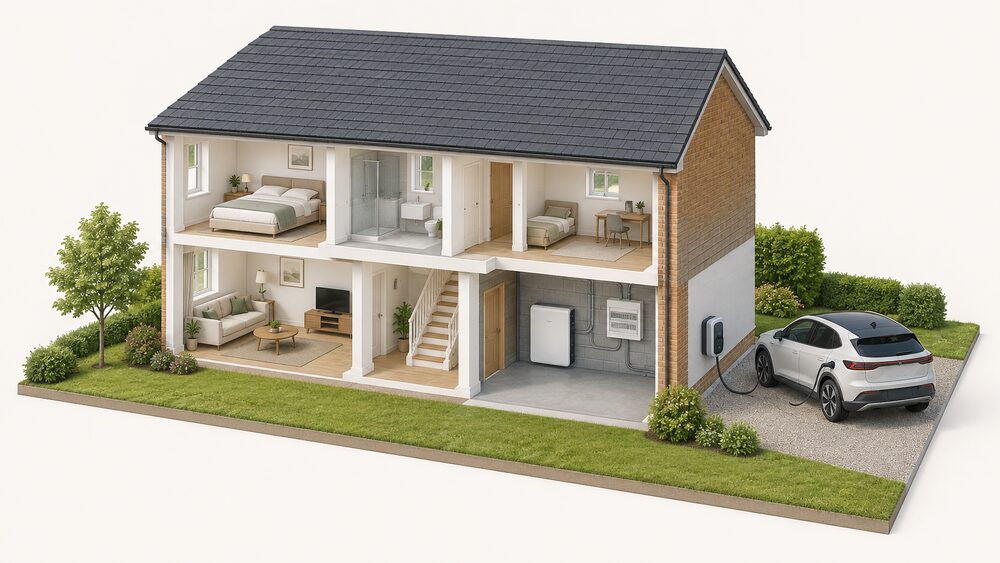
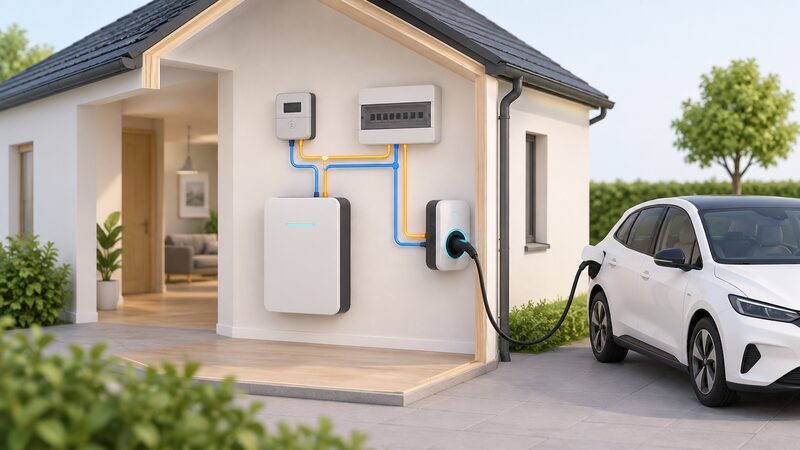
Vehicle-to-grid (V2G) and a home battery both store electricity and both can move it back out again, but they are not the same purchase. A home battery is a fixed asset in the house that is always available. A V2G system is a bidirectional charger plus the car parked on the drive, and it only works when the car is there and plugged in.
The cost gap is the reason the comparison matters. A 7kW home EV charger costs around £900 to buy and install1. A V2G charger has historically carried a large premium over that: around £4,000 in 20212, falling to around £3,700 above a smart chargepoint by the end of the Sciurus trial3, with the V2G Britain report projecting a premium of between £656 and £1,164 by 20304.
The earnings gap runs the other way. Ofgem's case study of the Sciurus trial reports customers earning as much as £725 a year without doing anything except keeping their car plugged in5. A home battery earns nothing directly; it saves money by shifting cheap off-peak electricity to expensive hours6.
Vehicle-to-grid and a home battery: what each one actually is
V2G is a technology that allows electric vehicles to draw power from the grid to charge their batteries and also to send electricity back to the grid when needed, generating cash for the EV owner8. The Welsh Government's national standards for EV infrastructure describe it more broadly as the use of vehicle batteries as storage to help balance supply and demand on the electricity network, applying at scales from individual batteries up to aggregation of multiple batteries across one or multiple carparks9.
The narrower term is vehicle-to-home, or V2H. Electricity Networks describe V2H as utilising the energy to power a home rather than delivering it back to the grid8. Uswitch's glossary frames the same capability as releasing power back through the charger either for use in the building it is connected to or back into the grid in general10. The Climate Change Committee uses V2X as the umbrella term: it allows electric vehicles to operate bidirectionally, charging from the grid but also discharging to the grid, building or home as needed11.
A home battery is a different proposition. It sits in the house, wired to the consumer unit, and stores electricity for later use. The IAAS guide notes the technology splits between lithium-ion and lead-acid batteries12. The National Energy Action best practice guide describes the non-solar use case plainly: electricity is used to charge the battery during cheap-rate periods and used later when electricity is more expensive, for example using Economy 7, Economy 10, or more innovative time-of-use arrangements6.

The core difference: a battery is always there, a car comes and goes
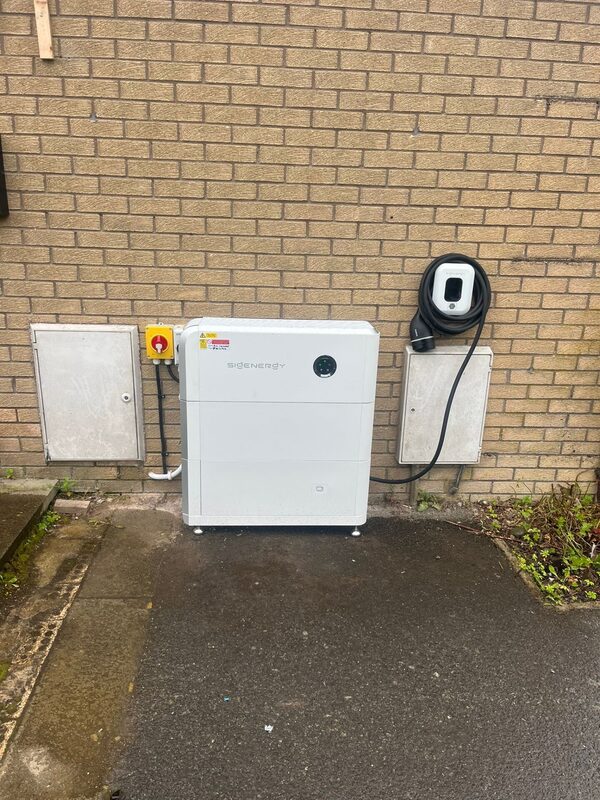
The decisive difference is availability. A home battery is on site every hour of the year. A V2G system depends on the car being parked and plugged in, which is why plug-in behaviour drives the modelled returns so heavily.
The V2G Britain report models a 7kW V2G charger achieving annual revenues of around £436 above smart charging for a high plug-in rate archetype, where the car is connected 75% of the time4. That archetype is the point: the revenue depends on the car being at home and connected, not on the hardware alone.
Home battery economics rest on the same principle but with a fixed asset. The Energy Systems Catapult's Living Lab data shows homes with batteries consistently have lower total daily grid consumption across three seasons, with strong overnight charging peaks across autumn, winter and spring consistent with energy arbitrage on time-of-use tariffs13. Winter consumption in those homes rose, which the Catapult attributes to a suspected arbitrage pattern13.
There is a second difference in what the asset is for. A car has to be ready to drive. A home battery has no other job. That matters for how much of the stored energy a household is willing to commit, and it matters for warranty terms, which for vehicles are set by the manufacturer rather than the charger maker.
"At household-level, further innovation in home battery technology, vehicle-to-everything (V2X), and solar can provide households with additional backup options during power outages"
What V2G can earn, and what a home battery can earn
V2G earnings figures in the public record span a wide range, and the spread comes from assumptions rather than from hardware. Ofgem's case study reports customers in the Sciurus trial earning as much as £725 a year without needing to do anything except keep their car plugged in5. Cenex modelling of Sciurus trial data put V2G at around £410 per year compared with unmanaged charging2. The V2G Britain report models around £436 a year above smart charging for a 7kW charger at high plug-in rates4, and a net annual revenue of £278 per battery electric vehicle in its stacked case for customers with solar and high plug-in rates in a constrained area4.
The comparison against smart charging turns on whether grid services are accessible. The V2G Britain report states that, including grid services, smart charging captures 40% of the total value of V2G for low plug-in scenarios, or merely 10% for high plug-in cases4. A separate Cenex press release states that if V2G is unable to access grid services, then smart charging gives you the upper range of that value14. The two figures are not reconciled, and the practical answer depends on whether grid services are accessible to the household.
Home batteries do not earn export revenue in the same way. Their return is avoided import cost: charging on a cheap overnight tariff and discharging when electricity is more expensive6. The Energy Saving Trust case study of a household with solar and an EV describes charging the EV and battery at night on a cheaper off-peak tariff, with excess energy exported to the grid15.
At network scale, Cenex estimates V2G could defer network upgrades of £5bn, or £180 per household16. Ofgem's case study projects that if 50% of 2030 EVs were V2G enabled, this would open up 22 TWh of flexible EV discharging capacity per year and provide around 16GW of daily flexible capacity to the grid5.
Costs compared: charger, battery and installation
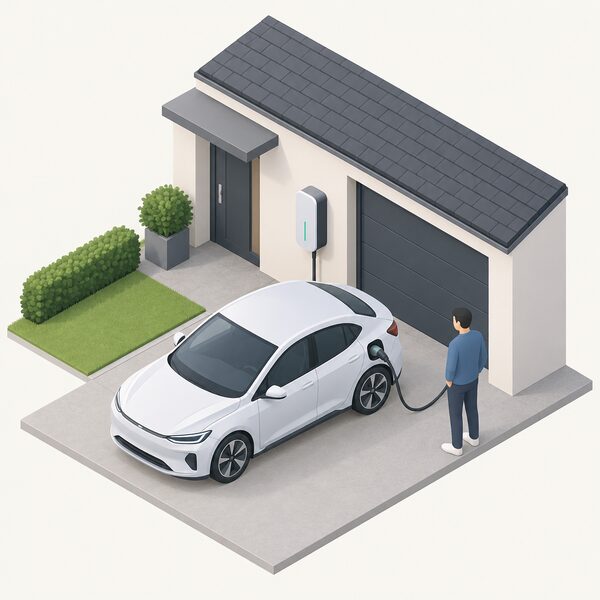
The hardware cost gap has narrowed sharply since the first trials, and the projections point to further narrowing. At the beginning of the Sciurus project, buying a V2G unit would cost in the region of £15k, plus installation2. By the end of the trial, the V2G hardware and installation cost was around £3,700 higher than a smart chargepoint3. Cenex's commercial viability work records the Indra unit retailing to end users at approximately £5,000 including installation in 20212, and a 2022 Cenex article refers to a V2G charger costing around £4,500 at that time17.
| Item | Figure | Date of figure |
|---|---|---|
| 7kW home EV charger, buy and install | around £9001 | 2026-02-25 |
| V2G premium over smart charger | around £4,0002 | 2021-01 |
| V2G hardware and installation premium | around £3,700 above a smart chargepoint3 | 2021-06 |
| V2G charger retail, Indra unit | approximately £5,000 including installation2 | 2021-01 |
| V2G charger price | around £4,50017 | 2022-02-21 |
| Projected V2G premium by 2030 | between £656 and £1,1644 | 2030 |
Home battery prices are installer-quoted and the documents in this comparison do not carry a published UK figure, so no range is given here. The relevant point for the comparison is that a home battery is a second asset on top of the car, whereas V2G is an upgrade to a charger the household may be buying anyway.
Which cars and chargers support V2G in the UK
V2G is still not widely available, with eligibility requirements such as having a compatible car, charger and smart meter7. Government guidance on registering energy devices states that a V2G enabled chargepoint is able to draw power to charge the vehicle and export the electricity from the car battery back to the home or the grid, and that this requires a bidirectional chargepoint and for the car to be V2G compatible18.
On the vehicle side, Uswitch lists the Nissan Leaf and Volkswagen ID Buzz as common V2G-ready vehicles7. In the Sciurus trial, the only type of compatible EV was a Nissan Leaf5. Cenex recorded four V2G charger models available in the UK through different suppliers in 2021, with new suppliers entering the market regularly2.
Charger connectors follow the standard pattern for home charging: units are available either with a tethered Type 1 or Type 2 cable, which can be plugged straight into the car, or with a Type 2 socket for use with the vehicle's charging cable19. A bidirectional unit adds the export path on top of that.
The market context is that battery electric cars accounted for two in five, or 40.9%, of available models in 202620, and 84% of electric car drivers have access to home charging21. Home charging access is the precondition for both options in this comparison.
What the UK trials show: PAVE, Utrecht and the research so far
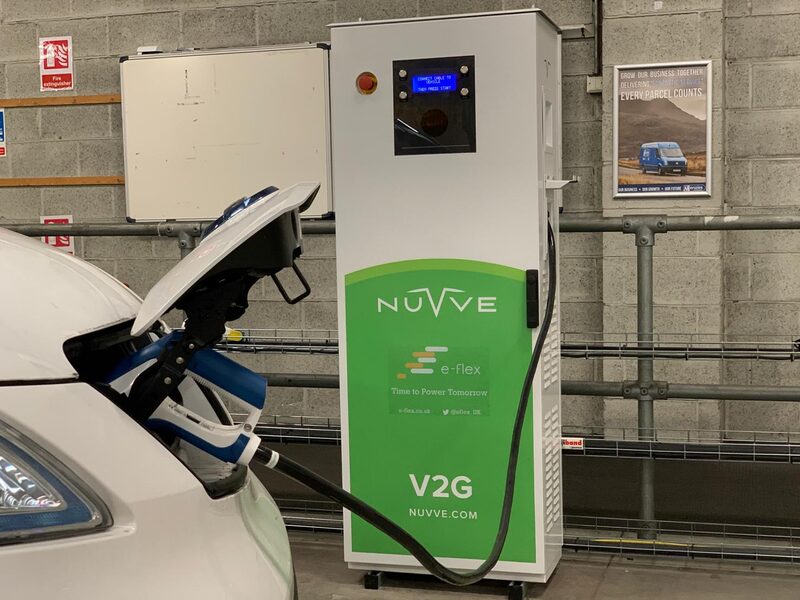
The UK evidence base is built on a small number of trials, and their results are the strongest material available on what V2G actually delivers. Ofgem's case study records that 330 V2G devices were installed across the UK during the project22. The V2G Britain feasibility study is part of the Vehicle-to-Grid competition4.
The Sciurus trial is the largest domestic V2G trial in Britain, and its headline finding is that customers could recover the majority of their household energy costs3. The trial also produced the cost data that anchors most later projections: the incremental hardware cost was around £3,700 at the end of the trial23, and the V2G unit dropped to around £3,700 more than a comparable smart charger in hardware and installation24.
Beyond Sciurus, the PAVE project is described as Europe's largest Vehicle-to-Grid pilot, with findings showing low public awareness of bidirectional charging and its potential25. The Utrecht deployment, run by Hyundai and We Drive Solar, launched a V2G mobility service in the Cartesius district with 25 IONIQ 5 units scaling to 150 during 202226.
On battery life, the EV-elocity work found that V2G could extend the life of an EV battery by about 10%, around one extra year of use4. Uswitch reports that while there are concerns that frequent charging and discharging could shorten EV battery life, the impact should be relatively minimal within recommended guidelines7.
Which fits which household: a choice, not a winner

The two options suit different circumstances, and the deciding factors are whether the household already has an EV, how often that car is at home, and whether a battery is wanted for reasons other than arbitrage.
A household with an EV that sits on the drive for long periods, a smart meter, and a willingness to accept a narrow list of compatible cars and chargers is the natural V2G case. The V2G Britain modelling shows the returns concentrate in high plug-in rate archetypes and in constrained areas4. The Sciurus trial's compatible vehicle list was a single model5, which is the clearest illustration of how narrow the current fit is.
A household without an EV, or with a car that is usually away during the day, is the natural home battery case. The IAAS guide states a battery is most worthwhile if you want backup power, do not have full-retail export rates, or can access cheap overnight charging tariffs12. The NEA describes the mechanism as charging during cheap-rate periods and using the electricity later when it is more expensive6.
There is a third consideration that applies to both: the design of the equipment. The Energy Systems Catapult notes that the focus of EV charging and V2G technology design is customer needs and cost, and that it will do just enough to meet grid-related regulations such as fault ride-through and high voltage and low voltage withstand27. That is a statement about engineering priorities, not about reliability, but it explains why the feature set varies between units.
For a household weighing the two, the honest position is that V2G is a trial-stage technology with a narrow compatible vehicle list and a hardware premium that is projected to fall, while a home battery is a mature fixed installation with no vehicle dependency. Neither is a winner in the abstract.
What owning either means for energy independence
Both options reduce dependence on imported electricity at the margin, and both leave significant dependence in place.
A home battery shifts when grid electricity is bought, not whether it is bought. The Energy Saving Trust case study describes the pattern: charging the EV and battery at night on a cheaper off-peak tariff, with excess energy exported to the grid15. The household remains connected, remains on a supplier's tariff, and remains exposed to standing charges and to the difference between peak and off-peak rates. The Energy Systems Catapult's Living Lab data shows battery-equipped homes with lower total daily grid consumption across three seasons, but winter consumption rose in those homes, attributed to a suspected arbitrage pattern13.
V2G adds a second dependency: the car. The household cannot export when the car is away, and the compatible vehicle list is short7. It also adds a dependency on the charger maker and on whatever platform coordinates the discharge, which is a supplier or aggregator relationship rather than a purely domestic one.
Backup power is the one area where the two diverge most sharply. The Climate Change Committee states that when a building or home also has the functionality to operate independently from the grid, known as islanding, V2X can enable the vehicle to act as a backup power source in a power cut11. Uswitch notes that V2H can provide backup power from an EV to a home during power outages and support off-grid setups, but that this is limited to certain EV models and compatible chargers7. A home battery with islanding capability provides the same function without the car being present.
The independence question therefore turns on what the household is trying to be independent of. A battery reduces dependence on peak grid pricing. V2G reduces dependence on peak grid pricing and adds an export income stream, at the cost of depending on the car, the charger and the aggregator being available and compatible.
Sources27 cited
- Electric car charging at home, Which?, 2026-02-25
- Commercial viability of V2G, Cenex, 2021-01
- World's largest domestic vehicle-to-grid trial reveals customers could recover the majority of their household energy costs, Cenex, 2021-06-03
- V2GB - Vehicle to Grid Britain, Cenex, 2026-09-17
- Case study: UK electric vehicle to grid (V2G) charging, Ofgem, 2021-07-06
- Domestic batteries best practice guide, National Energy Action, 2019-03-16
- Vehicle-to-grid charging, Uswitch, 2025-07-02
- LCT strategy, Energy Networks Association, 2026-09-17
- Electric vehicle infrastructure national standards, Welsh Government, 2023-06
- EV glossary, Uswitch, 2024-11-26
- Well-adapted energy system, Climate Change Committee, 2026-09-19
- Solar battery storage guide: is a home battery worth it?, Independent Assessment and Advisory Service, 2026-09-20
- Grid impacts of heat pumps, EVs and solar revealed, Energy Systems Catapult, 2025-08-18
- New research finds V2G charging delivers greater value than standard electric vehicle smart charging, Cenex, 2019-05-14
- Beth Martin story: solar panels and electric vehicle, Energy Saving Trust, 2025-03-03
- More than money: finding the true power of V2G, Cenex, 2026-09-17
- Nearly everything you need to know about vehicle-to-grid, Cenex, 2022-02-21
- Register energy devices in homes or small businesses: guidance for device owners and installation contractors, GOV.UK, 2021-03-31
- Home charging, Zapmap, 2025-06-19
- Britain's decarbonisation decade takes EVs from niche to normal, SMMT, 2026
- Consumer support key to faster and fairer EV transition as market enters new phase, SMMT, 2023-09-18
- Case study: UK hydrogen heated homes of the future, Ofgem, 2021-07-29
- Project Sciurus trial insights report, Cenex, 2021-05
- Changing perceptions: the importance of V2G, Cenex, 2021-06-29
- PAVE V2G project: power back home, Easee, 2025-10-28
- Hyundai and We Drive Solar launch energy system of the future in Utrecht, Hyundai, 2022-04-21
- Resilient electric vehicle charging, Energy Systems Catapult, 2022-02-21
 V2G and V2H ChargingCan your electric car earn money by sending power back to your home or the grid?
 V2G Earnings and TariffsExplains how households are paid under vehicle-to-grid arrangements, whether through export payments, a flat monthly credit or a time-of-use tariff.
 Batteries and IndependenceHow far home battery storage moves a UK household away from the grid and supplier pricing, covering self-sufficiency, winter limits, cost, lifespan, backup, export payments and flexibility earnings.
 Grid-Scale Battery StorageConnected and pipeline battery capacity in Great Britain, what these assets are paid to do, how long they can run, and how grid batteries differ in purpose and scale from a home battery.
 The Full Home Batteries GuideA home battery stores cheap or solar power for later, but will it really cut your bills enough to be worth it?
 Batteries by Home TypeLooks at how house type, occupancy pattern, electrical supply and available space change what storage can achieve, from flats and terraces to rural and off-grid properties.