In this guide
Bidirectional charging lets an electric vehicle either draw power from the grid or supply it back to the home, the building or the grid itself1. In the UK it is legal, and the government has said it is keen to encourage it1. What a household can actually buy today is narrower than that permission suggests: the technology is being trialled in some places but is not widely available2.
The car list is short and dominated by one model. The Nissan Leaf has been able to charge bidirectionally for several years and is described as the pioneer of the technology1. Common V2G-ready vehicles include the Nissan Leaf and the VW ID Buzz3. The Renault Zoe Z.E.50 carries a standard 22 kW AC charger4, but its bidirectional support is not documented to the same standard. Hyundai and Kia models on the E-GMP platform, including the IONIQ 5 and EV6, are known for very fast DC charging rather than for confirmed bidirectional export5.
The scale of what is at stake is set out by the Climate Change Committee: if 50% of the UK's electric vehicles were V2G enabled, that would open up 22 TWh of flexible EV discharging capacity per year by 20306. That is a national figure, not a household one, and it depends on vehicles and chargers that are not yet widely sold.
What bidirectional charging is: V2G, V2L and V2H
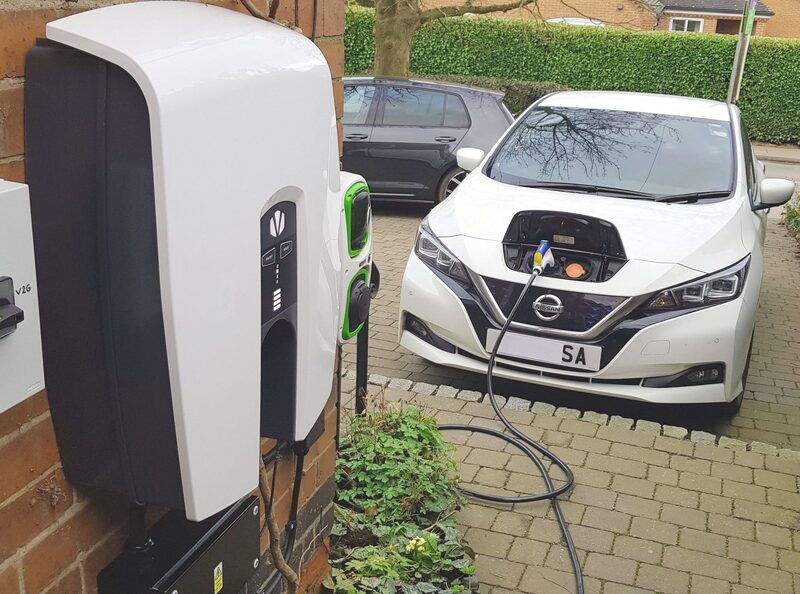
The Climate Change Committee defines the family of technologies as V2X, which "allows for electric vehicles to operate bidirectionally, charging from the electricity grid but also discharging to the grid, building or home as needed"9. Three variants sit inside that definition, and they differ in where the power goes rather than in the hardware alone.
- Vehicle-to-grid (V2G): exports power back to the electricity network, usually under a tariff or a trial arrangement.
- Vehicle-to-home (V2H): supplies the house instead, which is the version that matters in a blackout.
- Vehicle-to-load (V2L): runs an appliance or a tool from the car through a socket, without involving the building's wiring at all.
Energy Saving Trust describes the underlying function simply: bidirectional charging "lets an EV either draw or supply power to your home or the grid"2.
The distinction matters because the three are not interchangeable in practice. A car with a V2L socket can run a kettle or a laptop but will not back up a consumer unit. A car with V2H capability needs a charger and a changeover arrangement that can safely isolate the house from the grid. A car with V2G capability needs all of that plus an agreement with a network operator or aggregator.
Plug-in hybrids complicate the picture. They can do bidirectional charging, but the benefits are slight because they only have a small battery1. A plug-in hybrid stores only a small amount of energy, so the export revenue and the backup duration are both limited by the same constraint.
Bidirectional charging is legal in the UK, with government encouragement
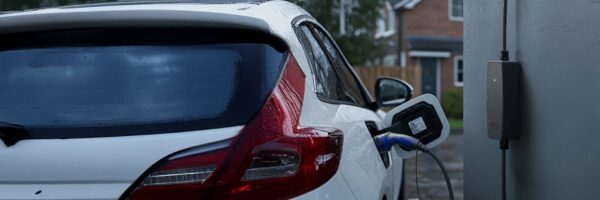
The legal position is settled. Bidirectional charging is allowed in the UK, and the government is keen to encourage the technology1. That is a permission rather than a product: a household can install and use it, but the market has not yet filled with equipment and tariffs.
The policy direction is visible in two places. The Zero Emission Vehicle Mandate consultation outcome states that the government "will consider models that seek to incentivise vehicles with bidirectional charging capabilities"10. Separately, the charging infrastructure programme has been running since 2022, when regulations supporting the installation of charging infrastructure for electric vehicles were introduced, with funding for local authorities in England11. The Electric Vehicle Charging Device Grant Scheme statistics cover the UK as a whole12.
The wider charging market has grown quickly. Charge point numbers more than doubled in the two years to July 202413, and the infrastructure is described as having made the sale of two million EVs possible14. More than two million pure-electric cars are now on UK roads5. That installed base is what makes bidirectional charging interesting to networks: it is a large, distributed battery that is parked most of the time.
The Nissan Leaf: the UK's volume V2G pioneer
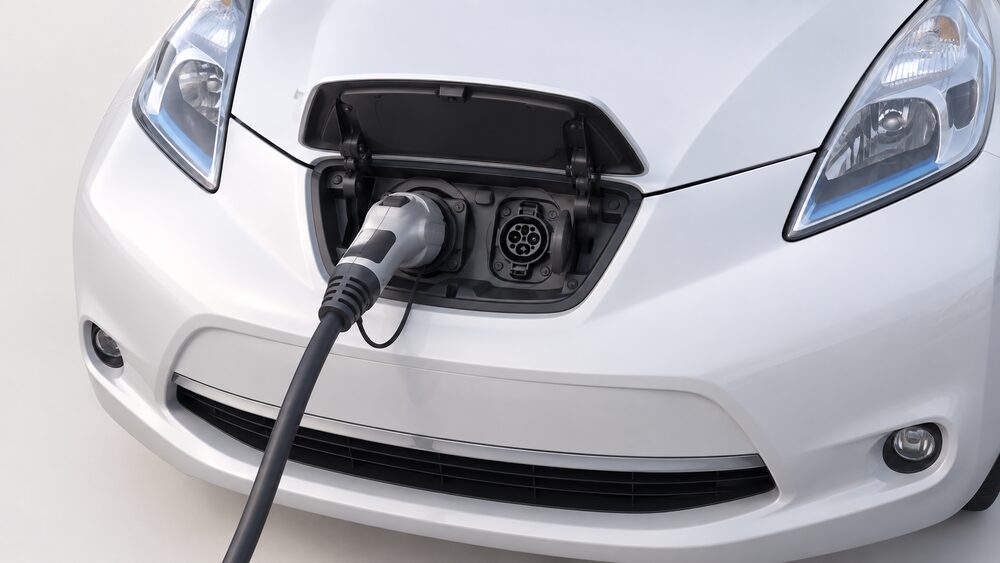
The Leaf is the model that made bidirectional charging real in Britain rather than theoretical. It has been able to charge bidirectionally for several years, and it is described as the pioneer of the technology1. It is also the model named most often as V2G-ready3.
The numbers behind that position are substantial. Nissan sold around 28,000 zero emission Leaf cars in the UK between 2010 and 2018, equivalent to about 825 MWh of battery storage capacity17. That is a fleet of used cars with a combined storage capacity comparable to a large grid asset, and it is already in private hands.
The Leaf's battery has grown across generations. The first 24 kWh family hatchback model was followed by a 30 kWh update, and the MkII is available with a 40 kWh battery8. Charging speed and range depend on the specific variant, because different models have different battery capacities18. The official WLTP range is 168 miles, with a real-world range of 151 miles8.
The Leaf is also unusual in its connector choice, which is central to its bidirectional story. For rapid charging, the CHAdeMO connector required is tethered to the charging unit8. CHAdeMO is primarily used for rapid DC charging on older Nissan Leaf models, and a Type 1 connector is used for AC charging on a few older EVs, notably older Leaf models19. The inlets sit behind a flap in the centre of what would normally be a car's grille8.
Nissan Leaf charging and backup figures: 40kWh, CHAdeMO and 48 hours of home backup
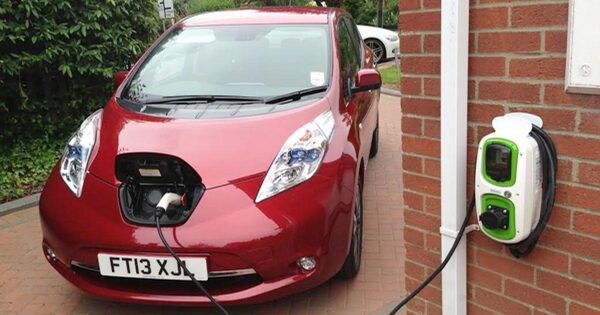
The Leaf's charging figures are well documented and worth setting out precisely, because they determine how useful the car is as a home asset.
On AC, the Leaf is fitted with a 6.6 kW on-board charger for Type 2 AC charging8. Even when connected to a fast charger with a rated output above 6.6 kW, the Leaf will only be able to charge at 6.6 kW8. A standard 7 kW AC home charger takes approximately seven hours to go from 0% to 100%18, and 7 kW charging to 100% is given as 7.5 hours8. For a 40 kWh version, a home charger provides an 80% charge in around 6 hours20.
On DC, the car has a maximum charging rate of 46 kW for DC charging and a maximum charging rate of 6.6 kW for AC charging18. Using a 50 kW DC charger, the car can take approximately 43 minutes to charge from 20% to 80%, which is approximately 14 to 116 miles of range18. The Leaf is able to be slow, fast and rapid charged from public points, depending on network and type of charge unit8.
| Nissan Leaf figure | Value |
|---|---|
| First generation battery | 24 kWh8 |
| First generation update battery | 30 kWh8 |
| MkII battery | 40 kWh8 |
| On-board AC charger | 6.6 kW8 |
| Maximum DC charging rate | 46 kW18 |
| 0 to 100% on 7 kW AC | 7.5 hours8 |
| 20 to 80% on 50 kW DC | approximately 43 minutes18 |
| Official WLTP range | 168 miles8 |
| Real-world range | 151 miles8 |
Nissan recommends charging to 80% in order to protect the battery and maximise efficiency8. That recommendation matters for a household planning to use the car as a store: the usable window is narrower than the nameplate capacity suggests.
Renault Zoe: 52kWh battery and 22kW AC charging
The Zoe's headline technical feature is its AC charging rate. The Renault Zoe Z.E.50 has a standard 22 kW AC charger4. That is unusual: most cars cannot make full use of a 22 kW charger, and the Renault Scenic E-Tech is one of the few exceptions21.
A 22 kW AC charger is not the same as rapid DC charging. It allows a faster top-up wherever a three-phase AC supply is available, which in the UK is far from universal in homes. The practical benefit depends on the supply at the charge point rather than on the car alone.
The Zoe's running costs have been modelled in detail. Under one 2030 scenario, the cost of charging a Zoe falls to £242 and saves its owner £873 a year, making the Zoe over 4.5 times cheaper to fuel than the Clio22. Under a second scenario, it saves its owner £812 in fuelling costs, up from £667 in 2023, making the Zoe almost 4.5 times cheaper to fuel than the Clio22. These are modelled figures for 2030, not current prices.
Second-hand savings are also documented. The Renault Zoe is cited with savings of £940 per year, alongside the Nissan Leaf at almost £700 per year13. Both figures come from the same analysis of popular second-hand EVs.
The Zoe's bidirectional position is weaker than the Leaf's. It does not appear in the list of common V2G-ready vehicles, which names the Nissan Leaf and VW ID Buzz3. A household considering a Zoe as a route into bidirectional charging should treat the capability as unconfirmed rather than established.
Hyundai, Kia and the E-GMP platform
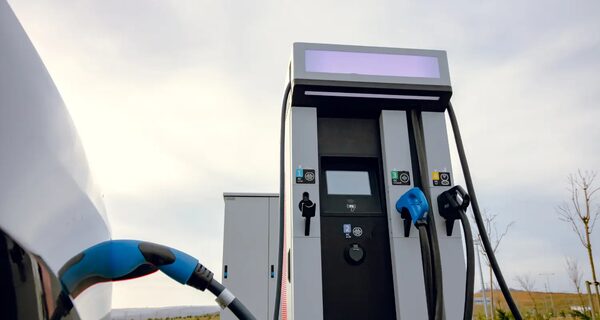
Hyundai and Kia models built on the E-GMP platform are among the most capable electric cars on sale in the UK for charging speed. The Kia EV6 and Hyundai IONIQ 5 can add 60 miles of range with just five minutes of charging using a 250 kW charger5. That is a DC charging claim, and it describes how quickly the car takes energy in, not how much it can give back.
The distinction is the one that catches households out. A car that charges very fast is not automatically a car that can export. The E-GMP models are widely discussed in the context of bidirectional charging, and Hyundai's plans are covered separately on What is Hyundai's plan for vehicle-to-grid technology?, but the confirmed UK list of V2G-ready vehicles names the Nissan Leaf and VW ID Buzz3.
The public charging networks these cars rely on are well established. Major charging networks include bp pulse, GeniePoint, GRIDSERVE, InstaVolt, Pod Point and ubitricity8. GRIDSERVE Electric Highway primarily offers public charging at service stations across Britain along the country's motorway network23. The government has mandated that contactless payment be available on all new rapid chargers that are installed, and within the next couple of years this will also apply to any existing rapid chargers without contactless capability5.
For a household thinking about bidirectional charging, the platform question is secondary to the connector and the charger. A car needs an inlet and an on-board arrangement that the bidirectional charger supports, and it needs a charger that can isolate the house safely. Fast DC charging says nothing about either.
Ford Explorer: 77kWh usable capacity and 135kW DC charging
The Ford Explorer Extended Range AWD is a useful example of a current model whose published figures describe charging in, not charging out. Its maximum charging power for fast charging (DC) is 185 kW, and its maximum charging power for normal charge (AC) is 11 kW24. The DC connector is CCS24.
The maker's own definition is worth quoting because it explains the categories: "DC charging stands for Direct Current and is usually found in fast charging stations, this charges with a power over 50kW"24. AC charging speed is given as 35 to 54 km per charging hour24.
| Ford Explorer Extended Range AWD | Value |
|---|---|
| Maximum DC charging power | 185 kW24 |
| Maximum AC charging power | 11 kW24 |
| DC connector | CCS24 |
| AC charging speed | 35 to 54 km per charging hour24 |
The Explorer's figures illustrate the gap between what a modern electric car can accept and what the UK bidirectional market can currently use. A CCS inlet is the connector that future bidirectional standards are expected to work with, and the standards question is covered on Bidirectional Charging Standards: CHAdeMO, CCS, ISO 15118 and OCPP. Until equipment and approvals catch up, a car with a high DC rating is a fast-charging car rather than a home power station.
What a car's battery can power: sizing backup against household demand
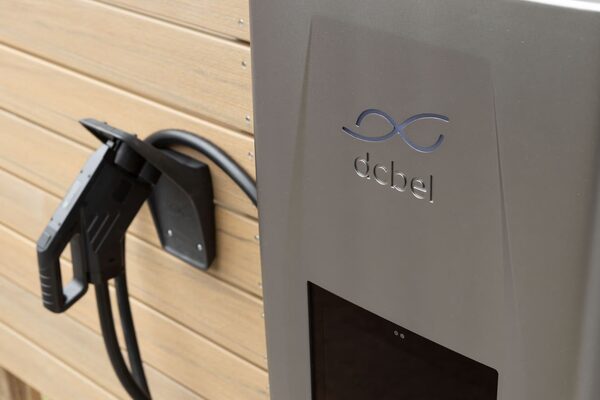
The published figures describe battery capacity, not measured backup duration. A household can size the question itself from the capacity figures and its own demand, but no source gives a tested runtime for a specific house.
The capacities are known. The Leaf runs from 24 kWh in the first generation, through 30 kWh and 40 kWh, to larger packs in later variants8. The Renault Zoe Z.E.50 has a 52 kWh battery4. A Ford Explorer Extended Range AWD has a usable capacity in the same order. What that means in the home depends on what is being run and for how long.
Two constraints bite before capacity does. The first is the charger: a bidirectional charger has to be able to isolate the house from the grid and manage the transfer, and the technology is currently being trialled in some places but is not widely available2. The second is the car's own state of charge. Nissan recommends charging to 80% in order to protect the battery and maximise efficiency8, so the usable window is narrower than the nameplate figure.
The national picture is more developed than the household one. If 50% of the UK's electric vehicles were V2G enabled, that would open up 22 TWh of flexible EV discharging capacity per year by 20306. That figure assumes a fleet-scale roll-out, and it is a projection rather than a measurement.
Costs of running a bidirectional-capable EV: charging bills and second-hand prices
Running costs for the models in question are documented, and they are the strongest argument for the category independent of bidirectional capability.
Home charging is the cheapest route. Energy Saving Trust gives £8 for a full charge on an EV tariff or other time-of-use tariff, typically requiring a smart meter, against £37 for public fast charging and £53 for public rapid charging7. Most electric car charging in the UK is done at home25. On a fixed tariff, the cost would remain the same regardless of when you charge the vehicle26, which is why time-of-use tariffs matter for anyone planning to charge overnight.
A worked example for a Leaf is available. At a typical UK average electricity price of 45p/kWh, a 30 kWh Leaf charging to 80% costs £10.8027. On a time-of-use tariff, overnight charging could cost as little as £2.8026.
| Cost item | Figure |
|---|---|
| Home charging, EV or time-of-use tariff | £8 per full charge7 |
| Public fast charging | £37 per full charge7 |
| Public rapid charging | £53 per full charge7 |
| 30 kWh Leaf, 80% charge at 45p/kWh | £10.8027 |
| Overnight time-of-use charge | as little as £2.8026 |
Per-mile comparisons favour electric cars. Driving 100 miles in an EV costs £7 in electricity, compared to £18 in a diesel or petrol car16. A separate comparison puts the cost over 7,100 miles at £516 on the home price cap against £1,120 on average diesel14.
Second-hand prices are the entry point for the Leaf and Zoe. One third of used electric cars cost under £20,0007. The Nissan Leaf is cited with savings of almost £700 per year, and the Renault Zoe with £940 per year13. These are running-cost savings against a comparable petrol car, not purchase prices.
Where the UK market stands, and what it means for independence
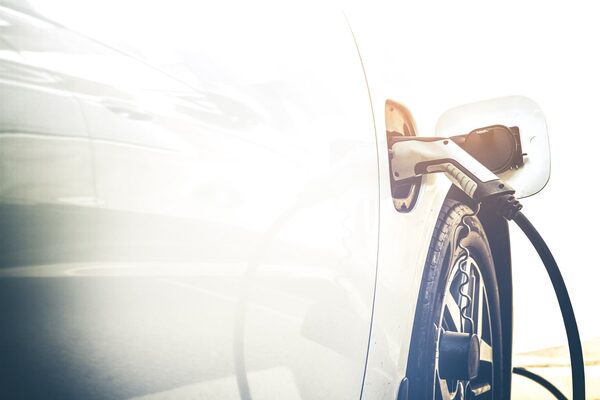
The position is straightforward to state. Bidirectional charging is legal and encouraged1, the confirmed V2G-ready list is short and led by the Nissan Leaf3, and the technology is being trialled in some places but is not widely available2. A household buying a car today is buying a vehicle, not a power station.
What the category offers for energy independence is real but conditional. A car with a large battery and a working bidirectional charger reduces reliance on the grid at the margin, and it can supply the home during an outage if the equipment supports it. What it does not remove is dependence on the grid for the energy that goes into the battery, on a supplier for the tariff, and on a manufacturer for the software and the warranty that make the function work at all. A car whose maker withdraws support leaves the household with a vehicle that charges one way only.
The national projections are the clearest signal of direction. The 22 TWh figure assumes half the UK fleet is V2G enabled by 20306, and the government has said it will consider models that incentivise vehicles with bidirectional charging capabilities10. Both point the same way. Neither changes what can be bought and installed this year.
For a household weighing the decision, the practical sequence is to establish which connector the car has, whether the maker supports bidirectional operation on that model, and whether a charger and an approval route exist for the property. The equipment side is covered on Bidirectional Chargers: The Equipment and What It Costs, the grid rules on Grid Connection Rules for Bidirectional Charging, and the wider context on Bidirectional Charging Explained and the Emerging Home Energy Technology: The Full UK Guide.
Sources27 cited
- What is bidirectional charging?, Carwow, 2025-05-30
- Battery storage, Energy Saving Trust, 2026-08-19
- Vehicle-to-grid charging, Uswitch, 2025-07-02
- Renault Zoe Z.E.50 review, Zapmap, 2024-05-14
- Guide to EV charging, Zapmap, 2026-09-04
- Case study: UK electric vehicle grid (V2G) charging, Ofgem, 2030
- Electric vehicles: debunking myths, Energy Saving Trust, 2025-09-22
- Nissan Leaf model charging, Zapmap, 2026
- Well-adapted energy system, Climate Change Committee, 2026-09-19
- Phasing out sales of new petrol and diesel cars from 2030: summary of responses and joint government response, GOV.UK, 2025-04-07
- Four more EV models qualify for £3,750 discount under Electric Car Grant, GOV.UK, 2025-12-03
- Electric vehicle charging device grant scheme statistics: October 2025, GOV.UK, 2025-11-26
- Popular second-hand EVs can save their drivers £1,450 a year, Energy and Climate Intelligence Unit, 2025-11-28
- Reduced public charging prices could boost EV sales, ChargeUK, 2026-07-31
- Apply for electric vehicle cross-pavement charging, nidirect, 2026-09-17
- Electric cars, Home Energy Scotland, 2026-09-20
- V2GB: Vehicle to Grid Britain, Cenex, 2026-09-17
- How long does it take to charge an electric car?, Zapmap, 2026-04-15
- Connector types, Zapmap, 2026-05-20
- Home charging, Zapmap, 2025-06-19
- How to use electric car charging points, Which?, 2026-05-20
- The future costs of running an electric vehicle, Energy and Climate Intelligence Unit, 2030
- En-route charging, Zapmap, 2026-02-26
- Explorer Extended Range AWD, DEFA, 2026-09-17
- Experiences of people who have already switched to using electric vehicles, Energy Saving Trust, 2025-03-31
- Should EV owners get fixed or time-of-use tariff?, Uswitch, 2025-07-02
- Public charging calculator details, Zapmap, 2026
 Bidirectional Charging StandardsDoes your electric car and charger actually support sending power back to your home or the grid?
 V2G and V2H ChargingCan your electric car earn money by sending power back to your home or the grid?
 Bidirectional Chargers and CostsA bidirectional charger lets your electric car send power back to your home or the grid, not just take it in.
 Bidirectional Charging ExplainedCan your electric car actually earn you money by sending power back to the grid?
 The Full New Technology GuideWhich new home energy ideas can you actually buy in the UK right now, and which are still stuck in trials?
 The Full EV Charging GuideCharging an electric car at home usually means a wallbox, but do you need one, and what will it cost to fit and run?