

In this answer
Short answer
The sale of new petrol and diesel cars in the UK is set to end in 2030, with only zero-emission models allowed from 2035. That is the government's stated position as restated in July 2025, and it is the date most published guidance now carries1. The commitment was first announced in November 2020, when the then Prime Minister brought the original 2040 target forward by a decade3.
The date has moved before and the documents do not all agree. The end of new petrol and diesel car sales was pushed back from 2030 to 2035 in 2023, and then restated as 2030 in 20254. Official guidance published in February 2024 still describes the sale of new petrol and diesel cars as being phased out by 20356. Both dates appear in current material, and the disagreement is unresolved.
For a household, the deadline matters less as a purchase date than as a signal about charging. The rules act on manufacturers and dealers, not on drivers, and they do not end the sale or use of used petrol and diesel cars. What changes is the direction of new car supply, and with it the case for a home chargepoint, a suitable supply and, in some properties, a network connection upgrade.
The end date: 2030, with 2035 for everything else
The headline answer is 2030. Independent guidance states that new petrol and diesel car sales are ending by 2030 and that electric cars are becoming the new normal across the UK2. The government pledged to end the sale of new petrol and diesel cars by 2030 in November 20203, and the commitment has been restated since. Independent news coverage in July 2025 reported that the government had restated its plans to phase out the sale of new petrol and diesel cars by 20305.
The 2035 date is not a rival headline so much as the second stage. The government plans to ban new petrol and diesel cars from 2030, with only zero-emission models allowed from 20357. That two-step structure, a 2030 cut-off for pure petrol and diesel followed by a 2035 cut-off for everything else, is the shape most official and independent material describes.
The complication is that some official guidance still gives 2035 as the phase-out date for new petrol and diesel cars outright6. Where a household is trying to plan around the deadline, the two dates sit side by side: 2030 is the restated policy and the date most sources carry, and 2035 is the date in the government's own published guidance on electric vehicle costs and infrastructure. The gap between them is five years, and it has already changed once.
The earlier history explains why the date keeps moving. In 2017 the UK Government announced that sales of diesel and petrol cars would stop in 20408. The Road to Zero strategy in 2018 confirmed that the government intended to end the sale of new conventional petrol and diesel cars and vans by 20409. The 2030 target is that 2040 date brought forward, and the 2035 date is a partial reversal of the bringing-forward.
Who the rules apply to

The commitment is described as covering the UK, and it applies to new cars and vans rather than to vehicles already on the road. The government's consultation outcome on the Zero Emission Vehicle mandate states the commitment to end the sale of all new petrol and diesel cars and vans by 20301. Independent guidance describes the ban on the sale of new diesel and petrol cars and vans by 2030 in the same terms10.
The rules act on the supply side. The ZEV mandate requires manufacturers to sell a rising share of zero-emission vehicles, and small-volume manufacturers must still end the sale of new petrol and diesel cars and vans by 2030 and be zero emission at the exhaust by 20351. That is a requirement on makers, not a restriction on what a household may buy, keep or drive.
Nothing in the published material ends the sale or use of used petrol and diesel cars, and no scrappage scheme or driving restriction is described. A household running an existing petrol or diesel car is unaffected by the new-sale deadline itself. The change is to what dealers can offer as new stock, and to the direction of the market behind it.
The scope of the 2035 stage is wider. Independent guidance states that the UK Government has banned the sale of all new diesel and petrol cars, including hybrid cars, from 203511. That is the point at which the exemption for plug-in hybrids, which were originally allowed to continue after 2030 if capable of a set electric distance12, is described as closing.
Charging infrastructure, planning rules and grants differ between England, Scotland, Wales and Northern Ireland, so the practical support around the deadline varies by nation even where the sales date does not. The Zero Emission Vehicle Mandate page sets out the supply-side mechanism in full.
Conditions, hybrids and the unresolved date
The conditions sit in the detail of the two dates rather than in the headline. From 1 January 2030, sales of new cars and vans powered only by a petrol or diesel engine would no longer be allowed, with plug-in hybrids allowed if capable of a certain distance12. That is the original 2030 rule as described in maker guidance, and it is the source of the hybrid exemption that the 2035 stage is described as closing.
The ZEV mandate carries its own conditions for smaller manufacturers. Small-volume manufacturers must still end the sale of new petrol and diesel cars and vans by 2030, and be zero emission at the exhaust by 20351. The mandate therefore does not offer a blanket exemption: it sets a later exhaust-emissions deadline for a defined group of makers while holding the 2030 sales cut-off.
The legal basis for the ban is the November 2020 announcement by the then Prime Minister, which banned the sale of new petrol and diesel cars and vans from 20303. That announcement is the origin of the 2030 date, and it is why the 2035 date reads as a change to an existing commitment rather than a separate policy.
"In November 2020, former Prime Minister, Boris Johnson, banned the sale of new petrol and diesel cars and vans from 2030"
The unresolved condition is which date is operative. Official guidance published in February 2024 states that the sale of new petrol and diesel cars will be phased out by 20356, while independent guidance published in 2026 states that the government plans to end the sale of all new petrol and diesel vehicles across the UK by 203010.
| Stage | What it covers | Date | Source |
|---|---|---|---|
| First announcement | Sales of diesel and petrol cars to stop | 2040 | 8 |
| Road to Zero | New conventional petrol and diesel cars and vans | 2040 | 9 |
| Restated commitment | All new petrol and diesel cars and vans | 2030 | 1 |
| Second stage | All new diesel and petrol cars, including hybrids | 2035 | 11 |
| Official guidance | New petrol and diesel cars phased out | 2035 | 6 |
How the phase-out is enforced
The mechanism is the Zero Emission Vehicle mandate, which operates on manufacturers rather than on households. It requires makers to sell a rising proportion of zero-emission vehicles, and it is the instrument through which the 2030 and 2035 dates are enforced on the supply side1. Independent press coverage describes the 2030 ban on selling new petrol and diesel vehicles as the driver of electricity demand13, which is the demand-side consequence of the same mechanism.
The mandate is a UK-wide measure, and the commitment it enforces is described as covering the UK1. That is why the sales date does not vary between England, Scotland, Wales and Northern Ireland, even though the charging support around it does.
The demand the mandate creates lands on the electricity network and on the home. Independent analysis describes the 2030 ban on selling new petrol and diesel vehicles as something that will drive electricity demand13, and the network operator's own material on electric vehicles sets out what that means for connections and capacity14. For a household, the practical route is a home chargepoint on a suitable supply, with a network connection upgrade where the existing supply cannot carry the load15.
The rules around the chargepoint itself are separate from the sales deadline. The electrical safety regulation page covers the wiring rules that apply, and the permitted development rights page covers the planning position for home charging equipment. New homes in England have been required to have electric car chargers by law since 202216, which is the clearest example of the deadline shaping what gets built rather than only what gets sold.
The EU has set its own date, with the sale of almost all petrol and diesel cars ceasing across the EU by 2035 if not before17. That matters to UK households only indirectly, through the model ranges manufacturers build for both markets, but it explains why the 2035 date keeps appearing alongside the UK's 2030 one.
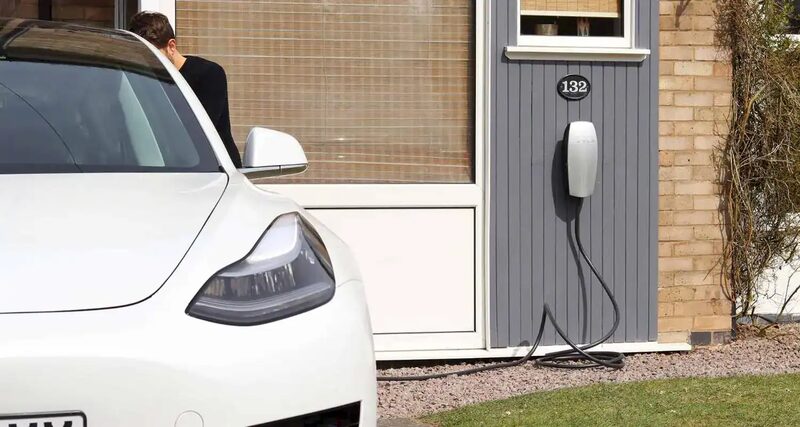
What the deadline means for a household's energy independence

The phase-out shifts new car buyers towards electric models, and an electric car charged at home moves a household's transport fuel from a forecourt to its own electricity supply. That is a real gain in independence: the fuel is no longer bought from an oil company at a roadside price, and a home with solar and a chargepoint can meet part of the demand itself.
The dependence that remains is substantial. A home chargepoint still draws from the grid, and the household still buys that electricity from a supplier. The chargepoint itself is a manufacturer's product, often with an app and a cloud account attached, so part of the control sits with a company rather than with the household. Where the supply cannot carry the load, a network connection upgrade is needed, and that is a dependence on the distribution network operator15.
Off-street parking is the constraint that decides whether any of this is available. Households without it depend on the public charging network, and independent analysis describes on-street chargepoints as key to an equitable transition18. That is the gap the deadline does not close on its own.
The deadline also does not remove the petrol or diesel car a household already owns. The rules act on new sales, so an existing vehicle keeps running, and the fuel it uses keeps being bought. The independence on offer is a direction of travel for the next new car, not a change to the one in the drive.
Sources18 cited
- Government response and outcome to technical consultation on Zero Emission Vehicle mandate policy design, GOV.UK, 2023-03-30
- Electric car charging guide, Carwow, 2025-07-16
- A brief history of the electric car, Energy Saving Trust, 2025-01
- MPs support Stop Burning Stuff initiative to combat misinformation about electric vehicles, REA, 2023-10-26
- NAPIT welcomes government announcement on discount for new electric cars, NAPIT, 2025-07-15
- Electric vehicles: costs, charging and infrastructure, GOV.UK, 2024-02-05
- Electric car charger grants rise to £500, Carwow, 2026-02-25
- Batteries, wheels and smart charging, NESO, 2017
- Government's Road to Zero strategy falls short, CCC says, Climate Change Committee, 2018-07-10
- EV charger regulations in England: what's changed, NICEIC, 2026-08-19
- A quick guide to England's clean air zones, Energy Saving Trust, 2035
- New car sales in 2030 and 2035, Ohme, 2024-03-11
- Energy retailers must radically evolve, Energy Systems Catapult, 2022-09-07
- Facilitating net zero: electric vehicles, Electricity North West, 2026-09-19
- Apply for a new connection: electric vehicles, Electricity North West, 2026-09-19
- New homes in England to have electric car chargers by law, Which?, 2021-11-22
- ChargeUK responds to EU changes to automotive emissions targets, ChargeUK, 2025-12-16
- On-street chargepoints are key for an equitable EV transition, Cenex, 2021-07-12
 Zero Emission Vehicle MandatePetrol and diesel cars are being phased out, but what does that mean if you are not buying a new one?
 Electric Vehicle RegistrationsNew car registration data showing the share of UK sales that are battery electric and plug-in, how that share has changed by year, and what the monthly reporting cycle means for home charging demand.
 Will Gas Boilers Be Banned?What has actually been legislated, proposed or dropped on gas and oil boiler phase-out across the four UK nations, and the difference between new build rules and replacement in existing homes.
 Domestic Energy Prices Over TimeTracks the published domestic gas and electricity unit rates, standing charges and cap levels over time, from the £1,277 cap of early 2022 through the crisis peak to the 2026 quarters.
 Future Homes StandardWill your new build still have a gas boiler, and when do the new rules actually start?
 Solid-State BatteriesAre solid-state batteries on sale yet, and should you wait for one?