
In this answer
Short answer
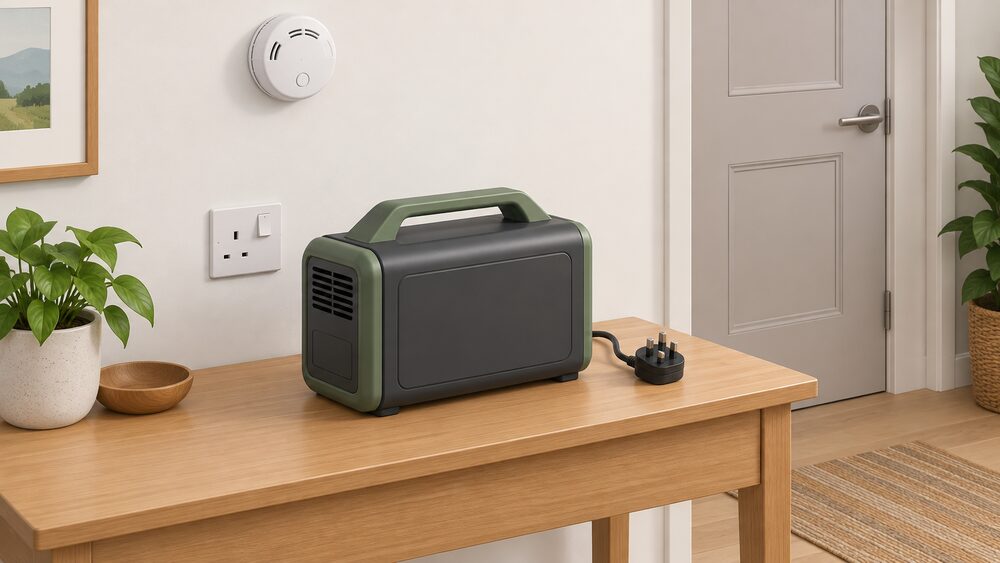
A plug-in battery is a battery you connect to a normal domestic socket rather than wire into a fixed circuit. In the UK it is not a legal product. Plug-in batteries are not included in the regulations that legalised plug-in solar on 27 August 2026, and they remain illegal for use in the UK1. The government's own product specification for plug-in solar states that a plug-in solar device is not intended to be connected to, operated with, or used in conjunction with a battery energy storage system2.
That is the answer to the safety question before any technical detail: there is no approved product, no certification route and no published warranty position for a plug-in battery in a UK home. The safety evidence that does exist covers plug-in solar generation, which was tested and found to operate safely within the tested conditions3. It does not cover a battery on a socket.
What follows is what the rules say, why batteries were left out, what the fire and electrical safety bodies advise, and what a household gives up or keeps in terms of energy independence.
Are plug-in batteries legal in the UK?
No. The legalisation that took effect on 27 August 2026 applies to plug-in solar panels, not to batteries. Before that date, UK standards only permitted solar power generation that was permanently connected, meaning wired into the mains and not plugged into a socket6. The consultation that preceded the change set out the position plainly: at present, solar plug-in microgenerators cannot be legally sold, supplied, or used in the UK due to constraints arising from existing product safety legislation8.
The rules were then revised to allow plug-in solar panels that meet certain standards to be used in Great Britain from 27 August 20269. Plug-in solar panels have been available to buy in the UK since that date10. The government said they would be available in shops within months and save people money on their bills11, and major retailers worked with the government on the rollout, with the panels now available in stores and online12.
The battery sits outside all of this. Plug-in batteries are not included in the new regulations and remain illegal for use in the UK1. That is a statement about the product category as a whole, not about one model or one maker. A household cannot lawfully install one, and a seller cannot lawfully supply one, whatever the packaging claims.
There is a separate Northern Ireland dimension. The removability and replaceability requirements under the EU Batteries Regulation are due to replace the readily removable requirement from 18 February 202713. Those are design rules for batteries placed on that market. They are not a permission to connect a battery to a socket in any part of the UK.
Why batteries were left out of the plug-in solar rules
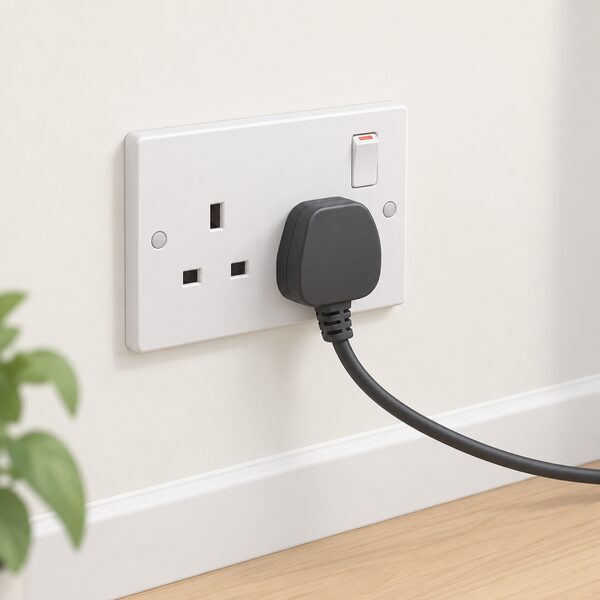
The plug-in solar specification is written around a single generating device on a socket circuit. A plug-in solar device shall only be connected to socket circuits and not to circuits supplying lighting or other fixed equipment14. The final specification states that it does not apply to other technologies including but not limited to plug-in battery systems2.
Two technical reasons sit behind that exclusion. The first is the socket circuit itself. A socket circuit is sized for appliances that draw a load and stop; a battery charger draws a sustained load for hours, and the specification's authors chose not to extend the approval envelope to cover it. The second is that a plug-in solar device is designed to switch off if there is a power cut9. That behaviour is a safety feature for a generator, and it is also why a plug-in solar panel cannot charge a battery through an outage.
The withdrawn interim specification and the final version both draw the same boundary, and the final version is the one that governs2. The practical effect is that the certification route built for plug-in solar, which requires a complete package meeting the government's Interim Product Specification and verification on the ENA G98 Type Test Register1, has no equivalent for a battery. A microinverter inside a plug-in solar unit is typically certified to EN 50549, the European safety standard15, but that certification covers the inverter, not a battery.
What a plug-in battery would do in the home
The case for the category is about access and cost. Plug-in batteries have the potential to make energy storage more accessible, lower installation barriers and help consumers maximise the value of renewable electricity17. The intended pattern is the same as a fixed home battery: charge during off-peak hours at the lowest rate and use the energy during the peak-rate period to minimise the electricity bill18.
That is a real function, and it is the reason the category keeps being discussed. It is also the reason the safety question matters, because the function depends on a large lithium-ion pack sitting in a living space, charged from an ordinary ring main, with no installer survey and no fixed wiring.
The evidence on cheap plug-in devices that claim to save energy is not encouraging. Electrical Safety First purchased 4 samples of plug-in devices purporting to either save energy or stabilise electrical current19. The energy saving claims are broadly linked to internal electronic components called capacitors which can smooth the electrical current19. Those devices are not batteries, but they show how the plug-in format attracts products whose claims outrun their engineering.
For a household, the honest comparison is with a fixed battery installed by a competent person on its own circuit, which is the route the standards, the warranty structures and the network notification process were built for. That route is covered in home battery storage and in plug-in and balcony battery storage.
Safety considerations for householders
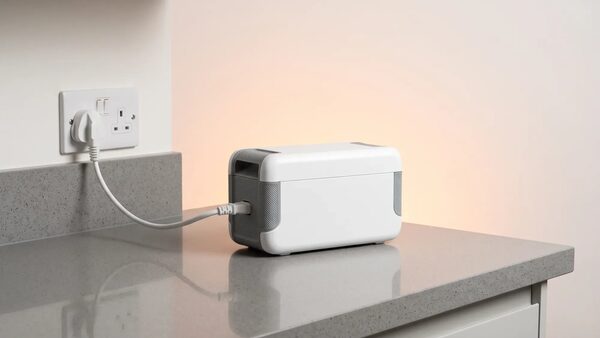
The fire risk from lithium-ion packs is well documented and scales with size. High temperatures can cause batteries, especially lithium-ion, to overheat and potentially catch fire20. The larger the battery, the larger the danger21. A plug-in battery is by definition a large pack in a domestic room.
Fire services give specific charging advice. Charge the device in a room that has a working smoke alarm, which does not compromise an escape route, keeping the door closed while it is charging and away from any heat source21. Electrical safety guidance adds that plug sockets should not be overloaded, as this can lead to overheating22. A recalled Screwfix space heater was withdrawn over excessive heat build-up in the product's plug, resulting in damage to the plug and posing a risk to the user23, which is the failure mode a sustained socket load can produce.
The charity's wider work on battery design points the same way. Its recommendations include safety standards for conversion kits and stricter charger regulations to prevent unsafe battery systems and reduce fire risk24. On e-scooters it recommends mounting the battery higher, such as on the handlebar stem, to make it less susceptible to water ingress25, and it advises charging the battery in a safe place which does not block any escape routes26. Those are design and placement lessons from a category with a longer record of incidents than plug-in storage.
Where a battery has been withdrawn, the advice is immediate: stop using it immediately, disconnect and keep the battery safely away from your living area25. That is the pattern for any pack that shows swelling, heat or a fault.
UK availability and who sells them
Plug-in solar panels are on sale. Plug-in solar batteries are a different matter. They are already being developed for the UK market15, which describes intent rather than a lawful product. No plug-in battery can currently be sold, supplied or used in the UK8.
The contrast with the solar side is sharp. Plug-in solar panels became legal to use in the UK on 27 August 202627, are legal to use in Great Britain if they meet certain standards9, and are available to buy in the UK10. Retailers worked with the government on the rollout12. The 800-watt limit applies to the system5.
For fixed storage, the UK market is mature and sold through installers. The Enphase AC Battery, for example, is available via UK installers18. That is the distribution model the standards assume: a surveyed installation, a fixed circuit, a registered product and a warranty held by a company that continues to trade.
What owning one means for energy independence
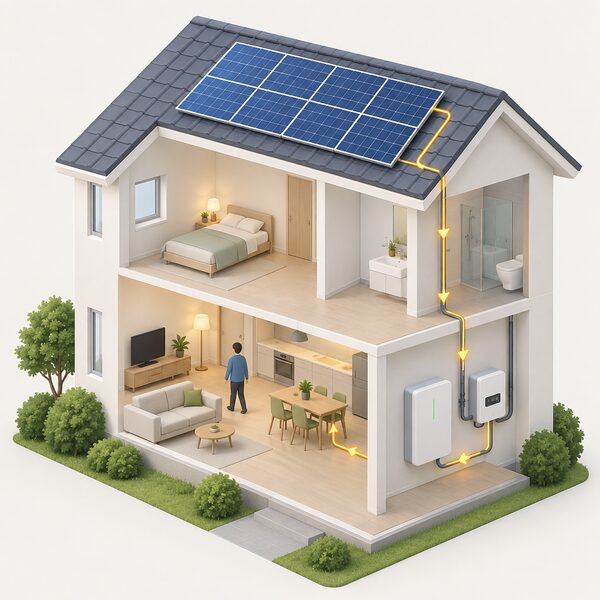
The independence case for storage is measurable. Adding a battery to a solar installation increases self-consumption from 30 to 40% to 70 to 80%, according to Great British Energy7. Self-sufficiency is defined as the percentage of electricity consumed in the property over a year which is met by either behind the meter solar or electrical energy storage28. More homegrown energy means greater energy independence29.
A plug-in battery would, in principle, serve that goal: it stores cheap or self-generated electricity and releases it when the household would otherwise buy from the grid. What it does not do is remove the dependencies. It still draws from the grid to charge, it still relies on a supplier and a tariff, and it still depends on a manufacturer that must remain in business to honour a warranty. A product that cannot lawfully be sold in the UK has no enforceable warranty route at all.
The dependencies that remain with any home battery are worth naming. Not all systems are suitable for power cuts, and the question of whether a battery will work in an outage, and for how long, is one for the installer18. Smart charge points are required not to allow the owner or other end-user to carry out specified operations where doing so could risk the health or safety of a person30. Those controls exist because storage interacts with the grid, and the grid sets the terms.
For a household weighing independence against risk, the fixed, installed route is the one with standards, notification and warranty behind it. The plug-in route has none of those for batteries, and the consumer body's advice is not to install one4.
Sources30 cited
- Plug-in solar panels, Which?, 2026-09-15
- Plug-in solar final interim product specification, GOV.UK, 2026-07
- Plug-in solar electrical safety study, GOV.UK, 2026-06-16
- Plug-in solar consumer guide, Electrical Safety First, 2026-08
- Plug-in solar panels: five top tips, REA, 2026-08-04
- Plug-in solar panels vs rooftop systems, Which?, 2026-04-27
- POST note 771: energy storage, Parliamentary Office of Science and Technology, 2026-06-25
- Plug-in solar consultation document, GOV.UK, 2026-06-16
- Plug-in solar panels, Energy Saving Trust, 2026-09-17
- Plug-in solar, Electricity North West, 2026-08-27
- Britain continues to break clean power records, GOV.UK, 2026-05-28
- What to know about plug-in solar panels, Home Energy Scotland, 2026-09
- EU Batteries Regulations in Northern Ireland, UK Parliament, 2024-07-29
- Plug-in solar interim product specification (withdrawn), GOV.UK, 2026-06
- Plug-in solar explained, Low Carbon Hub, 2026-07-09
- The Plug-in Microgenerators etc. Regulations 2026, legislation.gov.uk, 2026
- Plug-in battery, Electricity Storage Association UK, 2026-08-27
- Solar panel battery storage, Which?, 2026-05-14
- A costly saving: highly dangerous energy saving devices, Electrical Safety First, 2026-09-19
- Be summer ready, Electricity North West, 2026-09-19
- Lithium-ion batteries, North Wales Fire and Rescue Service, 2026
- Demand flexibility: running appliances at cheaper times, Electrical Safety First, 2026-09-19
- Screwfix space and convector heaters recall, Electrical Safety First, 2026-09-17
- How e-bike and e-scooter design can be improved, Electrical Safety First, 2026-09-17
- Battery Breakdown: e-bike battery safety, Electrical Safety First, 2026-09-17
- E-scooters, Electrical Safety First, 2026-09-17
- Plug-in solar panels guide, Uswitch, 2026-08-27
- MCS 032 self-consumption calculation, MCS, 2025-01-01
- Solar energy Scotland manifesto, Solar Energy UK, 2026-09-17
- Guide to EVSCP regulations 2021, GOV.UK, 2026-09-18
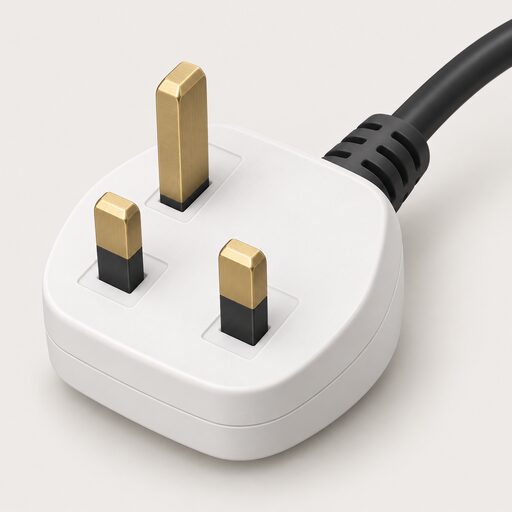 Plug-In Battery StoragePlug-in batteries are not legal in a grid-connected British home, even though plug-in solar panels are.
 Backup Power Safety RulesWho signs off a battery or backup circuit, and can you legally plug in a power station or a plug-in solar panel in the UK?
 Second-Life EV BatteriesUsed electric car batteries can store solar power at home, but can you actually buy one in the UK?
 Plug-In Solar KitsCan you really plug solar panels into a normal wall socket in the UK, and is it legal now?
 DIY Home Battery BuildsBuilding your own home battery?
 Installation StandardsWhich rules must an installer follow when fitting a home battery?